
Aprēķiniet precīzus rekonstituēšanas tilpumus, insulīna vienības un devas no flakona jebkuram peptīdam.
Flakons, ūdens un deva ir zināmi
Vienības mēra tilpumu, nevis aktīvo vielu. 100 SV = 1,00 ml. Cik mg tajā ir, atkarīgs no maisījuma. Kalkulators to jau ir aprēķinājis.
Gandrīz visas insulīna šļirces ir U-100. Izvēlieties U-40 tikai tad, ja šļirce ir marķēta ar U-40.
Saites uz avotiem ved uz PubMed un atveras jaunā cilnē.
Epithalon, also spelled Epitalon or Epithalone, is a synthetic tetrapeptide composed of four amino acids in the sequence alanine-glutamic acid-aspartic acid-glycine (Ala-Glu-Asp-Gly). It was developed as a synthetic analog of epithalamin, a polypeptide extract derived from the pineal gland. Research into this compound is largely associated with the Russian gerontologist Vladimir Khavinson and his team at the St. Petersburg Institute of Bioregulation and Gerontology, who from the 1980s and 1990s onward studied the role of pineal-derived peptides in the aging process.
The pineal gland is considered a central regulator of circadian rhythm and governs the sleep-wake cycle through the secretion of melatonin. With advancing age, pineal gland activity declines, which the research literature links to deterioration of circadian regulation, a reduction in nocturnal melatonin peaks, and a general decline in neuroendocrine function. Epithalon was conceived in this context as a short peptide intended to interact specifically with pineal-associated signaling pathways.
Epithalon is not a hormone and not a steroid. It does not bind to classical hormone receptors and does not suppress any endocrine axis. In preclinical models and a limited number of Russian studies, it has been investigated primarily in connection with telomerase activity, gene expression, and longevity. The available evidence comes predominantly from animal models and smaller investigations conducted by a single research group. Independent, large-scale human clinical trials are largely absent. For this reason, Epithalon is intended strictly for research purposes and is not offered as a medicine.
The mechanisms of action described for Epithalon in the research literature center on three closely interrelated areas: telomerase activation, pineal gland regulation, and effects on gene expression. These mechanisms are discussed in the context of aging research and should not be understood as established therapeutic effects.
Epithalon is typically administered in cycles in research rather than continuously. A typical protocol involves daily dosing over a limited period followed by an extended break. A slow titration is generally not required, since Epithalon does not exhibit a pronounced dose-dependent acute profile.
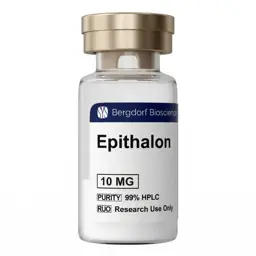
A common vial size is 10 mg. Adding 2 mL of bacteriostatic water gives a concentration of 5 mg/mL (5,000 mcg/mL).
At 5 mg once daily, a 10 mg vial provides two days of dosing. For longer cycles, a larger vial (20 mg or 50 mg) or a higher reconstitution volume is therefore advisable. Use the Epithalon calculator above to compute exact volumes for any vial size, reconstitution volume, and target dose.
Epithalon is generally administered subcutaneously into the abdominal fat tissue in research settings, since it aims for a systemic effect and does not require localized application. Subcutaneous administration is easy to perform and well tolerated. Some protocols use intramuscular injection as an alternative. Because of the short half-life, the daily dose is usually given as a single injection, occasionally split into two smaller doses.
Epithalon is supplied as a lyophilized (freeze-dried) powder in sealed vials. It must be reconstituted with bacteriostatic water (BAC water) before use. Do not use sterile water for injection for multi-dose vials. BAC water contains 0.9% benzyl alcohol, which inhibits microbial growth and extends the usable window of the reconstituted solution.
If the solution appears cloudy, discolored, or contains visible particulate matter, discard the vial and do not inject it.
Epithalon shows a favorable tolerability profile in the available research literature. The animal studies and smaller investigations conducted to date have not described serious toxic effects. However, the data is limited and originates predominantly from a single research group. Large-scale, independent human safety studies are absent, so all statements remain subject to the caveat of incomplete evidence.
No serious adverse events have been reported for Epithalon in the published literature at the doses commonly used in research. Given the absence of large-scale human clinical trials, caution is warranted, and consultation with a qualified healthcare professional is strongly recommended.
Epithalon is frequently studied as a standalone compound in research, because its central research focus, telomerase activation and pineal regulation, does not readily combine with other mechanisms. A typical research approach uses a time-limited Epithalon cycle without additional peptides, so that observed effects can be cleanly attributed.
Because Epithalon is discussed in the context of melatonin regulation and the sleep-wake cycle, it is occasionally grouped in research alongside DSIP (Delta Sleep-Inducing Peptide). Both compounds are associated with sleep architecture and circadian regulation, but they act through different mechanisms.
In the broader field of longevity research, Epithalon is often considered together with mitochondrial and cytoprotective peptides such as MOTS-c and SS-31. While Epithalon focuses on telomeres and the pineal gland, these peptides address mitochondrial function and protection against oxidative stress. For mood- and stress-related research, Selank is also discussed within the same peptide class. Each of these compounds should be reconstituted, dosed, and monitored separately.
Epithalon, Epitalon, and Epithalone all refer to the same compound. The differing spellings arose from transliteration of the originally Russian name. It is the same tetrapeptide with the sequence Ala-Glu-Asp-Gly. Differences in spelling do not indicate a different substance or a different quality.
In research protocols, Epithalon is usually used cyclically. A common approach involves daily dosing of approximately 5 mg over a period of 10 to 20 days, followed by a multi-month break. One to two cycles per year are frequently described. Continuous daily use is uncommon in the literature.
Epithalon is linked in research to the regulation of the pineal gland and melatonin secretion. In preclinical models, a restoration of nocturnal melatonin peaks has been described. Some users report more vivid dreams or changes in sleep patterns at the start of a cycle. However, robust clinical data on sleep quality in humans is limited.
Epithalon is a peptide and is largely broken down by digestive enzymes in the gastrointestinal tract. Oral bioavailability is therefore low. In research, Epithalon is administered almost exclusively subcutaneously or intramuscularly. Oral or intranasal formulations are not the standard route and are poorly characterized in terms of efficacy.
Epithalon is not used for immediately noticeable acute effects. The mechanisms discussed in research, such as telomerase activation and pineal-related effects, relate to slow cellular and neuroendocrine processes. Changes in sleep patterns may occur within the first days of a cycle, while other described effects appear only over longer time frames and in preclinical models.
No. Epithalon is a short peptide and not a hormone. It does not bind to classical hormone receptors and does not suppress any endocrine axis. No post-cycle therapy (PCT) is required. Through the pineal axis, it may indirectly influence neuroendocrine markers, but its mode of action differs fundamentally from that of hormones or steroids.
The cyclical approach is derived directly from the original research protocols, which combined short, intensive administration phases with long breaks. The rationale rests on the assumption that the described effects on telomeres and the pineal gland are triggered through a limited impulse and do not require continuous use. Cyclical administration also reduces cumulative exposure given the limited long-term evidence.
Epithalon is not currently available in the BergdorfBio product range. This page serves as a research and dosing reference. For available research peptides in related categories, it is worth looking at MOTS-c and Selank.
Medical Disclaimer: The information on this page is provided for educational and research purposes only. Epithalon is not an approved drug or medical treatment and is provided strictly for research use. Nothing on this page constitutes medical advice, diagnosis, or a recommendation to use any specific compound. Always consult a qualified healthcare professional before beginning any peptide protocol. BergdorfBio assumes no liability for the use or misuse of the information presented here.
No pulvera līdz gatavai šļircei piecos soļos. Kalkulators augstāk automātiski aprēķina daudzumus.
Ļaujiet flakonam un ūdenim sasilt līdz istabas temperatūrai. Noslaukiet abus gumijas aizbāžņus ar spirta salveti.
Ar lielāku šļirci uzvelciet tādu BAC ūdens daudzumu, kādu iesaka kalkulators.
Ļaujiet ūdenim notecēt pa peptīda flakona iekšējo sienu; neizsmidziniet to tieši uz pulvera.
Maigi pagroziet flakonu, nekratiet. Pulveris 1-2 minūšu laikā izšķīst līdz dzidram šķīdumam.
Ar insulīna šļirci uzvelciet tieši līdz aprēķinātajai atzīmei. Gatavs.
Tipiskas sākuma vērtības orientācijai. Katra rinda atver kalkulatoru šim peptīdam.
| Peptīds | Kategorija | Tipiskā deva | Flakonu izmēri | BAC (sākums) | Pieejamība | Aprēķināt |
|---|---|---|---|---|---|---|
| VIP | Neiropetīdu pētniecība | - | 10 mg | 2 ml | Tikai kalkulators | Aprēķināt |
| Retatrutide | GLP-1/GIP/GCG | 0,5-12 mg | 2 / 5 / 10 / 15 mg | 2 ml | Tikai kalkulators | Aprēķināt |
| Cagrilintide | Amilīna analogs | - | 5 mg | 2 ml | Tikai kalkulators | Aprēķināt |
| Semaglutide | GLP-1 | 0,25-2,4 mg | 2 / 5 / 10 mg | 2 ml | Tikai kalkulators | Aprēķināt |
| Tirzepatide | GLP-1/GIP | 2,5-15 mg | 10 / 15 / 20 / 30 / 60 / 90 mg | 2 ml | Tikai kalkulators | Aprēķināt |
| GHK-Cu | Vara peptīds | 1-4 mg | 10 / 20 / 50 mg | 5 ml | Tikai kalkulators | Aprēķināt |
| AHK-Cu | Vara peptīds | - | 100 mg | 5 ml | Tikai kalkulators | Aprēķināt |
| BPC-157 | Audu atjaunošana | 0,2-0,5 mg | 2 / 5 / 10 mg | 2 ml | Tikai kalkulators | Aprēķināt |
| TB-500 | Thymosin Beta-4 | 2-5 mg | 2 / 5 / 10 mg | 2 ml | Tikai kalkulators | Aprēķināt |
| CJC-1295 (bez DAC) | GHRH analogs | 100-200 mcg | 2 / 5 / 10 mg | 2 ml | Tikai kalkulators | Aprēķināt |
| Ipamorelin | GHRP | 200-300 mcg | 2 / 5 mg | 2 ml | Tikai kalkulators | Aprēķināt |
| AOD-9604 | Tauku vielmaiņa | 250-500 mcg | 2 / 5 mg | 2 ml | Tikai kalkulators | Aprēķināt |
| PT-141 | Bremelanotide | - | 2 / 5 / 10 mg | 2 ml | Tikai kalkulators | Aprēķināt |
| MOTS-c | Mitohondriāls | 5-10 mg | 5 / 10 mg | 2 ml | Tikai kalkulators | Aprēķināt |
| Selank | Anksiolītisks | 150-500 mcg | 2 / 5 / 10 mg | 2 ml | Tikai kalkulators | Aprēķināt |
| SS-31 | Elamipretide | 0,1-1 mg | 5 / 10 mg | 2 ml | Tikai kalkulators | Aprēķināt |
| Glow Stack | Stack | 0,5-2 mg | 70 mg | 3 ml | Tikai kalkulators | Aprēķināt |
| Klow Stack | Stack | 0,5-2 mg | 55 mg | 3 ml | Tikai kalkulators | Aprēķināt |
| Melanotan II | Melanokortīns | 100-1000 mcg | 5 / 10 mg | 2 ml | Tikai kalkulators | Aprēķināt |
| Melanotan I | Melanokortīns | - | 5 / 10 mg | 2 ml | Tikai kalkulators | Aprēķināt |
| Sermorelin | GHRH analogs | 50-300 mcg | 5 mg | 2 ml | Tikai kalkulators | Aprēķināt |
| Tesamorelin | GHRH analogs | 1-2 mg | 10 / 20 mg | 2 ml | Tikai kalkulators | Aprēķināt |
| Thymosin Alpha-1 | Timusa peptīds | 0,8-3,2 mg | 1.6 / 5 / 10 mg | 1 ml | Tikai kalkulators | Aprēķināt |
| Epithalon | Ilgmūžība | 2-10 mg | 10 / 20 / 50 mg | 2 ml | Tikai kalkulators | Aprēķināt |
| KPV | Imūnā sistēma / barjera | 100-1000 mcg | 5 / 10 mg | 2 ml | Tikai kalkulators | Aprēķināt |
| HGH Fragment 176-191 | Metabolais fragments | 100-500 mcg | 2 / 5 / 10 mg | 2 ml | Tikai kalkulators | Aprēķināt |
| Semax | Kognitīvs | 100-1000 mcg | 10 / 30 mg | 2 ml | Tikai kalkulators | Aprēķināt |
| N-Acetyl Semax | Kognitīvs | 100-1000 mcg | 5 / 10 mg | 2 ml | Tikai kalkulators | Aprēķināt |
| Hexarelin | GHRP | 50-200 mcg | 2 / 5 mg | 2 ml | Tikai kalkulators | Aprēķināt |
| GHRP-6 | GHRP | 50-300 mcg | 2 / 5 mg | 2 ml | Tikai kalkulators | Aprēķināt |
| GHRP-2 | GHRP | 50-250 mcg | 2 / 5 mg | 2 ml | Tikai kalkulators | Aprēķināt |
| DSIP | Miegs | 50-500 mcg | 10 mg | 2 ml | Tikai kalkulators | Aprēķināt |
| 5-Amino-1MQ | Metabolais | 2,5-10 mg | 10 mg | 2 ml | Tikai kalkulators | Aprēķināt |
| Pinealon | Pētniecības peptīds | - | 10 mg | 2 ml | Tikai kalkulators | Aprēķināt |
| Survodutide | GLP-1/glikagons | - | 10 mg | 2 ml | Tikai kalkulators | Aprēķināt |
| Kisspeptin-10 | KISS1R / GPR54 | - | 10 mg | 2 ml | Tikai kalkulators | Aprēķināt |
| HGH 191AA | Augšanas hormons | 1-5 mg | 10 mg | 1 ml | Tikai kalkulators | Aprēķināt |
| NAD+ | Ilmūžība / kofaktors | 100-500 mg | 1000 mg | 10 ml | Tikai kalkulators | Aprēķināt |
Vērtības ir orientējošas pētniecības kontekstā un neaizstāj profesionālu padomu.
Koncentrācijas un injekcijas tilpuma pareiza aprēķināšana šķiet vienkārša, taču tā ir visbiežākais kļūdu avots. Pat 10 % kļūda rekonstituēšanas laikā nozīmē, ka saņemat pārāk maz aktīvās vielas vai netīšām pārdozējat.
Liofilizēti peptīdi tiek piegādāti miligramos un izšķīdināti bakteriostatiskajā ūdenī (BAC ūdens). Peptīda un ūdens attiecība nosaka koncentrāciju, un no tās izriet, cik vienības uzvelkat insulīna šļircē. Insulīna šļirces ir graduētas vienībās, nevis miligramos. Kalkulators veic šo pārrēķinu, tostarp ticamības pārbaudi pret bīstamāko kļūdu: mg un mcg sajaukšanu.
Miligrami (mg) ir vienība, kādā pārdod liofilizētus peptīdus, piemēram, „5 mg BPC-157”. Mikrogrami (mcg) raksturo atsevišķu devu, piemēram, „250 mcg uz injekciju”. 1 mg = 1000 mcg. Kalkulators pārrēķina automātiski un brīdina, ja ievadītais lielums izskatās pēc sajaukšanas.
U-100 nozīmē, ka šļirce ir kalibrēta 100 vienībām mililitrā. 100 SV = 1 ml, tātad 10 SV = 0,10 ml neatkarīgi no tā, kas ir šļircē. SV aprēķins balstās tieši uz šo attiecību.
Ja peptīda ir daudz un ūdens maz, šķīdums kļūst ļoti koncentrēts, tāpēc tilpums uz devu ir niecīgs un grūti nolasāms. Izmantojiet sajaukšanas palīgu: tas atrod ūdens tilpumu, kas dod tīru, viegli nolasāmu atzīmi.
Ledusskapī 2-8 °C temperatūrā parasti 21-30 dienas. Marķējiet flakonu ar rekonstituēšanas datumu. Duļķains šķīdums vai daļiņas nav pieņemami.
Maisījumi satur vairākas aktīvās vielas vienā flakonā. Vienkārši izvēlieties maisījumu kā savu peptīdu: kalkulators papildus parāda, cik daudz katras sastāvdaļas ir jūsu injekcijā. Vairāku atsevišķu flakonu kombinācijām izmantojiet Stack Builder.
Nē. Jūsu pēdējie iestatījumi tiek saglabāti lokāli pārlūkprogrammā un atjaunoti nākamajā apmeklējumā. Aprēķinus varat arī atsaukt no vēstures, saglabāt kā protokolu vai kopīgot ar saiti.
Izvēlieties peptīdu, lai atvērtu tam veltīto kalkulatora lapu ar jau aizpildītām vērtībām.
Ir noliktavā
Ir noliktavā
Skatīt produktu
EpithalonSkatīt produktu
EpithalonTipiskas sākuma vērtības orientācijai. Katra rinda atver kalkulatoru šim peptīdam.
| Peptīds | Kategorija | Tipiskā deva | Flakonu izmēri | BAC (sākums) | Pieejamība | Aprēķināt |
|---|---|---|---|---|---|---|
| VIP | Neiropetīdu pētniecība | - | 10 mg | 2 ml | Ir noliktavā | Aprēķināt |
| Retatrutide | GLP-1/GIP/GCG | 0,5-12 mg | 2 / 5 / 10 / 15 mg | 2 ml | Ir noliktavā | Aprēķināt |
| Cagrilintide | Amilīna analogs | - | 5 mg | 2 ml | Ir noliktavā | Aprēķināt |
| Tirzepatide | GLP-1/GIP | 2,5-15 mg | 10 / 15 / 20 / 30 / 60 / 90 mg | 2 ml | Ir noliktavā | Aprēķināt |
| GHK-Cu | Vara peptīds | 1-4 mg | 10 / 20 / 50 mg | 5 ml | Ir noliktavā | Aprēķināt |
| AHK-Cu | Vara peptīds | - | 100 mg | 5 ml | Ir noliktavā | Aprēķināt |
| BPC-157 | Audu atjaunošana | 0,2-0,5 mg | 2 / 5 / 10 mg | 2 ml | Ir noliktavā | Aprēķināt |
| TB-500 | Thymosin Beta-4 | 2-5 mg | 2 / 5 / 10 mg | 2 ml | Ir noliktavā | Aprēķināt |
| CJC-1295 (bez DAC) | GHRH analogs | 100-200 mcg | 2 / 5 / 10 mg | 2 ml | Ir noliktavā | Aprēķināt |
| Ipamorelin | GHRP | 200-300 mcg | 2 / 5 mg | 2 ml | Ir noliktavā | Aprēķināt |
| PT-141 | Bremelanotide | - | 2 / 5 / 10 mg | 2 ml | Ir noliktavā | Aprēķināt |
| MOTS-c | Mitohondriāls | 5-10 mg | 5 / 10 mg | 2 ml | Ir noliktavā | Aprēķināt |
| Selank | Anksiolītisks | 150-500 mcg | 2 / 5 / 10 mg | 2 ml | Ir noliktavā | Aprēķināt |
| SS-31 | Elamipretide | 0,1-1 mg | 5 / 10 mg | 2 ml | Ir noliktavā | Aprēķināt |
| Glow Stack | Stack | 0,5-2 mg | 70 mg | 3 ml | Ir noliktavā | Aprēķināt |
| Klow Stack | Stack | 0,5-2 mg | 55 mg | 3 ml | Ir noliktavā | Aprēķināt |
| Melanotan II | Melanokortīns | 100-1000 mcg | 5 / 10 mg | 2 ml | Ir noliktavā | Aprēķināt |
| Melanotan I | Melanokortīns | - | 5 / 10 mg | 2 ml | Ir noliktavā | Aprēķināt |
| Sermorelin | GHRH analogs | 50-300 mcg | 5 mg | 2 ml | Ir noliktavā | Aprēķināt |
| Tesamorelin | GHRH analogs | 1-2 mg | 10 / 20 mg | 2 ml | Ir noliktavā | Aprēķināt |
| Thymosin Alpha-1 | Timusa peptīds | 0,8-3,2 mg | 1.6 / 5 / 10 mg | 1 ml | Ir noliktavā | Aprēķināt |
| Epithalon | Ilgmūžība | 2-10 mg | 10 / 20 / 50 mg | 2 ml | Ir noliktavā | Aprēķināt |
| KPV | Imūnā sistēma / barjera | 100-1000 mcg | 5 / 10 mg | 2 ml | Ir noliktavā | Aprēķināt |
| Semax | Kognitīvs | 100-1000 mcg | 10 / 30 mg | 2 ml | Ir noliktavā | Aprēķināt |
| DSIP | Miegs | 50-500 mcg | 10 mg | 2 ml | Ir noliktavā | Aprēķināt |
| 5-Amino-1MQ | Metabolais | 2,5-10 mg | 10 mg | 2 ml | Ir noliktavā | Aprēķināt |
| Pinealon | Pētniecības peptīds | - | 10 mg | 2 ml | Ir noliktavā | Aprēķināt |
| Survodutide | GLP-1/glikagons | - | 10 mg | 2 ml | Ir noliktavā | Aprēķināt |
| Kisspeptin-10 | KISS1R / GPR54 | - | 10 mg | 2 ml | Ir noliktavā | Aprēķināt |
| NAD+ | Ilmūžība / kofaktors | 100-500 mg | 1000 mg | 10 ml | Ir noliktavā | Aprēķināt |
| Semaglutide | GLP-1 | 0,25-2,4 mg | 2 / 5 / 10 mg | 2 ml | Tikai kalkulators | Aprēķināt |
| AOD-9604 | Tauku vielmaiņa | 250-500 mcg | 2 / 5 mg | 2 ml | Tikai kalkulators | Aprēķināt |
| HGH Fragment 176-191 | Metabolais fragments | 100-500 mcg | 2 / 5 / 10 mg | 2 ml | Tikai kalkulators | Aprēķināt |
| N-Acetyl Semax | Kognitīvs | 100-1000 mcg | 5 / 10 mg | 2 ml | Tikai kalkulators | Aprēķināt |
| Hexarelin | GHRP | 50-200 mcg | 2 / 5 mg | 2 ml | Tikai kalkulators | Aprēķināt |
| GHRP-6 | GHRP | 50-300 mcg | 2 / 5 mg | 2 ml | Tikai kalkulators | Aprēķināt |
| GHRP-2 | GHRP | 50-250 mcg | 2 / 5 mg | 2 ml | Tikai kalkulators | Aprēķināt |
| HGH 191AA | Augšanas hormons | 1-5 mg | 10 mg | 1 ml | Tikai kalkulators | Aprēķināt |
Vērtības ir orientējošas pētniecības kontekstā un neaizstāj profesionālu padomu.
Tipiskas sākuma vērtības orientācijai. Katra rinda atver kalkulatoru šim peptīdam.
| Peptīds | Kategorija | Tipiskā deva | Flakonu izmēri | BAC (sākums) | Pieejamība | Aprēķināt |
|---|---|---|---|---|---|---|
| VIP | Neiropetīdu pētniecība | - | 10 mg | 2 ml | Ir noliktavā | Aprēķināt |
| Retatrutide | GLP-1/GIP/GCG | 0,5-12 mg | 2 / 5 / 10 / 15 mg | 2 ml | Ir noliktavā | Aprēķināt |
| Cagrilintide | Amilīna analogs | - | 5 mg | 2 ml | Ir noliktavā | Aprēķināt |
| Tirzepatide | GLP-1/GIP | 2,5-15 mg | 10 / 15 / 20 / 30 / 60 / 90 mg | 2 ml | Ir noliktavā | Aprēķināt |
| GHK-Cu | Vara peptīds | 1-4 mg | 10 / 20 / 50 mg | 5 ml | Ir noliktavā | Aprēķināt |
| AHK-Cu | Vara peptīds | - | 100 mg | 5 ml | Ir noliktavā | Aprēķināt |
| BPC-157 | Audu atjaunošana | 0,2-0,5 mg | 2 / 5 / 10 mg | 2 ml | Ir noliktavā | Aprēķināt |
| TB-500 | Thymosin Beta-4 | 2-5 mg | 2 / 5 / 10 mg | 2 ml | Ir noliktavā | Aprēķināt |
| CJC-1295 (bez DAC) | GHRH analogs | 100-200 mcg | 2 / 5 / 10 mg | 2 ml | Ir noliktavā | Aprēķināt |
| Ipamorelin | GHRP | 200-300 mcg | 2 / 5 mg | 2 ml | Ir noliktavā | Aprēķināt |
| PT-141 | Bremelanotide | - | 2 / 5 / 10 mg | 2 ml | Ir noliktavā | Aprēķināt |
| MOTS-c | Mitohondriāls | 5-10 mg | 5 / 10 mg | 2 ml | Ir noliktavā | Aprēķināt |
| Selank | Anksiolītisks | 150-500 mcg | 2 / 5 / 10 mg | 2 ml | Ir noliktavā | Aprēķināt |
| SS-31 | Elamipretide | 0,1-1 mg | 5 / 10 mg | 2 ml | Ir noliktavā | Aprēķināt |
| Glow Stack | Stack | 0,5-2 mg | 70 mg | 3 ml | Ir noliktavā | Aprēķināt |
| Klow Stack | Stack | 0,5-2 mg | 55 mg | 3 ml | Ir noliktavā | Aprēķināt |
| Melanotan II | Melanokortīns | 100-1000 mcg | 5 / 10 mg | 2 ml | Ir noliktavā | Aprēķināt |
| Melanotan I | Melanokortīns | - | 5 / 10 mg | 2 ml | Ir noliktavā | Aprēķināt |
| Sermorelin | GHRH analogs | 50-300 mcg | 5 mg | 2 ml | Ir noliktavā | Aprēķināt |
| Tesamorelin | GHRH analogs | 1-2 mg | 10 / 20 mg | 2 ml | Ir noliktavā | Aprēķināt |
| Thymosin Alpha-1 | Timusa peptīds | 0,8-3,2 mg | 1.6 / 5 / 10 mg | 1 ml | Ir noliktavā | Aprēķināt |
| Epithalon | Ilgmūžība | 2-10 mg | 10 / 20 / 50 mg | 2 ml | Ir noliktavā | Aprēķināt |
| KPV | Imūnā sistēma / barjera | 100-1000 mcg | 5 / 10 mg | 2 ml | Ir noliktavā | Aprēķināt |
| Semax | Kognitīvs | 100-1000 mcg | 10 / 30 mg | 2 ml | Ir noliktavā | Aprēķināt |
| DSIP | Miegs | 50-500 mcg | 10 mg | 2 ml | Ir noliktavā | Aprēķināt |
| 5-Amino-1MQ | Metabolais | 2,5-10 mg | 10 mg | 2 ml | Ir noliktavā | Aprēķināt |
| Pinealon | Pētniecības peptīds | - | 10 mg | 2 ml | Ir noliktavā | Aprēķināt |
| Survodutide | GLP-1/glikagons | - | 10 mg | 2 ml | Ir noliktavā | Aprēķināt |
| Kisspeptin-10 | KISS1R / GPR54 | - | 10 mg | 2 ml | Ir noliktavā | Aprēķināt |
| NAD+ | Ilmūžība / kofaktors | 100-500 mg | 1000 mg | 10 ml | Ir noliktavā | Aprēķināt |
| Semaglutide | GLP-1 | 0,25-2,4 mg | 2 / 5 / 10 mg | 2 ml | Tikai kalkulators | Aprēķināt |
| AOD-9604 | Tauku vielmaiņa | 250-500 mcg | 2 / 5 mg | 2 ml | Tikai kalkulators | Aprēķināt |
| HGH Fragment 176-191 | Metabolais fragments | 100-500 mcg | 2 / 5 / 10 mg | 2 ml | Tikai kalkulators | Aprēķināt |
| N-Acetyl Semax | Kognitīvs | 100-1000 mcg | 5 / 10 mg | 2 ml | Tikai kalkulators | Aprēķināt |
| Hexarelin | GHRP | 50-200 mcg | 2 / 5 mg | 2 ml | Tikai kalkulators | Aprēķināt |
| GHRP-6 | GHRP | 50-300 mcg | 2 / 5 mg | 2 ml | Tikai kalkulators | Aprēķināt |
| GHRP-2 | GHRP | 50-250 mcg | 2 / 5 mg | 2 ml | Tikai kalkulators | Aprēķināt |
| HGH 191AA | Augšanas hormons | 1-5 mg | 10 mg | 1 ml | Tikai kalkulators | Aprēķināt |
Vērtības ir orientējošas pētniecības kontekstā un neaizstāj profesionālu padomu.
Izvēlieties peptīdu, lai atvērtu tam veltīto kalkulatora lapu ar jau aizpildītām vērtībām.
Izvēlieties peptīdu, lai atvērtu tam veltīto kalkulatora lapu ar jau aizpildītām vērtībām.