
CJC-1295 (No DAC) in Research Overview: Modified GRF (1-29), Mechanism, Half-Life and Differentiation
Dr. Sieglinde Klaus
Scientific Editorial Team · Bergdorf Bioscience
Table of Contents
- 01What is CJC-1295 (No DAC) and how is it structured?
- 02How does CJC-1295 (No DAC) act at the molecular level?
- 03What is the half-life of CJC-1295 (No DAC)?
- 04How does CJC-1295 (No DAC) differ from the DAC variant?
- 05Which dosages are reported in the research literature?
- 06How is CJC-1295 (No DAC) reconstituted and stored?
- 07Which adverse effects are known from the substance class?
- 08How does CJC-1295 (No DAC) differ from Sermorelin?
- 09How does CJC-1295 (No DAC) differ from Ipamorelin?
- 10Why is CJC-1295 (No DAC) considered \"more physiological\" than the DAC variant?
- 11Frequently Asked Questions (FAQ)
- Is CJC-1295 (No DAC) the same as Modified GRF (1-29)?
- Why is the half-life so much shorter than with CJC-1295 with DAC?
- Do controlled human studies exist specifically on the No-DAC form?
- How long is the reconstituted solution stable?
- Why are GHRH analogs and Ipamorelin often studied together?
CJC-1295 (No DAC), identical to Modified GRF (1-29), is a synthetic 29-amino-acid GHRH analog with four stabilizing substitutions. Unlike the DAC variant, it does not bind to serum albumin and is therefore short-acting, with a reported plasma half-life of approximately 30 minutes. This article summarizes the preclinical and clinical evidence base exclusively for research purposes.
What is CJC-1295 (No DAC) and how is it structured?
CJC-1295 without DAC is chemically identical to the compound listed in the literature as \"Modified GRF (1-29)\". It is a synthetic analog of growth hormone-releasing hormone (GHRH). Structurally it corresponds to the N-terminal fragment 1-29 of human GHRH, that is, the same active core as Sermorelin, but it carries four stabilizing amino acid substitutions relative to native GRF(1-29): position 2 D-Ala instead of L-Ala, position 8 Gln instead of Asn, position 15 Ala instead of Gly and position 27 Leu instead of Met. The tetrasubstituted GRF(1-29) core is documented in the work of Jett\u00e9 et al., 2005, with the substitution overview additionally found in secondary sources.
The sequence is (N to C): Tyr-D-Ala-Asp-Ala-Ile-Phe-Thr-Gln-Ser-Tyr-Arg-Lys-Val-Leu-Ala-Gln-Leu-Ser-Ala-Arg-Lys-Leu-Leu-Gln-Asp-Ile-Leu-Ser-Arg-NH2. The reported molecular formula is C152H252N44O42 with a molar mass of approximately 3367.9 g/mol; these figures come from supplier and chemical data sources, are not peer-reviewed and are considered approximate. The CAS number 446036-97-1 is in part assigned to the entire CJC-1295/DAC family. Crucial for understanding this compound: the \"No DAC\" form has no Drug-Affinity-Complex (maleimidopropionyl-lysine) at the C-terminus and therefore does not bind covalently to serum albumin. This is precisely what makes it short-acting, as shown in the work of Jett\u00e9 et al., 2005 and Teichman et al., 2006.
How does CJC-1295 (No DAC) act at the molecular level?
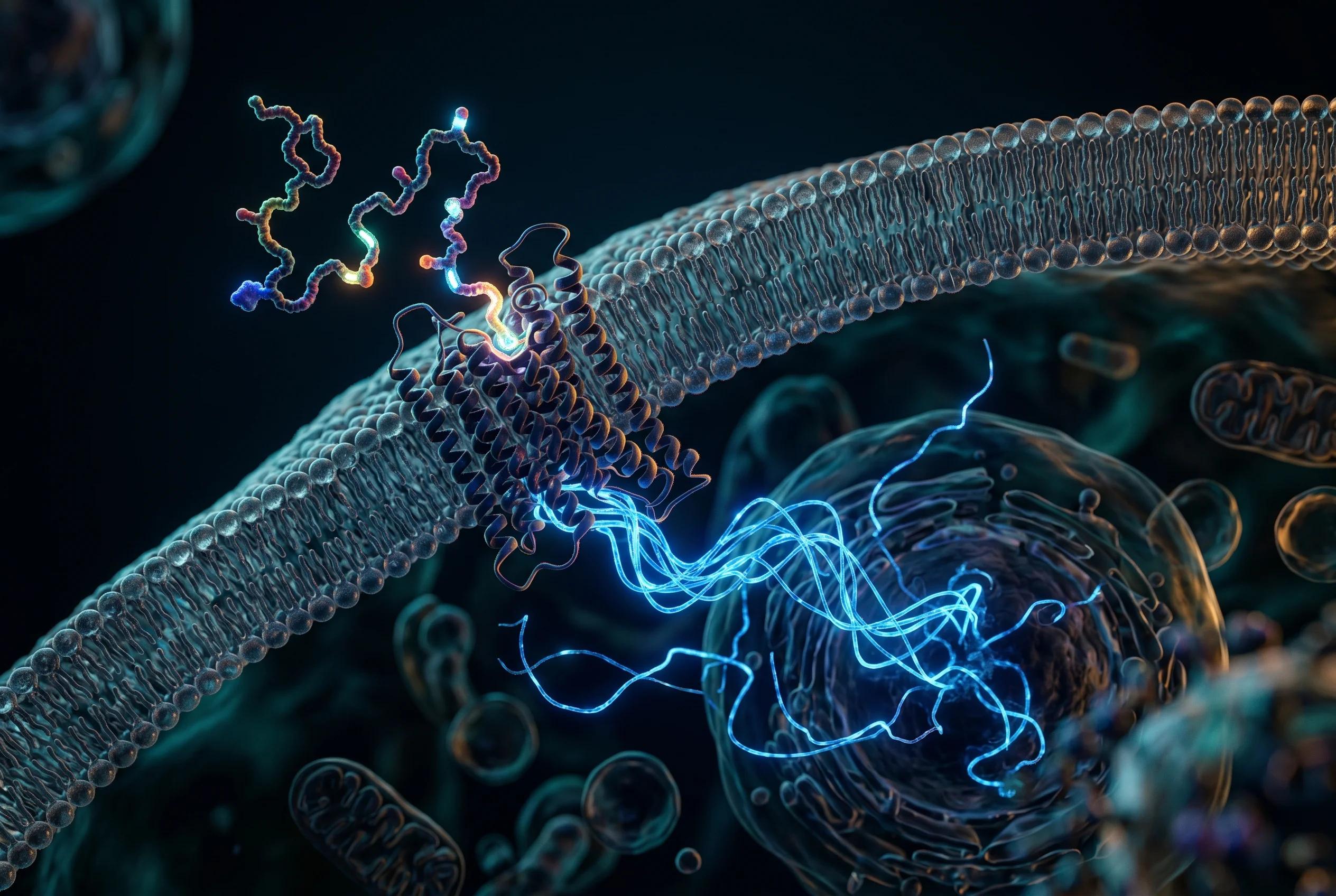
CJC-1295 (No DAC) acts as an agonist at the GHRH receptor (GHRH-R), a class B seven-transmembrane G-protein-coupled receptor on the somatotrophs of the anterior pituitary. Binding couples predominantly to Gs, activates adenylyl cyclase and thereby increases intracellular cAMP. This activates protein kinase A (PKA), leads to CREB phosphorylation and to a voltage-dependent calcium influx that triggers the exocytosis of stored growth hormone (GH). Chronically, this pathway additionally promotes the Pit-1-mediated transcription of the GH gene, as described in the review by Mayo et al., 1995.
The functional advantage of the four substitutions lies in stability. They confer resistance to cleavage by dipeptidyl peptidase-IV (DPP-IV) at the N-terminus as well as to further proteolysis. This increases potency and metabolic stability relative to native GRF(1-29). The isolated D-Ala2 substitution alone lowered metabolic clearance in humans from 39.7 to 21 mL/kg/min and prolonged the disappearance half-life from 4.3 to 6.7 minutes, as Soule et al., 1994 demonstrated; the DPP-IV stability of the substituted core is documented in Jett\u00e9 et al., 2005. Downstream, pituitary GH release increases hepatic IGF-1. This axis of GHRH-R, GH, IGF-1 forms the pharmacological backbone of the entire substance class.
What is the half-life of CJC-1295 (No DAC)?
CJC-1295 (No DAC), that is Modified GRF (1-29), is clearly short-acting. The reported plasma half-life is approximately 30 minutes, with a range frequently cited in the literature of around 30 minutes to about 2 hours. For comparison: native Sermorelin or GRF(1-29) is eliminated even faster, with an intravenous disappearance half-life of about 6 to 7 minutes and a plasma half-life in the range of about 10 to 20 minutes. The kinetics of the native fragment rest on Soule et al., 1994, while the specific 30-minute figure for Modified GRF (1-29) derives from the design principle of the compound and from secondary sources.
Because no albumin anchor is present, growth hormone in the research literature typically rises within about 15 to 30 minutes after subcutaneous administration and returns toward baseline within about 2 to 3 hours. This results in a pulsatile, more physiological-seeming GH profile with minimal sustained tonic stimulation. This is the defining difference from the DAC variant. Important for scientific context: the rigorous human pharmacokinetic studies (Teichman et al., 2006; Ionescu et al., 2006) were conducted with the albumin-binding DAC construct, not with the No-DAC form. A dedicated, peer-reviewed human PK study specifically on the No-DAC variant is, to current knowledge, sparse, which is why the 30-minute figure should be interpreted with appropriate caution. Calculate CJC-1295 (No DAC) in the peptide calculator can illustrate the key kinetic parameters for modeling purposes.
How does CJC-1295 (No DAC) differ from the DAC variant?
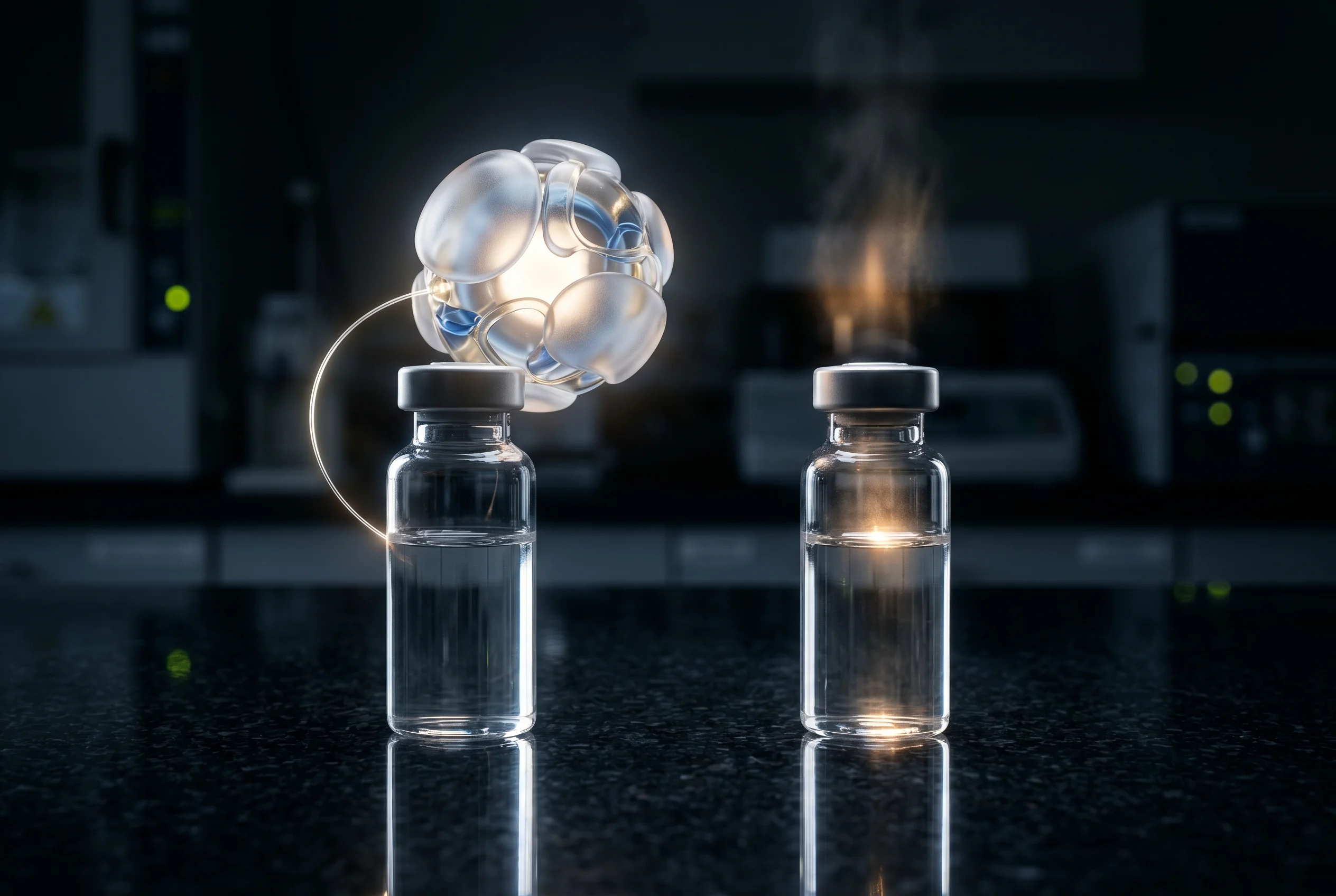
The DAC variant shares the same tetrasubstituted GRF(1-29) core but carries an N-epsilon-3-maleimidopropionamide-lysine. This group reacts ex vivo or in vivo with the free Cys-34 thiol group of human serum albumin and forms a stable thioether bioconjugate. This conjugate is too large for renal filtration and at the same time protected against DPP-IV, as described by Jett\u00e9 et al., 2005. This extends the half-life in humans to approximately 5.8 to 8.1 days, shown by Teichman et al., 2006.
In healthy adults, single subcutaneous doses of CJC-1295/DAC increased mean GH 2- to 10-fold for at least 6 days and IGF-1 1.5- to 3-fold over 9 to 11 days; with repeated administration, IGF-1 remained above baseline for up to approximately 28 days (Teichman et al., 2006). Notably, GH secretion remained pulsatile even under this continuous albumin-bound stimulation. Pulse frequency and amplitude were preserved, while trough, mean and IGF-1 values rose, as Ionescu et al., 2006 documented. It is precisely this finding that explains why the short-acting No-DAC form is preferred in research when the goal is to reproduce the natural episodic GH release rather than a tonic sustained elevation. The No-DAC form is fully eliminated between administrations and therefore produces no chronic IGF-1 plateau. The human PK and efficacy evidence base, however, concerns the DAC construct, not directly the No-DAC form.
Which dosages are reported in the research literature?
For the No-DAC form there is no FDA-approved human dosage. Controlled human data come exclusively from studies with the DAC variant. There, single subcutaneous doses of approximately 30, 60 and 90 mcg/kg were investigated, with the range of 30 to 60 mcg/kg rated as relatively well tolerated, as Teichman et al., 2006 report. The pulsatility study used 60 and 90 mcg/kg with no significant difference between the two dosages; there, basal GH was elevated about 7.5-fold, mean GH was 46 percent and IGF-1 was 45 percent above baseline (Ionescu et al., 2006).
For Modified GRF (1-29) itself, non-clinical or secondary protocols typically describe fixed amounts in the microgram range per subcutaneous administration, often around 100 mcg per administration, frequently timed 1 to 3 times daily to exploit the short half-life. These protocols are frequently combined with a GHRP or a ghrelin receptor agonist. It must be clearly emphasized that these figures do not come from controlled studies. They are mentioned here exclusively to characterize the existing literature and do not constitute a recommendation for action. A 2 mg lyophilizate vial corresponds to 2000 mcg, from which, in calculation terms, a large number of microgram-scaled aliquots results. The exact concentration depends on the reconstitution volume. For pure modeling and calculation purposes, this can be represented in the peptide calculator.
How is CJC-1295 (No DAC) reconstituted and stored?
CJC-1295 (No DAC) is supplied as a lyophilizate. The lyophilized powder should be stored frozen, typically at -20 degrees Celsius, and for long-term storage even colder at -80 degrees Celsius. The reported stability of the lyophilizate is approximately 12 to 24 months or longer at -20 degrees Celsius. Brief transport at ambient or refrigerator temperature is generally tolerated for the dry powder, since the solid form is considerably more robust than the dissolved one.
After reconstitution, usually with bacteriostatic water containing approximately 0.9 percent benzyl alcohol, the solution should be refrigerated at 2 to 8 degrees Celsius and used within approximately 28 days. This time window results from benzyl alcohol as a preservative; some sources cite 4 to 6 weeks at 2 to 8 degrees Celsius. Repeated freeze-thaw cycles of the reconstituted solution should be avoided, as should vigorous shaking, which can jeopardize peptide integrity through foam formation and mechanical stress. Protect the material from light and heat. During reconstitution, the solvent is ideally added slowly down the vial wall rather than directly onto the powder. These figures come from secondary sources on peptide handling; a peptide-specific, peer-reviewed stability study was not found, which is why these notes should be understood as general handling guidelines for GHRH peptides and not as a validated specification for this batch.
Which adverse effects are known from the substance class?
In the human CJC-1295/DAC studies, no serious adverse reactions were reported, and tolerability was described as good, particularly in the range of 30 to 60 mcg/kg, as Teichman et al., 2006 document. This evidence base, however, concerns the albumin-binding DAC variant and not specifically the short-acting No-DAC form.
Class-typical and frequently described effects of GHRH analogs and GH axis stimulation include transient reactions at the injection site such as redness, swelling and pain, as well as facial flushing or a sensation of warmth, headache, dizziness and transient water retention. Theoretical concerns linked to a sustained elevation of GH and IGF-1, such as joint pain (arthralgia), peripheral edema, paresthesia or carpal-tunnel-like symptoms as well as reduced insulin sensitivity, derive from the pharmacology of the GH axis. They have not been specifically demonstrated for the short-acting No-DAC form. Since the No-DAC variant is eliminated between administrations and produces no tonic sustained IGF-1 elevation, the theoretical basis for sustained-exposure-dependent effects is less pronounced here than with the DAC form. Nevertheless, it holds that the long-term safety of the No-DAC form is not established in controlled human studies. This compilation serves scientific context and not the evaluation of use in humans.
How does CJC-1295 (No DAC) differ from Sermorelin?
Sermorelin corresponds to native GRF(1-29) and shares the same 29-amino-acid active core with CJC-1295 (No DAC). The decisive difference lies in the four substitutions that Sermorelin lacks. As a result, Sermorelin is degraded more rapidly by DPP-IV and has a shorter half-life, with a plasma half-life in the range of about 10 to 20 minutes and an intravenous disappearance half-life of about 6 to 7 minutes, as well as lower metabolic stability. Modified GRF (1-29) can therefore at its core be described as a DPP-IV-stabilized, longer-acting Sermorelin.
The quantitative evidence for the stability gain comes from Soule et al., 1994: the isolated D-Ala2 substitution alone approximately halved metabolic clearance and prolonged the intravenous disappearance half-life from 4.3 to 6.7 minutes in humans. Mechanistically, both compounds are identical, since they activate the same GHRH receptor, as Mayo et al., 1995 describe for the shared signaling pathway. The difference is therefore primarily pharmacokinetic and not pharmacodynamic. For research this means that both substances trigger the same effector type at the receptor, but Modified GRF (1-29) offers a longer plasma presence and higher potency per microgram amount administered. Background information on Sermorelin or GRF(1-29) pharmacology is provided by the review by Prakash and Goa, 1999, which is drawn upon here as a comparative reference for native, unmodified GHRH(1-29).
How does CJC-1295 (No DAC) differ from Ipamorelin?
The difference from Ipamorelin is mechanistically fundamental and not merely pharmacokinetic. Ipamorelin is a pentapeptide and acts as an agonist at the ghrelin receptor (growth hormone secretagogue receptor 1a, GHS-R1a), not at the GHRH receptor. Signal transduction proceeds via Gq, phospholipase C, IP3 and a calcium influx and thereby also triggers a GH release. Crucially, Ipamorelin was the first GH secretagogue to act selectively for GH without increasing ACTH, cortisol or prolactin, with a selectivity of up to 200 times the effective dose, as Raun et al., 1998 demonstrated.
Whereas CJC-1295 (No DAC) as a GHRH analog directly \"instructs\" the somatotrophs via the GHRH-R to release stored GH, Ipamorelin acts via the complementary ghrelin pathway. Both axes, that is GHRH and ghrelin, are physiologically distinct and act at different receptors. This is precisely why GHRH analogs and ghrelin receptor agonists are frequently studied together in research, to characterize additive or synergistic effects on GH release. The logic behind this: a GHRH analog increases the readiness of the somatotrophs, while a ghrelin agonist in parallel dampens somatostatinergic inhibition and amplifies pulse amplitude. This complementarity is the reason why combined research protocols favor the short-acting No-DAC form, since its pulsatile profile overlaps well with the action window of a GHRP. Both, however, remain exclusively research substances without established human use.
Why is CJC-1295 (No DAC) considered \"more physiological\" than the DAC variant?
The term \"more physiological\" refers in the research literature to the temporal pattern of GH release. Natural GH secretion occurs episodically in pulses, separated by phases of low activity. The short-acting No-DAC form with its half-life of about 30 minutes produces a GH rise within about 15 to 30 minutes and a return toward baseline within about 2 to 3 hours. As a result, the receptor is not continuously stimulated between administrations, which comes closer to the natural pulse-trough pattern.
The DAC variant, by contrast, maintains an elevated baseline stimulation over days through albumin binding. Interestingly, Ionescu et al., 2006 showed that even under this continuous stimulation GH secretion remained pulsatile, since the overriding hypothalamic control via somatostatin continues to shape the pulse structure. Nevertheless, the DAC form persistently raises the trough and mean values as well as IGF-1 and produces a chronic IGF-1 plateau that in the studies remained above baseline for up to about 28 days (Teichman et al., 2006). The No-DAC form avoids this plateau because it is fully eliminated. So if a research model is meant to capture the episodic nature of the GH axis, the short-acting variant is methodologically more attractive. This characterization remains a pharmacological description and implies no therapeutic benefit whatsoever.
Frequently Asked Questions (FAQ)
Is CJC-1295 (No DAC) the same as Modified GRF (1-29)?
Yes. CJC-1295 without DAC and Modified GRF (1-29) denote the same compound. Both describe the tetrasubstituted GRF(1-29) core without the albumin-binding Drug-Affinity-Complex. The four substitutions (D-Ala at position 2, Gln at position 8, Ala at position 15, Leu at position 27) are documented for the core in Jett\u00e9 et al., 2005. The term \"No DAC\" merely emphasizes the absence of the maleimide linker, which in the DAC variant provides the long half-life.
Why is the half-life so much shorter than with CJC-1295 with DAC?
Because the albumin anchor is missing. The DAC variant binds covalently to the Cys-34 thiol group of serum albumin and forms a large conjugate protected from renal clearance with a half-life of about 5.8 to 8.1 days (Teichman et al., 2006). Without this anchor, the No-DAC form is rapidly eliminated, with a reported half-life of about 30 minutes. The four substitutions do slow degradation relative to Sermorelin, but they do not replace albumin binding.
Do controlled human studies exist specifically on the No-DAC form?
To current knowledge, rigorous, peer-reviewed human PK studies specifically on the No-DAC form are sparse. The central human data (Teichman et al., 2006; Ionescu et al., 2006) were collected with the albumin-binding DAC construct. The 30-minute half-life of the No-DAC form rests predominantly on the design principle and secondary sources, not on a dedicated clinical PK study.
How long is the reconstituted solution stable?
Secondary handling sources cite, after reconstitution with bacteriostatic water (approximately 0.9 percent benzyl alcohol), use within approximately 28 days when stored at 2 to 8 degrees Celsius; some sources give 4 to 6 weeks. Freeze-thaw cycles and vigorous shaking should be avoided. These figures are general GHRH peptide guidelines and not a validated batch-specific specification.
Why are GHRH analogs and Ipamorelin often studied together?
Because they act at different receptors. CJC-1295 (No DAC) is a GHRH receptor agonist, Ipamorelin a selective ghrelin receptor agonist (GHS-R1a) via the Gq/PLC/IP3 calcium pathway (Raun et al., 1998). Since the two pathways are complementary, they are studied together in research to characterize additive or synergistic effects on GH release.
For research purposes only. Not intended for human consumption. Scientific editing: Dr. Sieglinde Klaus
References
- Jetté L, et al. Human growth hormone-releasing factor (hGRF)1-29-albumin bioconjugates activate the GRF receptor on the anterior pituitary in rats: identification of CJC-1295 as a long-lasting GRF analog. Endocrinology. 2005.PMID
- https://pubmed.ncbi.nlm.nih.gov/16352683/
- Ionescu M, Frohman LA. Pulsatile secretion of growth hormone (GH) persists during continuous stimulation by CJC-1295, a long-acting GH-releasing hormone analog. The Journal of clinical endocrinology and metabolism. 2006.PMID
- Soule S, King JA, Millar RP. Incorporation of D-Ala2 in growth hormone-releasing hormone-(1-29)-NH2 increases the half-life and decreases metabolic clearance in normal men. The Journal of clinical endocrinology and metabolism. 1994.PMID
- Raun K, et al. Ipamorelin, the first selective growth hormone secretagogue. European journal of endocrinology. 1998.PMID