
BPC-157 (Body Protection Compound) and TB-500 (Thymosin Beta-4 fragment) are widely regarded as the two most extensively studied peptides in preclinical regenerative research. We contrast their mechanisms, evidence base, and application areas so you can ground your research protocol in robust data.
 Medically reviewed by Dr. Sieglinde Klaus · Last reviewed May 2026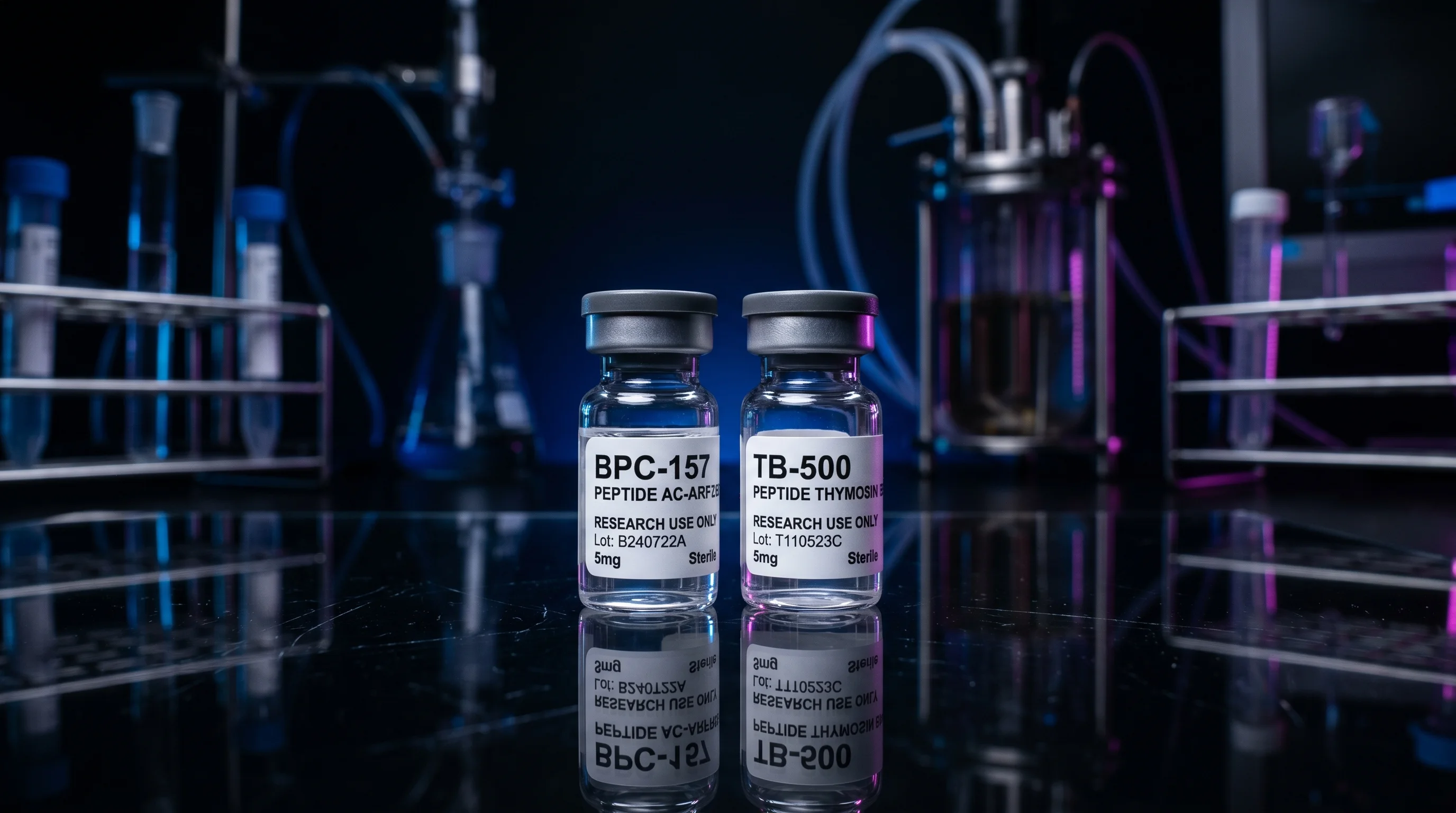
BPC-157 is a synthetic pentadecapeptide (15 amino acids) derived from human gastric juice that shows strong preclinical effects on tendon, ligament, and gastrointestinal healing through the VEGFR2-Akt-eNOS axis 13. TB-500 is a synthetic heptapeptide (Ac-LKKTETQ) representing the active actin-binding region of Thymosin Beta-4, acting primarily via cell migration, actin sequestration, and systemic angiogenesis 57. The two molecules complement each other in research: BPC-157 for localized tissue repair and GI models, TB-500 for musculoskeletal regeneration and wound healing on a broader scale. Based on the current data, no blanket superiority can be established.
Activates the VEGFR2-Akt-eNOS axis, modulates the NO system, promotes local angiogenesis
Sequesters G-actin via the LKKTETQ motif, promotes cell migration and systemic angiogenesis
15 amino acids (pentadecapeptide), sequence GEPPPGKPADDAGLV, approx. 1,419 Da
7 amino acids (acetylated heptapeptide), sequence Ac-LKKTETQ, approx. 889 Da
Very short: approx. 15 minutes i.v. in rats, under 30 minutes i.m. 9
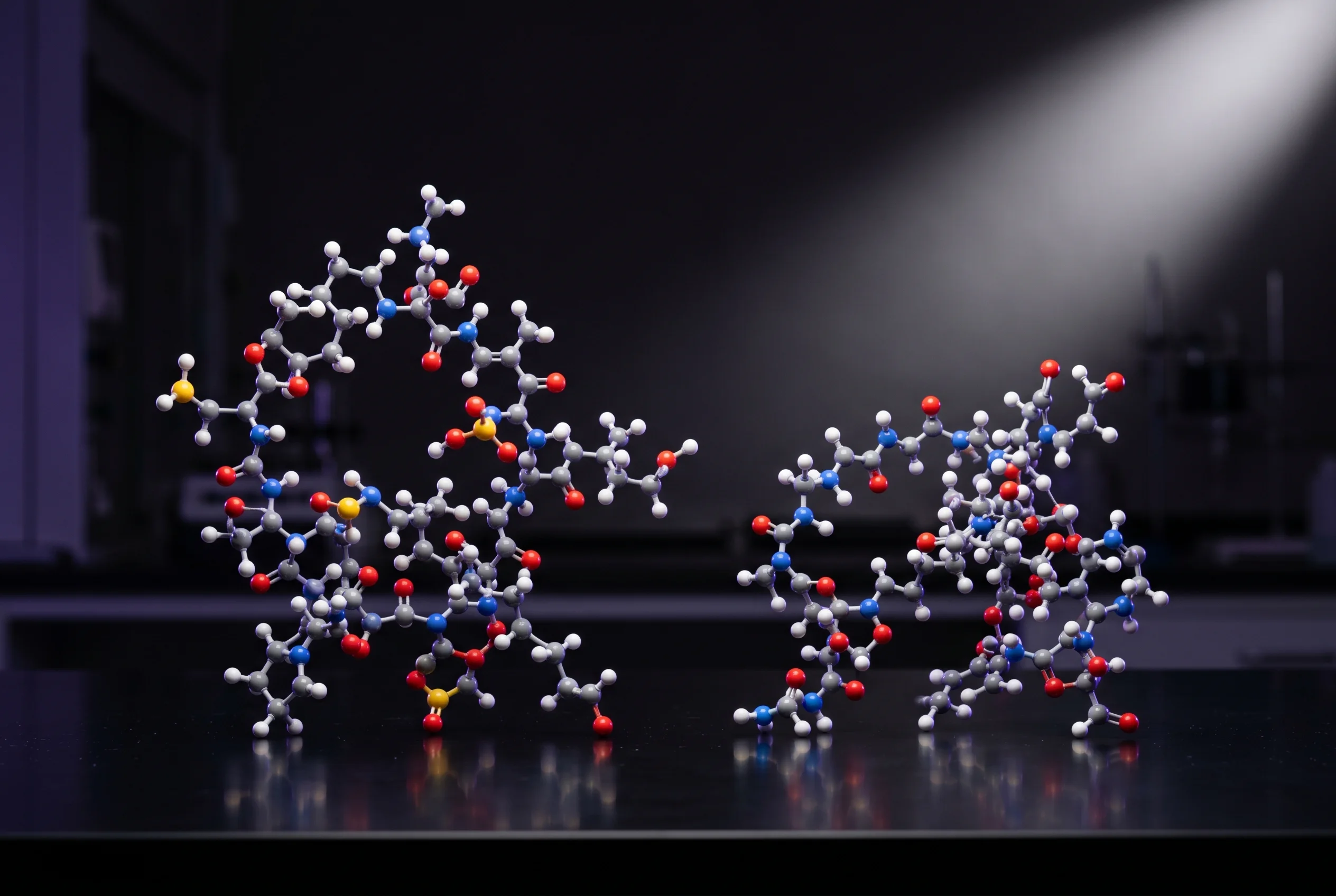
BPC-157 acts primarily at the local injury site. The dominant signaling pathway is the activation of VEGFR2 (Vascular Endothelial Growth Factor Receptor 2) with downstream Akt-eNOS phosphorylation, leading to rapid release of nitric oxide and the formation of new capillaries 3. In addition, BPC-157 modulates Caveolin-1-eNOS binding and regulates vasomotor balance in damaged tissues. In tendon, ligament, and muscle models, it promotes the migration and survival of fibroblasts as well as tendon-outgrowth activity 1. In the gastrointestinal tract, it protects the mucosa against NSAID, ethanol, and stress damage, as demonstrated by accelerated ulcer healing in rodent models 2.
TB-500 is a synthetic heptapeptide (Ac-LKKTETQ) representing the active actin-binding region of the 43-amino-acid Thymosin Beta-4 5. Its primary mechanism of action is the sequestration of G-actin, which mobilizes the actin cytoskeleton for cell migration, wound closure, and tissue regeneration. TB-500 stimulates the migration of endothelial cells, keratinocytes, and cardiac progenitor cells . In animal models of wound healing, it accelerates closure of full-thickness skin wounds, and in cardiac infarction models, it promotes epicardial neovascularization . The action of TB-500 tends to be systemic: it distributes broadly after injection and influences tissues that are considerably remote from the injection site.
As of May 2026, no randomized, placebo-controlled trials directly compare BPC-157 and TB-500 against one another. Comparative statements rely on parallel investigations in different laboratories and models, which methodologically complicates direct comparisons 4. A 2025 narrative review classifies both peptides as complementary tools: BPC-157 for local-vascular and gastrointestinal repair models, TB-500 for systemic cell migration and muscle or skin regeneration 4.
Without controlled head-to-head data, any claim of a direct winner remains speculative. Research teams should align model, endpoint, and route of administration with their scientific objective, not with a presumed ranking.
BPC-157 is considered exceptionally well tolerated in preclinical studies. Animal studies spanning several months report no significant organ toxicities. However, long-term human data are entirely absent, which is why the substance remains strictly limited to research applications [4](#ref-4).
TB-500 demonstrates a favorable safety profile in preclinical studies and in the available Phase 2 trials of Thymosin Beta-4. The substance is, however, on the WADA prohibited list and is banned in competitive sport [6](#ref-6).
BPC-157 has the most comprehensive preclinical evidence base for tendon-to-bone healing, fibroblast migration, and Achilles models. The work of Sikiric, Krivic, and Chang forms a consistent body of data [1](#ref-1)[2](#ref-2).
BPC-157 was originally isolated from human gastric juice and is documented in numerous ulcer, colitis, and anastomosis models. TB-500 has few studies in this indication area.
TB-500 acts via actin sequestration and cell migration and shows robust effects in dermal, muscular, and cardiac models. For cell-based systemic regeneration, it is the better-characterized tool [7](#ref-7)[8](#ref-8).
Per milligram of active substance, TB-500 (10 mg per vial) is more cost-effective than BPC-157 (5 mg per vial). For purely local models, BPC-157 is often sufficient at lower doses, which offsets the price advantage. The decision should be based primarily on the model, not on price.
BPC-157 is a 15-amino-acid pentadecapeptide derived from human gastric juice that primarily promotes angiogenesis and tissue repair locally via the VEGFR2-Akt-eNOS axis. TB-500, by contrast, is a synthetic heptapeptide (Ac-LKKTETQ) that represents the active region of Thymosin Beta-4 and triggers systemic cell migration via actin sequestration.
TB-500 has a slight edge, since Thymosin Beta-4 has been investigated in two Phase 2 trials in patients with chronic ulcers. BPC-157 has not been examined in any published, randomized, placebo-controlled trial in humans. Neither body of evidence is sufficient to support clinical recommendations.
In some preclinical studies, both peptides are used together because their mechanisms are considered complementary. However, controlled combination studies with clear statistical endpoints are rare, so synergistic effects remain largely hypothetical at present.
For tendon models, BPC-157 is better documented. Studies such as those by Krivic and Chang demonstrate consistent effects on tendon-to-bone healing, fibroblast migration, and tendon outgrowth. TB-500 also acts on connective tissue, but it has been less specifically investigated in this indication area.
BPC-157 and TB-500 are not interchangeable peptides. They act through distinct molecular mechanisms, cover overlapping but not identical research fields, and each brings its own strengths and limitations. BPC-157 excels in local vascular and gastrointestinal repair research, supported by over 200 animal studies from the Sikiric school. TB-500 stands out in systemic wound healing and muscle and cardiac regeneration, and as the only one of the two peptides with published human Phase 2 data. The choice should be guided by the model and the endpoint, not by marketing.
No dominant winner emerges, because the two peptides serve different research questions. For local tissue repair, tendon research, and GI models, BPC-157 is the better choice. For systemic migration, wound healing, and cardiac regeneration, TB-500 leads. A blanket recommendation without a model context would not be scientifically defensible.
BPC-157 (Body Protection Compound) and TB-500 (Thymosin Beta-4 fragment) are widely regarded as the two most extensively studied peptides in preclinical regenerative research. We contrast their mechanisms, evidence base, and application areas so you can ground your research protocol in robust data.
Medically reviewed by Dr. Sieglinde Klaus · Last reviewed May 2026BPC-157 is a synthetic pentadecapeptide (15 amino acids) derived from human gastric juice that shows strong preclinical effects on tendon, ligament, and gastrointestinal healing through the VEGFR2-Akt-eNOS axis 13. TB-500 is a synthetic heptapeptide (Ac-LKKTETQ) representing the active actin-binding region of Thymosin Beta-4, acting primarily via cell migration, actin sequestration, and systemic angiogenesis 57. The two molecules complement each other in research: BPC-157 for localized tissue repair and GI models, TB-500 for musculoskeletal regeneration and wound healing on a broader scale. Based on the current data, no blanket superiority can be established.
Activates the VEGFR2-Akt-eNOS axis, modulates the NO system, promotes local angiogenesis
Sequesters G-actin via the LKKTETQ motif, promotes cell migration and systemic angiogenesis
15 amino acids (pentadecapeptide), sequence GEPPPGKPADDAGLV, approx. 1,419 Da
7 amino acids (acetylated heptapeptide), sequence Ac-LKKTETQ, approx. 889 Da
Very short: approx. 15 minutes i.v. in rats, under 30 minutes i.m. 9
BPC-157 acts primarily at the local injury site. The dominant signaling pathway is the activation of VEGFR2 (Vascular Endothelial Growth Factor Receptor 2) with downstream Akt-eNOS phosphorylation, leading to rapid release of nitric oxide and the formation of new capillaries 3. In addition, BPC-157 modulates Caveolin-1-eNOS binding and regulates vasomotor balance in damaged tissues. In tendon, ligament, and muscle models, it promotes the migration and survival of fibroblasts as well as tendon-outgrowth activity 1. In the gastrointestinal tract, it protects the mucosa against NSAID, ethanol, and stress damage, as demonstrated by accelerated ulcer healing in rodent models 2.
TB-500 is a synthetic heptapeptide (Ac-LKKTETQ) representing the active actin-binding region of the 43-amino-acid Thymosin Beta-4 5. Its primary mechanism of action is the sequestration of G-actin, which mobilizes the actin cytoskeleton for cell migration, wound closure, and tissue regeneration. TB-500 stimulates the migration of endothelial cells, keratinocytes, and cardiac progenitor cells . In animal models of wound healing, it accelerates closure of full-thickness skin wounds, and in cardiac infarction models, it promotes epicardial neovascularization . The action of TB-500 tends to be systemic: it distributes broadly after injection and influences tissues that are considerably remote from the injection site.
As of May 2026, no randomized, placebo-controlled trials directly compare BPC-157 and TB-500 against one another. Comparative statements rely on parallel investigations in different laboratories and models, which methodologically complicates direct comparisons 4. A 2025 narrative review classifies both peptides as complementary tools: BPC-157 for local-vascular and gastrointestinal repair models, TB-500 for systemic cell migration and muscle or skin regeneration 4.
Without controlled head-to-head data, any claim of a direct winner remains speculative. Research teams should align model, endpoint, and route of administration with their scientific objective, not with a presumed ranking.
BPC-157 is considered exceptionally well tolerated in preclinical studies. Animal studies spanning several months report no significant organ toxicities. However, long-term human data are entirely absent, which is why the substance remains strictly limited to research applications [4](#ref-4).
TB-500 demonstrates a favorable safety profile in preclinical studies and in the available Phase 2 trials of Thymosin Beta-4. The substance is, however, on the WADA prohibited list and is banned in competitive sport [6](#ref-6).
BPC-157 has the most comprehensive preclinical evidence base for tendon-to-bone healing, fibroblast migration, and Achilles models. The work of Sikiric, Krivic, and Chang forms a consistent body of data [1](#ref-1)[2](#ref-2).
BPC-157 was originally isolated from human gastric juice and is documented in numerous ulcer, colitis, and anastomosis models. TB-500 has few studies in this indication area.
TB-500 acts via actin sequestration and cell migration and shows robust effects in dermal, muscular, and cardiac models. For cell-based systemic regeneration, it is the better-characterized tool [7](#ref-7)[8](#ref-8).
Per milligram of active substance, TB-500 (10 mg per vial) is more cost-effective than BPC-157 (5 mg per vial). For purely local models, BPC-157 is often sufficient at lower doses, which offsets the price advantage. The decision should be based primarily on the model, not on price.
BPC-157 is a 15-amino-acid pentadecapeptide derived from human gastric juice that primarily promotes angiogenesis and tissue repair locally via the VEGFR2-Akt-eNOS axis. TB-500, by contrast, is a synthetic heptapeptide (Ac-LKKTETQ) that represents the active region of Thymosin Beta-4 and triggers systemic cell migration via actin sequestration.
TB-500 has a slight edge, since Thymosin Beta-4 has been investigated in two Phase 2 trials in patients with chronic ulcers. BPC-157 has not been examined in any published, randomized, placebo-controlled trial in humans. Neither body of evidence is sufficient to support clinical recommendations.
In some preclinical studies, both peptides are used together because their mechanisms are considered complementary. However, controlled combination studies with clear statistical endpoints are rare, so synergistic effects remain largely hypothetical at present.
For tendon models, BPC-157 is better documented. Studies such as those by Krivic and Chang demonstrate consistent effects on tendon-to-bone healing, fibroblast migration, and tendon outgrowth. TB-500 also acts on connective tissue, but it has been less specifically investigated in this indication area.
BPC-157 and TB-500 are not interchangeable peptides. They act through distinct molecular mechanisms, cover overlapping but not identical research fields, and each brings its own strengths and limitations. BPC-157 excels in local vascular and gastrointestinal repair research, supported by over 200 animal studies from the Sikiric school. TB-500 stands out in systemic wound healing and muscle and cardiac regeneration, and as the only one of the two peptides with published human Phase 2 data. The choice should be guided by the model and the endpoint, not by marketing.
No dominant winner emerges, because the two peptides serve different research questions. For local tissue repair, tendon research, and GI models, BPC-157 is the better choice. For systemic migration, wound healing, and cardiac regeneration, TB-500 leads. A blanket recommendation without a model context would not be scientifically defensible.
Short in plasma, but extended tissue activity through binding to the actin pool
Subcutaneous or intramuscular; oral administration also described in rodent models
Subcutaneous or intramuscular only; no established oral bioavailability
Tendon, ligament, bone, and gastrointestinal healing; ulcer models
Cutaneous wound healing, muscle regeneration, cardiac repair, ophthalmic research
Transient local redness, mild fatigue, headaches (rare)
Transient lethargy, local irritation, mild nausea
Theoretical tumor risk from angiogenesis stimulation; long-term safety unknown
WADA-prohibited substance in sport; theoretical tumor risk via angiogenesis
At 2-8 degrees Celsius, protected from light; refrigerated for up to 30 days after reconstitution
At 2-8 degrees Celsius, protected from light; refrigerated for up to 30 days after reconstitution
Over 99 percent (HPLC-certified), lyophilized, batch-documented
Over 99 percent (HPLC-certified), lyophilized, batch-documented
66.99 euros per 5 mg vial (volume pricing from 60.44 euros for a 3-pack)
79.99 euros per 10 mg vial (volume pricing from 77.66 euros for a 3-pack)
In summary: BPC-157 acts focally and is strongly angiogenic, while TB-500 acts systemically and promotes migration. In preclinical co-administration studies, the effects are described as complementary; however, controlled head-to-head comparisons in humans are lacking.
BPC-157 has the broadest preclinical evidence base, with over 200 animal studies, but it has not been clinically validated in humans. TB-500 rests on fewer animal studies but has Phase 2 data on wound healing in humans to its credit. In both cases, the data are insufficient to support clinical claims.
This information is provided exclusively for scientific purposes. Neither peptide is approved by the EMA, the FDA, or any other drug regulatory authority for human use. For research purposes only. Not intended for human consumption.
BPC-157 is the best characterized at the molecular level with respect to VEGFR2-Akt-eNOS activation and Caveolin-1-mediated endothelial modulation, making it the preferred tool for endothelial cell research [3](#ref-3).
The plasma half-life of BPC-157 is very short, at approximately 15 minutes following intravenous administration. TB-500 is likewise rapidly eliminated from plasma but binds to the actin pool in tissue, extending its biological duration of action. Both peptides exhibit a pronounced pharmacokinetic-pharmacodynamic disconnect.
Both peptides stimulate angiogenic processes, which is why a theoretical risk of tumor growth is discussed. This risk has not yet been confirmed in animal studies, but long-term human data do not exist. TB-500 is additionally WADA-prohibited and is therefore relevant for sport-related research.
TB-500 is offered in 10 mg vials, BPC-157 in 5 mg vials. Per milligram of active substance, TB-500 is more cost-effective. The larger vial size reflects typical dosing in preclinical protocols in which TB-500 is administered systemically and requires higher absolute amounts.
Short in plasma, but extended tissue activity through binding to the actin pool
Subcutaneous or intramuscular; oral administration also described in rodent models
Subcutaneous or intramuscular only; no established oral bioavailability
Tendon, ligament, bone, and gastrointestinal healing; ulcer models
Cutaneous wound healing, muscle regeneration, cardiac repair, ophthalmic research
Transient local redness, mild fatigue, headaches (rare)
Transient lethargy, local irritation, mild nausea
Theoretical tumor risk from angiogenesis stimulation; long-term safety unknown
WADA-prohibited substance in sport; theoretical tumor risk via angiogenesis
At 2-8 degrees Celsius, protected from light; refrigerated for up to 30 days after reconstitution
At 2-8 degrees Celsius, protected from light; refrigerated for up to 30 days after reconstitution
Over 99 percent (HPLC-certified), lyophilized, batch-documented
Over 99 percent (HPLC-certified), lyophilized, batch-documented
66.99 euros per 5 mg vial (volume pricing from 60.44 euros for a 3-pack)
79.99 euros per 10 mg vial (volume pricing from 77.66 euros for a 3-pack)
In summary: BPC-157 acts focally and is strongly angiogenic, while TB-500 acts systemically and promotes migration. In preclinical co-administration studies, the effects are described as complementary; however, controlled head-to-head comparisons in humans are lacking.
BPC-157 has the broadest preclinical evidence base, with over 200 animal studies, but it has not been clinically validated in humans. TB-500 rests on fewer animal studies but has Phase 2 data on wound healing in humans to its credit. In both cases, the data are insufficient to support clinical claims.
This information is provided exclusively for scientific purposes. Neither peptide is approved by the EMA, the FDA, or any other drug regulatory authority for human use. For research purposes only. Not intended for human consumption.
BPC-157 is the best characterized at the molecular level with respect to VEGFR2-Akt-eNOS activation and Caveolin-1-mediated endothelial modulation, making it the preferred tool for endothelial cell research [3](#ref-3).
The plasma half-life of BPC-157 is very short, at approximately 15 minutes following intravenous administration. TB-500 is likewise rapidly eliminated from plasma but binds to the actin pool in tissue, extending its biological duration of action. Both peptides exhibit a pronounced pharmacokinetic-pharmacodynamic disconnect.
Both peptides stimulate angiogenic processes, which is why a theoretical risk of tumor growth is discussed. This risk has not yet been confirmed in animal studies, but long-term human data do not exist. TB-500 is additionally WADA-prohibited and is therefore relevant for sport-related research.
TB-500 is offered in 10 mg vials, BPC-157 in 5 mg vials. Per milligram of active substance, TB-500 is more cost-effective. The larger vial size reflects typical dosing in preclinical protocols in which TB-500 is administered systemically and requires higher absolute amounts.

