Two very different approaches in mitochondrial and metabolic research: MOTS-c as an exercise mimetic and AMPK activator versus NAD+ as a central redox coenzyme and sirtuin substrate. These compounds do not compete within the same drug class but address orthogonal research questions.
 Medically reviewed by Dr. Sieglinde Klaus · Last reviewed June 2026
MOTS-c is a 16-amino-acid, mitochondrially encoded signaling peptide studied in research as an exercise mimetic; it activates the AMPK signaling cascade and sits at the center of studies on metabolic homeostasis and age-dependent muscle decline 12. NAD+, by contrast, is not a peptide but the central redox coenzyme of cellular metabolism and an obligate co-substrate for sirtuins, PARP1 and CD38 45. In research, the two compounds are not interchangeable alternatives: MOTS-c has a narrower, peptide-specific evidence base around exercise mimicry, whereas NAD+ rests on a substantially more extensive and mature body of literature, including a randomized phase I trial . Important caveat: the most robust clinical human data concern NAD+ precursors (NR/NMN), not systemically administered NAD+ itself.
Two very different approaches in mitochondrial and metabolic research: MOTS-c as an exercise mimetic and AMPK activator versus NAD+ as a central redox coenzyme and sirtuin substrate. These compounds do not compete within the same drug class but address orthogonal research questions.
Medically reviewed by Dr. Sieglinde Klaus · Last reviewed June 2026MOTS-c is a 16-amino-acid, mitochondrially encoded signaling peptide studied in research as an exercise mimetic; it activates the AMPK signaling cascade and sits at the center of studies on metabolic homeostasis and age-dependent muscle decline 12. NAD+, by contrast, is not a peptide but the central redox coenzyme of cellular metabolism and an obligate co-substrate for sirtuins, PARP1 and CD38 45. In research, the two compounds are not interchangeable alternatives: MOTS-c has a narrower, peptide-specific evidence base around exercise mimicry, whereas NAD+ rests on a substantially more extensive and mature body of literature, including a randomized phase I trial . Important caveat: the most robust clinical human data concern NAD+ precursors (NR/NMN), not systemically administered NAD+ itself.
16-amino-acid signaling peptide, mitochondrially encoded (mtDNA 12S rRNA region)
Redox coenzyme / dinucleotide cofactor (CAS 53-84-9, C21H27N7O14P2, 663 g/mol)
AMPK activation via inhibition of the folate-methionine cycle; nuclear translocation; exercise mimetic; receptor-independent
Redox electron carrier (NAD+/NADH); obligate substrate for sirtuins, PARP1 and CD38; intended to offset the age-related decline in NAD+
Exercise mimicry, metabolic homeostasis, insulin sensitivity, age-dependent muscle and performance decline
Cellular energy redox, longevity, sirtuin and DNA-repair activity, neuroprotection (Parkinson's research context)
5 mg (range 5-10 mg)
250 mg (range 100-500 mg)
Subcutaneous injection (research reconstitution)
Subcutaneous injection; clinical NAD+ research often uses IV infusion
Weekly
Once daily
~12 hours
~1-2 hours
Preclinical / early translational phase; no completed interventional human studies
More mature literature; randomized phase I trial (NADPARK), though the strongest human data concern precursors (NR/NMN)
Undefined human side-effect profile; theoretical risks from AMPK modulation; research only
Generally well tolerated in studies; rapid IV infusion can trigger flushing, chest tightness and nausea; research only
Lyophilized at -20C (stable long term); reconstituted 2-8C, use within weeks; protect from light and freeze-thaw cycles
Lyophilized at -20C (light- and moisture-sensitive); reconstituted 2-8C, use promptly; solution degrades faster
5 mg / 10 mg vials (BergdorfBio: 10 mg)
1000 mg vials (BergdorfBio: 1000 mg), >=99% HPLC
66.99 EUR / 10 mg vial
149.99 EUR / 1000 mg vial (substantially more mg per vial, far lower cost per mg)
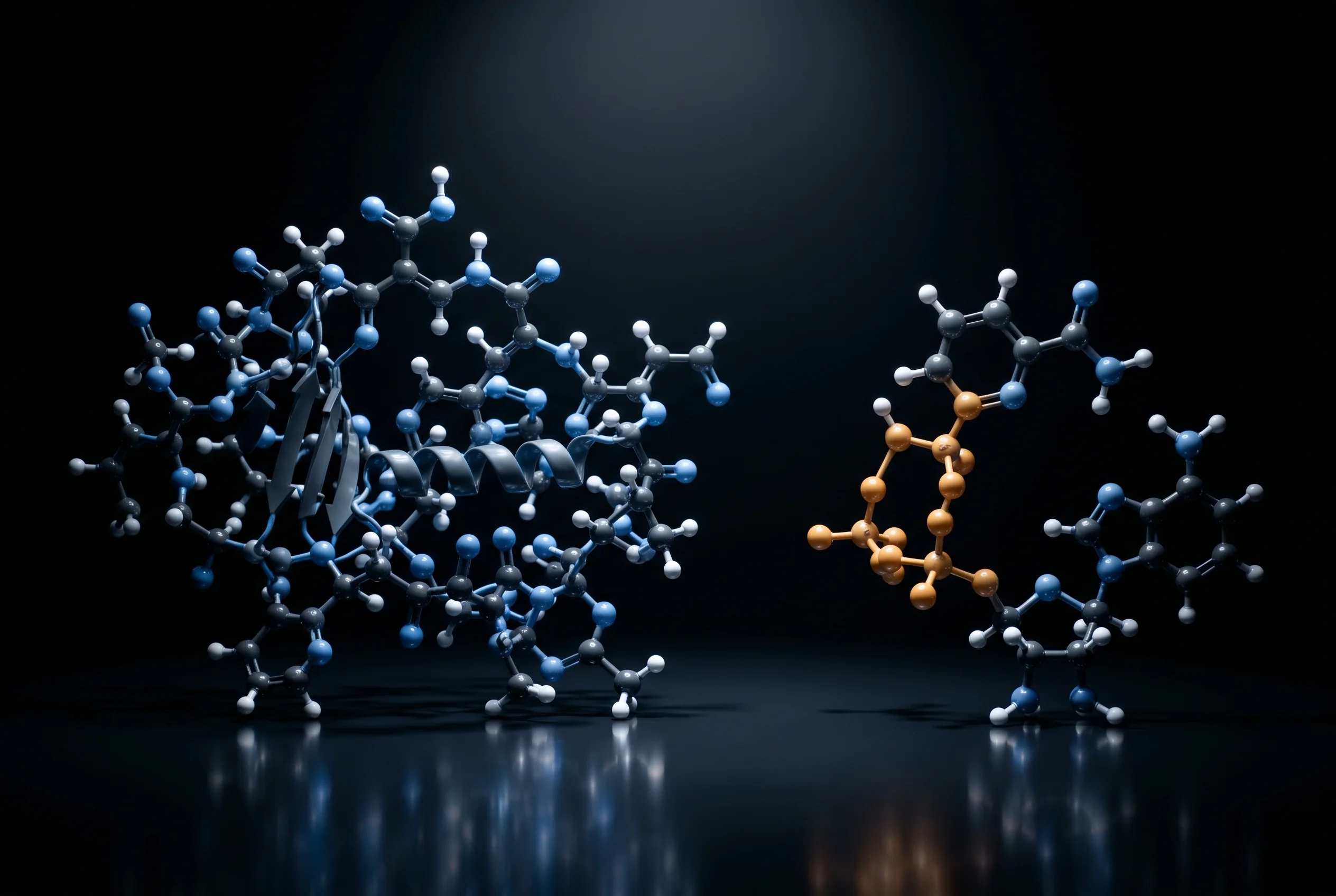
MOTS-c (Mitochondrial Open Reading Frame of the Twelve S rRNA type-c) is a 16-amino-acid peptide encoded within the 12S rRNA region of the mitochondrial genome. In research, MOTS-c acts as an exercise mimetic: it inhibits the folate-methionine cycle, which leads to the accumulation of 5-aminoimidazole-4-carboxamide ribonucleotide and, consequently, to activation of the AMPK signaling cascade 1. Under metabolic stress, MOTS-c translocates to the nucleus, where it modulates nuclear gene expression. The peptide has no defined cell-surface receptor; its action is receptor-independent. In preclinical models, MOTS-c improved glucose utilization and insulin sensitivity and counteracted diet-induced obesity 1. Later work showed that MOTS-c is induced by physical activity and mitigates age-dependent physical decline in animal models 2.
NAD+ (nicotinamide adenine dinucleotide) is not a peptide but the central redox coenzyme of cellular metabolism. Through the NAD+/NADH redox pair it functions as an obligate electron carrier in glycolysis, the citric acid cycle and oxidative phosphorylation. Beyond this, NAD+ is the obligate co-substrate for three important enzyme classes: sirtuins (SIRT1-7, deacylation), PARP1 (DNA repair) and CD38 (NAD+ consumption) 45. The research hypothesis behind NAD+ augmentation is that the age-related decline in cellular NAD+ levels weakens sirtuin- and PARP-dependent maintenance pathways, and that restoration could reactivate these pathways. Importantly, NAD+ acts at the cofactor level, not as a signaling peptide. Moreover, a substantial portion of the robust human evidence concerns the NAD+ precursors NR and NMN, not intact, systemically administered NAD+; the bioavailability of intact NAD+ is debated in the literature.
The decisive difference is the level of action: MOTS-c is a signaling peptide that triggers a specific cascade (AMPK) and modulates gene expression, whereas NAD+ is a metabolic cofactor broadly embedded in energy metabolism, redox balance and enzymatic maintenance pathways. Interestingly, both compounds converge functionally on mitochondrial energy homeostasis, yet reach it via entirely separate molecular paths. For this reason, a direct efficacy comparison makes little sense in research; the choice depends on the research question being investigated.
The evidence base for MOTS-c is peptide-specific and consistent but remains preclinical: there are no completed interventional human studies using administered MOTS-c 12. NAD+ rests on a more mature and broader body of literature, including a randomized phase I trial 6; crucially, however, the most robust human data concern the precursors NR/NMN, not intact, administered NAD+. Both compounds are research substances only, without an established human safety database for systemic administration.
A head-to-head comparison of MOTS-c and NAD+ is only of limited value, because the two compounds address different research questions. MOTS-c scores with a narrow, well-defined signaling axis (AMPK), a longer half-life of about 12 hours and a weekly research cadence 1. NAD+ scores with higher clinical maturity, broader literature and a substantially lower cost per milligram, but suffers from a short plasma half-life of one to two hours and the open question of intact NAD+ bioavailability 46. On pharmacokinetics, MOTS-c leads; on clinical data volume and cost-per-mg efficiency, NAD+ leads.
MOTS-c wins on pharmacokinetics and dosing cadence, NAD+ on clinical maturity and cost efficiency per milligram. Neither compound replaces the other.
MOTS-c is a pure research compound without an established human safety database. There are no completed interventional human studies using administered MOTS-c, so its side-effect profile in humans remains undefined. There are no black-box warnings, as MOTS-c is not an approved drug.
NAD+ is generally well tolerated in clinical research (predominantly with precursors). However, intact, systemically administered NAD+ is not an approved therapeutic, and the long-term safety of systemic administration is undefined. There are no black-box warnings, as NAD+ is not an approved drug.
All information presented here relates exclusively to preclinical and early translational research. Neither MOTS-c nor NAD+ is approved as a medicinal product, and nothing in this comparison constitutes a therapeutic recommendation, dosing guidance, or any statement about safety or efficacy in humans. Both compounds are handled without an established human safety database for systemic use. For research purposes only. Not for human consumption.
MOTS-c is explicitly characterized as an exercise mimetic and is induced by physical activity; the preclinical literature links it directly to muscle and performance preservation [2](#ref-2).
NAD+ is the obligate co-substrate for sirtuins, PARP1 and CD38; for redox- and enzyme-substrate-related questions it is the mechanistically appropriate object of study [4](#ref-4)[5](#ref-5).
NAD+ and its precursors have a randomized phase I trial and a broader translational literature, whereas MOTS-c remains purely preclinical [6](#ref-6).
MOTS-c's longer half-life (about 12 hours versus 1-2 hours) allows a weekly rather than daily research cadence, which simplifies protocols with less frequent administration.
Both compounds converge functionally on mitochondrial energy homeostasis but reach it via separate pathways; the choice depends on whether the AMPK signaling axis (MOTS-c) or the redox/sirtuin axis (NAD+) is the focus.
No. MOTS-c is a mitochondrially encoded signaling peptide that activates the AMPK cascade, whereas NAD+ is a redox coenzyme and cofactor for sirtuins, PARP1 and CD38 14. They act at entirely different molecular levels and address orthogonal research questions; in no meaningful sense is one a direct substitute for the other.
NAD+ rests on the more mature and broader literature, including the randomized phase I NADPARK trial 6. However, the most robust human data concern the NAD+ precursors NR and NMN, not intact, administered NAD+. MOTS-c remains purely preclinical with no completed interventional human studies.
The difference reflects the molecular nature. MOTS-c is a potent signaling peptide used in research in the low milligram range (5-10 mg), whereas NAD+ as a metabolic cofactor is studied in substantially higher amounts (100-500 mg). Per milligram, NAD+ is therefore considerably cheaper, but per vial MOTS-c offers the lower entry price.
The dosing frequency follows the half-life. MOTS-c has a half-life of about 12 hours and a sustained signaling effect, which allows a weekly cadence in research protocols 1. NAD+, by contrast, has a short plasma half-life of only one to two hours, which is why a more frequent, usually daily administration is studied in research.
A large part of the clinically robust evidence, such as the NADPARK study, uses nicotinamide riboside (NR) or nicotinamide mononucleotide (NMN), that is, precursors that the cell converts into NAD+ 6. The bioavailability of intact, administered NAD+ is contested in the literature. Research data on precursors therefore cannot be readily transferred to systemically supplied NAD+.
Because both compounds converge functionally on mitochondrial energy homeostasis but via separate pathways (AMPK signaling versus redox/sirtuin cofactor), combined research designs are mechanistically conceivable. However, there are no validated data on a joint application; such a design would remain purely exploratory and belongs exclusively in the preclinical research context.
No. Both MOTS-c and NAD+ are research substances only. Neither compound is approved as a medicinal product, and no established human safety database exists for systemic use. All data presented here come from preclinical and early translational research.
MOTS-c and NAD+ are not competing compounds of the same class in research, but tools for different questions. MOTS-c stands out with a narrow, peptide-specific evidence base around exercise mimicry and muscle homeostasis, more favorable pharmacokinetics (half-life about 12 hours, weekly cadence) and a lower entry price per vial 12. NAD+ stands out with more mature and broader literature, a central position in cellular energy redox and DNA-repair pathways, and substantially lower cost per milligram; its clinical maturity, however, is carried predominantly by precursor studies (NR/NMN), not by intact, administered NAD+ 46. The choice is therefore context-dependent and should be guided by the specific research question, not by a blanket claim of superiority.
The two compounds have distinct mechanisms and research goals and are not interchangeable. MOTS-c has a narrower, peptide-specific evidence base (exercise mimicry, age-dependent muscle decline) and more advantageous pharmacokinetics; NAD+ rests on a more mature, broader literature including a randomized phase I trial and is cheaper per milligram, yet its clinical maturity derives predominantly from precursors (NR/NMN), not from systemically administered NAD+. Because neither compound replaces the other and each leads in its own research field, the honest verdict is context-dependent.
16-amino-acid signaling peptide, mitochondrially encoded (mtDNA 12S rRNA region)
Redox coenzyme / dinucleotide cofactor (CAS 53-84-9, C21H27N7O14P2, 663 g/mol)
AMPK activation via inhibition of the folate-methionine cycle; nuclear translocation; exercise mimetic; receptor-independent
Redox electron carrier (NAD+/NADH); obligate substrate for sirtuins, PARP1 and CD38; intended to offset the age-related decline in NAD+
Exercise mimicry, metabolic homeostasis, insulin sensitivity, age-dependent muscle and performance decline
Cellular energy redox, longevity, sirtuin and DNA-repair activity, neuroprotection (Parkinson's research context)
5 mg (range 5-10 mg)
250 mg (range 100-500 mg)
Subcutaneous injection (research reconstitution)
Subcutaneous injection; clinical NAD+ research often uses IV infusion
Weekly
Once daily
~12 hours
~1-2 hours
Preclinical / early translational phase; no completed interventional human studies
More mature literature; randomized phase I trial (NADPARK), though the strongest human data concern precursors (NR/NMN)
Undefined human side-effect profile; theoretical risks from AMPK modulation; research only
Generally well tolerated in studies; rapid IV infusion can trigger flushing, chest tightness and nausea; research only
Lyophilized at -20C (stable long term); reconstituted 2-8C, use within weeks; protect from light and freeze-thaw cycles
Lyophilized at -20C (light- and moisture-sensitive); reconstituted 2-8C, use promptly; solution degrades faster
5 mg / 10 mg vials (BergdorfBio: 10 mg)
1000 mg vials (BergdorfBio: 1000 mg), >=99% HPLC
66.99 EUR / 10 mg vial
149.99 EUR / 1000 mg vial (substantially more mg per vial, far lower cost per mg)
MOTS-c (Mitochondrial Open Reading Frame of the Twelve S rRNA type-c) is a 16-amino-acid peptide encoded within the 12S rRNA region of the mitochondrial genome. In research, MOTS-c acts as an exercise mimetic: it inhibits the folate-methionine cycle, which leads to the accumulation of 5-aminoimidazole-4-carboxamide ribonucleotide and, consequently, to activation of the AMPK signaling cascade 1. Under metabolic stress, MOTS-c translocates to the nucleus, where it modulates nuclear gene expression. The peptide has no defined cell-surface receptor; its action is receptor-independent. In preclinical models, MOTS-c improved glucose utilization and insulin sensitivity and counteracted diet-induced obesity 1. Later work showed that MOTS-c is induced by physical activity and mitigates age-dependent physical decline in animal models 2.
NAD+ (nicotinamide adenine dinucleotide) is not a peptide but the central redox coenzyme of cellular metabolism. Through the NAD+/NADH redox pair it functions as an obligate electron carrier in glycolysis, the citric acid cycle and oxidative phosphorylation. Beyond this, NAD+ is the obligate co-substrate for three important enzyme classes: sirtuins (SIRT1-7, deacylation), PARP1 (DNA repair) and CD38 (NAD+ consumption) 45. The research hypothesis behind NAD+ augmentation is that the age-related decline in cellular NAD+ levels weakens sirtuin- and PARP-dependent maintenance pathways, and that restoration could reactivate these pathways. Importantly, NAD+ acts at the cofactor level, not as a signaling peptide. Moreover, a substantial portion of the robust human evidence concerns the NAD+ precursors NR and NMN, not intact, systemically administered NAD+; the bioavailability of intact NAD+ is debated in the literature.
The decisive difference is the level of action: MOTS-c is a signaling peptide that triggers a specific cascade (AMPK) and modulates gene expression, whereas NAD+ is a metabolic cofactor broadly embedded in energy metabolism, redox balance and enzymatic maintenance pathways. Interestingly, both compounds converge functionally on mitochondrial energy homeostasis, yet reach it via entirely separate molecular paths. For this reason, a direct efficacy comparison makes little sense in research; the choice depends on the research question being investigated.
The evidence base for MOTS-c is peptide-specific and consistent but remains preclinical: there are no completed interventional human studies using administered MOTS-c 12. NAD+ rests on a more mature and broader body of literature, including a randomized phase I trial 6; crucially, however, the most robust human data concern the precursors NR/NMN, not intact, administered NAD+. Both compounds are research substances only, without an established human safety database for systemic administration.
A head-to-head comparison of MOTS-c and NAD+ is only of limited value, because the two compounds address different research questions. MOTS-c scores with a narrow, well-defined signaling axis (AMPK), a longer half-life of about 12 hours and a weekly research cadence 1. NAD+ scores with higher clinical maturity, broader literature and a substantially lower cost per milligram, but suffers from a short plasma half-life of one to two hours and the open question of intact NAD+ bioavailability 46. On pharmacokinetics, MOTS-c leads; on clinical data volume and cost-per-mg efficiency, NAD+ leads.
MOTS-c wins on pharmacokinetics and dosing cadence, NAD+ on clinical maturity and cost efficiency per milligram. Neither compound replaces the other.
MOTS-c is a pure research compound without an established human safety database. There are no completed interventional human studies using administered MOTS-c, so its side-effect profile in humans remains undefined. There are no black-box warnings, as MOTS-c is not an approved drug.
NAD+ is generally well tolerated in clinical research (predominantly with precursors). However, intact, systemically administered NAD+ is not an approved therapeutic, and the long-term safety of systemic administration is undefined. There are no black-box warnings, as NAD+ is not an approved drug.
All information presented here relates exclusively to preclinical and early translational research. Neither MOTS-c nor NAD+ is approved as a medicinal product, and nothing in this comparison constitutes a therapeutic recommendation, dosing guidance, or any statement about safety or efficacy in humans. Both compounds are handled without an established human safety database for systemic use. For research purposes only. Not for human consumption.
MOTS-c is explicitly characterized as an exercise mimetic and is induced by physical activity; the preclinical literature links it directly to muscle and performance preservation [2](#ref-2).
NAD+ is the obligate co-substrate for sirtuins, PARP1 and CD38; for redox- and enzyme-substrate-related questions it is the mechanistically appropriate object of study [4](#ref-4)[5](#ref-5).
NAD+ and its precursors have a randomized phase I trial and a broader translational literature, whereas MOTS-c remains purely preclinical [6](#ref-6).
MOTS-c's longer half-life (about 12 hours versus 1-2 hours) allows a weekly rather than daily research cadence, which simplifies protocols with less frequent administration.
Both compounds converge functionally on mitochondrial energy homeostasis but reach it via separate pathways; the choice depends on whether the AMPK signaling axis (MOTS-c) or the redox/sirtuin axis (NAD+) is the focus.
No. MOTS-c is a mitochondrially encoded signaling peptide that activates the AMPK cascade, whereas NAD+ is a redox coenzyme and cofactor for sirtuins, PARP1 and CD38 14. They act at entirely different molecular levels and address orthogonal research questions; in no meaningful sense is one a direct substitute for the other.
NAD+ rests on the more mature and broader literature, including the randomized phase I NADPARK trial 6. However, the most robust human data concern the NAD+ precursors NR and NMN, not intact, administered NAD+. MOTS-c remains purely preclinical with no completed interventional human studies.
The difference reflects the molecular nature. MOTS-c is a potent signaling peptide used in research in the low milligram range (5-10 mg), whereas NAD+ as a metabolic cofactor is studied in substantially higher amounts (100-500 mg). Per milligram, NAD+ is therefore considerably cheaper, but per vial MOTS-c offers the lower entry price.
The dosing frequency follows the half-life. MOTS-c has a half-life of about 12 hours and a sustained signaling effect, which allows a weekly cadence in research protocols 1. NAD+, by contrast, has a short plasma half-life of only one to two hours, which is why a more frequent, usually daily administration is studied in research.
A large part of the clinically robust evidence, such as the NADPARK study, uses nicotinamide riboside (NR) or nicotinamide mononucleotide (NMN), that is, precursors that the cell converts into NAD+ 6. The bioavailability of intact, administered NAD+ is contested in the literature. Research data on precursors therefore cannot be readily transferred to systemically supplied NAD+.
Because both compounds converge functionally on mitochondrial energy homeostasis but via separate pathways (AMPK signaling versus redox/sirtuin cofactor), combined research designs are mechanistically conceivable. However, there are no validated data on a joint application; such a design would remain purely exploratory and belongs exclusively in the preclinical research context.
No. Both MOTS-c and NAD+ are research substances only. Neither compound is approved as a medicinal product, and no established human safety database exists for systemic use. All data presented here come from preclinical and early translational research.
MOTS-c and NAD+ are not competing compounds of the same class in research, but tools for different questions. MOTS-c stands out with a narrow, peptide-specific evidence base around exercise mimicry and muscle homeostasis, more favorable pharmacokinetics (half-life about 12 hours, weekly cadence) and a lower entry price per vial 12. NAD+ stands out with more mature and broader literature, a central position in cellular energy redox and DNA-repair pathways, and substantially lower cost per milligram; its clinical maturity, however, is carried predominantly by precursor studies (NR/NMN), not by intact, administered NAD+ 46. The choice is therefore context-dependent and should be guided by the specific research question, not by a blanket claim of superiority.
The two compounds have distinct mechanisms and research goals and are not interchangeable. MOTS-c has a narrower, peptide-specific evidence base (exercise mimicry, age-dependent muscle decline) and more advantageous pharmacokinetics; NAD+ rests on a more mature, broader literature including a randomized phase I trial and is cheaper per milligram, yet its clinical maturity derives predominantly from precursors (NR/NMN), not from systemically administered NAD+. Because neither compound replaces the other and each leads in its own research field, the honest verdict is context-dependent.