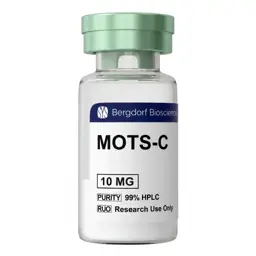
A research-oriented comparison of two fundamentally different approaches: MOTS-c, a mitochondrially encoded peptide with AMPK-mediated metabolic and longevity effects, versus Tesamorelin, a clinically approved GHRH analog for reducing visceral fat via the growth hormone axis.
 Medically reviewed by Dr. Sieglinde Klaus · Last reviewed June 2026
MOTS-c is a 16-amino-acid peptide encoded in the mitochondrial genome that activates the cellular energy hub AMPK. In preclinical models it improved insulin sensitivity, physical performance, and metabolic homeostasis, but it is not clinically approved and has only been studied in early observational data in humans 12.
Tesamorelin is a synthetic GHRH analog (growth-hormone-releasing hormone) that stimulates the body's own growth hormone secretion. It is approved by the US FDA for the treatment of visceral fat accumulation in HIV-associated lipodystrophy and is supported by large, randomized Phase III trials 34.
A research-oriented comparison of two fundamentally different approaches: MOTS-c, a mitochondrially encoded peptide with AMPK-mediated metabolic and longevity effects, versus Tesamorelin, a clinically approved GHRH analog for reducing visceral fat via the growth hormone axis.
Medically reviewed by Dr. Sieglinde Klaus · Last reviewed June 2026MOTS-c is a 16-amino-acid peptide encoded in the mitochondrial genome that activates the cellular energy hub AMPK. In preclinical models it improved insulin sensitivity, physical performance, and metabolic homeostasis, but it is not clinically approved and has only been studied in early observational data in humans 12.
Tesamorelin is a synthetic GHRH analog (growth-hormone-releasing hormone) that stimulates the body's own growth hormone secretion. It is approved by the US FDA for the treatment of visceral fat accumulation in HIV-associated lipodystrophy and is supported by large, randomized Phase III trials 34.
The two peptides address partially overlapping targets (metabolism, body composition) but do so through completely different mechanisms and with very different levels of evidence.
Mitochondrially encoded peptide (MDP)
GHRH analog (synthetic)
AMPK activation, folate cycle inhibition
Stimulation of GH secretion from the pituitary
16 amino acids
44 amino acids (stabilized GHRH 1-44)
Not approved, pure research compound
FDA-approved (Egrifta) for HIV lipodystrophy
Metabolism, insulin sensitivity, longevity
Reduction of visceral abdominal fat
Preclinical + observational data
Multiple randomized Phase III trials
Indirect (metabolic improvement, animal model)
Directly demonstrated (approx. minus 15 to 18 percent)
Doubling of running capacity (old mice)
Not a primary endpoint
Intraperitoneal (animal model)
Subcutaneous injection, 2 mg daily
No direct GH/IGF-1 effect
Increase of approx. 80 percent
Improved in animal models
Reduction clinically demonstrated (approx. minus 3 percent)
Early (mechanism, animal models)
High (approved, long-term data)
MOTS-c (Mitochondrial Open Reading Frame of the Twelve S rRNA-c) is encoded in the mitochondrial genome and is one of the so-called mitochondrially derived peptides. Its central mechanism is the activation of AMP-activated protein kinase (AMPK), a cellular energy sensor. Lee et al. showed that MOTS-c inhibits the folate cycle and purine biosynthesis, which leads to an increase in AICAR and thereby to AMPK activation 1.
As a result, MOTS-c improves glucose uptake in skeletal muscle, increases GLUT4 expression, and coordinates glucose, fatty acid, and mitochondrial metabolism. Endogenous MOTS-c levels decline with advancing age, which makes the peptide a candidate in longevity research.
Tesamorelin is a stabilized synthetic analog of human growth-hormone-releasing hormone (GHRH 1-44). It binds to GHRH receptors on anterior pituitary cells and stimulates the pulsatile, physiological release of the body's own growth hormone (GH).
The released GH subsequently acts via the liver, where it stimulates the production of IGF-1, and exerts lipolytic effects that particularly break down visceral fat tissue. Because Tesamorelin largely preserves the natural feedback loop of the GH axis, pulsatile secretion remains intact, which distinguishes it from direct GH replacement 3.
The decisive difference: MOTS-c acts intracellularly and mitochondrially as a direct metabolic regulator independent of the hormone axis, whereas Tesamorelin works extracellularly and endocrinologically via the downstream GH/IGF-1 axis. In a sense, MOTS-c mimics the effects of physical exercise, while Tesamorelin mimics physiological growth hormone stimulation. Both can influence body composition, but they intervene at completely different points of metabolism.
The quality of evidence is asymmetric: Tesamorelin is supported by multiple randomized, placebo-controlled human studies with over 800 participants and is officially approved 345. MOTS-c, on the other hand, has so far relied almost exclusively on compelling but preclinical animal models and mechanistic studies 12. For researchers, this means: Tesamorelin is an established clinical agent, MOTS-c a highly interesting but not yet human-validated candidate.
No controlled human safety data are available for MOTS-c; the safety profile comes exclusively from preclinical animal models in which the peptide was generally well tolerated. Statements about human safety are therefore not possible.
Tesamorelin has a well-characterized safety profile from large Phase III trials. Most side effects are mild to moderate and are related to increased GH activity. The most important marker for monitoring is glucose metabolism.
This comparison is for scientific information purposes only and does not constitute medical advice, diagnosis, or treatment recommendation. None of the applications presented here are intended for self-medication. Tesamorelin is intended only for approved medical indications under medical supervision; MOTS-c is an unapproved research compound with no proven human safety. Always consult qualified professionals. For research purposes only. Not intended for human consumption.
Tesamorelin is the only one of the two agents with directly demonstrated, officially recognized reduction of visceral abdominal fat in randomized human studies [3](#ref-3).
MOTS-c is a direct AMPK activator and a unique model molecule for studying mitochondrially driven metabolic regulation and folate cycle inhibition [1](#ref-1).
MOTS-c levels decline with age, and treatment started late in life increased physical capacity and healthspan in animal models, which predestines it for aging research [2](#ref-2).
Tesamorelin stimulates physiological, pulsatile GH secretion and raises IGF-1 reproducibly, which makes it the tool of choice for studies of the GH/IGF-1 axis [3](#ref-3).
Both peptides influence glucose and lipid metabolism, but via different axes; the choice depends on whether an intracellular (MOTS-c) or endocrine (Tesamorelin) mechanism is to be investigated.
MOTS-c is a mitochondrially encoded peptide that regulates metabolism intracellularly via the energy sensor AMPK. Tesamorelin is a GHRH analog that stimulates the body's own growth hormone secretion extracellularly. MOTS-c partially mimics the effects of exercise, while Tesamorelin mimics growth hormone stimulation 13.
Only Tesamorelin is approved (in the USA as Egrifta, for the treatment of visceral fat accumulation in HIV-associated lipodystrophy). MOTS-c holds no market authorization and is considered exclusively a research compound.
Tesamorelin stimulates the pulsatile release of the body's own growth hormone, which has a pronounced lipolytic (fat-breaking-down) effect particularly on visceral fat tissue. In the Phase III trial, visceral fat fell by about 15 percent, accompanied by an IGF-1 increase of around 80 percent 3.
No. They pursue different mechanisms and objectives. Tesamorelin specializes in visceral fat reduction via the GH axis, while MOTS-c addresses mitochondrial and AMPK-mediated metabolic processes. Which peptide is relevant depends entirely on the respective research question.
The comparison between MOTS-c and Tesamorelin is ultimately a comparison between two very different levels of research maturity. Tesamorelin is a clinically validated, officially approved agent with robust evidence for the reduction of visceral fat and liver fat from randomized human studies 345. Anyone looking for a solid body of data on body composition will find it here.
MOTS-c, by contrast, is one of the most fascinating molecules in longevity and metabolic research: it acts as a direct AMPK activator, improves insulin sensitivity and physical performance in animal models, and declines physiologically with age 12. Its major shortcoming is the absence of human evidence.
There is therefore no blanket winner. The choice depends strictly on the research question.
Tesamorelin clearly wins on clinical evidence and visceral fat reduction, while MOTS-c is unique in mechanistic and longevity research. The preferred agent depends entirely on the research objective.
The two peptides address partially overlapping targets (metabolism, body composition) but do so through completely different mechanisms and with very different levels of evidence.
Mitochondrially encoded peptide (MDP)
GHRH analog (synthetic)
AMPK activation, folate cycle inhibition
Stimulation of GH secretion from the pituitary
16 amino acids
44 amino acids (stabilized GHRH 1-44)
Not approved, pure research compound
FDA-approved (Egrifta) for HIV lipodystrophy
Metabolism, insulin sensitivity, longevity
Reduction of visceral abdominal fat
Preclinical + observational data
Multiple randomized Phase III trials
Indirect (metabolic improvement, animal model)
Directly demonstrated (approx. minus 15 to 18 percent)
Doubling of running capacity (old mice)
Not a primary endpoint
Intraperitoneal (animal model)
Subcutaneous injection, 2 mg daily
No direct GH/IGF-1 effect
Increase of approx. 80 percent
Improved in animal models
Reduction clinically demonstrated (approx. minus 3 percent)
Early (mechanism, animal models)
High (approved, long-term data)
MOTS-c (Mitochondrial Open Reading Frame of the Twelve S rRNA-c) is encoded in the mitochondrial genome and is one of the so-called mitochondrially derived peptides. Its central mechanism is the activation of AMP-activated protein kinase (AMPK), a cellular energy sensor. Lee et al. showed that MOTS-c inhibits the folate cycle and purine biosynthesis, which leads to an increase in AICAR and thereby to AMPK activation 1.
As a result, MOTS-c improves glucose uptake in skeletal muscle, increases GLUT4 expression, and coordinates glucose, fatty acid, and mitochondrial metabolism. Endogenous MOTS-c levels decline with advancing age, which makes the peptide a candidate in longevity research.
Tesamorelin is a stabilized synthetic analog of human growth-hormone-releasing hormone (GHRH 1-44). It binds to GHRH receptors on anterior pituitary cells and stimulates the pulsatile, physiological release of the body's own growth hormone (GH).
The released GH subsequently acts via the liver, where it stimulates the production of IGF-1, and exerts lipolytic effects that particularly break down visceral fat tissue. Because Tesamorelin largely preserves the natural feedback loop of the GH axis, pulsatile secretion remains intact, which distinguishes it from direct GH replacement 3.
The decisive difference: MOTS-c acts intracellularly and mitochondrially as a direct metabolic regulator independent of the hormone axis, whereas Tesamorelin works extracellularly and endocrinologically via the downstream GH/IGF-1 axis. In a sense, MOTS-c mimics the effects of physical exercise, while Tesamorelin mimics physiological growth hormone stimulation. Both can influence body composition, but they intervene at completely different points of metabolism.
The quality of evidence is asymmetric: Tesamorelin is supported by multiple randomized, placebo-controlled human studies with over 800 participants and is officially approved 345. MOTS-c, on the other hand, has so far relied almost exclusively on compelling but preclinical animal models and mechanistic studies 12. For researchers, this means: Tesamorelin is an established clinical agent, MOTS-c a highly interesting but not yet human-validated candidate.
No controlled human safety data are available for MOTS-c; the safety profile comes exclusively from preclinical animal models in which the peptide was generally well tolerated. Statements about human safety are therefore not possible.
Tesamorelin has a well-characterized safety profile from large Phase III trials. Most side effects are mild to moderate and are related to increased GH activity. The most important marker for monitoring is glucose metabolism.
This comparison is for scientific information purposes only and does not constitute medical advice, diagnosis, or treatment recommendation. None of the applications presented here are intended for self-medication. Tesamorelin is intended only for approved medical indications under medical supervision; MOTS-c is an unapproved research compound with no proven human safety. Always consult qualified professionals. For research purposes only. Not intended for human consumption.
Tesamorelin is the only one of the two agents with directly demonstrated, officially recognized reduction of visceral abdominal fat in randomized human studies [3](#ref-3).
MOTS-c is a direct AMPK activator and a unique model molecule for studying mitochondrially driven metabolic regulation and folate cycle inhibition [1](#ref-1).
MOTS-c levels decline with age, and treatment started late in life increased physical capacity and healthspan in animal models, which predestines it for aging research [2](#ref-2).
Tesamorelin stimulates physiological, pulsatile GH secretion and raises IGF-1 reproducibly, which makes it the tool of choice for studies of the GH/IGF-1 axis [3](#ref-3).
Both peptides influence glucose and lipid metabolism, but via different axes; the choice depends on whether an intracellular (MOTS-c) or endocrine (Tesamorelin) mechanism is to be investigated.
MOTS-c is a mitochondrially encoded peptide that regulates metabolism intracellularly via the energy sensor AMPK. Tesamorelin is a GHRH analog that stimulates the body's own growth hormone secretion extracellularly. MOTS-c partially mimics the effects of exercise, while Tesamorelin mimics growth hormone stimulation 13.
Only Tesamorelin is approved (in the USA as Egrifta, for the treatment of visceral fat accumulation in HIV-associated lipodystrophy). MOTS-c holds no market authorization and is considered exclusively a research compound.
Tesamorelin stimulates the pulsatile release of the body's own growth hormone, which has a pronounced lipolytic (fat-breaking-down) effect particularly on visceral fat tissue. In the Phase III trial, visceral fat fell by about 15 percent, accompanied by an IGF-1 increase of around 80 percent 3.
No. They pursue different mechanisms and objectives. Tesamorelin specializes in visceral fat reduction via the GH axis, while MOTS-c addresses mitochondrial and AMPK-mediated metabolic processes. Which peptide is relevant depends entirely on the respective research question.
The comparison between MOTS-c and Tesamorelin is ultimately a comparison between two very different levels of research maturity. Tesamorelin is a clinically validated, officially approved agent with robust evidence for the reduction of visceral fat and liver fat from randomized human studies 345. Anyone looking for a solid body of data on body composition will find it here.
MOTS-c, by contrast, is one of the most fascinating molecules in longevity and metabolic research: it acts as a direct AMPK activator, improves insulin sensitivity and physical performance in animal models, and declines physiologically with age 12. Its major shortcoming is the absence of human evidence.
There is therefore no blanket winner. The choice depends strictly on the research question.
Tesamorelin clearly wins on clinical evidence and visceral fat reduction, while MOTS-c is unique in mechanistic and longevity research. The preferred agent depends entirely on the research objective.