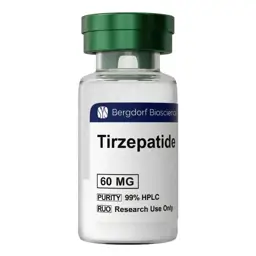
Two mechanistically fundamentally different approaches to reducing visceral fat: Tesamorelin stimulates the body's own growth hormone axis, while Tirzepatid, as a dual GLP-1 and GIP receptor agonist, reprograms satiety and metabolism. This comparison places the evidence base of both research peptides into context.
 Medically reviewed by Dr. Sieglinde Klaus · Last reviewed June 2026
Tesamorelin is a stabilized GHRH analogue (growth-hormone-releasing factor) that pulsatilely triggers the secretion of the body's own growth hormone (GH) and, in controlled studies, selectively reduced visceral adipose tissue (VAT) by roughly 15 to 18 percent without substantially affecting subcutaneous fat 12.
Tirzepatid is a dual incretin agonist (GLP-1R plus GIPR) that, in the SURMOUNT and SURPASS programs, achieved a mean total weight loss of up to 22.5 percent while reducing both visceral and subcutaneous fat 34.
Two mechanistically fundamentally different approaches to reducing visceral fat: Tesamorelin stimulates the body's own growth hormone axis, while Tirzepatid, as a dual GLP-1 and GIP receptor agonist, reprograms satiety and metabolism. This comparison places the evidence base of both research peptides into context.
Medically reviewed by Dr. Sieglinde Klaus · Last reviewed June 2026Tesamorelin is a stabilized GHRH analogue (growth-hormone-releasing factor) that pulsatilely triggers the secretion of the body's own growth hormone (GH) and, in controlled studies, selectively reduced visceral adipose tissue (VAT) by roughly 15 to 18 percent without substantially affecting subcutaneous fat 12.
Tirzepatid is a dual incretin agonist (GLP-1R plus GIPR) that, in the SURMOUNT and SURPASS programs, achieved a mean total weight loss of up to 22.5 percent while reducing both visceral and subcutaneous fat 34.
The two peptides address different research questions: Tesamorelin narrowly targets the visceral depot fraction and the GH/IGF-1 axis, Tirzepatid the global energy balance and glucose homeostasis. A direct head-to-head comparison in a randomized trial does not exist.
GHRH analogue: stimulates pulsatile secretion of the body's own growth hormone via the pituitary gland
Dual incretin agonist: activates GLP-1 and GIP signaling pathways, enhances satiety and glucose-dependent insulin secretion
GHRH receptor (pituitary)
GLP-1 receptor + GIP receptor (dual)
Selective reduction of visceral adipose tissue (VAT), liver fat, GH/IGF-1 axis
Total body weight, obesity, type 2 diabetes, cardiometabolic risk
2 mg subcutaneously daily
5, 10, or 15 mg subcutaneously weekly (titrated)
Daily
Once weekly
About 26 to 38 minutes (short; effect via the GH pulse)
About 5 days (around 120 hours)
Two pivotal Phase 3 studies (HIV-associated lipodystrophy); narrow, well-defined indication field
Extensive Phase 3 program (SURMOUNT, SURPASS) with tens of thousands of participants
Fluid retention, joint complaints, elevated IGF-1, glucose tolerance to be kept under observation
Predominantly gastrointestinal (nausea, diarrhea, vomiting); mostly dose-dependent and transient
Lyophilizate: stored cool, requires refrigeration after reconstitution
Cold chain recommended; stability over longer periods documented in studies
Widely available as a research peptide; usually cheaper per unit
Available as a research peptide; high demand, tends toward a higher price
Tesamorelin is a synthetic analogue of human growth-hormone-releasing factor (GHRH). An N-terminal trans-3-hexenoic acid modification protects the molecule from enzymatic degradation and prolongs its duration of action compared to native GHRH. The mechanism of action is indirect: Tesamorelin binds to the GHRH receptor of the pituitary gland and triggers a physiological, pulsatile GH pulse there. The secreted growth hormone increases the formation of IGF-1 in the liver and, via lipolysis, preferentially promotes the breakdown of the visceral fat depot 1.
Because the body itself regulates the hormone quantity via its feedback loops, the GH increase remains closer to the physiological pattern than with exogenous growth hormone. In the studies it was notable that primarily the visceral and not the subcutaneous fat decreased, accompanied by improved triglyceride values 2.
Tirzepatid is a single peptide with dual receptor activity. It simultaneously activates the GLP-1 receptor and the GIP receptor, two incretin pathways that are normally secreted after a meal. Via the GLP-1 arm, gastric emptying slows, the feeling of satiety rises, and food intake decreases; via the GIP arm, insulin secretion and fat metabolism are additionally modulated. A fatty-acid side chain binds to albumin and extends the half-life to around five days, which enables weekly administration 3.
The result is a global reduction in energy balance: in the studies, total body weight dropped sharply, including visceral and subcutaneous fat, with simultaneously improved glucose control 45.
The decisive difference: Tesamorelin acts in a building-regulatory manner via the body's own GH axis and selectively targets the visceral depot without affecting appetite. Tirzepatid acts in an appetite- and metabolism-controlling manner and lowers total weight via reduced caloric intake. Both reduce visceral fat, but through completely separate biological levers: one via lipolysis driven by growth hormone, the other via satiety and incretin physiology.
The evidence base is asymmetrically structured. Tesamorelin has two methodologically clean, CT-validated Phase 3 studies, which, however, cover a narrow endpoint field: the visceral fat fraction in HIV-associated lipodystrophy. Tirzepatid is supported by a considerably larger program with tens of thousands of participants and delivers hard data on total weight, glucose control, and cardiometabolic markers. Anyone looking purely at the visceral depot effect finds evidence for both; anyone weighting the breadth and depth of clinical validation sees the more robust evidence base with Tirzepatid.
The information presented here summarizes results of published research and does not constitute medical advice, diagnosis, or treatment recommendation. All dosages, effects, and side effects mentioned are taken from clinical or preclinical studies and must not be understood as usage instructions. For health-related questions, always consult qualified medical professionals. For research purposes only. Not intended for human consumption.
In the data, Tesamorelin specifically targets the visceral depot via the GH axis without affecting food intake. This makes it the obvious candidate when the research question is narrowly tailored to visceral fat and the GH/IGF-1 axis.
Tirzepatid shows the largest documented weight loss among incretin agents in SURMOUNT-1 and reduces visceral and subcutaneous fat equally, while simultaneously improving glucose control.
The dual GLP-1/GIP mechanism of Tirzepatid acts directly on glucose-dependent insulin secretion and HbA1c, as SURPASS-2 demonstrates in comparison to Semaglutid. Tesamorelin has no primary point of attack here and may even affect glucose tolerance.
Tirzepatid is administered once weekly, Tesamorelin daily. If injection frequency is a criterion, the weekly schedule clearly leads to Tirzepatid.
Only Tesamorelin engages the pituitary GH axis and produces a near-physiological, pulsatile GH increase with a subsequent IGF-1 effect. For questions surrounding growth hormone physiology, Tirzepatid is mechanistically irrelevant.
No. Both can reduce visceral fat, but they do so through completely separate biological pathways. Tesamorelin stimulates the body's own growth hormone secretion via the GHRH receptor and thereby promotes lipolysis in the visceral depot 1. Tirzepatid activates the incretin receptors GLP-1 and GIP, increases satiety, and thereby lowers total energy intake 3.
Clearly Tirzepatid in terms of scope: the SURMOUNT and SURPASS program encompasses tens of thousands of participants across several Phase 3 studies 35. Tesamorelin has two methodologically solid, CT-validated Phase 3 studies, but in a narrower indication field (HIV-associated lipodystrophy) 12. Both datasets are high-quality but cover different questions.
Tirzepatid reduces total body weight and thus both visceral and subcutaneous fat. Unlike Tesamorelin, it does not act selectively on the visceral depot but lowers the energy balance globally. Imaging substudies show a marked decrease in visceral fat mass as part of the total weight loss 4.
This is due to the pharmacokinetics. Tesamorelin has a very short plasma half-life of a few minutes and triggers a short, physiological GH pulse that must be renewed daily. Tirzepatid carries a fatty-acid side chain that binds it to albumin and extends the half-life to around five days, so that weekly administration is sufficient 3.
Tesamorelin raises IGF-1 levels as expected, since it activates the GH axis. In the approval studies, IGF-1 values were closely monitored; elevated IGF-1 carries theoretical proliferative concerns, which is why a history of malignant disease was an exclusion criterion 1. This is an important safety aspect that must be taken into account in any research planning.
With Tesamorelin, fluid retention, joint complaints, and injection-site reactions are at the forefront. With Tirzepatid, they are overwhelmingly gastrointestinal complaints, above all nausea, which are mostly dose-dependent and temporary and can be mitigated through slow titration.
There are no controlled clinical data on a combination of Tesamorelin and Tirzepatid. Mechanistically, they act on different axes, which fuels theoretical considerations about complementary effects, but without study evidence any combination remains purely speculative and belongs exclusively in a controlled research setting.
Tesamorelin and Tirzepatid cannot meaningfully be pitted against each other as winner and loser, because they serve different research goals. Tesamorelin is the more precise instrument when the focus is narrowly on the visceral fat fraction and the GH/IGF-1 axis: it targets the visceral depot selectively without touching appetite and is well documented in two CT-validated Phase 3 studies 12. Tirzepatid is the broader and more strongly validated instrument when total weight, glucose control, and cardiometabolic risk are at the center: the SURMOUNT and SURPASS program delivers the most robust evidence in the entire incretin field 345.
Anyone considering the visceral effect in isolation finds the more targeted approach with Tesamorelin. Anyone weighting the breadth, depth, and scale of clinical validation as well as a global metabolic effect cannot get past Tirzepatid. The choice thus depends entirely on the specific research question.
No universal winner: Tesamorelin leads for selective visceral fat reduction and GH axis questions, Tirzepatid for broad weight loss, glucose control, and the robustness of the Phase 3 evidence. The decision is strictly context-dependent.
The two peptides address different research questions: Tesamorelin narrowly targets the visceral depot fraction and the GH/IGF-1 axis, Tirzepatid the global energy balance and glucose homeostasis. A direct head-to-head comparison in a randomized trial does not exist.
GHRH analogue: stimulates pulsatile secretion of the body's own growth hormone via the pituitary gland
Dual incretin agonist: activates GLP-1 and GIP signaling pathways, enhances satiety and glucose-dependent insulin secretion
GHRH receptor (pituitary)
GLP-1 receptor + GIP receptor (dual)
Selective reduction of visceral adipose tissue (VAT), liver fat, GH/IGF-1 axis
Total body weight, obesity, type 2 diabetes, cardiometabolic risk
2 mg subcutaneously daily
5, 10, or 15 mg subcutaneously weekly (titrated)
Daily
Once weekly
About 26 to 38 minutes (short; effect via the GH pulse)
About 5 days (around 120 hours)
Two pivotal Phase 3 studies (HIV-associated lipodystrophy); narrow, well-defined indication field
Extensive Phase 3 program (SURMOUNT, SURPASS) with tens of thousands of participants
Fluid retention, joint complaints, elevated IGF-1, glucose tolerance to be kept under observation
Predominantly gastrointestinal (nausea, diarrhea, vomiting); mostly dose-dependent and transient
Lyophilizate: stored cool, requires refrigeration after reconstitution
Cold chain recommended; stability over longer periods documented in studies
Widely available as a research peptide; usually cheaper per unit
Available as a research peptide; high demand, tends toward a higher price
Tesamorelin is a synthetic analogue of human growth-hormone-releasing factor (GHRH). An N-terminal trans-3-hexenoic acid modification protects the molecule from enzymatic degradation and prolongs its duration of action compared to native GHRH. The mechanism of action is indirect: Tesamorelin binds to the GHRH receptor of the pituitary gland and triggers a physiological, pulsatile GH pulse there. The secreted growth hormone increases the formation of IGF-1 in the liver and, via lipolysis, preferentially promotes the breakdown of the visceral fat depot 1.
Because the body itself regulates the hormone quantity via its feedback loops, the GH increase remains closer to the physiological pattern than with exogenous growth hormone. In the studies it was notable that primarily the visceral and not the subcutaneous fat decreased, accompanied by improved triglyceride values 2.
Tirzepatid is a single peptide with dual receptor activity. It simultaneously activates the GLP-1 receptor and the GIP receptor, two incretin pathways that are normally secreted after a meal. Via the GLP-1 arm, gastric emptying slows, the feeling of satiety rises, and food intake decreases; via the GIP arm, insulin secretion and fat metabolism are additionally modulated. A fatty-acid side chain binds to albumin and extends the half-life to around five days, which enables weekly administration 3.
The result is a global reduction in energy balance: in the studies, total body weight dropped sharply, including visceral and subcutaneous fat, with simultaneously improved glucose control 45.
The decisive difference: Tesamorelin acts in a building-regulatory manner via the body's own GH axis and selectively targets the visceral depot without affecting appetite. Tirzepatid acts in an appetite- and metabolism-controlling manner and lowers total weight via reduced caloric intake. Both reduce visceral fat, but through completely separate biological levers: one via lipolysis driven by growth hormone, the other via satiety and incretin physiology.
The evidence base is asymmetrically structured. Tesamorelin has two methodologically clean, CT-validated Phase 3 studies, which, however, cover a narrow endpoint field: the visceral fat fraction in HIV-associated lipodystrophy. Tirzepatid is supported by a considerably larger program with tens of thousands of participants and delivers hard data on total weight, glucose control, and cardiometabolic markers. Anyone looking purely at the visceral depot effect finds evidence for both; anyone weighting the breadth and depth of clinical validation sees the more robust evidence base with Tirzepatid.
The information presented here summarizes results of published research and does not constitute medical advice, diagnosis, or treatment recommendation. All dosages, effects, and side effects mentioned are taken from clinical or preclinical studies and must not be understood as usage instructions. For health-related questions, always consult qualified medical professionals. For research purposes only. Not intended for human consumption.
In the data, Tesamorelin specifically targets the visceral depot via the GH axis without affecting food intake. This makes it the obvious candidate when the research question is narrowly tailored to visceral fat and the GH/IGF-1 axis.
Tirzepatid shows the largest documented weight loss among incretin agents in SURMOUNT-1 and reduces visceral and subcutaneous fat equally, while simultaneously improving glucose control.
The dual GLP-1/GIP mechanism of Tirzepatid acts directly on glucose-dependent insulin secretion and HbA1c, as SURPASS-2 demonstrates in comparison to Semaglutid. Tesamorelin has no primary point of attack here and may even affect glucose tolerance.
Tirzepatid is administered once weekly, Tesamorelin daily. If injection frequency is a criterion, the weekly schedule clearly leads to Tirzepatid.
Only Tesamorelin engages the pituitary GH axis and produces a near-physiological, pulsatile GH increase with a subsequent IGF-1 effect. For questions surrounding growth hormone physiology, Tirzepatid is mechanistically irrelevant.
No. Both can reduce visceral fat, but they do so through completely separate biological pathways. Tesamorelin stimulates the body's own growth hormone secretion via the GHRH receptor and thereby promotes lipolysis in the visceral depot 1. Tirzepatid activates the incretin receptors GLP-1 and GIP, increases satiety, and thereby lowers total energy intake 3.
Clearly Tirzepatid in terms of scope: the SURMOUNT and SURPASS program encompasses tens of thousands of participants across several Phase 3 studies 35. Tesamorelin has two methodologically solid, CT-validated Phase 3 studies, but in a narrower indication field (HIV-associated lipodystrophy) 12. Both datasets are high-quality but cover different questions.
Tirzepatid reduces total body weight and thus both visceral and subcutaneous fat. Unlike Tesamorelin, it does not act selectively on the visceral depot but lowers the energy balance globally. Imaging substudies show a marked decrease in visceral fat mass as part of the total weight loss 4.
This is due to the pharmacokinetics. Tesamorelin has a very short plasma half-life of a few minutes and triggers a short, physiological GH pulse that must be renewed daily. Tirzepatid carries a fatty-acid side chain that binds it to albumin and extends the half-life to around five days, so that weekly administration is sufficient 3.
Tesamorelin raises IGF-1 levels as expected, since it activates the GH axis. In the approval studies, IGF-1 values were closely monitored; elevated IGF-1 carries theoretical proliferative concerns, which is why a history of malignant disease was an exclusion criterion 1. This is an important safety aspect that must be taken into account in any research planning.
With Tesamorelin, fluid retention, joint complaints, and injection-site reactions are at the forefront. With Tirzepatid, they are overwhelmingly gastrointestinal complaints, above all nausea, which are mostly dose-dependent and temporary and can be mitigated through slow titration.
There are no controlled clinical data on a combination of Tesamorelin and Tirzepatid. Mechanistically, they act on different axes, which fuels theoretical considerations about complementary effects, but without study evidence any combination remains purely speculative and belongs exclusively in a controlled research setting.
Tesamorelin and Tirzepatid cannot meaningfully be pitted against each other as winner and loser, because they serve different research goals. Tesamorelin is the more precise instrument when the focus is narrowly on the visceral fat fraction and the GH/IGF-1 axis: it targets the visceral depot selectively without touching appetite and is well documented in two CT-validated Phase 3 studies 12. Tirzepatid is the broader and more strongly validated instrument when total weight, glucose control, and cardiometabolic risk are at the center: the SURMOUNT and SURPASS program delivers the most robust evidence in the entire incretin field 345.
Anyone considering the visceral effect in isolation finds the more targeted approach with Tesamorelin. Anyone weighting the breadth, depth, and scale of clinical validation as well as a global metabolic effect cannot get past Tirzepatid. The choice thus depends entirely on the specific research question.
No universal winner: Tesamorelin leads for selective visceral fat reduction and GH axis questions, Tirzepatid for broad weight loss, glucose control, and the robustness of the Phase 3 evidence. The decision is strictly context-dependent.