Research peptide · Bremelanotide
PT-141 10 mg
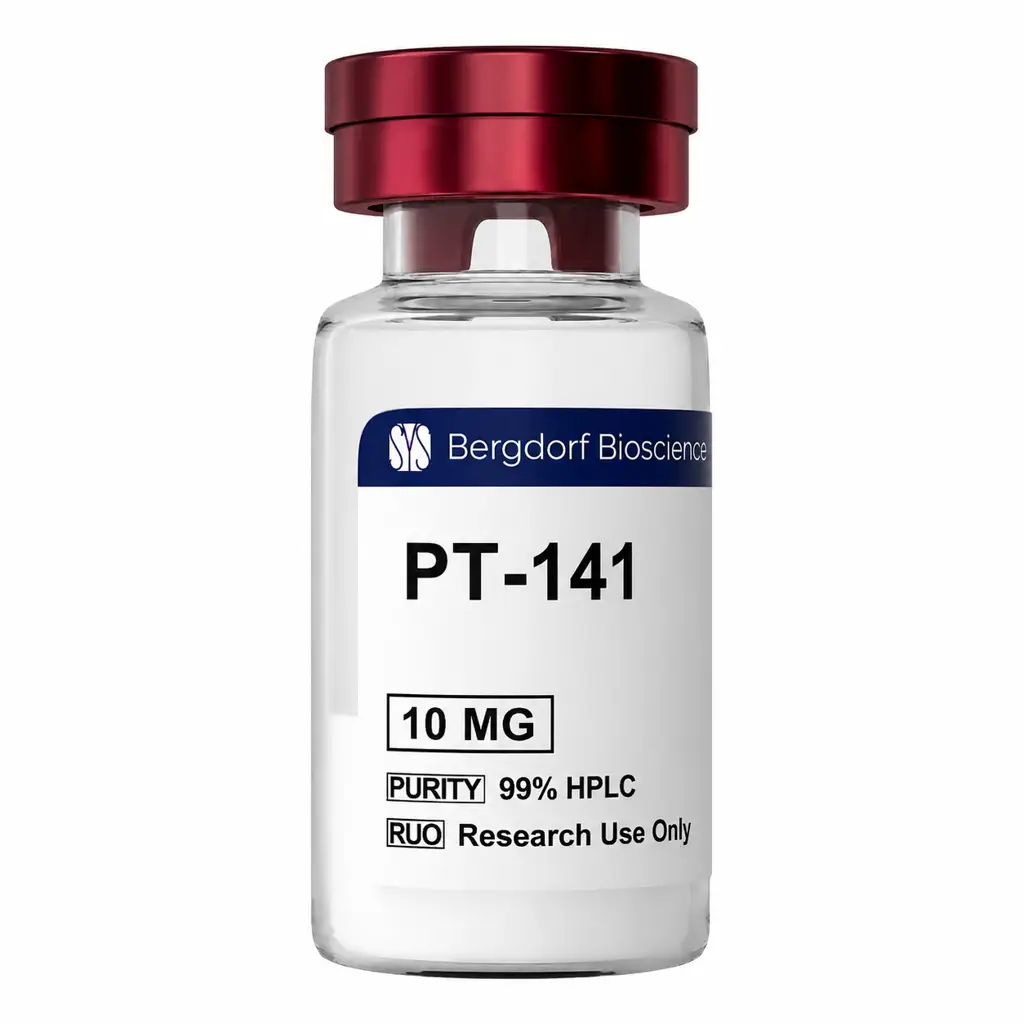
PT-141 (bremelanotide) 10 mg lyophilized research vial with documented melanocortin pharmacology and clear research-use-only positioning.

Research peptide · Bremelanotide
PT-141 (bremelanotide) 10 mg lyophilized research vial with documented melanocortin pharmacology and clear research-use-only positioning.
Research peptide · Bremelanotide
PT-141 (bremelanotide) 10 mg lyophilized research vial with documented melanocortin pharmacology and clear research-use-only positioning.
No reviews yet. Be the first to share your experience.
No reviews yet. Be the first to share your experience.
/ vial
Order today → Delivery Fri, Oct 02 – Mon, Oct 12 to United States
Payment Methods







/ vial
Order today → Delivery Fri, Oct 02 – Mon, Oct 12 to United States
Payment Methods
3,000+
satisfied researchers
99.43%
Avg. purity 2026
4.8 ★
ProvenExpert
99.43%
Avg. purity 2026
4.8 ★
ProvenExpert
3,000+ satisfied researchers
Steady-state plasma level after ~ 4 weeks with weekly administration.
Scientific references
Research details
PT-141, commonly called bremelanotide, is a synthetic cyclic heptapeptide developed from melanocortin peptide research. Its compact seven-amino-acid structure and activity across melanocortin receptor subtypes make it a defined reference material for receptor pharmacology, analytical method development, and other controlled laboratory investigations. This product contains 10 mg of lyophilized PT-141 in a sealed research vial.
The vial is supplied exclusively for research use. It is not a medicine, medical device, compounded preparation, or material intended for administration to people or animals. The 10 mg label describes the nominal research-vial format; it is not a recommended dose and must not be interpreted as clinical guidance.
The official prescribing information for bremelanotide describes it as a melanocortin receptor agonist that nonselectively activates MC1R, MC4R, MC3R, MC5R, and MC2R in that order of potency. MC1R is associated with melanocyte signaling, while MC4R-expressing neurons are distributed across several areas of the central nervous system. These receptor observations support mechanistic laboratory questions without establishing a result for any particular experimental system.
Receptor binding should not be converted into a broad efficacy promise. The Vyleesi label itself states that the mechanism by which that approved finished medicine acts in its labeled setting is unknown. Experimental outcomes can also depend on assay design, concentration, matrix, receptor expression, and material handling, so researchers should define and validate their own controls.
The official label identifies bremelanotide acetate as a synthetic cyclic heptapeptide and gives the sequence Ac-Nle-cyclo-(Asp-His-D-Phe-Arg-Trp-Lys-OH). It reports a free-base molecular weight of 1025.2 Da. The cyclic architecture, terminal modifications, and D-amino-acid component are relevant when selecting analytical standards, interpreting mass-based workflows, or comparing bremelanotide with other melanocortin ligands.
Bremelanotide is described as undergoing multiple hydrolyses of peptide amide bonds as its primary metabolic pathway. That in-vivo observation is useful scientific context but does not establish stability in a chosen buffer, assay, or storage environment. Researchers should qualify fitness for their own method rather than infer stability or purity from the pharmacology literature.
Following administration of the approved Vyleesi subcutaneous solution, the official label reports a mean terminal plasma half-life of approximately 2.7 hours and a range of 1.9 to 4.0 hours. Accordingly, 2.7 hours is the evidence-based scalar used for systemic half-life reference content, with the observed range retained wherever scientific interpretation requires more precision.
This value is formulation-, route-, and study-context specific. It is not an instruction for using the research vial, does not predict behavior in an in-vitro system, and must not be used to construct a human schedule. Earlier intranasal investigations mentioned in the pharmacology record did not create an approved intranasal product; the approved Vyleesi presentation described by the label is a subcutaneous solution in a single-dose autoinjector.
Vyleesi is a regulated prescription drug with a specific finished formulation, delivery system, manufacturing controls, labeling, indication, contraindications, and safety information. This Bergdorf Bioscience item is a separate lyophilized research material. It is not made or presented as Vyleesi, and no statement about Vyleesi approval should be read as approval, equivalence, interchangeability, sterility, or clinical suitability of this vial.
That distinction is also important when interpreting safety information. The approved label documents clinically relevant effects and precautions for its finished medicine, including transient blood-pressure changes, reduced heart rate, nausea, and focal hyperpigmentation. Product copy therefore avoids claims such as “no vascular effects” and does not translate prescription-drug findings into instructions or promises for this research material.
Use this material only within an appropriately controlled research workflow. Record the product identity, vial label, receipt condition, storage history, and study-specific acceptance criteria before use. Select controls and analytical methods that are suitable for the intended experiment. No GMP status, certificate result, analytical method, percentage purity, batch test, or clinical-grade claim is asserted in this master copy without product-specific supporting documentation.
Keep the sealed vial under the storage conditions printed on its own label and documentation. Do not borrow preparation or storage instructions from an autoinjector product with a different formulation. The vial is shipped with tracking in protective packaging. It remains strictly not for human or veterinary use, diagnosis, treatment, prevention, or consumption.
DailyMed: Vyleesi (bremelanotide injection), official prescribing information
FDA: Vyleesi prescribing information
For research use only. Not for human or veterinary use, diagnosis, treatment, prevention, or consumption. The presence of bremelanotide as the active peptide in an approved medicine does not make this research vial an approved, substitutable, or clinically validated product.
Bremelanotide nonselectively activates several melanocortin receptor subtypes. The official Vyleesi label reports the following order of potency: MC1R, MC4R, MC3R, MC5R, and MC2R, with MC1R and MC4R binding described as most relevant at the approved medicine's therapeutic exposure. These data provide receptor-level research context, not a clinical-use claim for this vial.
PT-141 is another name for bremelanotide, a synthetic cyclic heptapeptide that activates several melanocortin receptor subtypes. This catalog item is a 10 mg lyophilized research vial supplied only for laboratory research.
3,000+
satisfied researchers
99.43%
Avg. purity 2026
4.8 ★
ProvenExpert
99.43%
Avg. purity 2026
4.8 ★
ProvenExpert
3,000+ satisfied researchers
Steady-state plasma level after ~ 4 weeks with weekly administration.
Scientific references
Research details
PT-141, commonly called bremelanotide, is a synthetic cyclic heptapeptide developed from melanocortin peptide research. Its compact seven-amino-acid structure and activity across melanocortin receptor subtypes make it a defined reference material for receptor pharmacology, analytical method development, and other controlled laboratory investigations. This product contains 10 mg of lyophilized PT-141 in a sealed research vial.
The vial is supplied exclusively for research use. It is not a medicine, medical device, compounded preparation, or material intended for administration to people or animals. The 10 mg label describes the nominal research-vial format; it is not a recommended dose and must not be interpreted as clinical guidance.
The official prescribing information for bremelanotide describes it as a melanocortin receptor agonist that nonselectively activates MC1R, MC4R, MC3R, MC5R, and MC2R in that order of potency. MC1R is associated with melanocyte signaling, while MC4R-expressing neurons are distributed across several areas of the central nervous system. These receptor observations support mechanistic laboratory questions without establishing a result for any particular experimental system.
Receptor binding should not be converted into a broad efficacy promise. The Vyleesi label itself states that the mechanism by which that approved finished medicine acts in its labeled setting is unknown. Experimental outcomes can also depend on assay design, concentration, matrix, receptor expression, and material handling, so researchers should define and validate their own controls.
The official label identifies bremelanotide acetate as a synthetic cyclic heptapeptide and gives the sequence Ac-Nle-cyclo-(Asp-His-D-Phe-Arg-Trp-Lys-OH). It reports a free-base molecular weight of 1025.2 Da. The cyclic architecture, terminal modifications, and D-amino-acid component are relevant when selecting analytical standards, interpreting mass-based workflows, or comparing bremelanotide with other melanocortin ligands.
Bremelanotide is described as undergoing multiple hydrolyses of peptide amide bonds as its primary metabolic pathway. That in-vivo observation is useful scientific context but does not establish stability in a chosen buffer, assay, or storage environment. Researchers should qualify fitness for their own method rather than infer stability or purity from the pharmacology literature.
Following administration of the approved Vyleesi subcutaneous solution, the official label reports a mean terminal plasma half-life of approximately 2.7 hours and a range of 1.9 to 4.0 hours. Accordingly, 2.7 hours is the evidence-based scalar used for systemic half-life reference content, with the observed range retained wherever scientific interpretation requires more precision.
This value is formulation-, route-, and study-context specific. It is not an instruction for using the research vial, does not predict behavior in an in-vitro system, and must not be used to construct a human schedule. Earlier intranasal investigations mentioned in the pharmacology record did not create an approved intranasal product; the approved Vyleesi presentation described by the label is a subcutaneous solution in a single-dose autoinjector.
Vyleesi is a regulated prescription drug with a specific finished formulation, delivery system, manufacturing controls, labeling, indication, contraindications, and safety information. This Bergdorf Bioscience item is a separate lyophilized research material. It is not made or presented as Vyleesi, and no statement about Vyleesi approval should be read as approval, equivalence, interchangeability, sterility, or clinical suitability of this vial.
That distinction is also important when interpreting safety information. The approved label documents clinically relevant effects and precautions for its finished medicine, including transient blood-pressure changes, reduced heart rate, nausea, and focal hyperpigmentation. Product copy therefore avoids claims such as “no vascular effects” and does not translate prescription-drug findings into instructions or promises for this research material.
Use this material only within an appropriately controlled research workflow. Record the product identity, vial label, receipt condition, storage history, and study-specific acceptance criteria before use. Select controls and analytical methods that are suitable for the intended experiment. No GMP status, certificate result, analytical method, percentage purity, batch test, or clinical-grade claim is asserted in this master copy without product-specific supporting documentation.
Keep the sealed vial under the storage conditions printed on its own label and documentation. Do not borrow preparation or storage instructions from an autoinjector product with a different formulation. The vial is shipped with tracking in protective packaging. It remains strictly not for human or veterinary use, diagnosis, treatment, prevention, or consumption.
DailyMed: Vyleesi (bremelanotide injection), official prescribing information
FDA: Vyleesi prescribing information
For research use only. Not for human or veterinary use, diagnosis, treatment, prevention, or consumption. The presence of bremelanotide as the active peptide in an approved medicine does not make this research vial an approved, substitutable, or clinically validated product.
Bremelanotide nonselectively activates several melanocortin receptor subtypes. The official Vyleesi label reports the following order of potency: MC1R, MC4R, MC3R, MC5R, and MC2R, with MC1R and MC4R binding described as most relevant at the approved medicine's therapeutic exposure. These data provide receptor-level research context, not a clinical-use claim for this vial.
PT-141 is another name for bremelanotide, a synthetic cyclic heptapeptide that activates several melanocortin receptor subtypes. This catalog item is a 10 mg lyophilized research vial supplied only for laboratory research.