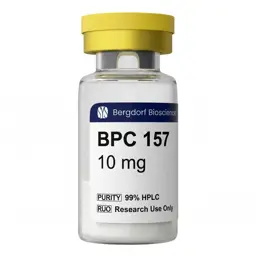
The gastric pentadecapeptide for tissue repair (NO/VEGFR2 angiogenesis) in a scientific comparison with the thymic immunomodulator (TLR2/TLR9, T-cell maturation). Two different modes of action, two different fields of research.
 Medically reviewed by Dr. Sieglinde Klaus · Last reviewed June 2026
BPC-157 is a stable pentadecapeptide derived from gastric juice that accelerates tissue repair in preclinical models, primarily by promoting angiogenesis (nitric oxide signaling pathway, VEGFR2 upregulation) and through growth-promoting effects on fibroblasts 2. The evidence, however, consists almost exclusively of animal and cell studies; controlled human data are largely lacking 3.
Thymosin Alpha-1 (Tα1) is an approved thymic immunomodulator that triggers the maturation and function of T cells via Toll-like receptors (TLR2/TLR9). For Tα1, randomized and multicenter human studies on sepsis and viral infections exist 4.
The gastric pentadecapeptide for tissue repair (NO/VEGFR2 angiogenesis) in a scientific comparison with the thymic immunomodulator (TLR2/TLR9, T-cell maturation). Two different modes of action, two different fields of research.
Medically reviewed by Dr. Sieglinde Klaus · Last reviewed June 2026BPC-157 is a stable pentadecapeptide derived from gastric juice that accelerates tissue repair in preclinical models, primarily by promoting angiogenesis (nitric oxide signaling pathway, VEGFR2 upregulation) and through growth-promoting effects on fibroblasts 2. The evidence, however, consists almost exclusively of animal and cell studies; controlled human data are largely lacking 3.
Thymosin Alpha-1 (Tα1) is an approved thymic immunomodulator that triggers the maturation and function of T cells via Toll-like receptors (TLR2/TLR9). For Tα1, randomized and multicenter human studies on sepsis and viral infections exist 4.
The two peptides address fundamentally different research questions: BPC-157 targets local/systemic tissue healing, Tα1 targets immune regulation. A direct head-to-head comparison is therefore only of limited value; what matters is the specific research question.
Synthetic pentadecapeptide (15 amino acids), fragment of the human gastric protective protein BPC
Synthetic thymic peptide (28 amino acids), N-acetylated fragment of prothymosin alpha
Tissue repair and angiogenesis via the NO signaling pathway and VEGFR2 upregulation
Immunomodulation via TLR2/TLR9, maturation and activation of T cells and dendritic cells
Muscle, tendon, ligament, bone, and gastrointestinal healing (preclinical)
Sepsis, viral infections, immunosuppression, adjuvant oncology
Not approved; banned by WADA (S0); research substance only
Approved as a medicinal product in several countries (e.g. Zadaxin); not broadly approved in the EU/USA
Very limited: one retrospective case series (n=12), no randomized controlled trials
Several randomized and multicenter trials (e.g. ETASS, n=361)
Extensive: numerous animal and cell models on tissue regeneration
Extensive, with a focus on immune cell function and cytokine regulation
Subcutaneous, intra-articular, or oral (systemically active in animal models)
Subcutaneous
High stability, including in an acidic environment (gastric juice); no known systemic hormone profile
Short plasma half-life (about 2 hours); biological effect via a downstream immune cascade
Lack of long-term and human safety data; angiogenic effects to be monitored theoretically
Well-documented profile from clinical trials; possible injection-site reactions
Frequently studied together with Thymosin Beta-4 in repair stacks
Studied as an immunological adjuvant (e.g. with antiviral therapy)
BPC-157 is a stable pentadecapeptide derived from a sequence of the body's own gastric protective protein BPC. The central mechanism described in preclinical models is the promotion of angiogenesis: BPC-157 modulates the nitric oxide (NO) signaling pathway and upregulates vascular endothelial growth factor receptor 2 (VEGFR2), thereby favoring the formation of new blood vessels in injured tissue.
In addition, BPC-157 was shown to increase the expression of the growth hormone receptor in isolated tendon fibroblasts in a dose- and time-dependent manner, with up to a sevenfold increase after three days 2. This is discussed as an explanatory approach for the observed acceleration of tendon and ligament healing. Further postulated effects include interaction with the dopamine and serotonin systems as well as a cytoprotective effect on the gastrointestinal epithelium.
Thymosin Alpha-1 (Tα1) is an N-acetylated peptide of 28 amino acids that is naturally produced in the thymus. Its mode of action is fundamentally immunomodulatory: Tα1 signals via Toll-like receptors (TLR2 and TLR9) on dendritic cells and monocytes, thereby promoting the maturation and differentiation of T cells as well as the activation of natural killer cells.
In clinical contexts, it has been described that Tα1 increases the number of circulating T cells in pronounced lymphocytopenia and reduces the expression of the exhaustion markers PD-1 and Tim-3 on CD8-positive T cells 5. In this way, Tα1 aims to restore an impaired or suppressed immune response, for example in sepsis or severe viral infections.
The mechanisms are non-overlapping: BPC-157 acts predominantly on vascular and tissue repair (angiogenesis, fibroblasts, epithelial protection), while Tα1 recalibrates the adaptive and innate immune response. A direct comparison of potency is therefore misleading; the peptides address different biological axes and are used in different research scenarios.
The evidence base is asymmetric: for Thymosin Alpha-1 there are randomized and multicenter human studies, including the ETASS trial with 361 participants 4. For BPC-157, the data rely almost entirely on animal and cell models; the only source of human data is a small, uncontrolled case series 13. Anyone who needs a research basis supported by human studies will find it more readily with Tα1; BPC-157 remains predominantly a preclinical hypothesis.
BPC-157 showed a favorable safety profile in preclinical models with no discernible toxicity, but robust human safety data are virtually entirely lacking. It is not approved and is banned by WADA.
Thymosin Alpha-1 is well characterized from clinical trials and is considered generally well tolerated in that setting. The profile is considerably better documented than that of BPC-157, but is based on specific disease contexts.
This comparison is intended solely for scientific information and does not constitute medical advice. None of the substances described here is intended for the diagnosis, treatment, cure, or prevention of diseases in humans. The studies mentioned describe the state of research and cannot be applied to individual cases. For research purposes only. Not intended for human consumption.
BPC-157 is the peptide best documented mechanistically and preclinically for tissue regeneration via angiogenesis and fibroblast effects. The human evidence, however, remains limited.
Thymosin Alpha-1 has randomized human studies on restoring T-cell function and reducing mortality in severe sepsis and viral infections.
Only Tα1 has controlled, multicenter studies in humans. BPC-157 relies almost exclusively on animal and cell data.
BPC-157 is structurally derived from a gastric protective protein and shows cytoprotective effects on the gastrointestinal epithelium in preclinical models, a field with no Tα1 relevance.
Since the mechanisms do not overlap, both peptides can be investigated in separate study arms; however, replacing one directly with the other is not mechanistically justified.
No. The two peptides act via completely different mechanisms. BPC-157 targets tissue repair and angiogenesis (NO/VEGFR2), Thymosin Alpha-1 targets immunomodulation (TLR2/TLR9, T-cell maturation). They address different research questions and cannot substitute for one another.
BPC-157 is investigated primarily in preclinical models of tissue regeneration: tendon, ligament, muscle, and bone healing as well as protection of the gastrointestinal epithelium. The central mechanism is the promotion of angiogenesis and the upregulation of the growth hormone receptor in fibroblasts 2.
BPC-157 is not approved and is on WADA's prohibited list. Thymosin Alpha-1 is approved as a medicinal product (e.g. Zadaxin) in some countries, but not uniformly worldwide. Both are considered here exclusively as research substances.
Since the mechanisms do not overlap, they can in principle be investigated in separate study arms. In repair protocols, BPC-157 is frequently combined with Thymosin Beta-4 (not Tα1). There is no mechanistic justification for replacing one with the other.
For BPC-157, the main issue is the lack of controlled human safety data as well as unregulated product quality. For Thymosin Alpha-1, the well-documented but context-specific profile and possible excessive immune reactions in autoimmune diseases are at the forefront.
A blanket winner cannot be determined, because BPC-157 and Thymosin Alpha-1 address different biological axes. For research questions on tissue regeneration, BPC-157 is mechanistically best characterized, but relies almost exclusively on preclinical data 23. For research questions on immunomodulation, Thymosin Alpha-1 is the substance with the more robust human evidence, including randomized and multicenter trials 45.
Anyone who values a foundation supported by human studies has the clear advantage with Tα1. Anyone specifically investigating repair mechanisms of tendons, ligaments, or gastrointestinal tissue cannot avoid BPC-157, but must take the thin human evidence into account.
The choice depends entirely on the research question: BPC-157 for tissue-repair hypotheses (predominantly preclinical), Thymosin Alpha-1 for immunomodulation hypotheses (with randomized human evidence).
The two peptides address fundamentally different research questions: BPC-157 targets local/systemic tissue healing, Tα1 targets immune regulation. A direct head-to-head comparison is therefore only of limited value; what matters is the specific research question.
Synthetic pentadecapeptide (15 amino acids), fragment of the human gastric protective protein BPC
Synthetic thymic peptide (28 amino acids), N-acetylated fragment of prothymosin alpha
Tissue repair and angiogenesis via the NO signaling pathway and VEGFR2 upregulation
Immunomodulation via TLR2/TLR9, maturation and activation of T cells and dendritic cells
Muscle, tendon, ligament, bone, and gastrointestinal healing (preclinical)
Sepsis, viral infections, immunosuppression, adjuvant oncology
Not approved; banned by WADA (S0); research substance only
Approved as a medicinal product in several countries (e.g. Zadaxin); not broadly approved in the EU/USA
Very limited: one retrospective case series (n=12), no randomized controlled trials
Several randomized and multicenter trials (e.g. ETASS, n=361)
Extensive: numerous animal and cell models on tissue regeneration
Extensive, with a focus on immune cell function and cytokine regulation
Subcutaneous, intra-articular, or oral (systemically active in animal models)
Subcutaneous
High stability, including in an acidic environment (gastric juice); no known systemic hormone profile
Short plasma half-life (about 2 hours); biological effect via a downstream immune cascade
Lack of long-term and human safety data; angiogenic effects to be monitored theoretically
Well-documented profile from clinical trials; possible injection-site reactions
Frequently studied together with Thymosin Beta-4 in repair stacks
Studied as an immunological adjuvant (e.g. with antiviral therapy)
BPC-157 is a stable pentadecapeptide derived from a sequence of the body's own gastric protective protein BPC. The central mechanism described in preclinical models is the promotion of angiogenesis: BPC-157 modulates the nitric oxide (NO) signaling pathway and upregulates vascular endothelial growth factor receptor 2 (VEGFR2), thereby favoring the formation of new blood vessels in injured tissue.
In addition, BPC-157 was shown to increase the expression of the growth hormone receptor in isolated tendon fibroblasts in a dose- and time-dependent manner, with up to a sevenfold increase after three days 2. This is discussed as an explanatory approach for the observed acceleration of tendon and ligament healing. Further postulated effects include interaction with the dopamine and serotonin systems as well as a cytoprotective effect on the gastrointestinal epithelium.
Thymosin Alpha-1 (Tα1) is an N-acetylated peptide of 28 amino acids that is naturally produced in the thymus. Its mode of action is fundamentally immunomodulatory: Tα1 signals via Toll-like receptors (TLR2 and TLR9) on dendritic cells and monocytes, thereby promoting the maturation and differentiation of T cells as well as the activation of natural killer cells.
In clinical contexts, it has been described that Tα1 increases the number of circulating T cells in pronounced lymphocytopenia and reduces the expression of the exhaustion markers PD-1 and Tim-3 on CD8-positive T cells 5. In this way, Tα1 aims to restore an impaired or suppressed immune response, for example in sepsis or severe viral infections.
The mechanisms are non-overlapping: BPC-157 acts predominantly on vascular and tissue repair (angiogenesis, fibroblasts, epithelial protection), while Tα1 recalibrates the adaptive and innate immune response. A direct comparison of potency is therefore misleading; the peptides address different biological axes and are used in different research scenarios.
The evidence base is asymmetric: for Thymosin Alpha-1 there are randomized and multicenter human studies, including the ETASS trial with 361 participants 4. For BPC-157, the data rely almost entirely on animal and cell models; the only source of human data is a small, uncontrolled case series 13. Anyone who needs a research basis supported by human studies will find it more readily with Tα1; BPC-157 remains predominantly a preclinical hypothesis.
BPC-157 showed a favorable safety profile in preclinical models with no discernible toxicity, but robust human safety data are virtually entirely lacking. It is not approved and is banned by WADA.
Thymosin Alpha-1 is well characterized from clinical trials and is considered generally well tolerated in that setting. The profile is considerably better documented than that of BPC-157, but is based on specific disease contexts.
This comparison is intended solely for scientific information and does not constitute medical advice. None of the substances described here is intended for the diagnosis, treatment, cure, or prevention of diseases in humans. The studies mentioned describe the state of research and cannot be applied to individual cases. For research purposes only. Not intended for human consumption.
BPC-157 is the peptide best documented mechanistically and preclinically for tissue regeneration via angiogenesis and fibroblast effects. The human evidence, however, remains limited.
Thymosin Alpha-1 has randomized human studies on restoring T-cell function and reducing mortality in severe sepsis and viral infections.
Only Tα1 has controlled, multicenter studies in humans. BPC-157 relies almost exclusively on animal and cell data.
BPC-157 is structurally derived from a gastric protective protein and shows cytoprotective effects on the gastrointestinal epithelium in preclinical models, a field with no Tα1 relevance.
Since the mechanisms do not overlap, both peptides can be investigated in separate study arms; however, replacing one directly with the other is not mechanistically justified.
No. The two peptides act via completely different mechanisms. BPC-157 targets tissue repair and angiogenesis (NO/VEGFR2), Thymosin Alpha-1 targets immunomodulation (TLR2/TLR9, T-cell maturation). They address different research questions and cannot substitute for one another.
BPC-157 is investigated primarily in preclinical models of tissue regeneration: tendon, ligament, muscle, and bone healing as well as protection of the gastrointestinal epithelium. The central mechanism is the promotion of angiogenesis and the upregulation of the growth hormone receptor in fibroblasts 2.
BPC-157 is not approved and is on WADA's prohibited list. Thymosin Alpha-1 is approved as a medicinal product (e.g. Zadaxin) in some countries, but not uniformly worldwide. Both are considered here exclusively as research substances.
Since the mechanisms do not overlap, they can in principle be investigated in separate study arms. In repair protocols, BPC-157 is frequently combined with Thymosin Beta-4 (not Tα1). There is no mechanistic justification for replacing one with the other.
For BPC-157, the main issue is the lack of controlled human safety data as well as unregulated product quality. For Thymosin Alpha-1, the well-documented but context-specific profile and possible excessive immune reactions in autoimmune diseases are at the forefront.
A blanket winner cannot be determined, because BPC-157 and Thymosin Alpha-1 address different biological axes. For research questions on tissue regeneration, BPC-157 is mechanistically best characterized, but relies almost exclusively on preclinical data 23. For research questions on immunomodulation, Thymosin Alpha-1 is the substance with the more robust human evidence, including randomized and multicenter trials 45.
Anyone who values a foundation supported by human studies has the clear advantage with Tα1. Anyone specifically investigating repair mechanisms of tendons, ligaments, or gastrointestinal tissue cannot avoid BPC-157, but must take the thin human evidence into account.
The choice depends entirely on the research question: BPC-157 for tissue-repair hypotheses (predominantly preclinical), Thymosin Alpha-1 for immunomodulation hypotheses (with randomized human evidence).