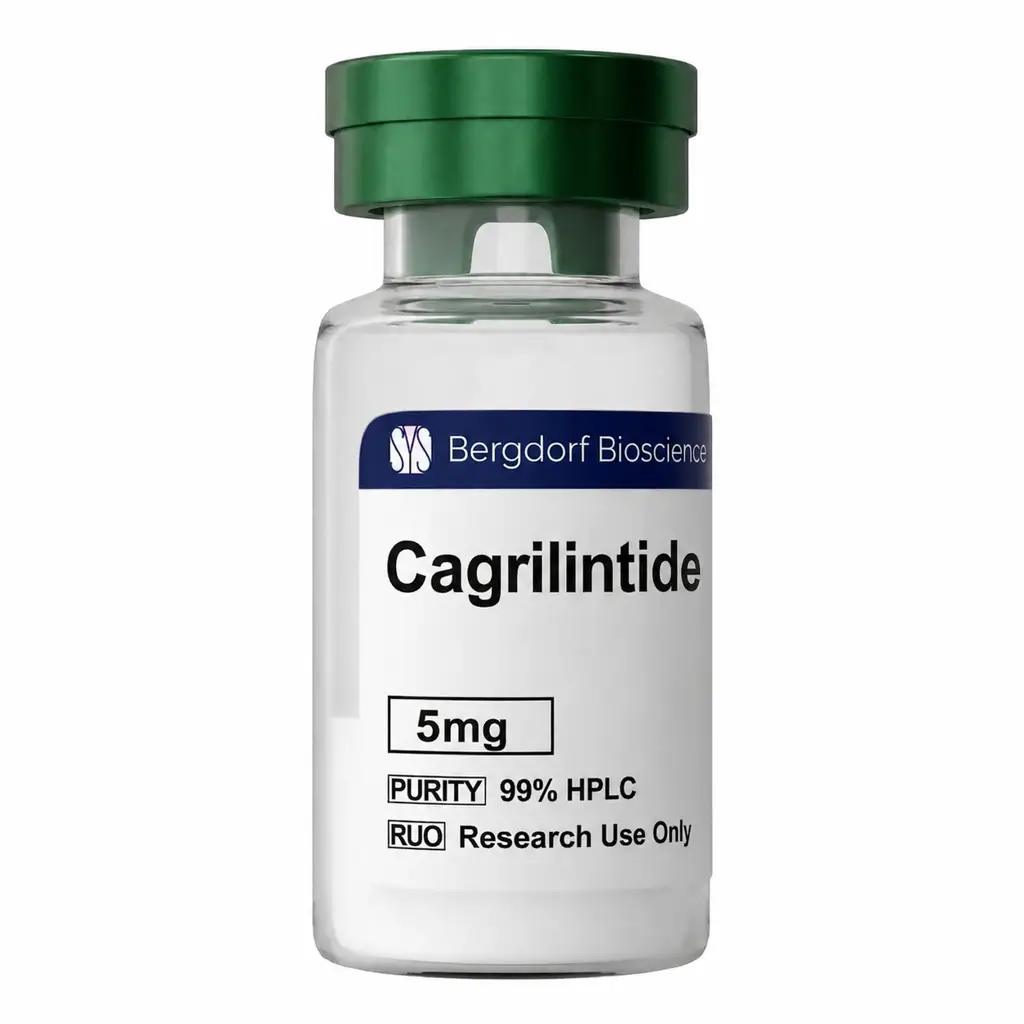
Research peptide · AM833
Cagrilintide 5 mg
Cagrilintide 5 mg lyophilized research vial with source-based context on long-acting amylin design and clinical pharmacokinetics. Research use only.

Research peptide · AM833
Cagrilintide 5 mg lyophilized research vial with source-based context on long-acting amylin design and clinical pharmacokinetics. Research use only.
Research peptide · AM833
Cagrilintide 5 mg lyophilized research vial with source-based context on long-acting amylin design and clinical pharmacokinetics. Research use only.
No reviews yet. Be the first to share your experience.
No reviews yet. Be the first to share your experience.
/ vial
Order today → Delivery Mon, Sep 28 – Tue, Oct 06 to United States
Payment Methods





/ vial
Order today → Delivery Mon, Sep 28 – Tue, Oct 06 to United States
Payment Methods
3,000+
satisfied researchers
99.43%
Avg. purity 2026
4.8 ★
ProvenExpert
99.43%
Avg. purity 2026
4.8 ★
ProvenExpert
3,000+ satisfied researchers
Steady-state plasma level after ~ 4 weeks with weekly administration.
Scientific references
Kruse et al. · J Med Chem, 2021
Development of Cagrilintide, a Long-Acting Amylin Analogue
Fletcher et al. · J Pharmacol Exp Ther, 2021
AM833 Is a Novel Agonist of Calcitonin Family G Protein-Coupled Receptors
Enebo et al. · Lancet, 2021
Safety, tolerability, pharmacokinetics, and pharmacodynamics of cagrilintide with semaglutide
Research details
Cagrilintide is a synthetic amylin analogue created through a peptide structure-activity development program. The primary medicinal-chemistry publication describes it as stable, lipidated and long acting. Lipidation is part of the molecular design used to extend exposure compared with short-lived native peptide signaling, while sequence and structural choices were evaluated to retain the intended pharmacological profile. These design characteristics define the compound for research purposes; they do not make a research vial a pharmaceutical product.
This product contains 5 mg of lyophilized cagrilintide research material in a sealed vial. The stated mass identifies the supplied format and is not a recommendation for administration. Cagrilintide remains an investigational compound, and this material is offered for controlled laboratory work such as analytical method development, receptor-focused research or appropriately designed experimental models. It is not represented as equivalent to material used in a clinical trial.
Preclinical pharmacology studied AM833, the development compound known as cagrilintide, across the calcitonin-family receptor system. That work characterized it as a nonselective agonist at amylin receptors and the calcitonin receptor. The result provides a receptor-level basis for classifying cagrilintide as a long-acting amylin analogue and for investigating signaling across more than one receptor configuration rather than treating the compound as a single-target ligand.
Receptor agonism is a molecular observation, not a clinical conclusion. Potency and response can vary with receptor composition, accessory proteins, cellular background and assay endpoint. Researchers comparing cagrilintide with native amylin or other analogues should therefore preserve the specific assay context and use suitable controls. This page does not convert preclinical receptor findings into claims about body weight, disease treatment, safety or expected outcomes in people or animals.
A randomized, placebo-controlled phase 1b multiple-ascending-dose study evaluated cagrilintide when it was co-administered with semaglutide. Under those study conditions, the reported cagrilintide half-life ranged from 159 to 195 hours. Median time to maximum concentration was reported as 24 to 72 hours, and exposure was approximately dose proportional across the studied conditions. These values support the description of cagrilintide as long acting within that specific clinical research setting.
For a half-life calculator, 180 hours can serve as a transparent representative scalar because it lies within the published 159–195-hour range. It is a modeling simplification, not a newly measured value and not a universal constant. Any display should retain the published range, identify the co-administration study and explain that individuals and experimental conditions can vary. The scalar must not be used to derive a human schedule or imply instructions for administration.
The phase 1b publication is useful because it provides direct human pharmacokinetic and tolerability observations from a controlled early-stage study. However, cagrilintide was studied in combination with semaglutide, while the comparator received placebo with semaglutide. The paper therefore does not provide a standalone cagrilintide-monotherapy efficacy data set. Findings from that design should remain attached to the studied population, regimen, duration and combination context.
Early-phase evidence is intended to inform subsequent research, not to establish broad clinical use. It cannot demonstrate that this research material shares the manufacturing, quality or clinical characteristics of the investigational product used by the study sponsor. For those reasons, this overview uses the trial for bounded pharmacokinetic context, avoids treatment promises and identifies cagrilintide as investigational. Readers can follow the linked primary papers to review the experimental methods and limitations.
Cagrilintide 5 mg is supplied as a lyophilized research material in a sealed vial. The dry format is practical for laboratory inventory, but it does not imply sterility, pharmaceutical grade, a verified purity percentage or suitability for clinical use. Researchers should work under institutionally approved procedures and select analytical methods, controls and experimental conditions appropriate to their own objectives. No reconstitution, injection or human dosing instructions are provided.
Keep the unopened vial sealed, dry and protected from light, following the handling information supplied with the material. The parcel is sent with tracking in protective packaging. This product is strictly for research use only and is not intended for human or veterinary use, diagnosis, treatment, prevention or consumption.
Kruse et al. (2021), development of cagrilintide as a long-acting amylin analogue
Fletcher et al. (2021), AM833 calcitonin-family receptor pharmacology
Enebo et al. (2021), randomized phase 1b cagrilintide and semaglutide study
For laboratory research use only. Not for human or veterinary use, diagnosis, treatment, prevention or consumption. No clinical equivalence, suitability for administration or therapeutic performance is represented.
Preclinical pharmacology characterized AM833, the development compound known as cagrilintide, as a nonselective agonist across amylin receptors and the calcitonin receptor. This receptor-level description explains its research rationale but does not establish a therapeutic outcome, clinical suitability or equivalence between this research material and a trial product.
Cagrilintide is a synthetic, stable and lipidated long-acting amylin analogue developed through structure-activity research. It remains investigational.
3,000+
satisfied researchers
99.43%
Avg. purity 2026
4.8 ★
ProvenExpert
99.43%
Avg. purity 2026
4.8 ★
ProvenExpert
3,000+ satisfied researchers
Steady-state plasma level after ~ 4 weeks with weekly administration.
Scientific references
Kruse et al. · J Med Chem, 2021
Development of Cagrilintide, a Long-Acting Amylin Analogue
Fletcher et al. · J Pharmacol Exp Ther, 2021
AM833 Is a Novel Agonist of Calcitonin Family G Protein-Coupled Receptors
Enebo et al. · Lancet, 2021
Safety, tolerability, pharmacokinetics, and pharmacodynamics of cagrilintide with semaglutide
Research details
Cagrilintide is a synthetic amylin analogue created through a peptide structure-activity development program. The primary medicinal-chemistry publication describes it as stable, lipidated and long acting. Lipidation is part of the molecular design used to extend exposure compared with short-lived native peptide signaling, while sequence and structural choices were evaluated to retain the intended pharmacological profile. These design characteristics define the compound for research purposes; they do not make a research vial a pharmaceutical product.
This product contains 5 mg of lyophilized cagrilintide research material in a sealed vial. The stated mass identifies the supplied format and is not a recommendation for administration. Cagrilintide remains an investigational compound, and this material is offered for controlled laboratory work such as analytical method development, receptor-focused research or appropriately designed experimental models. It is not represented as equivalent to material used in a clinical trial.
Preclinical pharmacology studied AM833, the development compound known as cagrilintide, across the calcitonin-family receptor system. That work characterized it as a nonselective agonist at amylin receptors and the calcitonin receptor. The result provides a receptor-level basis for classifying cagrilintide as a long-acting amylin analogue and for investigating signaling across more than one receptor configuration rather than treating the compound as a single-target ligand.
Receptor agonism is a molecular observation, not a clinical conclusion. Potency and response can vary with receptor composition, accessory proteins, cellular background and assay endpoint. Researchers comparing cagrilintide with native amylin or other analogues should therefore preserve the specific assay context and use suitable controls. This page does not convert preclinical receptor findings into claims about body weight, disease treatment, safety or expected outcomes in people or animals.
A randomized, placebo-controlled phase 1b multiple-ascending-dose study evaluated cagrilintide when it was co-administered with semaglutide. Under those study conditions, the reported cagrilintide half-life ranged from 159 to 195 hours. Median time to maximum concentration was reported as 24 to 72 hours, and exposure was approximately dose proportional across the studied conditions. These values support the description of cagrilintide as long acting within that specific clinical research setting.
For a half-life calculator, 180 hours can serve as a transparent representative scalar because it lies within the published 159–195-hour range. It is a modeling simplification, not a newly measured value and not a universal constant. Any display should retain the published range, identify the co-administration study and explain that individuals and experimental conditions can vary. The scalar must not be used to derive a human schedule or imply instructions for administration.
The phase 1b publication is useful because it provides direct human pharmacokinetic and tolerability observations from a controlled early-stage study. However, cagrilintide was studied in combination with semaglutide, while the comparator received placebo with semaglutide. The paper therefore does not provide a standalone cagrilintide-monotherapy efficacy data set. Findings from that design should remain attached to the studied population, regimen, duration and combination context.
Early-phase evidence is intended to inform subsequent research, not to establish broad clinical use. It cannot demonstrate that this research material shares the manufacturing, quality or clinical characteristics of the investigational product used by the study sponsor. For those reasons, this overview uses the trial for bounded pharmacokinetic context, avoids treatment promises and identifies cagrilintide as investigational. Readers can follow the linked primary papers to review the experimental methods and limitations.
Cagrilintide 5 mg is supplied as a lyophilized research material in a sealed vial. The dry format is practical for laboratory inventory, but it does not imply sterility, pharmaceutical grade, a verified purity percentage or suitability for clinical use. Researchers should work under institutionally approved procedures and select analytical methods, controls and experimental conditions appropriate to their own objectives. No reconstitution, injection or human dosing instructions are provided.
Keep the unopened vial sealed, dry and protected from light, following the handling information supplied with the material. The parcel is sent with tracking in protective packaging. This product is strictly for research use only and is not intended for human or veterinary use, diagnosis, treatment, prevention or consumption.
Kruse et al. (2021), development of cagrilintide as a long-acting amylin analogue
Fletcher et al. (2021), AM833 calcitonin-family receptor pharmacology
Enebo et al. (2021), randomized phase 1b cagrilintide and semaglutide study
For laboratory research use only. Not for human or veterinary use, diagnosis, treatment, prevention or consumption. No clinical equivalence, suitability for administration or therapeutic performance is represented.
Preclinical pharmacology characterized AM833, the development compound known as cagrilintide, as a nonselective agonist across amylin receptors and the calcitonin receptor. This receptor-level description explains its research rationale but does not establish a therapeutic outcome, clinical suitability or equivalence between this research material and a trial product.
Cagrilintide is a synthetic, stable and lipidated long-acting amylin analogue developed through structure-activity research. It remains investigational.
Cagrilintid als Amylin-Analogon: REDEFINE- und CagriSema-Studiendaten zum Wirkstoffkandidaten neutral eingeordnet, research-only.
Peptide zum Abnehmen im Forschungsvergleich: GLP-1, GIP und Amylin. Studiendaten zu Retatrutid und Cagrilintid im Leitfaden.
Cagrilintid als Amylin-Analogon: REDEFINE- und CagriSema-Studiendaten zum Wirkstoffkandidaten neutral eingeordnet, research-only.
Peptide zum Abnehmen im Forschungsvergleich: GLP-1, GIP und Amylin. Studiendaten zu Retatrutid und Cagrilintid im Leitfaden.