Izračunajte točne volumene rekonstitucije, inzulinske jedinice i doze po bočici za svaki peptid.
PT-141, also known by its pharmaceutical name Bremelanotide, is a cyclic heptapeptide melanocortin receptor agonist with a uniquely central mechanism of action that distinguishes it fundamentally from all other pharmacological approaches to sexual dysfunction. Unlike PDE5 inhibitors such as sildenafil (Viagra) or tadalafil (Cialis), which act peripherally by relaxing vascular smooth muscle to increase genital blood flow, PT-141 acts directly within the central nervous system — specifically at melanocortin receptors MC3R and MC4R in the hypothalamus and limbic system.
This distinction has significant clinical implications. PDE5 inhibitors require sexual arousal to produce an effect; they facilitate the vascular response to stimulation but do not initiate desire or motivation. PT-141, by engaging melanocortin receptors in the brain regions governing sexual motivation and reward, activates the central drive component of the sexual response cycle. This mechanism is why PT-141 has shown efficacy in populations where PDE5 inhibitors fail — including women with hypoactive sexual desire disorder (HSDD), where the primary deficit is in desire rather than vascular response.
PT-141 was developed as a derivative of Melanotan II (MT-II), a synthetic analog of alpha-melanocyte-stimulating hormone (alpha-MSH). Researchers studying MT-II for its tanning properties incidentally discovered profound effects on sexual arousal during early human trials. Subsequent medicinal chemistry work produced PT-141 — a modified cyclic structure with reduced MC1R affinity (minimizing pigmentation effects) and preserved MC3R/MC4R activity. In 2019, the U.S. Food and Drug Administration approved an intranasal formulation of Bremelanotide under the trade name Vyleesi for the treatment of premenopausal women with acquired, generalized HSDD — the first and only centrally acting drug approved for female sexual dysfunction.
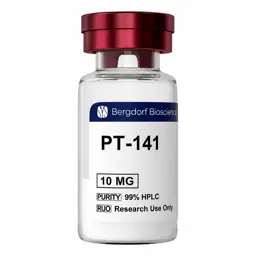
You can find PT-141 at BergdorfBio, available for research purposes.
The melanocortin system encompasses five receptor subtypes (MC1R through MC5R), each with distinct tissue distributions and physiological roles. PT-141 primarily engages:
MC1R, which governs skin pigmentation (the receptor responsible for MT-II's tanning effects), has significantly lower affinity for PT-141 compared to its parent compound. This selective profile makes PT-141 substantially less likely to cause the unintended pigmentation changes observed with Melanotan II at equivalent doses.
MC4R activation in the PVN triggers a cascade: oxytocin neurons are stimulated, increasing central and peripheral oxytocin levels. Oxytocin, in addition to its well-known role in social bonding, is a potent mediator of sexual arousal, lubrication, and orgasmic response in both sexes. The dopaminergic pathways in the mesolimbic system are also modulated by melanocortin signaling, contributing to the enhanced motivational and reward aspects of sexual desire that PT-141 users report. This multi-pathway central activation explains why PT-141's effect quality differs from PDE5 inhibitors — users describe not just functional improvement but increased sexual motivation and interest.
Precise dose calculation is essential when working with PT-141. For a standard 10 mg vial reconstituted with 2 ml of bacteriostatic water (BAC water), the concentration is:
10 mg / 2 ml = 5 mg/ml
At this concentration, the research dose range of 0.5–2 mg translates to the following injection volumes on a U100 insulin syringe:
Because PT-141 is an as-needed peptide rather than a daily protocol, many researchers prefer reconstituting with 4 ml BAC water to yield a 2.5 mg/ml concentration. This lower concentration allows finer dose titration, particularly useful when assessing initial tolerance:
Use the PT-141 calculator above to compute precise injection volumes for any combination of vial size, BAC water volume, and target dose.
PT-141 is structurally distinct from most research peptides in that it is an as-needed compound rather than a daily administration protocol. Its effects are not cumulative in the same way as peptides targeting chronic biological processes; each administration produces an acute pharmacological effect with a defined onset, peak, and duration.
Because PT-141 can transiently elevate blood pressure (average systolic increase of 6–10 mmHg in clinical trials), the first administration should be conducted in a calm, controlled environment. Individuals with pre-existing cardiovascular conditions, uncontrolled hypertension, or those taking antihypertensive medications should approach PT-141 research with particular caution and appropriate monitoring.
Nausea, the most commonly reported side effect, is strongly dose-dependent and typically peaks 1–2 hours post-injection. Maintaining adequate hydration before and after administration and avoiding alcohol consumption on the day of use significantly reduces nausea incidence. Starting with the 0.5 mg test dose and gradually titrating to the therapeutic range across separate sessions is the recommended approach for minimizing first-dose nausea.
PT-141 is supplied as a lyophilized powder that must be reconstituted before use. Correct technique preserves peptide stability and ensures accurate dosing:
PT-141's cyclic structure confers greater metabolic stability than many linear peptides, but appropriate storage conditions remain essential for preserving research-grade quality:
PT-141 has an established safety profile from both Phase II/III clinical trials for the FDA-approved Vyleesi indication and the broader research literature. Understanding the side effect profile allows for risk-minimizing protocol design.
PT-141's central mechanism of action is largely non-overlapping with most other research peptides, which operate through peripheral or systemic pathways. The following combinations are discussed in the research literature:
Understanding the relationship between research PT-141 and the FDA-approved pharmaceutical Vyleesi is important context for accurate literature interpretation:
PDE5 inhibitors (sildenafil, tadalafil) act peripherally by preventing the breakdown of cyclic GMP in vascular smooth muscle, prolonging vasodilation in the genitals during sexual stimulation. They require arousal to function — they facilitate the vascular response but do not generate desire. PT-141 acts centrally in the hypothalamus through MC3R and MC4R receptors, activating the neurological desire and motivation component of the sexual response. This means PT-141 can produce effects independent of direct genital stimulation and operates through a completely different biological pathway. The two approaches are pharmacologically non-overlapping and may theoretically be complementary, though concurrent use warrants careful oversight.
Onset of effects is typically 30–60 minutes post-subcutaneous injection. Peak pharmacological effect is generally experienced 2–4 hours after administration. Total duration of effect ranges from 6–12 hours, with significant inter-individual variability. Factors influencing response timing include body composition, injection site, hydration status, and individual receptor sensitivity.
Daily use is not recommended and is contrary to the clinical evidence base. The Vyleesi approval limits use to a maximum of 8 times per month. Daily administration significantly increases the risk of tachyphylaxis (rapid tolerance development), persistent nausea, blood pressure dysregulation, and hyperpigmentation. PT-141 is an as-needed compound designed for infrequent use.
PT-141 does not directly modulate the hypothalamic-pituitary-gonadal (HPG) axis or suppress endogenous steroid hormone production. It stimulates oxytocin release through MC4R activation in the paraventricular nucleus, but this is a transient effect that does not constitute endocrine suppression. No post-cycle therapy is required.
The clinical evidence is strongest for women with HSDD, which led to the FDA approval of Vyleesi for this indication. Research in men with erectile dysfunction has shown positive effects in trials where standard PDE5 inhibitors were ineffective, suggesting utility in psychogenic or central-deficit erectile dysfunction. The underlying MC3R/MC4R mechanism is present in both sexes, and both animal and human research supports central pro-sexual effects across sexes, though the magnitude and quality of response varies individually.
Both compounds act as melanocortin receptor agonists, but with different receptor affinity profiles. Melanotan II has significant MC1R agonism in addition to MC3R and MC4R activity; MC1R drives skin pigmentation (tanning), which is why MT-II users frequently experience darkening of the skin and moles. PT-141 was specifically modified from MT-II to reduce MC1R affinity while preserving the pro-sexual MC3R/MC4R effects. As a result, PT-141 has substantially less pigmentation-related activity, though at very high or prolonged doses some residual pigmentation effect can occur.
BergdorfBio offers research-grade PT-141 in lyophilized form. You can order directly from the product page: PT-141 at BergdorfBio.
For a first administration, researchers recommend:
Medical Disclaimer:The information on this page is provided for educational and research purposes only. PT-141 (Bremelanotide) is not an approved drug or medical treatment for general use. It is sold strictly for research purposes. Nothing on this page constitutes medical advice, diagnosis, or a recommendation to use any specific compound. Always consult a qualified healthcare professional before beginning any peptide protocol. BergdorfBio assumes no liability for the use or misuse of the information presented here. Regulations regarding research chemicals vary by jurisdiction; it is the purchaser's responsibility to verify compliance with applicable local laws.
Pogledajte proizvod
PT-141