
Apskaičiuokite tikslius rekonstitucijos tūrius, insulino vienetus ir dozių skaičių flakone bet kuriam peptidui.
Flakonas, vanduo ir dozė žinomi
Vienetai matuoja tūrį, o ne veikliąją medžiagą. 100 IU = 1,00 ml. Kiek tame yra mg, priklauso nuo mišinio. Skaičiuoklė tai jau apskaičiavo už Jus.
Beveik visi insulino švirkštai yra U-100. Rinkitės U-40 tik tuo atveju, jei ant švirkšto pažymėta U-40.
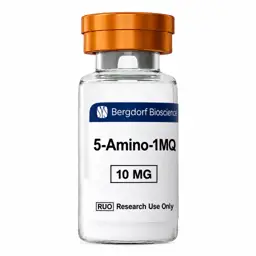
5-Amino-1MQ (5-amino-1-methylquinolinium) is a small, orally active molecule studied in metabolic research as a selective inhibitor of the enzyme nicotinamide N-methyltransferase (NNMT). Unlike most compounds discussed across this calculator, 5-Amino-1MQ is not a peptide or a chain of amino acids — it is a low-molecular-weight chemical compound belonging to the quinolinium class. The name describes the structure directly: a methylquinolinium scaffold carrying an amino group at the 5 position. This small molecular size is the reason 5-Amino-1MQ is orally bioavailable in research models and does not need to be injected.
Interest in 5-Amino-1MQ grew out of the observation that NNMT becomes overactive in adipose tissue and the liver when metabolism is disrupted, such as in diet-induced obesity in rodent models. NNMT consumes two important cellular molecules by transferring a methyl group from S-adenosylmethionine (SAM) onto nicotinamide. Nicotinamide is a precursor of NAD+, the central cofactor of energy metabolism. When NNMT is inhibited, nicotinamide remains available for NAD+ regeneration and SAM is preserved for methylation reactions. It is precisely this dual effect that makes 5-Amino-1MQ interesting for research into adipocyte biology, energy expenditure, and aging.
5-Amino-1MQ was first described in a widely cited 2018 study that linked NNMT inhibition to a reduction in fat mass in obese mice without any change in food intake. Since then, the compound has been a recurring topic in preclinical metabolic and longevity research. To date, however, there are no completed large-scale human clinical trials. 5-Amino-1MQ is not an approved drug and is traded strictly for research purposes.
5-Amino-1MQ does not act through hormone receptors and is not a stimulant. Its entire activity profile derives from a single primary target — NNMT inhibition — which triggers a cascade of downstream metabolic effects:
An important distinction: 5-Amino-1MQ does not raise NAD+ by supplying an external NAD+ precursor, as NMN or NR do. Instead, it raises NAD+ by closing a leak in the existing recycling pathway. These two approaches — substrate supplementation and enzyme inhibition — can be considered conceptually complementary, but they are mechanistically distinct.
Because 5-Amino-1MQ is administered orally, dose calculation centers on the amount of active compound per dose rather than on injection volumes. Research protocols typically use a fixed daily dose without an elaborate titration ramp, although starting at the lower end of the range is a reasonable precaution.
5-Amino-1MQ is often supplied as loose powder or in 5 mg or 10 mg vials. Anyone preparing a capsule form divides the total amount of a vial across the desired daily dose. A 5 mg vial yields exactly one daily portion at a standard dose of 5 mg per day, or two portions at a conservative dose of 2.5 mg.
If the powder is dissolved in water or another suitable solvent, the 5-Amino-1MQ calculator above can determine the exact volume per dose: enter the vial size in mg, the added volume, and the target dose, and the calculator returns the volume to draw per administration. A precise milligram scale (0.001 g resolution) is the most reliable way to measure powder amounts accurately in a research setting.
5-Amino-1MQ is not an injectable compound. The entire reconstitution-with-bacteriostatic-water step common to peptides therefore does not apply. Instead, the task is to measure the powder precisely and bring it into an ingestible form. Two approaches are common in research practice: filling empty capsules, or dissolving a measured amount in liquid.
If the powder changes color, clumps heavily, or smells unusual, it should not be used further. High-quality 5-Amino-1MQ is a fine, uniform powder.
The safety profile of 5-Amino-1MQ rests largely on preclinical rodent models, in which the compound was well tolerated and did not produce obvious organ toxicity. Robust safety data from controlled human trials, however, is lacking. All use therefore remains explicitly within the research domain, and the tolerability profile is not fully characterized.
No serious adverse events have been described in the published preclinical literature at standard research doses. However, because robust human data is lacking, caution is warranted. Consultation with a qualified healthcare professional is strongly recommended before beginning any protocol.
5-Amino-1MQ can be conceptually paired with NAD+ precursors such as NMN or NR: the precursor supplies additional substrate, while 5-Amino-1MQ protects the recycling of nicotinamide that is already present. Both approaches aim at greater NAD+ availability but act at different points in metabolism. This combination is discussed in longevity research but is not clinically validated.
In mitochondrial research, 5-Amino-1MQ is often mentioned alongside peptides such as MOTS-c and SS-31. MOTS-c is a mitochondrially encoded peptide linked to AMPK signaling and glucose utilization, while SS-31 targets the inner mitochondrial membrane and cardiolipin stability. With NAD+ availability, 5-Amino-1MQ addresses a third, independent lever of energy metabolism.
For research questions around fat metabolism and body composition, 5-Amino-1MQ is occasionally considered alongside AOD-9604, a fragment of growth hormone associated with lipolysis. The two compounds act through entirely different mechanisms, which is why research discussions treat them as complementary tools rather than interchangeable alternatives. For a complete overview of available tools, see the peptide calculator hub.
No. 5-Amino-1MQ is a low-molecular-weight chemical molecule from the quinolinium class, not a chain of amino acids. It is covered on this platform alongside peptides because it is grouped into similar metabolic and longevity research contexts. Mechanistically and structurally, however, it differs fundamentally from true peptides.
No. 5-Amino-1MQ is orally active and is swallowed in research protocols, typically as a filled capsule or dissolved in water. Reconstitution with bacteriostatic water and injection are not part of its use. It is precisely this oral availability that sets it apart from many injectable peptides.
NNMT, or nicotinamide N-methyltransferase, is an enzyme that attaches a methyl group to nicotinamide and thereby removes it from the NAD+ recycling loop. 5-Amino-1MQ blocks this enzyme. As a result, nicotinamide remains available for NAD+ resynthesis, and at the same time less S-adenosylmethionine is consumed. NNMT inhibition is the only known primary mechanism of the compound.
NMN and NR are direct NAD+ precursors: they supply the body with additional building material for NAD+. 5-Amino-1MQ supplies no building material; instead, it prevents existing nicotinamide from being intercepted by NNMT. Figuratively speaking, NMN and NR fill the tank, while 5-Amino-1MQ seals a leak in the tank. Both approaches aim at higher NAD+ levels, but they are mechanistically distinct.
In research protocols, 5-Amino-1MQ is typically taken once daily in the morning, since the metabolic focus is on the active part of the day. Above all, consistency matters: the same time and the same relationship to meals every day keep absorption comparable across the cycle.
Preclinical models often run for several weeks, roughly six to twelve, followed by a break. There are no established human protocols, since controlled human trials are lacking. Cyclical use with defined breaks is preferred as a precaution as long as the long-term consequences of sustained NNMT inhibition remain unstudied.
5-Amino-1MQ does not act through hormone receptors and is not a growth hormone secretagogue. It does not suppress the hypothalamic-pituitary axis, and no post-cycle therapy is required. Its effect runs exclusively through the metabolic level — specifically through the NAD+ and methylation balance.
5-Amino-1MQ is not currently listed in the BergdorfBio catalog. Related metabolic and research tools can be found through the peptide calculator hub. All products listed there are sold strictly for research purposes.
Medical Disclaimer: The information on this page is provided for educational and research purposes only. 5-Amino-1MQ is not an approved drug or medical treatment and is traded strictly for research use. Nothing on this page constitutes medical advice, diagnosis, or a recommendation to use any specific compound. Always consult a qualified healthcare professional before beginning any research protocol. BergdorfBio assumes no liability for the use or misuse of the information presented here.
Nuo miltelių iki paruošto švirkšto per penkis žingsnius. Kiekius automatiškai apskaičiuoja aukščiau esanti skaičiuoklė.
Leiskite flakonui ir vandeniui sušilti iki kambario temperatūros. Nuvalykite abu guminius kamštelius alkoholiu.
Didesniu švirkštu įtraukite skaičiuoklės rekomenduojamą BAC vandens kiekį.
Leiskite vandeniui tekėti peptido flakono sienele, nepurkškite jo tiesiai ant miltelių.
Atsargiai pasukite flakoną, nekratykite. Milteliai ištirps ir tirpalas taps skaidrus per 1-2 minutes.
Insulino švirkštu įtraukite tiksliai iki apskaičiuotos žymės. Paruošta.
Įprastos pradinės reikšmės orientacijai. Kiekviena eilutė atidaro to peptido skaičiuoklę.
| Peptidas | Kategorija | Įprasta dozė | Flakonų dydžiai | BAC (pradžiai) | Prieinamumas | Skaičiuoti |
|---|---|---|---|---|---|---|
| VIP | Nevropeptidų tyrimai | - | 10 mg | 2 ml | Tik skaičiuoklė | Skaičiuoti |
| Retatrutide | GLP-1/GIP/GCG | 0,5-12 mg | 2 / 5 / 10 / 15 mg | 2 ml | Tik skaičiuoklė | Skaičiuoti |
| Cagrilintide | Amilino analogas | - | 5 mg | 2 ml | Tik skaičiuoklė | Skaičiuoti |
| Semaglutide | GLP-1 | 0,25-2,4 mg | 2 / 5 / 10 mg | 2 ml | Tik skaičiuoklė | Skaičiuoti |
| Tirzepatide | GLP-1/GIP | 2,5-15 mg | 10 / 15 / 20 / 30 / 60 / 90 mg | 2 ml | Tik skaičiuoklė | Skaičiuoti |
| GHK-Cu | Vario peptidas | 1-4 mg | 10 / 20 / 50 mg | 5 ml | Tik skaičiuoklė | Skaičiuoti |
| AHK-Cu | Vario peptidas | - | 100 mg | 5 ml | Tik skaičiuoklė | Skaičiuoti |
| BPC-157 | Audinių atkūrimas | 0,2-0,5 mg | 2 / 5 / 10 mg | 2 ml | Tik skaičiuoklė | Skaičiuoti |
| TB-500 | Thymosin Beta-4 | 2-5 mg | 2 / 5 / 10 mg | 2 ml | Tik skaičiuoklė | Skaičiuoti |
| CJC-1295 (be DAC) | GHRH analogas | 100-200 mcg | 2 / 5 / 10 mg | 2 ml | Tik skaičiuoklė | Skaičiuoti |
| Ipamorelin | GHRP | 200-300 mcg | 2 / 5 mg | 2 ml | Tik skaičiuoklė | Skaičiuoti |
| AOD-9604 | Riebalų apykaita | 250-500 mcg | 2 / 5 mg | 2 ml | Tik skaičiuoklė | Skaičiuoti |
| PT-141 | Bremelanotide | - | 2 / 5 / 10 mg | 2 ml | Tik skaičiuoklė | Skaičiuoti |
| MOTS-c | Mitochondrinis | 5-10 mg | 5 / 10 mg | 2 ml | Tik skaičiuoklė | Skaičiuoti |
| Selank | Anksiolitinis | 150-500 mcg | 2 / 5 / 10 mg | 2 ml | Tik skaičiuoklė | Skaičiuoti |
| SS-31 | Elamipretide | 0,1-1 mg | 5 / 10 mg | 2 ml | Tik skaičiuoklė | Skaičiuoti |
| Glow Stack | Stack | 0,5-2 mg | 70 mg | 3 ml | Tik skaičiuoklė | Skaičiuoti |
| Klow Stack | Stack | 0,5-2 mg | 55 mg | 3 ml | Tik skaičiuoklė | Skaičiuoti |
| Melanotan II | Melanokortinas | 100-1000 mcg | 5 / 10 mg | 2 ml | Tik skaičiuoklė | Skaičiuoti |
| Melanotan I | Melanokortinas | - | 5 / 10 mg | 2 ml | Tik skaičiuoklė | Skaičiuoti |
| Sermorelin | GHRH analogas | 50-300 mcg | 5 mg | 2 ml | Tik skaičiuoklė | Skaičiuoti |
| Tesamorelin | GHRH analogas | 1-2 mg | 10 / 20 mg | 2 ml | Tik skaičiuoklė | Skaičiuoti |
| Thymosin Alpha-1 | Timuso peptidas | 0,8-3,2 mg | 1.6 / 5 / 10 mg | 1 ml | Tik skaičiuoklė | Skaičiuoti |
| Epithalon | Ilgaamžiškumas | 2-10 mg | 10 / 20 / 50 mg | 2 ml | Tik skaičiuoklė | Skaičiuoti |
| KPV | Imuninė sistema / barjeras | 100-1000 mcg | 5 / 10 mg | 2 ml | Tik skaičiuoklė | Skaičiuoti |
| HGH Fragment 176-191 | Metabolinis fragmentas | 100-500 mcg | 2 / 5 / 10 mg | 2 ml | Tik skaičiuoklė | Skaičiuoti |
| Semax | Kognityvinis | 100-1000 mcg | 10 / 30 mg | 2 ml | Tik skaičiuoklė | Skaičiuoti |
| N-Acetyl Semax | Kognityvinis | 100-1000 mcg | 5 / 10 mg | 2 ml | Tik skaičiuoklė | Skaičiuoti |
| Hexarelin | GHRP | 50-200 mcg | 2 / 5 mg | 2 ml | Tik skaičiuoklė | Skaičiuoti |
| GHRP-6 | GHRP | 50-300 mcg | 2 / 5 mg | 2 ml | Tik skaičiuoklė | Skaičiuoti |
| GHRP-2 | GHRP | 50-250 mcg | 2 / 5 mg | 2 ml | Tik skaičiuoklė | Skaičiuoti |
| DSIP | Miegas | 50-500 mcg | 10 mg | 2 ml | Tik skaičiuoklė | Skaičiuoti |
| 5-Amino-1MQ | Metabolinis | 2,5-10 mg | 10 mg | 2 ml | Tik skaičiuoklė | Skaičiuoti |
| Pinealon | Tiriamasis peptidas | - | 10 mg | 2 ml | Tik skaičiuoklė | Skaičiuoti |
| Survodutide | GLP-1/glukagonas | - | 10 mg | 2 ml | Tik skaičiuoklė | Skaičiuoti |
| Kisspeptin-10 | KISS1R / GPR54 | - | 10 mg | 2 ml | Tik skaičiuoklė | Skaičiuoti |
| HGH 191AA | Augimo hormonas | 1-5 mg | 10 mg | 1 ml | Tik skaičiuoklė | Skaičiuoti |
| NAD+ | Ilgaamžiškumas / kofaktorius | 100-500 mg | 1000 mg | 10 ml | Tik skaičiuoklė | Skaičiuoti |
Reikšmės skirtos orientacijai tyrimų kontekste ir nepakeičia profesionalios konsultacijos.
Koncentracijos ir injekcijos tūrio apskaičiavimas atrodo paprastas, tačiau tai dažniausia klaidų priežastis. Net 10 % paklaida ištirpinant reiškia, kad veikliosios medžiagos gausite per mažai arba netyčia suleisite per daug.
Liofilizuoti peptidai tiekiami miligramais ir ištirpinami bakteriostatiniame vandenyje (BAC vanduo). Peptido ir vandens santykis lemia koncentraciją, o iš jos išplaukia, kiek vienetų įtrauksite į insulino švirkštą. Insulino švirkštai graduoti vienetais, o ne miligramais. Skaičiuoklė atlieka šį perskaičiavimą ir patikrina patikimumą dėl pavojingiausios klaidos: supainioti mg ir mcg.
Miligramas (mg) yra vienetas, kuriuo parduodami liofilizuoti peptidai, pavyzdžiui, „5 mg BPC-157“. Mikrogramas (mcg) matuoja vienkartinę dozę, pavyzdžiui, „250 mcg vienai injekcijai“. 1 mg = 1 000 mcg. Skaičiuoklė perskaičiuoja automatiškai ir įspėja, jei įvestis atrodo kaip supainioti vienetai.
U-100 reiškia, kad švirkštas sugraduotas 100 vienetų mililitre. 100 IU = 1 ml, todėl 10 IU = 0,10 ml, nepriklausomai nuo to, kas yra švirkšte. IU skaičiavimas pagrįstas būtent šiuo santykiu.
Kai peptido daug, o vandens mažai, tirpalas tampa labai koncentruotas, todėl vienos dozės tūris būna mažas ir sunkiai nuskaitomas. Naudokitės rekonstitucijos pagalbininku: jis suranda vandens kiekį, kuris duoda aiškią, lengvai nuskaitomą žymę.
Šaldytuve 2-8 °C temperatūroje paprastai 21-30 dienų. Pažymėkite ant flakono rekonstitucijos datą. Drumstas tirpalas ar dalelės netinka.
Mišiniuose viename flakone yra kelios veikliosios medžiagos. Tiesiog pasirinkite mišinį kaip peptidą: skaičiuoklė papildomai parodys, kiek kiekvieno komponento yra Jūsų injekcijoje. Jei norite derinti kelis atskirus flakonus, naudokitės stackų kūrėju.
Ne. Paskutiniai nustatymai saugomi šioje naršyklėje ir atkuriami kitą kartą. Skaičiavimus galite atkurti ir iš istorijos, išsaugoti kaip protokolą arba bendrinti nuoroda.
Pasirinkite peptidą, kad atidarytumėte jo skaičiuoklės puslapį su iš anksto užpildytomis reikšmėmis.
Turime
Turime
Peržiūrėti produktą
5-Amino-1MQPeržiūrėti produktą
5-Amino-1MQĮprastos pradinės reikšmės orientacijai. Kiekviena eilutė atidaro to peptido skaičiuoklę.
| Peptidas | Kategorija | Įprasta dozė | Flakonų dydžiai | BAC (pradžiai) | Prieinamumas | Skaičiuoti |
|---|---|---|---|---|---|---|
| VIP | Nevropeptidų tyrimai | - | 10 mg | 2 ml | Turime | Skaičiuoti |
| Retatrutide | GLP-1/GIP/GCG | 0,5-12 mg | 2 / 5 / 10 / 15 mg | 2 ml | Turime | Skaičiuoti |
| Cagrilintide | Amilino analogas | - | 5 mg | 2 ml | Turime | Skaičiuoti |
| Tirzepatide | GLP-1/GIP | 2,5-15 mg | 10 / 15 / 20 / 30 / 60 / 90 mg | 2 ml | Turime | Skaičiuoti |
| GHK-Cu | Vario peptidas | 1-4 mg | 10 / 20 / 50 mg | 5 ml | Turime | Skaičiuoti |
| AHK-Cu | Vario peptidas | - | 100 mg | 5 ml | Turime | Skaičiuoti |
| BPC-157 | Audinių atkūrimas | 0,2-0,5 mg | 2 / 5 / 10 mg | 2 ml | Turime | Skaičiuoti |
| TB-500 | Thymosin Beta-4 | 2-5 mg | 2 / 5 / 10 mg | 2 ml | Turime | Skaičiuoti |
| CJC-1295 (be DAC) | GHRH analogas | 100-200 mcg | 2 / 5 / 10 mg | 2 ml | Turime | Skaičiuoti |
| Ipamorelin | GHRP | 200-300 mcg | 2 / 5 mg | 2 ml | Turime | Skaičiuoti |
| PT-141 | Bremelanotide | - | 2 / 5 / 10 mg | 2 ml | Turime | Skaičiuoti |
| MOTS-c | Mitochondrinis | 5-10 mg | 5 / 10 mg | 2 ml | Turime | Skaičiuoti |
| Selank | Anksiolitinis | 150-500 mcg | 2 / 5 / 10 mg | 2 ml | Turime | Skaičiuoti |
| SS-31 | Elamipretide | 0,1-1 mg | 5 / 10 mg | 2 ml | Turime | Skaičiuoti |
| Glow Stack | Stack | 0,5-2 mg | 70 mg | 3 ml | Turime | Skaičiuoti |
| Klow Stack | Stack | 0,5-2 mg | 55 mg | 3 ml | Turime | Skaičiuoti |
| Melanotan II | Melanokortinas | 100-1000 mcg | 5 / 10 mg | 2 ml | Turime | Skaičiuoti |
| Melanotan I | Melanokortinas | - | 5 / 10 mg | 2 ml | Turime | Skaičiuoti |
| Sermorelin | GHRH analogas | 50-300 mcg | 5 mg | 2 ml | Turime | Skaičiuoti |
| Tesamorelin | GHRH analogas | 1-2 mg | 10 / 20 mg | 2 ml | Turime | Skaičiuoti |
| Thymosin Alpha-1 | Timuso peptidas | 0,8-3,2 mg | 1.6 / 5 / 10 mg | 1 ml | Turime | Skaičiuoti |
| Epithalon | Ilgaamžiškumas | 2-10 mg | 10 / 20 / 50 mg | 2 ml | Turime | Skaičiuoti |
| KPV | Imuninė sistema / barjeras | 100-1000 mcg | 5 / 10 mg | 2 ml | Turime | Skaičiuoti |
| Semax | Kognityvinis | 100-1000 mcg | 10 / 30 mg | 2 ml | Turime | Skaičiuoti |
| DSIP | Miegas | 50-500 mcg | 10 mg | 2 ml | Turime | Skaičiuoti |
| 5-Amino-1MQ | Metabolinis | 2,5-10 mg | 10 mg | 2 ml | Turime | Skaičiuoti |
| Pinealon | Tiriamasis peptidas | - | 10 mg | 2 ml | Turime | Skaičiuoti |
| Survodutide | GLP-1/glukagonas | - | 10 mg | 2 ml | Turime | Skaičiuoti |
| Kisspeptin-10 | KISS1R / GPR54 | - | 10 mg | 2 ml | Turime | Skaičiuoti |
| NAD+ | Ilgaamžiškumas / kofaktorius | 100-500 mg | 1000 mg | 10 ml | Turime | Skaičiuoti |
| Semaglutide | GLP-1 | 0,25-2,4 mg | 2 / 5 / 10 mg | 2 ml | Tik skaičiuoklė | Skaičiuoti |
| AOD-9604 | Riebalų apykaita | 250-500 mcg | 2 / 5 mg | 2 ml | Tik skaičiuoklė | Skaičiuoti |
| HGH Fragment 176-191 | Metabolinis fragmentas | 100-500 mcg | 2 / 5 / 10 mg | 2 ml | Tik skaičiuoklė | Skaičiuoti |
| N-Acetyl Semax | Kognityvinis | 100-1000 mcg | 5 / 10 mg | 2 ml | Tik skaičiuoklė | Skaičiuoti |
| Hexarelin | GHRP | 50-200 mcg | 2 / 5 mg | 2 ml | Tik skaičiuoklė | Skaičiuoti |
| GHRP-6 | GHRP | 50-300 mcg | 2 / 5 mg | 2 ml | Tik skaičiuoklė | Skaičiuoti |
| GHRP-2 | GHRP | 50-250 mcg | 2 / 5 mg | 2 ml | Tik skaičiuoklė | Skaičiuoti |
| HGH 191AA | Augimo hormonas | 1-5 mg | 10 mg | 1 ml | Tik skaičiuoklė | Skaičiuoti |
Reikšmės skirtos orientacijai tyrimų kontekste ir nepakeičia profesionalios konsultacijos.
Įprastos pradinės reikšmės orientacijai. Kiekviena eilutė atidaro to peptido skaičiuoklę.
| Peptidas | Kategorija | Įprasta dozė | Flakonų dydžiai | BAC (pradžiai) | Prieinamumas | Skaičiuoti |
|---|---|---|---|---|---|---|
| VIP | Nevropeptidų tyrimai | - | 10 mg | 2 ml | Turime | Skaičiuoti |
| Retatrutide | GLP-1/GIP/GCG | 0,5-12 mg | 2 / 5 / 10 / 15 mg | 2 ml | Turime | Skaičiuoti |
| Cagrilintide | Amilino analogas | - | 5 mg | 2 ml | Turime | Skaičiuoti |
| Tirzepatide | GLP-1/GIP | 2,5-15 mg | 10 / 15 / 20 / 30 / 60 / 90 mg | 2 ml | Turime | Skaičiuoti |
| GHK-Cu | Vario peptidas | 1-4 mg | 10 / 20 / 50 mg | 5 ml | Turime | Skaičiuoti |
| AHK-Cu | Vario peptidas | - | 100 mg | 5 ml | Turime | Skaičiuoti |
| BPC-157 | Audinių atkūrimas | 0,2-0,5 mg | 2 / 5 / 10 mg | 2 ml | Turime | Skaičiuoti |
| TB-500 | Thymosin Beta-4 | 2-5 mg | 2 / 5 / 10 mg | 2 ml | Turime | Skaičiuoti |
| CJC-1295 (be DAC) | GHRH analogas | 100-200 mcg | 2 / 5 / 10 mg | 2 ml | Turime | Skaičiuoti |
| Ipamorelin | GHRP | 200-300 mcg | 2 / 5 mg | 2 ml | Turime | Skaičiuoti |
| PT-141 | Bremelanotide | - | 2 / 5 / 10 mg | 2 ml | Turime | Skaičiuoti |
| MOTS-c | Mitochondrinis | 5-10 mg | 5 / 10 mg | 2 ml | Turime | Skaičiuoti |
| Selank | Anksiolitinis | 150-500 mcg | 2 / 5 / 10 mg | 2 ml | Turime | Skaičiuoti |
| SS-31 | Elamipretide | 0,1-1 mg | 5 / 10 mg | 2 ml | Turime | Skaičiuoti |
| Glow Stack | Stack | 0,5-2 mg | 70 mg | 3 ml | Turime | Skaičiuoti |
| Klow Stack | Stack | 0,5-2 mg | 55 mg | 3 ml | Turime | Skaičiuoti |
| Melanotan II | Melanokortinas | 100-1000 mcg | 5 / 10 mg | 2 ml | Turime | Skaičiuoti |
| Melanotan I | Melanokortinas | - | 5 / 10 mg | 2 ml | Turime | Skaičiuoti |
| Sermorelin | GHRH analogas | 50-300 mcg | 5 mg | 2 ml | Turime | Skaičiuoti |
| Tesamorelin | GHRH analogas | 1-2 mg | 10 / 20 mg | 2 ml | Turime | Skaičiuoti |
| Thymosin Alpha-1 | Timuso peptidas | 0,8-3,2 mg | 1.6 / 5 / 10 mg | 1 ml | Turime | Skaičiuoti |
| Epithalon | Ilgaamžiškumas | 2-10 mg | 10 / 20 / 50 mg | 2 ml | Turime | Skaičiuoti |
| KPV | Imuninė sistema / barjeras | 100-1000 mcg | 5 / 10 mg | 2 ml | Turime | Skaičiuoti |
| Semax | Kognityvinis | 100-1000 mcg | 10 / 30 mg | 2 ml | Turime | Skaičiuoti |
| DSIP | Miegas | 50-500 mcg | 10 mg | 2 ml | Turime | Skaičiuoti |
| 5-Amino-1MQ | Metabolinis | 2,5-10 mg | 10 mg | 2 ml | Turime | Skaičiuoti |
| Pinealon | Tiriamasis peptidas | - | 10 mg | 2 ml | Turime | Skaičiuoti |
| Survodutide | GLP-1/glukagonas | - | 10 mg | 2 ml | Turime | Skaičiuoti |
| Kisspeptin-10 | KISS1R / GPR54 | - | 10 mg | 2 ml | Turime | Skaičiuoti |
| NAD+ | Ilgaamžiškumas / kofaktorius | 100-500 mg | 1000 mg | 10 ml | Turime | Skaičiuoti |
| Semaglutide | GLP-1 | 0,25-2,4 mg | 2 / 5 / 10 mg | 2 ml | Tik skaičiuoklė | Skaičiuoti |
| AOD-9604 | Riebalų apykaita | 250-500 mcg | 2 / 5 mg | 2 ml | Tik skaičiuoklė | Skaičiuoti |
| HGH Fragment 176-191 | Metabolinis fragmentas | 100-500 mcg | 2 / 5 / 10 mg | 2 ml | Tik skaičiuoklė | Skaičiuoti |
| N-Acetyl Semax | Kognityvinis | 100-1000 mcg | 5 / 10 mg | 2 ml | Tik skaičiuoklė | Skaičiuoti |
| Hexarelin | GHRP | 50-200 mcg | 2 / 5 mg | 2 ml | Tik skaičiuoklė | Skaičiuoti |
| GHRP-6 | GHRP | 50-300 mcg | 2 / 5 mg | 2 ml | Tik skaičiuoklė | Skaičiuoti |
| GHRP-2 | GHRP | 50-250 mcg | 2 / 5 mg | 2 ml | Tik skaičiuoklė | Skaičiuoti |
| HGH 191AA | Augimo hormonas | 1-5 mg | 10 mg | 1 ml | Tik skaičiuoklė | Skaičiuoti |
Reikšmės skirtos orientacijai tyrimų kontekste ir nepakeičia profesionalios konsultacijos.
Pasirinkite peptidą, kad atidarytumėte jo skaičiuoklės puslapį su iš anksto užpildytomis reikšmėmis.
Pasirinkite peptidą, kad atidarytumėte jo skaičiuoklės puslapį su iš anksto užpildytomis reikšmėmis.