
Apskaičiuokite tikslius rekonstitucijos tūrius, insulino vienetus ir dozių skaičių flakone bet kuriam peptidui.
Flakonas, vanduo ir dozė žinomi
Šiai dozei reikia 2,50 ml. Didžiausias insulino švirkštas talpina 1 ml, todėl didesnio pasirinkti nėra.
Naudokite mažiau bakteriostatinio vandens: iki 4,0 ml užtikrina, kad vienas traukimas neviršytų 1 ml.
Padalykite dozę į 3 atskirus suleidimus.
Vienetai matuoja tūrį, o ne veikliąją medžiagą. 250 IU = 2,50 ml. Kiek tame yra mg, priklauso nuo mišinio. Skaičiuoklė tai jau apskaičiavo už Jus.
Beveik visi insulino švirkštai yra U-100. Rinkitės U-40 tik tuo atveju, jei ant švirkšto pažymėta U-40.
Susieti šaltiniai veda į PubMed ir atidaromi naujame skirtuke.
NAD+ (nicotinamide adenine dinucleotide) is an essential coenzyme present in every nucleated cell of the body. Strictly speaking, NAD+ is not a peptide but a dinucleotide, built from two linked nucleotides: one carrying nicotinamide (derived from vitamin B3) and one carrying adenine. It is handled in the same research context as injectable peptides because it ships as a lyophilized powder, is reconstituted with bacteriostatic water, and is administered subcutaneously for research purposes. Within this calculator, NAD+ is therefore presented as a research compound that follows the same dosing and reconstitution rules as a peptide.
The central biological role of NAD+ is that of an electron carrier. In metabolism, the molecule shuttles back and forth between its oxidized form (NAD+) and its reduced form (NADH), transporting reducing equivalents between the reactions that break down nutrients and those that build ATP, the universal energy currency of the cell. Without sufficient NAD+, glycolysis, the citric acid cycle, and oxidative phosphorylation cannot run efficiently. Beyond its role as a cofactor, NAD+ is also a consumed substrate: enzymes such as the sirtuins, PARPs, and CD38 cleave NAD+ and use its building blocks, which means the intracellular pool must be continuously replenished.
The interest of longevity research in NAD+ rests on the repeatedly reported observation that NAD+ levels decline in many tissues with advancing age. This decline has been linked to diminished mitochondrial performance, reduced sirtuin activity, and a constrained capacity for DNA repair. Strategies to restore the NAD+ pool, whether through precursors such as NMN and NR or through NAD+ itself, are therefore among the most intensively studied approaches in aging research. NAD+ is not a hormone, does not bind to hormone receptors, and does not act on the hypothalamic-pituitary axis.
NAD+ does not act through a single receptor but functions as a hub connecting numerous cellular pathways. The following mechanisms explain why it occupies such a prominent place in research on energy metabolism and aging:
NAD+ is used in research in the milligram range, not the microgram range that applies to many classic peptides. Subcutaneous administration is considered sensitive to injection speed, which is why many protocols ramp in gradually from the lower end of the range and increase the dose over several days until tolerability can be assessed.
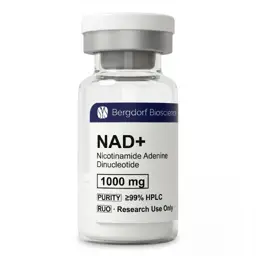
The common vial size is 1000 mg. Adding 10 mL of bacteriostatic water gives a concentration of 100 mg/mL.
At a dose of 250 mg, a 1000 mg vial provides 4 administrations. Because the required volumes are relatively large, some research protocols split a single dose or use a smaller reconstitution volume to raise the concentration. Use the NAD+ calculator above to compute exact volumes for any vial size, reconstitution volume, and target dose.
NAD+ is well known for producing intense but short-lived sensations when administered too quickly. Research protocols therefore consistently recommend a slow injection. The large half-life discrepancy between NAD+ and its precursors is also relevant: with a systemic half-life of only about 1 to 2 hours, NAD+ is metabolized rapidly, which is why administration frequency is a deliberate part of protocol design.
NAD+ is supplied as a lyophilized (freeze-dried) powder in sealed vials. It must be reconstituted with bacteriostatic water (BAC water) before use. Do not use sterile water for injection for multi-dose vials. BAC water contains 0.9% benzyl alcohol, which inhibits microbial growth and extends the usable window of the reconstituted solution. Note that NAD+ requires larger reconstitution volumes than most peptides because of its milligram-scale dosing.
A slight yellow tint is not unusual for NAD+ solutions. However, if the solution appears cloudy, strongly discolored, or contains visible particulate matter, discard the vial and do not inject it.
NAD+ is an endogenous compound, and its safety profile in the research context is generally regarded as favorable. The most common observations relate less to the molecule itself than to the speed of administration. Because controlled clinical data on subcutaneous NAD+ are limited, all use explicitly remains in the research domain.
With slow administration and standard research doses, NAD+ is generally regarded as well tolerated. Given the absence of large-scale clinical trials on injectable use, caution is warranted, and consultation with a qualified healthcare provider is strongly recommended.
NAD+ is frequently considered alongside MOTS-c in longevity research, a mitochondrially encoded peptide that acts on metabolic stress. NAD+ provides the coenzyme that drives the respiratory chain, while MOTS-c acts as a signaling peptide that modulates metabolic adaptation. From a research perspective, both address the mitochondrion from different angles, which is why they are often studied together in protocols focused on mitochondrial function.
A conceptually interesting combination is NAD+ with 5-Amino-1MQ. 5-Amino-1MQ is an inhibitor of nicotinamide N-methyltransferase (NNMT), an enzyme that breaks down nicotinamide. By inhibiting this degradation pathway, it can theoretically keep more nicotinamide available for the NAD+ salvage pathway. Research therefore examines how supplying NAD+ and preserving its precursors complement one another.
NAD+ can also be considered alongside SS-31, a peptide that binds to cardiolipin in the inner mitochondrial membrane and supports the efficiency of the electron transport chain. While NAD+ supplies the fuel for the respiratory chain, SS-31 targets the structural integrity of the membrane on which those reactions take place. This combination is a common theme in research on mitochondrial bioenergetics.
Research-grade NAD+ is available directly from BergdorfBio: NAD+ at BergdorfBio.
No. NAD+ is a dinucleotide, not a peptide. It is not made of amino acids but of two linked nucleotides. It is listed in this calculator because it is handled like an injectable peptide in research: it ships as a lyophilized powder, is reconstituted with bacteriostatic water, and follows the same dosing and storage principles.
NMN (nicotinamide mononucleotide) and NR (nicotinamide riboside) are precursors that the cell must convert into NAD+. NAD+ is the finished coenzyme itself. Precursors are frequently studied orally and pass through several metabolic steps, whereas NAD+ is directly the active molecule. Research compares both approaches to understand how the cellular NAD+ pool can be maintained most effectively.
NAD+ is known for producing intense but short-lived sensations such as warmth, chest pressure, or nausea when administered too quickly. A markedly slower injection substantially reduces these reactions. For this reason, research protocols consistently recommend slow administration.
NAD+ has a half-life of only about 1 to 2 hours in the systemic circulation because it is rapidly metabolized by NAD+-consuming enzymes such as CD38 and through salvage pathways. This short half-life is the reason why administration frequency is a deliberately chosen element of protocol design in the research context.
No. NAD+ is a metabolic coenzyme, not a hormone. It does not bind to hormone receptors and has no direct effect on the hypothalamic-pituitary-gonadal axis, the thyroid, or the adrenal glands. No post-cycle therapy is required.
In research, NAD+ is frequently considered alongside mitochondrially oriented compounds such as MOTS-c or SS-31, as well as the NNMT inhibitor 5-Amino-1MQ. Each compound should, however, be reconstituted separately and administered in its own syringe, as their combined stability in solution is not sufficiently characterized.
Because NAD+ is dosed in the milligram range, the required volumes are considerably larger than for microgram-dosed peptides. At a concentration of 100 mg/mL, a 250 mg dose already requires 2.5 mL. A 1 mL insulin syringe is therefore standard, and larger doses are split as needed.
BergdorfBio offers research-grade NAD+ with verified purity and concentration. View the product page: Buy NAD+ at BergdorfBio. All products are sold strictly for research purposes.
Medical Disclaimer: The information on this page is provided for educational and research purposes only. NAD+ is not an approved drug or medical treatment and is sold strictly for research use. Nothing on this page constitutes medical advice, diagnosis, or a recommendation to use any specific compound. Always consult a qualified healthcare professional before beginning any research protocol. BergdorfBio assumes no liability for the use or misuse of the information presented here.
Nuo miltelių iki paruošto švirkšto per penkis žingsnius. Kiekius automatiškai apskaičiuoja aukščiau esanti skaičiuoklė.
Leiskite flakonui ir vandeniui sušilti iki kambario temperatūros. Nuvalykite abu guminius kamštelius alkoholiu.
Didesniu švirkštu įtraukite skaičiuoklės rekomenduojamą BAC vandens kiekį.
Leiskite vandeniui tekėti peptido flakono sienele, nepurkškite jo tiesiai ant miltelių.
Atsargiai pasukite flakoną, nekratykite. Milteliai ištirps ir tirpalas taps skaidrus per 1-2 minutes.
Insulino švirkštu įtraukite tiksliai iki apskaičiuotos žymės. Paruošta.
Įprastos pradinės reikšmės orientacijai. Kiekviena eilutė atidaro to peptido skaičiuoklę.
| Peptidas | Kategorija | Įprasta dozė | Flakonų dydžiai | BAC (pradžiai) | Prieinamumas | Skaičiuoti |
|---|---|---|---|---|---|---|
| VIP | Nevropeptidų tyrimai | - | 10 mg | 2 ml | Tik skaičiuoklė | Skaičiuoti |
| Retatrutide | GLP-1/GIP/GCG | 0,5-12 mg | 2 / 5 / 10 / 15 mg | 2 ml | Tik skaičiuoklė | Skaičiuoti |
| Cagrilintide | Amilino analogas | - | 5 mg | 2 ml | Tik skaičiuoklė | Skaičiuoti |
| Semaglutide | GLP-1 | 0,25-2,4 mg | 2 / 5 / 10 mg | 2 ml | Tik skaičiuoklė | Skaičiuoti |
| Tirzepatide | GLP-1/GIP | 2,5-15 mg | 10 / 15 / 20 / 30 / 60 / 90 mg | 2 ml | Tik skaičiuoklė | Skaičiuoti |
| GHK-Cu | Vario peptidas | 1-4 mg | 10 / 20 / 50 mg | 5 ml | Tik skaičiuoklė | Skaičiuoti |
| AHK-Cu | Vario peptidas | - | 100 mg | 5 ml | Tik skaičiuoklė | Skaičiuoti |
| BPC-157 | Audinių atkūrimas | 0,2-0,5 mg | 2 / 5 / 10 mg | 2 ml | Tik skaičiuoklė | Skaičiuoti |
| TB-500 | Thymosin Beta-4 | 2-5 mg | 2 / 5 / 10 mg | 2 ml | Tik skaičiuoklė | Skaičiuoti |
| CJC-1295 (be DAC) | GHRH analogas | 100-200 mcg | 2 / 5 / 10 mg | 2 ml | Tik skaičiuoklė | Skaičiuoti |
| Ipamorelin | GHRP | 200-300 mcg | 2 / 5 mg | 2 ml | Tik skaičiuoklė | Skaičiuoti |
| AOD-9604 | Riebalų apykaita | 250-500 mcg | 2 / 5 mg | 2 ml | Tik skaičiuoklė | Skaičiuoti |
| PT-141 | Bremelanotide | - | 2 / 5 / 10 mg | 2 ml | Tik skaičiuoklė | Skaičiuoti |
| MOTS-c | Mitochondrinis | 5-10 mg | 5 / 10 mg | 2 ml | Tik skaičiuoklė | Skaičiuoti |
| Selank | Anksiolitinis | 150-500 mcg | 2 / 5 / 10 mg | 2 ml | Tik skaičiuoklė | Skaičiuoti |
| SS-31 | Elamipretide | 0,1-1 mg | 5 / 10 mg | 2 ml | Tik skaičiuoklė | Skaičiuoti |
| Glow Stack | Stack | 0,5-2 mg | 70 mg | 3 ml | Tik skaičiuoklė | Skaičiuoti |
| Klow Stack | Stack | 0,5-2 mg | 55 mg | 3 ml | Tik skaičiuoklė | Skaičiuoti |
| Melanotan II | Melanokortinas | 100-1000 mcg | 5 / 10 mg | 2 ml | Tik skaičiuoklė | Skaičiuoti |
| Melanotan I | Melanokortinas | - | 5 / 10 mg | 2 ml | Tik skaičiuoklė | Skaičiuoti |
| Sermorelin | GHRH analogas | 50-300 mcg | 5 mg | 2 ml | Tik skaičiuoklė | Skaičiuoti |
| Tesamorelin | GHRH analogas | 1-2 mg | 10 / 20 mg | 2 ml | Tik skaičiuoklė | Skaičiuoti |
| Thymosin Alpha-1 | Timuso peptidas | 0,8-3,2 mg | 1.6 / 5 / 10 mg | 1 ml | Tik skaičiuoklė | Skaičiuoti |
| Epithalon | Ilgaamžiškumas | 2-10 mg | 10 / 20 / 50 mg | 2 ml | Tik skaičiuoklė | Skaičiuoti |
| KPV | Imuninė sistema / barjeras | 100-1000 mcg | 5 / 10 mg | 2 ml | Tik skaičiuoklė | Skaičiuoti |
| HGH Fragment 176-191 | Metabolinis fragmentas | 100-500 mcg | 2 / 5 / 10 mg | 2 ml | Tik skaičiuoklė | Skaičiuoti |
| Semax | Kognityvinis | 100-1000 mcg | 10 / 30 mg | 2 ml | Tik skaičiuoklė | Skaičiuoti |
| N-Acetyl Semax | Kognityvinis | 100-1000 mcg | 5 / 10 mg | 2 ml | Tik skaičiuoklė | Skaičiuoti |
| Hexarelin | GHRP | 50-200 mcg | 2 / 5 mg | 2 ml | Tik skaičiuoklė | Skaičiuoti |
| GHRP-6 | GHRP | 50-300 mcg | 2 / 5 mg | 2 ml | Tik skaičiuoklė | Skaičiuoti |
| GHRP-2 | GHRP | 50-250 mcg | 2 / 5 mg | 2 ml | Tik skaičiuoklė | Skaičiuoti |
| DSIP | Miegas | 50-500 mcg | 10 mg | 2 ml | Tik skaičiuoklė | Skaičiuoti |
| 5-Amino-1MQ | Metabolinis | 2,5-10 mg | 10 mg | 2 ml | Tik skaičiuoklė | Skaičiuoti |
| Pinealon | Tiriamasis peptidas | - | 10 mg | 2 ml | Tik skaičiuoklė | Skaičiuoti |
| Survodutide | GLP-1/glukagonas | - | 10 mg | 2 ml | Tik skaičiuoklė | Skaičiuoti |
| Kisspeptin-10 | KISS1R / GPR54 | - | 10 mg | 2 ml | Tik skaičiuoklė | Skaičiuoti |
| HGH 191AA | Augimo hormonas | 1-5 mg | 10 mg | 1 ml | Tik skaičiuoklė | Skaičiuoti |
| NAD+ | Ilgaamžiškumas / kofaktorius | 100-500 mg | 1000 mg | 10 ml | Tik skaičiuoklė | Skaičiuoti |
Reikšmės skirtos orientacijai tyrimų kontekste ir nepakeičia profesionalios konsultacijos.
Koncentracijos ir injekcijos tūrio apskaičiavimas atrodo paprastas, tačiau tai dažniausia klaidų priežastis. Net 10 % paklaida ištirpinant reiškia, kad veikliosios medžiagos gausite per mažai arba netyčia suleisite per daug.
Liofilizuoti peptidai tiekiami miligramais ir ištirpinami bakteriostatiniame vandenyje (BAC vanduo). Peptido ir vandens santykis lemia koncentraciją, o iš jos išplaukia, kiek vienetų įtrauksite į insulino švirkštą. Insulino švirkštai graduoti vienetais, o ne miligramais. Skaičiuoklė atlieka šį perskaičiavimą ir patikrina patikimumą dėl pavojingiausios klaidos: supainioti mg ir mcg.
Miligramas (mg) yra vienetas, kuriuo parduodami liofilizuoti peptidai, pavyzdžiui, „5 mg BPC-157“. Mikrogramas (mcg) matuoja vienkartinę dozę, pavyzdžiui, „250 mcg vienai injekcijai“. 1 mg = 1 000 mcg. Skaičiuoklė perskaičiuoja automatiškai ir įspėja, jei įvestis atrodo kaip supainioti vienetai.
U-100 reiškia, kad švirkštas sugraduotas 100 vienetų mililitre. 100 IU = 1 ml, todėl 10 IU = 0,10 ml, nepriklausomai nuo to, kas yra švirkšte. IU skaičiavimas pagrįstas būtent šiuo santykiu.
Kai peptido daug, o vandens mažai, tirpalas tampa labai koncentruotas, todėl vienos dozės tūris būna mažas ir sunkiai nuskaitomas. Naudokitės rekonstitucijos pagalbininku: jis suranda vandens kiekį, kuris duoda aiškią, lengvai nuskaitomą žymę.
Šaldytuve 2-8 °C temperatūroje paprastai 21-30 dienų. Pažymėkite ant flakono rekonstitucijos datą. Drumstas tirpalas ar dalelės netinka.
Mišiniuose viename flakone yra kelios veikliosios medžiagos. Tiesiog pasirinkite mišinį kaip peptidą: skaičiuoklė papildomai parodys, kiek kiekvieno komponento yra Jūsų injekcijoje. Jei norite derinti kelis atskirus flakonus, naudokitės stackų kūrėju.
Ne. Paskutiniai nustatymai saugomi šioje naršyklėje ir atkuriami kitą kartą. Skaičiavimus galite atkurti ir iš istorijos, išsaugoti kaip protokolą arba bendrinti nuoroda.
Pasirinkite peptidą, kad atidarytumėte jo skaičiuoklės puslapį su iš anksto užpildytomis reikšmėmis.
Turime
Turime
Peržiūrėti produktą
NAD+Peržiūrėti produktą
NAD+Įprastos pradinės reikšmės orientacijai. Kiekviena eilutė atidaro to peptido skaičiuoklę.
| Peptidas | Kategorija | Įprasta dozė | Flakonų dydžiai | BAC (pradžiai) | Prieinamumas | Skaičiuoti |
|---|---|---|---|---|---|---|
| VIP | Nevropeptidų tyrimai | - | 10 mg | 2 ml | Turime | Skaičiuoti |
| Retatrutide | GLP-1/GIP/GCG | 0,5-12 mg | 2 / 5 / 10 / 15 mg | 2 ml | Turime | Skaičiuoti |
| Cagrilintide | Amilino analogas | - | 5 mg | 2 ml | Turime | Skaičiuoti |
| Tirzepatide | GLP-1/GIP | 2,5-15 mg | 10 / 15 / 20 / 30 / 60 / 90 mg | 2 ml | Turime | Skaičiuoti |
| GHK-Cu | Vario peptidas | 1-4 mg | 10 / 20 / 50 mg | 5 ml | Turime | Skaičiuoti |
| AHK-Cu | Vario peptidas | - | 100 mg | 5 ml | Turime | Skaičiuoti |
| BPC-157 | Audinių atkūrimas | 0,2-0,5 mg | 2 / 5 / 10 mg | 2 ml | Turime | Skaičiuoti |
| TB-500 | Thymosin Beta-4 | 2-5 mg | 2 / 5 / 10 mg | 2 ml | Turime | Skaičiuoti |
| CJC-1295 (be DAC) | GHRH analogas | 100-200 mcg | 2 / 5 / 10 mg | 2 ml | Turime | Skaičiuoti |
| Ipamorelin | GHRP | 200-300 mcg | 2 / 5 mg | 2 ml | Turime | Skaičiuoti |
| PT-141 | Bremelanotide | - | 2 / 5 / 10 mg | 2 ml | Turime | Skaičiuoti |
| MOTS-c | Mitochondrinis | 5-10 mg | 5 / 10 mg | 2 ml | Turime | Skaičiuoti |
| Selank | Anksiolitinis | 150-500 mcg | 2 / 5 / 10 mg | 2 ml | Turime | Skaičiuoti |
| SS-31 | Elamipretide | 0,1-1 mg | 5 / 10 mg | 2 ml | Turime | Skaičiuoti |
| Glow Stack | Stack | 0,5-2 mg | 70 mg | 3 ml | Turime | Skaičiuoti |
| Klow Stack | Stack | 0,5-2 mg | 55 mg | 3 ml | Turime | Skaičiuoti |
| Melanotan II | Melanokortinas | 100-1000 mcg | 5 / 10 mg | 2 ml | Turime | Skaičiuoti |
| Melanotan I | Melanokortinas | - | 5 / 10 mg | 2 ml | Turime | Skaičiuoti |
| Sermorelin | GHRH analogas | 50-300 mcg | 5 mg | 2 ml | Turime | Skaičiuoti |
| Tesamorelin | GHRH analogas | 1-2 mg | 10 / 20 mg | 2 ml | Turime | Skaičiuoti |
| Thymosin Alpha-1 | Timuso peptidas | 0,8-3,2 mg | 1.6 / 5 / 10 mg | 1 ml | Turime | Skaičiuoti |
| Epithalon | Ilgaamžiškumas | 2-10 mg | 10 / 20 / 50 mg | 2 ml | Turime | Skaičiuoti |
| KPV | Imuninė sistema / barjeras | 100-1000 mcg | 5 / 10 mg | 2 ml | Turime | Skaičiuoti |
| Semax | Kognityvinis | 100-1000 mcg | 10 / 30 mg | 2 ml | Turime | Skaičiuoti |
| DSIP | Miegas | 50-500 mcg | 10 mg | 2 ml | Turime | Skaičiuoti |
| 5-Amino-1MQ | Metabolinis | 2,5-10 mg | 10 mg | 2 ml | Turime | Skaičiuoti |
| Pinealon | Tiriamasis peptidas | - | 10 mg | 2 ml | Turime | Skaičiuoti |
| Survodutide | GLP-1/glukagonas | - | 10 mg | 2 ml | Turime | Skaičiuoti |
| Kisspeptin-10 | KISS1R / GPR54 | - | 10 mg | 2 ml | Turime | Skaičiuoti |
| NAD+ | Ilgaamžiškumas / kofaktorius | 100-500 mg | 1000 mg | 10 ml | Turime | Skaičiuoti |
| Semaglutide | GLP-1 | 0,25-2,4 mg | 2 / 5 / 10 mg | 2 ml | Tik skaičiuoklė | Skaičiuoti |
| AOD-9604 | Riebalų apykaita | 250-500 mcg | 2 / 5 mg | 2 ml | Tik skaičiuoklė | Skaičiuoti |
| HGH Fragment 176-191 | Metabolinis fragmentas | 100-500 mcg | 2 / 5 / 10 mg | 2 ml | Tik skaičiuoklė | Skaičiuoti |
| N-Acetyl Semax | Kognityvinis | 100-1000 mcg | 5 / 10 mg | 2 ml | Tik skaičiuoklė | Skaičiuoti |
| Hexarelin | GHRP | 50-200 mcg | 2 / 5 mg | 2 ml | Tik skaičiuoklė | Skaičiuoti |
| GHRP-6 | GHRP | 50-300 mcg | 2 / 5 mg | 2 ml | Tik skaičiuoklė | Skaičiuoti |
| GHRP-2 | GHRP | 50-250 mcg | 2 / 5 mg | 2 ml | Tik skaičiuoklė | Skaičiuoti |
| HGH 191AA | Augimo hormonas | 1-5 mg | 10 mg | 1 ml | Tik skaičiuoklė | Skaičiuoti |
Reikšmės skirtos orientacijai tyrimų kontekste ir nepakeičia profesionalios konsultacijos.
Įprastos pradinės reikšmės orientacijai. Kiekviena eilutė atidaro to peptido skaičiuoklę.
| Peptidas | Kategorija | Įprasta dozė | Flakonų dydžiai | BAC (pradžiai) | Prieinamumas | Skaičiuoti |
|---|---|---|---|---|---|---|
| VIP | Nevropeptidų tyrimai | - | 10 mg | 2 ml | Turime | Skaičiuoti |
| Retatrutide | GLP-1/GIP/GCG | 0,5-12 mg | 2 / 5 / 10 / 15 mg | 2 ml | Turime | Skaičiuoti |
| Cagrilintide | Amilino analogas | - | 5 mg | 2 ml | Turime | Skaičiuoti |
| Tirzepatide | GLP-1/GIP | 2,5-15 mg | 10 / 15 / 20 / 30 / 60 / 90 mg | 2 ml | Turime | Skaičiuoti |
| GHK-Cu | Vario peptidas | 1-4 mg | 10 / 20 / 50 mg | 5 ml | Turime | Skaičiuoti |
| AHK-Cu | Vario peptidas | - | 100 mg | 5 ml | Turime | Skaičiuoti |
| BPC-157 | Audinių atkūrimas | 0,2-0,5 mg | 2 / 5 / 10 mg | 2 ml | Turime | Skaičiuoti |
| TB-500 | Thymosin Beta-4 | 2-5 mg | 2 / 5 / 10 mg | 2 ml | Turime | Skaičiuoti |
| CJC-1295 (be DAC) | GHRH analogas | 100-200 mcg | 2 / 5 / 10 mg | 2 ml | Turime | Skaičiuoti |
| Ipamorelin | GHRP | 200-300 mcg | 2 / 5 mg | 2 ml | Turime | Skaičiuoti |
| PT-141 | Bremelanotide | - | 2 / 5 / 10 mg | 2 ml | Turime | Skaičiuoti |
| MOTS-c | Mitochondrinis | 5-10 mg | 5 / 10 mg | 2 ml | Turime | Skaičiuoti |
| Selank | Anksiolitinis | 150-500 mcg | 2 / 5 / 10 mg | 2 ml | Turime | Skaičiuoti |
| SS-31 | Elamipretide | 0,1-1 mg | 5 / 10 mg | 2 ml | Turime | Skaičiuoti |
| Glow Stack | Stack | 0,5-2 mg | 70 mg | 3 ml | Turime | Skaičiuoti |
| Klow Stack | Stack | 0,5-2 mg | 55 mg | 3 ml | Turime | Skaičiuoti |
| Melanotan II | Melanokortinas | 100-1000 mcg | 5 / 10 mg | 2 ml | Turime | Skaičiuoti |
| Melanotan I | Melanokortinas | - | 5 / 10 mg | 2 ml | Turime | Skaičiuoti |
| Sermorelin | GHRH analogas | 50-300 mcg | 5 mg | 2 ml | Turime | Skaičiuoti |
| Tesamorelin | GHRH analogas | 1-2 mg | 10 / 20 mg | 2 ml | Turime | Skaičiuoti |
| Thymosin Alpha-1 | Timuso peptidas | 0,8-3,2 mg | 1.6 / 5 / 10 mg | 1 ml | Turime | Skaičiuoti |
| Epithalon | Ilgaamžiškumas | 2-10 mg | 10 / 20 / 50 mg | 2 ml | Turime | Skaičiuoti |
| KPV | Imuninė sistema / barjeras | 100-1000 mcg | 5 / 10 mg | 2 ml | Turime | Skaičiuoti |
| Semax | Kognityvinis | 100-1000 mcg | 10 / 30 mg | 2 ml | Turime | Skaičiuoti |
| DSIP | Miegas | 50-500 mcg | 10 mg | 2 ml | Turime | Skaičiuoti |
| 5-Amino-1MQ | Metabolinis | 2,5-10 mg | 10 mg | 2 ml | Turime | Skaičiuoti |
| Pinealon | Tiriamasis peptidas | - | 10 mg | 2 ml | Turime | Skaičiuoti |
| Survodutide | GLP-1/glukagonas | - | 10 mg | 2 ml | Turime | Skaičiuoti |
| Kisspeptin-10 | KISS1R / GPR54 | - | 10 mg | 2 ml | Turime | Skaičiuoti |
| NAD+ | Ilgaamžiškumas / kofaktorius | 100-500 mg | 1000 mg | 10 ml | Turime | Skaičiuoti |
| Semaglutide | GLP-1 | 0,25-2,4 mg | 2 / 5 / 10 mg | 2 ml | Tik skaičiuoklė | Skaičiuoti |
| AOD-9604 | Riebalų apykaita | 250-500 mcg | 2 / 5 mg | 2 ml | Tik skaičiuoklė | Skaičiuoti |
| HGH Fragment 176-191 | Metabolinis fragmentas | 100-500 mcg | 2 / 5 / 10 mg | 2 ml | Tik skaičiuoklė | Skaičiuoti |
| N-Acetyl Semax | Kognityvinis | 100-1000 mcg | 5 / 10 mg | 2 ml | Tik skaičiuoklė | Skaičiuoti |
| Hexarelin | GHRP | 50-200 mcg | 2 / 5 mg | 2 ml | Tik skaičiuoklė | Skaičiuoti |
| GHRP-6 | GHRP | 50-300 mcg | 2 / 5 mg | 2 ml | Tik skaičiuoklė | Skaičiuoti |
| GHRP-2 | GHRP | 50-250 mcg | 2 / 5 mg | 2 ml | Tik skaičiuoklė | Skaičiuoti |
| HGH 191AA | Augimo hormonas | 1-5 mg | 10 mg | 1 ml | Tik skaičiuoklė | Skaičiuoti |
Reikšmės skirtos orientacijai tyrimų kontekste ir nepakeičia profesionalios konsultacijos.
Pasirinkite peptidą, kad atidarytumėte jo skaičiuoklės puslapį su iš anksto užpildytomis reikšmėmis.
Pasirinkite peptidą, kad atidarytumėte jo skaičiuoklės puslapį su iš anksto užpildytomis reikšmėmis.