
Bacteriostatic Water: The Standard Solvent for Research Peptides
Dr. Sieglinde Klaus
Scientific Editorial Team · Bergdorf Bioscience
Table of Contents
- 01What exactly is bacteriostatic water?
- 02Why is 0.9% benzyl alcohol the preservative of choice?
- 03How does bacteriostatic water differ from sterile water?
- 04Why is it the standard solvent for lyophilised research peptides?
- 05How much bacteriostatic water do you use per vial?
- 06How long does bacteriostatic water last after opening?
- 07How do you store reconstituted peptides correctly?
- 08What mistakes in use should you avoid?
- 09When is bacteriostatic water not the right choice?
- Can bacteriostatic water be used more than once?
- Is bacteriostatic water the same as sterile water?
- Does bacteriostatic water need to be refrigerated?
- How do I know the solution is no longer usable?
Bacteriostatic water is sterile water for injection with 0.9% (9 mg/mL) benzyl alcohol added as a bacteriostatic preservative. That additive suppresses the growth of many bacteria and, in a research setting, allows repeated withdrawals from a single vial. This is precisely why it is the standard solvent for reconstituting lyophilised research peptides. This guide explains its composition, how it differs from other types of water, and its shelf life once opened.
What exactly is bacteriostatic water?
Bacteriostatic water (often shortened to BAC water) is non-pyrogenic, sterile water for injection per USP that contains a single additive: 0.9% benzyl alcohol, equal to 9 mg per millilitre. It is clear, colourless, and nearly odourless. The term "bacteriostatic" captures its core property: the water suppresses the multiplication of many microorganisms rather than actively killing them. The root "stasis" means standstill, not destruction.
Unlike plain distilled or demineralised laboratory water, BAC water is a precisely specified pharmaceutical product: defined purity, a set pH range (typically 4.5 to 7.0), controlled osmolarity, and a documented preservative content. Alongside phenol, m-cresol, and chlorobutanol, benzyl alcohol is one of the most widely used antimicrobial preservatives in parenteral preparations, as a review of preservatives in parenterals summarises Meyer et al., 2007.
For research applications, that controlled background matters. A solution of known composition delivers more reproducible conditions than improvised lab water. Researchers working with lyophilised peptides can order bacteriostatic water and receive a standardised 10 mL vial with a defined benzyl alcohol content.
Why is 0.9% benzyl alcohol the preservative of choice?
Benzyl alcohol is an aromatic alcohol that, even at low concentration, acts across a broad spectrum of vegetative bacteria, yeasts, and moulds. The proposed mechanism rests on disrupting the bacterial cell membrane and membrane-associated transport processes, which halts the proliferation of the organisms. At the standardised 0.9% concentration, the multiplication of typical contaminants such as Staphylococcus aureus, Escherichia coli, Pseudomonas aeruginosa, Candida albicans, and Aspergillus niger is suppressed.
The figure 0.9% is no accident but a compromise. It is high enough to act reliably as a bacteriostat and low enough to preserve the tolerability of the solution and its compatibility with sensitive active ingredients. A systematic review of preservatives in protein and peptide formulations names phenol and benzyl alcohol as the two most common preservatives in peptide and protein products and discusses their interactions with molecular stability Stroppel et al., 2023.
Important: benzyl alcohol does not act against bacterial spores and is no substitute for sterilisation. It merely provides a window during which a vial, once aseptically opened, can be used multiple times with correct handling. A safety note from the clinical literature concerns neonates: high cumulative benzyl alcohol doses were linked to the so-called "gasping syndrome" Gershanik et al., 1982. In a research context, this underscores why concentration-accurate, declared products deserve preference.
How does bacteriostatic water differ from sterile water?
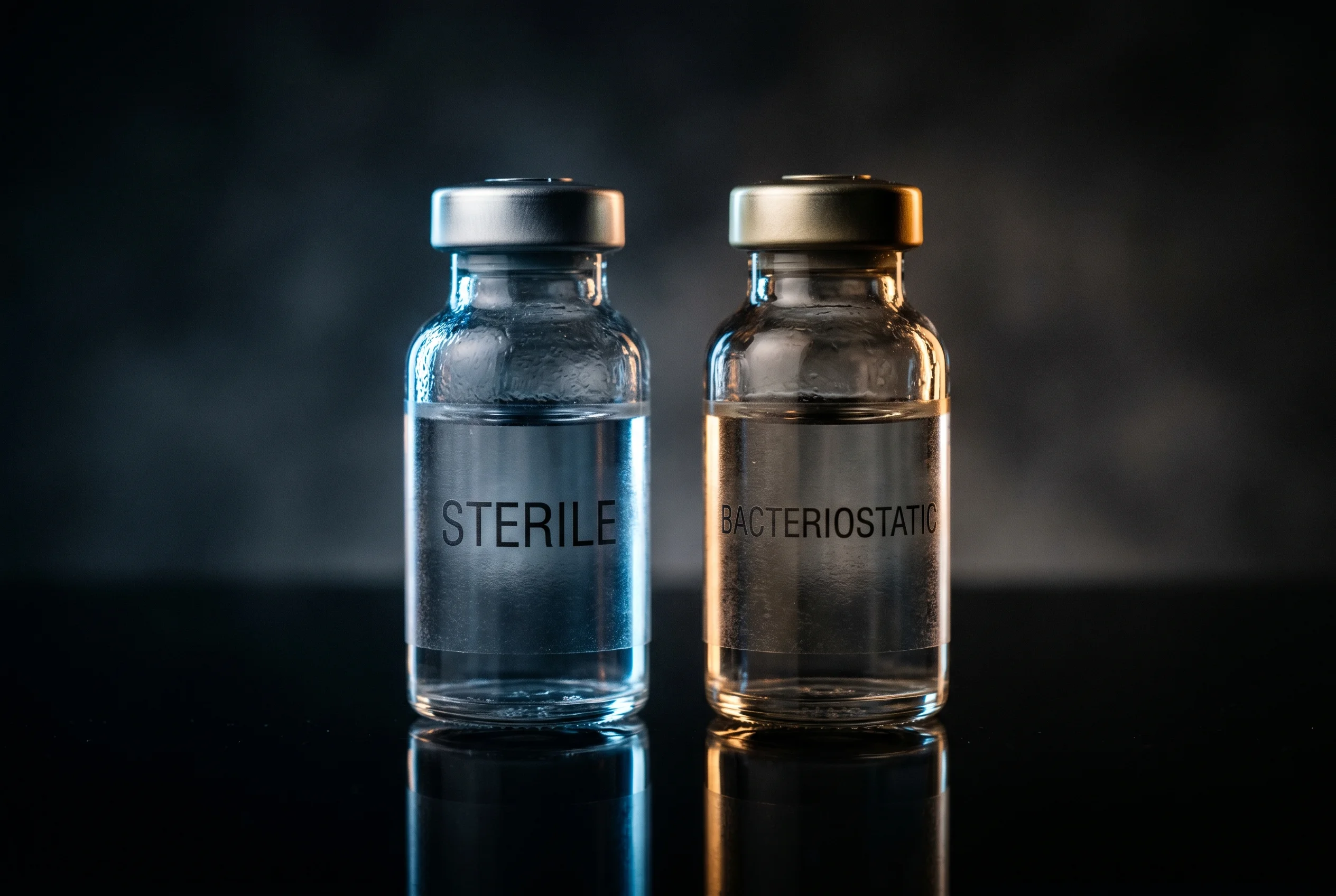
The difference lies solely in the preservative. Sterile water for injection (SWFI) contains no additives whatsoever: it is pure, non-pyrogenic water and guarantees sterility only up to the moment it is punctured. Once a needle pierces the vial, nothing prevents introduced microbes from multiplying. Sterile water is therefore intended for single use and should be discarded after opening.
Bacteriostatic water, by contrast, contains 0.9% benzyl alcohol and can therefore serve as a multiple-dose container. That is exactly its reason for existing: repeated withdrawals from the same vial over a limited period. "Normal" water, such as tap, mineral, or plain distilled water, is entirely unsuitable for peptide work. It is neither sterile nor pyrogen-free, contains dissolved minerals, possible endotoxins, and an uncontrolled pH that can compromise sensitive peptide structures.
The three categories in brief:
- Sterile water (SWFI): no additives, single use only, discard after puncture.
- Bacteriostatic water: 0.9% benzyl alcohol, multiple withdrawals possible over a limited time.
- Normal/distilled water: not sterile, not pyrogen-free, unsuitable for research peptides.
For solutions consumed within minutes, sterile water may suffice. For several withdrawals across days, bacteriostatic water is the more rational choice.
Why is it the standard solvent for lyophilised research peptides?
Lyophilised peptides come as a freeze-dried powder, which is the most thermodynamically stable form. In the dry state, hydrolytic and oxidative degradation pathways are largely braked. As soon as the powder is dissolved in water, however, the stability clock starts: in aqueous solution, chemical processes such as deamidation, oxidation, hydrolysis, and aggregation proceed and can alter the integrity of the molecule over days to weeks Nugrahadi et al., 2023.
This is exactly where BAC water shows its practical advantage. Because a lyophilised batch often contains more material than a single investigation requires, multiple withdrawals are the norm. If unpreserved sterile water were used, the reconstituted solution would have to be consumed or discarded almost immediately, since introduced microbes could grow unchecked. The benzyl alcohol provides the window in which several aseptic withdrawals are defensible.
For reconstitution technique itself, such as adding the solvent slowly down the glass wall rather than directly onto the powder, and swirling gently rather than shaking, the detailed peptide reconstitution guide is worth consulting. Bacteriostatic water is the solvent of choice for most readily water-soluble peptides; strongly hydrophobic or disulphide-containing sequences may require different solvents.
How much bacteriostatic water do you use per vial?
The amount used is not a fixed rule but a question of the desired concentration. The basic calculation is: concentration equals peptide mass divided by solvent volume. A typical example from research practice: dissolving 10 mg of lyophilised peptide in 2 mL of bacteriostatic water yields a concentration of 5 mg/mL. Dissolving the same 10 mg in 1 mL gives 10 mg/mL.
What matters is translating this into withdrawn volumes. At 5 mg/mL, 0.1 mL of solution (marked as 10 units on an insulin syringe) corresponds to exactly 0.5 mg of active substance. A researcher needing smaller aliquots chooses a larger solvent volume to read the scale more precisely. Anyone wanting to use up the vial quickly picks a smaller volume.
Practical reference points:
- More solvent (e.g. 2 to 3 mL): lower concentration, larger withdrawal volumes, easier to measure exactly.
- Less solvent (e.g. 1 mL): higher concentration, smaller withdrawal volumes, less solution per vial.
- Mind the capacity: a 10 mL vial of bacteriostatic water mathematically covers several peptide vials, depending on the chosen volume.
Important in a research context: these figures serve only for concentration calculation and documentation, never for human use.
How long does bacteriostatic water last after opening?
Unopened vials are stable until the expiry date printed on the label, provided they are stored cool, dry, and protected from light. After the first puncture the situation changes: while the benzyl alcohol keeps the solution bacteriostatic for a limited period, every needle puncture raises the contamination risk. The generally accepted reference value is a usable life of about 28 days after opening, when stored refrigerated between 2 and 8 degrees Celsius.
This 28-day span corresponds to the window over which the preservative can cover repeated withdrawals under correct aseptic handling. It is no blank cheque: visible cloudiness, particulates, discolouration, or a damaged closure mean immediate disposal, regardless of the date. Preservation delays microbial growth but does not replace clean technique.
Recommended storage practice at a glance:
- Unopened: cool, dry, protected from light until the expiry date.
- Opened: refrigerated at 2 to 8 degrees Celsius, reference value around 28 days.
- Hygiene: disinfect the rubber septum with an alcohol swab before every withdrawal, use a fresh sterile needle.
- Do not freeze: freezing is not intended for the solvent itself.
Note too that the shelf life of the already reconstituted peptide solution is a separate, often shorter question and depends heavily on the specific molecule Nugrahadi et al., 2023.
How do you store reconstituted peptides correctly?
Once a lyophilised peptide is dissolved in bacteriostatic water, different rules apply than for the dry powder. The dissolved form is markedly less stable: shelf life drops from months or years in the lyophilisate to typically days or a few weeks. The limiting factor is chemical and physical degradation reactions in the aqueous environment, tied to temperature, light, and pH.
The reconstituted solution belongs in the refrigerator, usually at 2 to 8 degrees Celsius, and should be protected from light. Repeated freeze-thaw cycles are to be avoided, as each cycle can cause a measurable loss of molecular integrity through denaturation and aggregation. Anyone wishing to keep a larger quantity for a longer time therefore divides the solution into single-use portions (aliquots) immediately after reconstitution.
Practical cornerstones of storage:
- Short term: reconstituted solution at 2 to 8 degrees Celsius, protected from light.
- Longer term: split into aliquots to minimise freeze-thaw cycles.
- Labelling: document the reconstitution date, concentration, and solvent.
- Stability is molecule-dependent: disulphide-containing or especially oxidation-sensitive sequences demand more caution Nugrahadi et al., 2023.
This practice protects the reproducibility of research data, because a degraded peptide no longer yields reliable results.
What mistakes in use should you avoid?
The most common mistakes lie less in the chemistry than in the handling. A classic beginner error is forcing the solvent directly onto the peptide pellet under pressure. The mechanical jet can damage sensitive structures and create foam. It is better to let the bacteriostatic water run slowly down the inner wall of the glass vial and bring the powder into solution by gentle swirling, never by vigorous shaking.
Equally problematic is neglecting asepsis. Failing to disinfect the rubber septum with an alcohol swab before each withdrawal, or reusing the same needle, undermines exactly the protection the benzyl alcohol is meant to offer. The bacteriostatic effect is a reserve, not a substitute for clean technique.
Other typical stumbling blocks:
- Wrong solvent: tap or mineral water instead of BAC water, which destroys sterility and pH stability.
- Exceeded deadlines: using the solution beyond the 28-day mark or when cloudy.
- Wrong storage temperature: leaving the reconstituted solution at room temperature instead of refrigerating it.
- Missing documentation: no note on concentration and date, which jeopardises reproducibility.
Observing these points means using the preservative as intended: as a reliable window for clean, repeated withdrawals.
When is bacteriostatic water not the right choice?
Not every scenario calls for benzyl alcohol. If a solution is to be fully consumed within minutes, unpreserved sterile water may suffice, since no multiple-withdrawal window is needed. There are also peptides whose physicochemical properties require a different solvent. Strongly hydrophobic sequences often dissolve poorly in plain water and may need a small fraction of an organic solvent or a pH adjustment via dilute acetic acid.
Compatibility with the preservative itself is another consideration. The review of preservatives in protein and peptide formulations cited above describes that, in rare cases, preservatives can interact with sensitive molecules and, for example, promote aggregation Stroppel et al., 2023. For the vast majority of readily water-soluble peptides, however, BAC water is unproblematic and remains the pragmatic standard solvent.
Decision aid in brief:
- BAC water: the standard case, water-soluble peptide, several withdrawals planned over days.
- Sterile water: immediate single use, no preservation needed.
- Special solvent (e.g. dilute acetic acid, DMSO): poorly soluble or especially sensitive sequences.
The choice of solvent is thus part of the experimental design and should match the solubility, stability, and planned duration of use of the solution.
Can bacteriostatic water be used more than once?
Yes, that is exactly what it is designed for. The addition of 0.9% benzyl alcohol allows repeated withdrawals from the same vial over a limited period of about 28 days, provided handling is consistently aseptic and the solution is stored refrigerated.
Is bacteriostatic water the same as sterile water?
No. Both are sterile and non-pyrogenic, but only bacteriostatic water contains the preservative benzyl alcohol. Plain sterile water is intended for single use and should be discarded after puncture, whereas BAC water permits multiple withdrawals.
Does bacteriostatic water need to be refrigerated?
Unopened vials can be stored cool, dry, and protected from light at room temperature. After opening, refrigeration at 2 to 8 degrees Celsius is advisable, as it is for the reconstituted peptide solution made from it, which should be kept cool and protected from light in any case.
How do I know the solution is no longer usable?
Discard the solution at any visible change: cloudiness, suspended particles, discolouration, odour, or a damaged closure. Also, once the reference value of about 28 days after opening is exceeded, the vial should no longer be used, regardless of its outward appearance.
For research purposes only. Not for human consumption. Scientific editor: Dr. Sieglinde Klaus
References
- Gershanik J., et al. The Gasping Syndrome and Benzyl Alcohol Poisoning. New England Journal of Medicine. 1982.DOI
- Stroppel L., et al. Antimicrobial Preservatives for Protein and Peptide Formulations: An Overview. Pharmaceutics. 2023.DOI
- Nugrahadi P., et al. Designing Formulation Strategies for Enhanced Stability of Therapeutic Peptides in Aqueous Solutions: A Review. Pharmaceutics. 2023.DOI
- Meyer B., et al. Antimicrobial preservative use in parenteral products: Past and present. Journal of Pharmaceutical Sciences. 2007.DOI
