Ipamorelin: Effects and Dosing of the Selective GHRP in Research
Dr. Sieglinde Klaus
Scientific Editorial Team · Bergdorf Bioscience

Dr. Sieglinde Klaus
Scientific Editorial Team · Bergdorf Bioscience
Dr. Sieglinde Klaus
Scientific Editorial Team · Bergdorf Bioscience
Ipamorelin is a synthetic pentapeptide in the growth-hormone-secretagogue (GHRP) class. In preclinical research, the profile of ipamorelin effects and dosing is characterised by a selective, pulsatile release of growth hormone without any meaningful rise in cortisol or prolactin. This guide summarises the evidence strictly as research documentation and makes no claims about human use.
Ipamorelin is a synthetic pentapeptide with the sequence Aib-His-D-2-Nal-D-Phe-Lys-NH2. It belongs to the growth hormone secretagogue (GHS) family and, within it, to the growth-hormone-releasing peptide (GHRP) subgroup. Structurally it is derived from the GHRP-1 backbone but was deliberately modified to display a particularly narrow pharmacological profile.
The foundational characterisation comes from Raun et al., 1998, who described ipamorelin as "the first selective growth hormone secretagogue." In the taxonomy of research peptides, ipamorelin therefore sits between the older, less selective compounds such as GHRP-2 and GHRP-6 on one side and the GHRH analogues such as CJC-1295 or tesamorelin on the other. Whereas GHRH analogues act at the GHRH receptor, ipamorelin works at the ghrelin receptor.
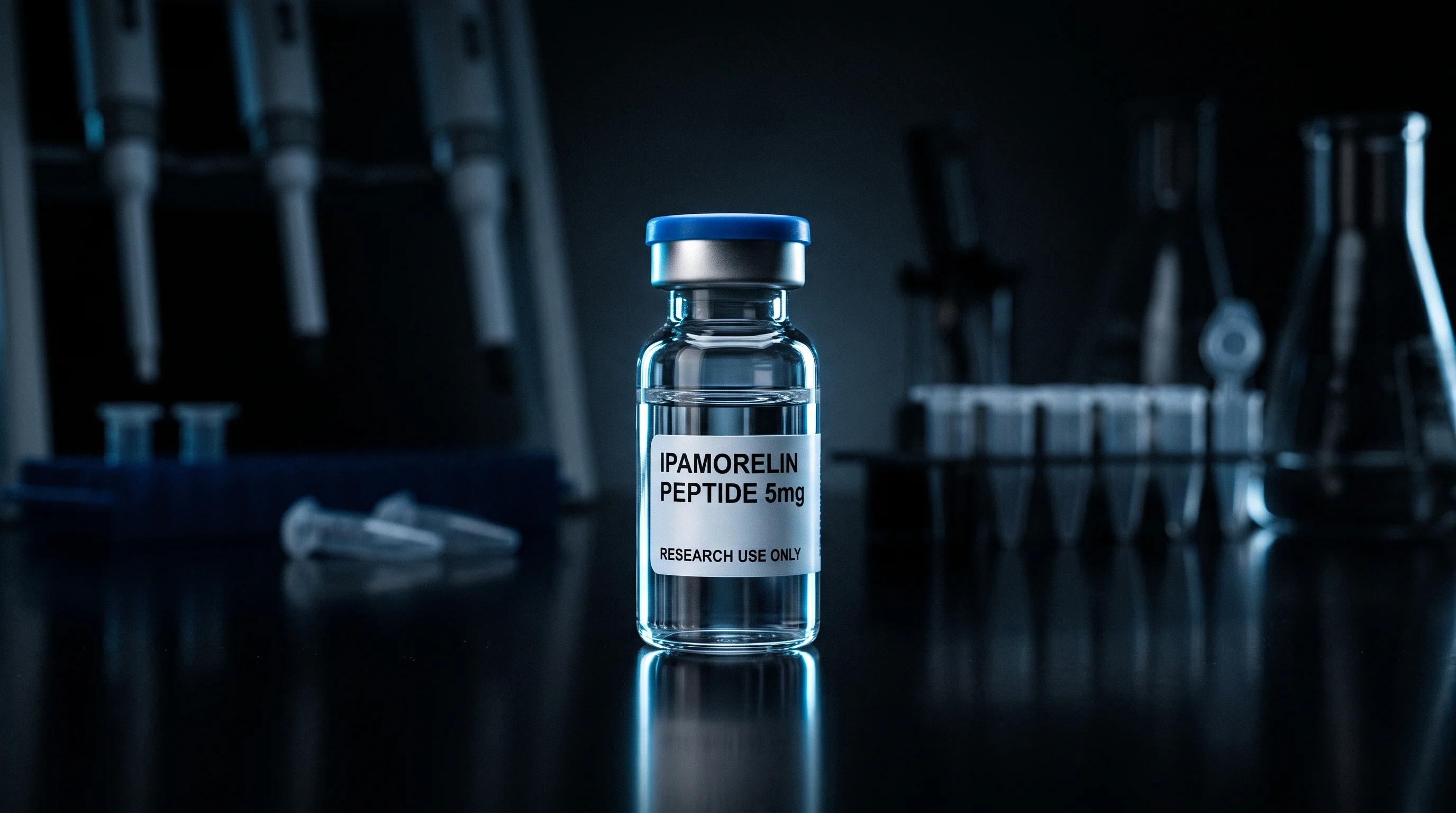
The molecular weight is around 711 daltons, making ipamorelin a comparatively small peptide. The free base is a white lyophilisate that, in laboratory practice, is reconstituted in bacteriostatic water and stored cool and protected from light. As a research compound, ipamorelin holds no marketing authorisation as a medicine; the available data derive overwhelmingly from cell-culture and animal models.
The documented profile of ipamorelin effects and dosing rests almost entirely on preclinical models. In the original description by Raun et al., 1998, ipamorelin released growth hormone dose-dependently both in vitro on isolated pituitary cells and in vivo. Its efficacy and potency were comparable to GHRP-6, but the selective profile clearly distinguished the compound from the older members of the class.
In animal models, intravenous bolus doses in the range of 0.01 to 1 mg/kg were used. The rodent model of postoperative ileus by Venkova et al., 2009 used exactly this dose window and showed a dose-dependent acceleration of gastric emptying. For chronic administration, the bone study by Svensson et al., 2000 used subcutaneous 0.5 mg/kg per day over twelve weeks.
Important for correct interpretation: these figures are body-weight-based animal doses and cannot be transferred to humans. There is no established human dose outside the early clinical ileus study described below. Anyone wishing to follow the underlying pharmacokinetics can model the time courses in the ipamorelin peptide calculator. This guide deliberately provides no dosing recommendation for humans and documents only the published research doses.
Ipamorelin is an agonist at the growth hormone secretagogue receptor GHS-R1a, which is also the endogenous receptor for the hormone ghrelin. According to the review by Petersenn, 2002, this is a 366-amino-acid, seven-transmembrane-domain G-protein-coupled receptor (7-TM GPCR). The receptor exists in two splice variants: the active GHS-R1a, which binds acylated ghrelin, and the truncated GHS-R1b, which is pharmacologically inactive but can modulate the activity of 1a through heterodimerisation.
The signalling cascade runs via a Gq/11 protein. As Kojima and Kangawa, 2005 describe for the entire ghrelin system, the occupied receptor activates phospholipase C (PLC), which releases inositol trisphosphate (IP3). IP3 mobilises intracellular calcium, and the resulting calcium rise drives the exocytosis of growth hormone vesicles from the somatotroph cells of the pituitary.
Crucially, ipamorelin selectively mimics this ghrelin-mediated pathway. Bowers, 2001 positions the GHRP class as a whole as secretagogues at the same receptor at which endogenous ghrelin acts. Ipamorelin therefore does not engage the GHRH receptor but a parallel signalling route, which mechanistically explains the frequently studied combination with GHRH analogues.
Selectivity is the central feature that sets ipamorelin apart from older secretagogues. In the work of Raun et al., 1998, ipamorelin released growth hormone dose-dependently without measurably activating the adrenocorticotropic axis. Specifically, ACTH and cortisol did not rise above the levels already produced by GHRH alone, and prolactin was likewise unaffected.
This behaviour clearly distinguishes ipamorelin from GHRP-2 and GHRP-6, which in the same comparisons measurably raised ACTH, cortisol and prolactin. In the research literature, this narrow profile is described as "clean" or selective secretagogue behaviour and is regarded as the defining hallmark of the compound.
The mechanistic background lies in the specific receptor binding. Whereas the older GHRPs show a broader interaction across hypothalamic-pituitary pathways, ipamorelin preferentially activates the GH-releasing arm of the GHS-R1a signal. For preclinical research this matters, because it allows the release of growth hormone to be studied without parallel rises in stress hormones confounding the interpretation.
It remains, however, a preclinical characterisation. No therapeutic or body-composition claims for humans can be derived from the observed hormonal selectivity. Selectivity describes the endocrine response pattern in the model, not a proven benefit.
The kinetics of ipamorelin described in research are pulsatile and short. After subcutaneous injection in animal models, the rise in growth hormone begins within about 15 to 20 minutes. The peak of the GH pulse is typically reached after roughly 30 to 60 minutes, and levels return to baseline within about two to three hours.
This pattern is significant because it imitates the physiological pulsatility of the growth hormone axis rather than producing a persistently elevated level. In the research discussion it is emphasised that a pulsatile signal tends to preserve the natural regulation of the axis rather than continuously flooding the system. The short duration of action also explains why preclinical protocols used repeated administration.
The contrast with long-acting GHRH analogues is instructive here. Whereas CJC-1295 with DAC achieves half-lives of several days via albumin binding, ipamorelin is a short-acting peptide with a tightly limited time window. This juxtaposition makes the two compound classes frequent study partners.
Anyone wishing to model the underlying time-concentration courses can explore the parameters in the ipamorelin peptide calculator. The curves shown there serve solely to illustrate the pharmacokinetics scientifically and are not an application guide.
An instructive example of how ipamorelin effects and dosing interact comes from the bone study by Svensson et al., 2000. In this model, female rats received subcutaneous 0.5 mg/kg ipamorelin per day over twelve weeks. The question was whether the secretagogue influences bone mineral content.
The results showed an increase in body weight as well as in tibial and vertebral bone mineral content (BMC). At first glance this suggests a bone-building effect. The decisive nuance, however, lies in the correction: once BMC was normalised to the gain in body weight, the apparent advantage disappeared, and volumetric cortical bone mineral density (BMD) remained unchanged.
From this follows an important methodological point. The observed effect is growth-mediated, not density-mediated. The larger animal simply has more bone mass, without any increase in bone quality in terms of density. This distinction is a useful safeguard against over-interpretation: a rise in mineral content alone does not prove a gain in bone density.
For research this example is valuable because it shows how important the choice of metric is. It also underscores that preclinical endpoints must be interpreted carefully before conclusions are drawn. No statements about human bone health can be derived from it.
The only notable human data on ipamorelin come not from the growth-hormone or body-composition field but from gastroenterology. The phase-2 proof-of-concept study by Beck et al., 2014 investigated ipamorelin as a ghrelin mimetic for the management of postoperative ileus, the temporary intestinal paralysis after surgery.
In this double-blind, placebo-controlled trial, 114 patients after bowel resection received ipamorelin at a dose of 0.03 mg/kg intravenously twice daily, starting on the first postoperative day through day seven or until discharge. On the primary endpoint, time to tolerate solid food, the trial showed only a numerical, not statistically significant trend favoring ipamorelin (25.3 vs. 32.6 hours, p=0.15), with good tolerability.
This data point is central for two reasons. First, it establishes the only robust human dose documented in the literature, and it comes from a strictly clinical setting with intravenous administration. Second, it makes clear that the human evidence for ipamorelin is focused on gastrointestinal motility and expressly not on anti-aging, muscle building or similar applications.
The mechanistic link arises from the ghrelin receptor. Since ghrelin promotes gastrointestinal motility in addition to GH release, the prokinetic effect of a selective ghrelin mimetic is biologically plausible and consistent with the rodent data from Venkova et al., 2009. No marketing authorisation exists on this basis.
The combination of ipamorelin with CJC-1295 is one of the most frequently discussed constellations in research peptides, because the two compounds act at different receptors. Ipamorelin is a GHRP and activates the ghrelin receptor GHS-R1a, while CJC-1295 is a GHRH analogue and works at the GHRH receptor. Mechanistically they therefore address two parallel inputs of the somatotroph cell.
The theoretical appeal of this ipamorelin-CJC-1295 combination lies in the complementary pharmacology: a GHRH analogue raises the pituitary's readiness to release growth hormone, while the GHRP triggers the release impulse and simultaneously dampens somatostatin output. A synergistic GH response of this kind has been described in preclinical models, but it remains a subject of basic research.
The distinction between the CJC variants is important. CJC-1295 with DAC binds to albumin via a drug-affinity-complex technology and acts for days, whereas CJC-1295 without DAC (also known as Mod-GRF 1-29) is short-acting and harmonises more pulsatilely with a GHRP. These kinetic differences are why combination research differentiates so carefully between the forms.
Deeper treatments can be found in the CJC-1295 guide and in the dedicated CJC-1295/ipamorelin blend guide. All statements refer exclusively to published research; no recommendation for human use is implied.
The direct comparison with GHRP-2 and GHRP-6 is the classic way to position ipamorelin, because all three are growth-hormone-releasing peptides at the same GHS-R1a receptor. The difference lies not in the fundamental ability to release growth hormone but in the accompanying hormonal effects.
GHRP-6 is considered a potent GH trigger but simultaneously drives appetite and, in comparisons, cortisol and prolactin upward. GHRP-2 also releases growth hormone strongly but measurably activates the ACTH-cortisol axis. This is exactly where the characterisation by Raun et al., 1998 applies: ipamorelin achieved a GH release comparable to GHRP-6 without raising ACTH, cortisol or prolactin above the GHRH level.
This selectivity is why ipamorelin is valued in research as a cleaner tool for isolating the GH axis. When stress hormones remain constant, GH-dependent endpoints can be studied with less distortion. Bowers, 2001 provides the overarching framework by locating the entire GHRP class relative to endogenous ghrelin.
In summary, ipamorelin is not necessarily the most potent GHRP, but the one with the narrowest side profile in the cited preclinical comparisons. This positioning applies to research and implies no statement about safety or efficacy in humans.
Ipamorelin holds no marketing authorisation as a medicine, neither in the European Union nor in other major jurisdictions. The compound has not been tested, approved or marketed as a finished medicinal product. The available human evidence is limited to early phase-2 studies on postoperative ileus, as reported by Beck et al., 2014, and has not led to any authorisation.
For classification, this means ipamorelin is in practice a research compound. There is currently no purchasable ipamorelin product at BergdorfBio and no CJC-1295/ipamorelin blend in the assortment. This guide therefore deliberately does not point to a product but treats ipamorelin exclusively as a subject of the scientific literature.
The absence of authorisation status also yields the most important editorial guardrail of this text. No therapeutic claims, no body-composition recommendations and no human doses are derived. The documented doses, such as 0.01 to 1 mg/kg intravenously in animal models or 0.03 mg/kg intravenously in the clinical ileus study, are pure study parameters and serve to describe the state of research.
Anyone working with research peptides should always keep the difference between documented preclinical characterisation and proven clinical benefit in mind. Ipamorelin is scientifically well described but clinically investigated only in a very narrow context.
Within the landscape of growth-hormone-active research peptides, ipamorelin occupies a clearly defined position. It is the prototypical selective GHRP: a short-acting, pulsatile secretagogue at the ghrelin receptor with a strikingly narrow hormonal side profile. It thus differs both from the broader-acting older GHRPs and from the long-acting GHRH analogues.
The scientific appeal lies precisely in this selectivity. A tool that releases growth hormone without moving the stress axis allows more precise investigation of GH-dependent physiology. The work of Raun et al., 1998 and Svensson et al., 2000 provides the fundamental characterisation, while Kojima and Kangawa, 2005 supply the physiological context of the ghrelin system.
For a structured engagement with the time behaviour, the ipamorelin peptide calculator is recommended, as it models the pulsatile kinetics. Anyone wishing to deepen the combination logic with GHRH analogues will find suitable follow-up texts in the CJC-1295 guide and the CJC-1295/ipamorelin blend guide.
As a research compound, ipamorelin remains a well-documented but clinically only narrowly investigated member of its class. The available evidence is preclinically solid but limited in human medicine to a single field of application. This proximity between clean basic research and limited clinical data makes ipamorelin an instructive object of study.
Ipamorelin is a GHRP, that is, a growth-hormone-releasing peptide, and acts at the ghrelin receptor GHS-R1a. It is expressly not a GHRH analogue; compounds such as CJC-1295 or tesamorelin act at the GHRH receptor. This mechanistic difference is why both classes are often considered together in research.
In the characterisation by Raun et al., 1998, ipamorelin released growth hormone without raising ACTH, cortisol or prolactin above the level triggered by GHRH. Older secretagogues such as GHRP-2 and GHRP-6 measurably raised these hormones as well. This narrow side profile is the defining feature of ipamorelin.
Yes, but only in gastroenterology. The phase-2 study by Beck et al., 2014 investigated ipamorelin in 114 patients with postoperative ileus at a dose of 0.03 mg/kg intravenously twice daily. No data on anti-aging or muscle building in humans exist.
At present no ipamorelin product and no CJC-1295/ipamorelin blend are available at BergdorfBio. This guide treats ipamorelin exclusively as a research compound and a subject of the scientific literature, not as a purchasable assortment product.
In preclinical models, the rise in growth hormone begins about 15 to 20 minutes after subcutaneous administration, peaks after roughly 30 to 60 minutes, and returns to baseline within about two to three hours. This short, pulsatile pattern is characteristic of the compound.
For research purposes only. Not intended for human consumption. Scientific editing: Dr. Sieglinde Klaus
Ipamorelin is a synthetic pentapeptide in the growth-hormone-secretagogue (GHRP) class. In preclinical research, the profile of ipamorelin effects and dosing is characterised by a selective, pulsatile release of growth hormone without any meaningful rise in cortisol or prolactin. This guide summarises the evidence strictly as research documentation and makes no claims about human use.
Ipamorelin is a synthetic pentapeptide with the sequence Aib-His-D-2-Nal-D-Phe-Lys-NH2. It belongs to the growth hormone secretagogue (GHS) family and, within it, to the growth-hormone-releasing peptide (GHRP) subgroup. Structurally it is derived from the GHRP-1 backbone but was deliberately modified to display a particularly narrow pharmacological profile.
The foundational characterisation comes from Raun et al., 1998, who described ipamorelin as "the first selective growth hormone secretagogue." In the taxonomy of research peptides, ipamorelin therefore sits between the older, less selective compounds such as GHRP-2 and GHRP-6 on one side and the GHRH analogues such as CJC-1295 or tesamorelin on the other. Whereas GHRH analogues act at the GHRH receptor, ipamorelin works at the ghrelin receptor.
The molecular weight is around 711 daltons, making ipamorelin a comparatively small peptide. The free base is a white lyophilisate that, in laboratory practice, is reconstituted in bacteriostatic water and stored cool and protected from light. As a research compound, ipamorelin holds no marketing authorisation as a medicine; the available data derive overwhelmingly from cell-culture and animal models.
The documented profile of ipamorelin effects and dosing rests almost entirely on preclinical models. In the original description by Raun et al., 1998, ipamorelin released growth hormone dose-dependently both in vitro on isolated pituitary cells and in vivo. Its efficacy and potency were comparable to GHRP-6, but the selective profile clearly distinguished the compound from the older members of the class.
In animal models, intravenous bolus doses in the range of 0.01 to 1 mg/kg were used. The rodent model of postoperative ileus by Venkova et al., 2009 used exactly this dose window and showed a dose-dependent acceleration of gastric emptying. For chronic administration, the bone study by Svensson et al., 2000 used subcutaneous 0.5 mg/kg per day over twelve weeks.
Important for correct interpretation: these figures are body-weight-based animal doses and cannot be transferred to humans. There is no established human dose outside the early clinical ileus study described below. Anyone wishing to follow the underlying pharmacokinetics can model the time courses in the ipamorelin peptide calculator. This guide deliberately provides no dosing recommendation for humans and documents only the published research doses.
Ipamorelin is an agonist at the growth hormone secretagogue receptor GHS-R1a, which is also the endogenous receptor for the hormone ghrelin. According to the review by Petersenn, 2002, this is a 366-amino-acid, seven-transmembrane-domain G-protein-coupled receptor (7-TM GPCR). The receptor exists in two splice variants: the active GHS-R1a, which binds acylated ghrelin, and the truncated GHS-R1b, which is pharmacologically inactive but can modulate the activity of 1a through heterodimerisation.
The signalling cascade runs via a Gq/11 protein. As Kojima and Kangawa, 2005 describe for the entire ghrelin system, the occupied receptor activates phospholipase C (PLC), which releases inositol trisphosphate (IP3). IP3 mobilises intracellular calcium, and the resulting calcium rise drives the exocytosis of growth hormone vesicles from the somatotroph cells of the pituitary.
Crucially, ipamorelin selectively mimics this ghrelin-mediated pathway. Bowers, 2001 positions the GHRP class as a whole as secretagogues at the same receptor at which endogenous ghrelin acts. Ipamorelin therefore does not engage the GHRH receptor but a parallel signalling route, which mechanistically explains the frequently studied combination with GHRH analogues.
Selectivity is the central feature that sets ipamorelin apart from older secretagogues. In the work of Raun et al., 1998, ipamorelin released growth hormone dose-dependently without measurably activating the adrenocorticotropic axis. Specifically, ACTH and cortisol did not rise above the levels already produced by GHRH alone, and prolactin was likewise unaffected.
This behaviour clearly distinguishes ipamorelin from GHRP-2 and GHRP-6, which in the same comparisons measurably raised ACTH, cortisol and prolactin. In the research literature, this narrow profile is described as "clean" or selective secretagogue behaviour and is regarded as the defining hallmark of the compound.
The mechanistic background lies in the specific receptor binding. Whereas the older GHRPs show a broader interaction across hypothalamic-pituitary pathways, ipamorelin preferentially activates the GH-releasing arm of the GHS-R1a signal. For preclinical research this matters, because it allows the release of growth hormone to be studied without parallel rises in stress hormones confounding the interpretation.
It remains, however, a preclinical characterisation. No therapeutic or body-composition claims for humans can be derived from the observed hormonal selectivity. Selectivity describes the endocrine response pattern in the model, not a proven benefit.
The kinetics of ipamorelin described in research are pulsatile and short. After subcutaneous injection in animal models, the rise in growth hormone begins within about 15 to 20 minutes. The peak of the GH pulse is typically reached after roughly 30 to 60 minutes, and levels return to baseline within about two to three hours.
This pattern is significant because it imitates the physiological pulsatility of the growth hormone axis rather than producing a persistently elevated level. In the research discussion it is emphasised that a pulsatile signal tends to preserve the natural regulation of the axis rather than continuously flooding the system. The short duration of action also explains why preclinical protocols used repeated administration.
The contrast with long-acting GHRH analogues is instructive here. Whereas CJC-1295 with DAC achieves half-lives of several days via albumin binding, ipamorelin is a short-acting peptide with a tightly limited time window. This juxtaposition makes the two compound classes frequent study partners.
Anyone wishing to model the underlying time-concentration courses can explore the parameters in the ipamorelin peptide calculator. The curves shown there serve solely to illustrate the pharmacokinetics scientifically and are not an application guide.
An instructive example of how ipamorelin effects and dosing interact comes from the bone study by Svensson et al., 2000. In this model, female rats received subcutaneous 0.5 mg/kg ipamorelin per day over twelve weeks. The question was whether the secretagogue influences bone mineral content.
The results showed an increase in body weight as well as in tibial and vertebral bone mineral content (BMC). At first glance this suggests a bone-building effect. The decisive nuance, however, lies in the correction: once BMC was normalised to the gain in body weight, the apparent advantage disappeared, and volumetric cortical bone mineral density (BMD) remained unchanged.
From this follows an important methodological point. The observed effect is growth-mediated, not density-mediated. The larger animal simply has more bone mass, without any increase in bone quality in terms of density. This distinction is a useful safeguard against over-interpretation: a rise in mineral content alone does not prove a gain in bone density.
For research this example is valuable because it shows how important the choice of metric is. It also underscores that preclinical endpoints must be interpreted carefully before conclusions are drawn. No statements about human bone health can be derived from it.
The only notable human data on ipamorelin come not from the growth-hormone or body-composition field but from gastroenterology. The phase-2 proof-of-concept study by Beck et al., 2014 investigated ipamorelin as a ghrelin mimetic for the management of postoperative ileus, the temporary intestinal paralysis after surgery.
In this double-blind, placebo-controlled trial, 114 patients after bowel resection received ipamorelin at a dose of 0.03 mg/kg intravenously twice daily, starting on the first postoperative day through day seven or until discharge. On the primary endpoint, time to tolerate solid food, the trial showed only a numerical, not statistically significant trend favoring ipamorelin (25.3 vs. 32.6 hours, p=0.15), with good tolerability.
This data point is central for two reasons. First, it establishes the only robust human dose documented in the literature, and it comes from a strictly clinical setting with intravenous administration. Second, it makes clear that the human evidence for ipamorelin is focused on gastrointestinal motility and expressly not on anti-aging, muscle building or similar applications.
The mechanistic link arises from the ghrelin receptor. Since ghrelin promotes gastrointestinal motility in addition to GH release, the prokinetic effect of a selective ghrelin mimetic is biologically plausible and consistent with the rodent data from Venkova et al., 2009. No marketing authorisation exists on this basis.
The combination of ipamorelin with CJC-1295 is one of the most frequently discussed constellations in research peptides, because the two compounds act at different receptors. Ipamorelin is a GHRP and activates the ghrelin receptor GHS-R1a, while CJC-1295 is a GHRH analogue and works at the GHRH receptor. Mechanistically they therefore address two parallel inputs of the somatotroph cell.
The theoretical appeal of this ipamorelin-CJC-1295 combination lies in the complementary pharmacology: a GHRH analogue raises the pituitary's readiness to release growth hormone, while the GHRP triggers the release impulse and simultaneously dampens somatostatin output. A synergistic GH response of this kind has been described in preclinical models, but it remains a subject of basic research.
The distinction between the CJC variants is important. CJC-1295 with DAC binds to albumin via a drug-affinity-complex technology and acts for days, whereas CJC-1295 without DAC (also known as Mod-GRF 1-29) is short-acting and harmonises more pulsatilely with a GHRP. These kinetic differences are why combination research differentiates so carefully between the forms.
Deeper treatments can be found in the CJC-1295 guide and in the dedicated CJC-1295/ipamorelin blend guide. All statements refer exclusively to published research; no recommendation for human use is implied.
The direct comparison with GHRP-2 and GHRP-6 is the classic way to position ipamorelin, because all three are growth-hormone-releasing peptides at the same GHS-R1a receptor. The difference lies not in the fundamental ability to release growth hormone but in the accompanying hormonal effects.
GHRP-6 is considered a potent GH trigger but simultaneously drives appetite and, in comparisons, cortisol and prolactin upward. GHRP-2 also releases growth hormone strongly but measurably activates the ACTH-cortisol axis. This is exactly where the characterisation by Raun et al., 1998 applies: ipamorelin achieved a GH release comparable to GHRP-6 without raising ACTH, cortisol or prolactin above the GHRH level.
This selectivity is why ipamorelin is valued in research as a cleaner tool for isolating the GH axis. When stress hormones remain constant, GH-dependent endpoints can be studied with less distortion. Bowers, 2001 provides the overarching framework by locating the entire GHRP class relative to endogenous ghrelin.
In summary, ipamorelin is not necessarily the most potent GHRP, but the one with the narrowest side profile in the cited preclinical comparisons. This positioning applies to research and implies no statement about safety or efficacy in humans.
Ipamorelin holds no marketing authorisation as a medicine, neither in the European Union nor in other major jurisdictions. The compound has not been tested, approved or marketed as a finished medicinal product. The available human evidence is limited to early phase-2 studies on postoperative ileus, as reported by Beck et al., 2014, and has not led to any authorisation.
For classification, this means ipamorelin is in practice a research compound. There is currently no purchasable ipamorelin product at BergdorfBio and no CJC-1295/ipamorelin blend in the assortment. This guide therefore deliberately does not point to a product but treats ipamorelin exclusively as a subject of the scientific literature.
The absence of authorisation status also yields the most important editorial guardrail of this text. No therapeutic claims, no body-composition recommendations and no human doses are derived. The documented doses, such as 0.01 to 1 mg/kg intravenously in animal models or 0.03 mg/kg intravenously in the clinical ileus study, are pure study parameters and serve to describe the state of research.
Anyone working with research peptides should always keep the difference between documented preclinical characterisation and proven clinical benefit in mind. Ipamorelin is scientifically well described but clinically investigated only in a very narrow context.
Within the landscape of growth-hormone-active research peptides, ipamorelin occupies a clearly defined position. It is the prototypical selective GHRP: a short-acting, pulsatile secretagogue at the ghrelin receptor with a strikingly narrow hormonal side profile. It thus differs both from the broader-acting older GHRPs and from the long-acting GHRH analogues.
The scientific appeal lies precisely in this selectivity. A tool that releases growth hormone without moving the stress axis allows more precise investigation of GH-dependent physiology. The work of Raun et al., 1998 and Svensson et al., 2000 provides the fundamental characterisation, while Kojima and Kangawa, 2005 supply the physiological context of the ghrelin system.
For a structured engagement with the time behaviour, the ipamorelin peptide calculator is recommended, as it models the pulsatile kinetics. Anyone wishing to deepen the combination logic with GHRH analogues will find suitable follow-up texts in the CJC-1295 guide and the CJC-1295/ipamorelin blend guide.
As a research compound, ipamorelin remains a well-documented but clinically only narrowly investigated member of its class. The available evidence is preclinically solid but limited in human medicine to a single field of application. This proximity between clean basic research and limited clinical data makes ipamorelin an instructive object of study.
Ipamorelin is a GHRP, that is, a growth-hormone-releasing peptide, and acts at the ghrelin receptor GHS-R1a. It is expressly not a GHRH analogue; compounds such as CJC-1295 or tesamorelin act at the GHRH receptor. This mechanistic difference is why both classes are often considered together in research.
In the characterisation by Raun et al., 1998, ipamorelin released growth hormone without raising ACTH, cortisol or prolactin above the level triggered by GHRH. Older secretagogues such as GHRP-2 and GHRP-6 measurably raised these hormones as well. This narrow side profile is the defining feature of ipamorelin.
Yes, but only in gastroenterology. The phase-2 study by Beck et al., 2014 investigated ipamorelin in 114 patients with postoperative ileus at a dose of 0.03 mg/kg intravenously twice daily. No data on anti-aging or muscle building in humans exist.
At present no ipamorelin product and no CJC-1295/ipamorelin blend are available at BergdorfBio. This guide treats ipamorelin exclusively as a research compound and a subject of the scientific literature, not as a purchasable assortment product.
In preclinical models, the rise in growth hormone begins about 15 to 20 minutes after subcutaneous administration, peaks after roughly 30 to 60 minutes, and returns to baseline within about two to three hours. This short, pulsatile pattern is characteristic of the compound.
For research purposes only. Not intended for human consumption. Scientific editing: Dr. Sieglinde Klaus