Storing Peptides and Shelf Life: The Complete Guide
Dr. Sieglinde Klaus
Scientific Editorial Team · Bergdorf Bioscience

Dr. Sieglinde Klaus
Scientific Editorial Team · Bergdorf Bioscience
Dr. Sieglinde Klaus
Scientific Editorial Team · Bergdorf Bioscience
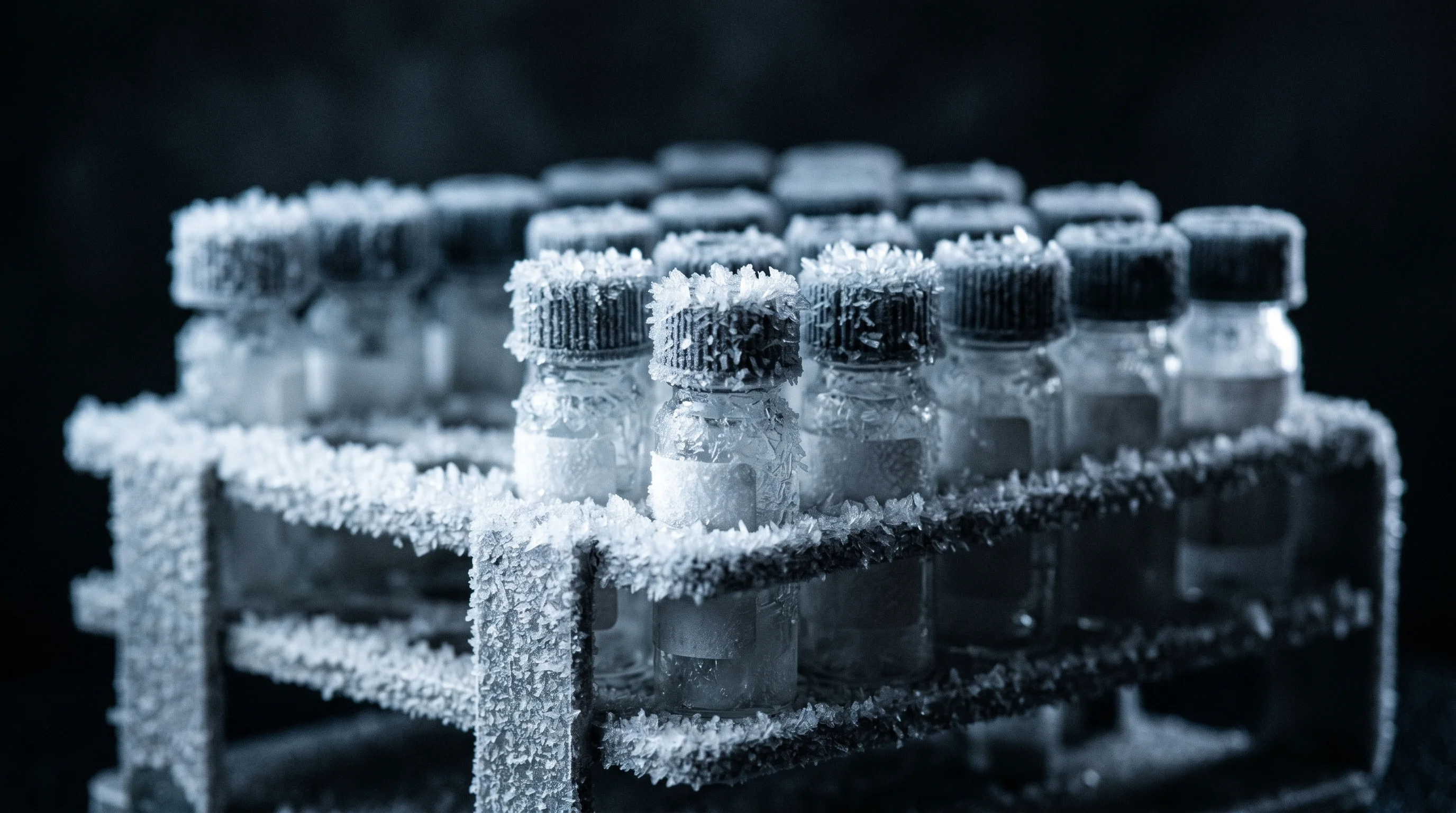
Lyophilised research peptides stay most stable when kept dry, dark and frozen: at -20 degrees Celsius for years, optionally -80 degrees Celsius for the longest shelf life. Reconstituted solutions belong in the refrigerator at 2 to 8 degrees Celsius and should be used within a few weeks. Repeated freezing and thawing is the single biggest threat to molecular integrity.
Peptides are short amino acid chains whose function depends on a precise chemical structure. Even minor degradation can measurably lower the purity of a research preparation. The principal breakdown routes are hydrolysis of the peptide bond, oxidation of sensitive residues such as methionine, cysteine and tryptophan, and deamidation of asparagine and glutamine. These reactions accelerate the more water, heat, light and oxygen are present.
In a comprehensive review of protein pharmaceutical stability, Manning et al., 2010 describe both chemical instability (deamidation, oxidation, hydrolysis, racemisation) and physical instability (aggregation, precipitation, denaturation, surface adsorption) as the central mechanisms. Crucially for practice, these two categories are linked: a chemically altered molecule is more prone to aggregation.
For laboratory storage of research material this yields a clear principle: remove the water or freeze the molecules in place. Lyophilised (freeze-dried) peptides sit in a dry, glassy matrix in which degradation reactions effectively stall. As soon as water is added, the clock starts ticking. Anyone wanting to maximise shelf life therefore minimises moisture, keeps temperature low, and reduces contact with air and light throughout the entire storage period.
The most stable form of a research peptide is the lyophilised powder. During freeze-drying, water is removed under vacuum, creating an amorphous, glassy matrix that physically immobilises the molecules and drastically slows hydrolytic and oxidative processes. In his influential review, Wang, 200000423-3) explains that proteins often have to be converted into solid form to achieve an acceptable shelf life, and that the storage temperature should sit well below the glass transition temperature.
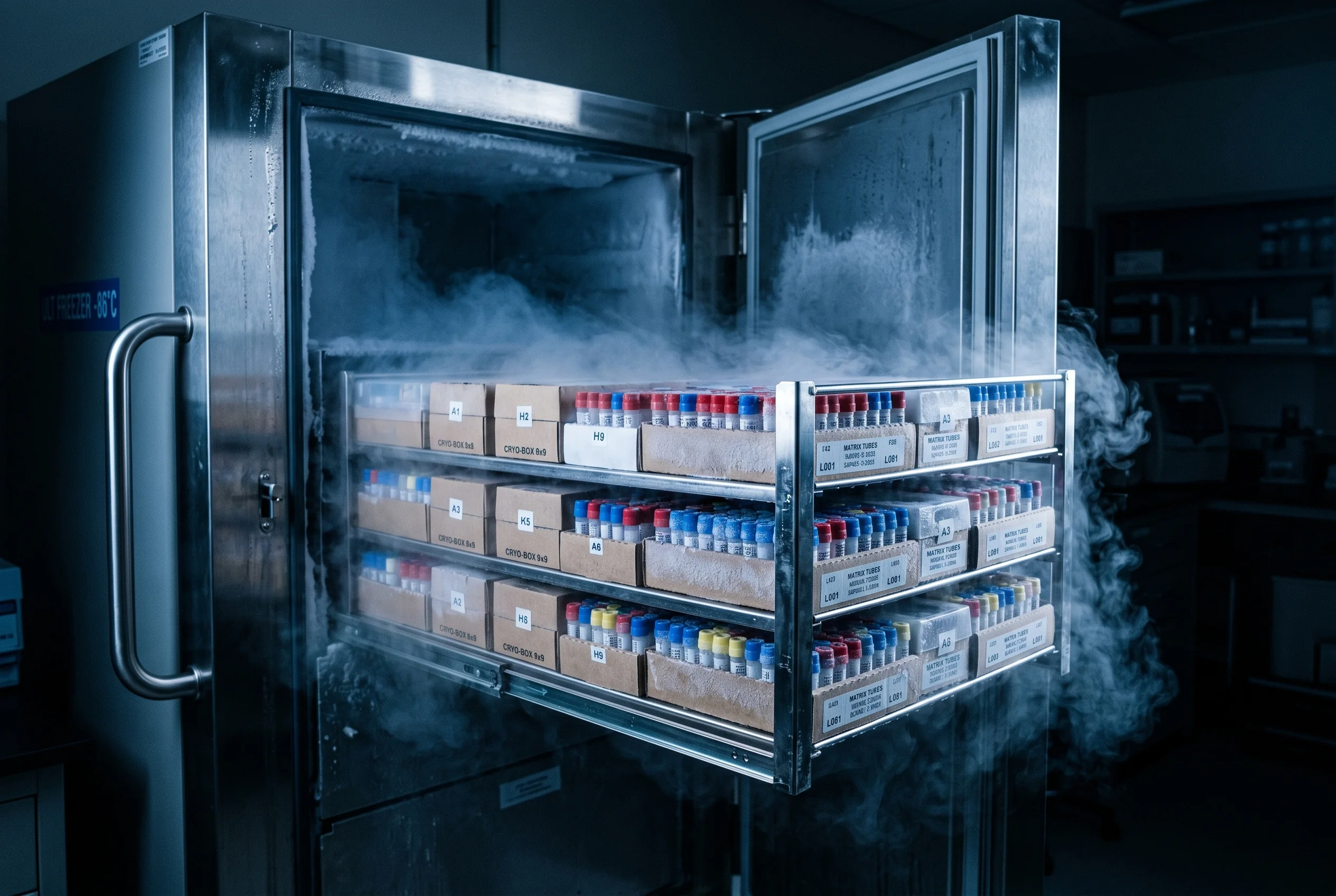
For laboratory practice the rule is: store lyophilised powder at -20 degrees Celsius, which gives most sequences multi-year stability. For especially sensitive peptides, such as those bearing cysteine or methionine residues, or for storage planned over several years, -80 degrees Celsius is preferable, since degradation there remains nearly negligible.
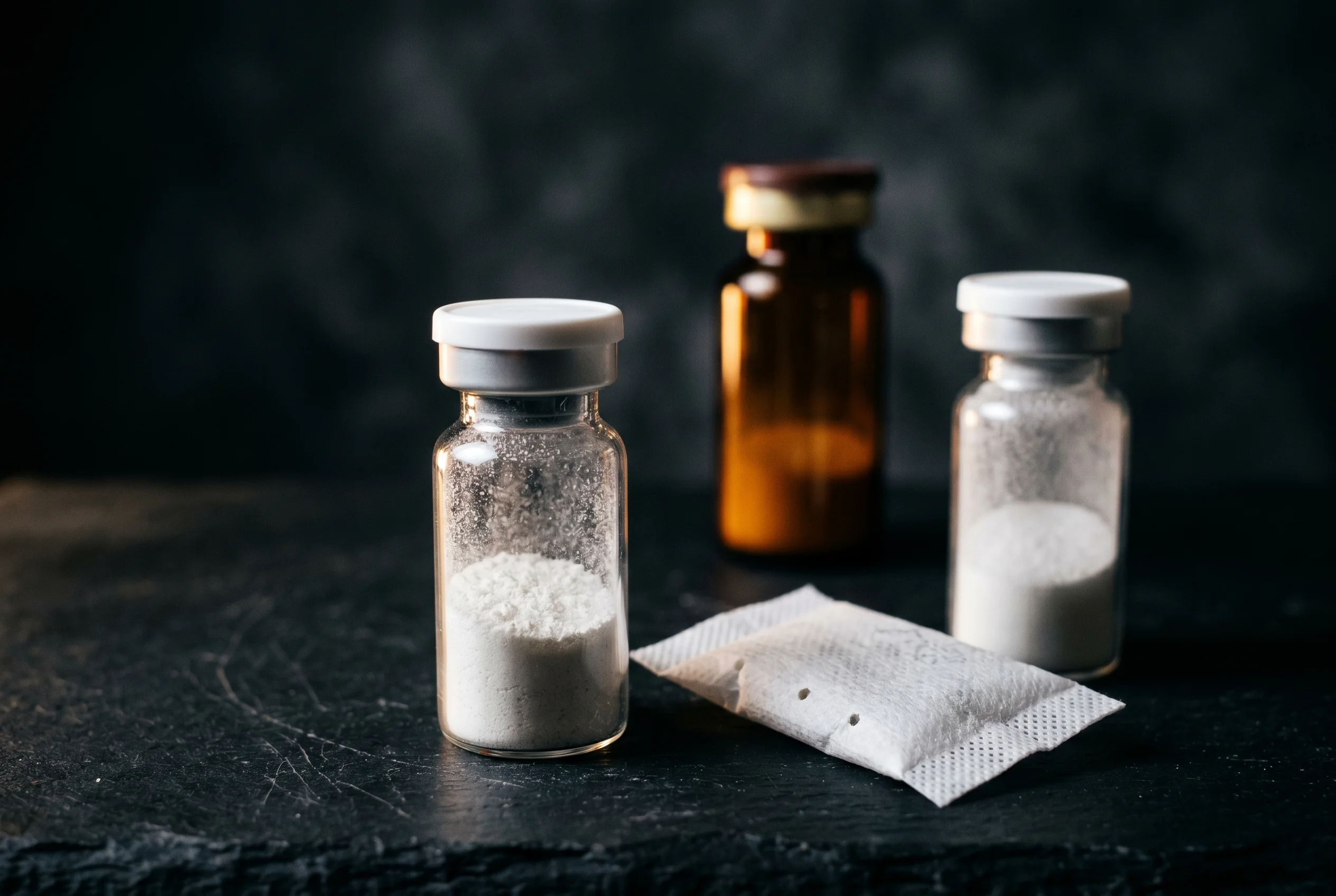
An airtight container is essential. Residual moisture is the critical factor: even small amounts of water lower chemical stability, so the original vial should stay sealed and a desiccant in the storage container is sensible. Avoid frost-free (no-frost) freezers, since their automatic defrost cycles periodically raise the temperature and create unintended partial thaws. Label every vial with substance, batch and intake date so shelf life stays traceable. A constant, low temperature without fluctuation is more valuable than an occasionally even lower one.
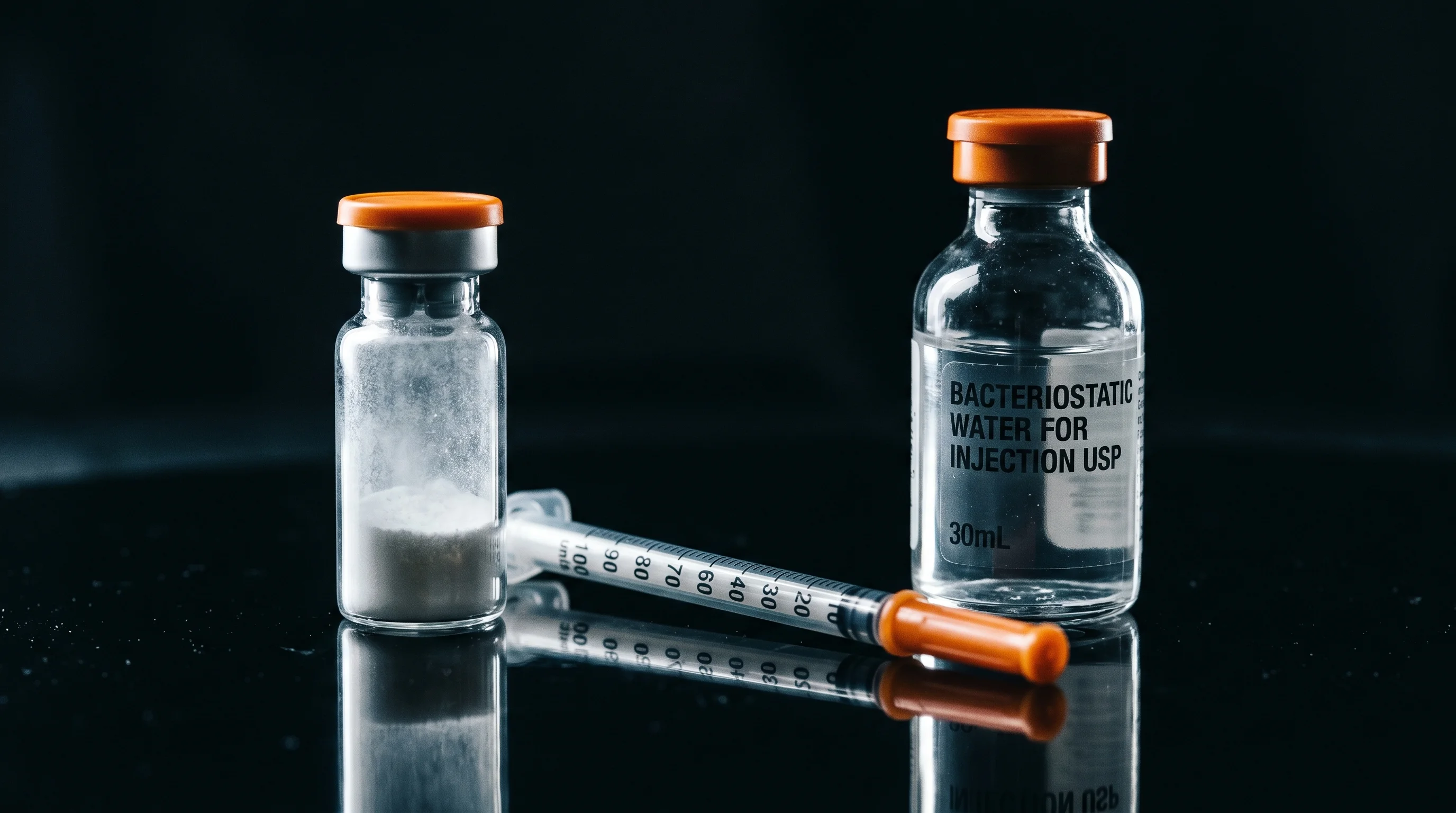
Once a peptide has been reconstituted with bacteriostatic water, it leaves the protective dry form and returns to an aqueous environment in which hydrolysis and oxidation are actively underway. The reconstituted solution therefore belongs in the refrigerator at 2 to 8 degrees Celsius and should not sit at room temperature. Within this range many peptides remain usable for several weeks, depending on sequence and sensitivity.
The bacteriostatic additive matters decisively: bacteriostatic water contains 0.9 percent benzyl alcohol, which inhibits microbial growth and is what makes multi-week refrigerated storage of the solution worthwhile in the first place. Plain water without preservative offers no such protection. The exact procedure for dissolving is covered in our guide on reconstituting peptides.
Buffer chemistry measurably affects stability. Oxidation and deamidation are pH- and temperature-dependent: Manning et al., 2010 show that deamidation is base-catalysed and proceeds especially fast in asparagine-glycine sequences, while methionine oxidation peaks in the neutral range. For the lab, that means: keep it cold, protect it from light, allow as little air contact as possible, and do not keep the solution longer than necessary. Anyone reconstituting larger amounts should consider splitting into aliquots, which we cover in the next section.
Every freeze-thaw cycle stresses dissolved peptides on a physical level. During freezing, ice crystals form whose growth generates mechanical forces and pushes molecules into close contact; at the same time, solutes concentrate in the remaining liquid regions, creating locally extreme conditions. The result is aggregation and a creeping loss of intact active substance.
Jain et al., 2021 specifically studied the freeze-thaw stress of a monoclonal antibody in Scientific Reports and showed that aggregation can be significantly reduced through optimised freezing and thawing conditions. The study provides a framework for minimising damage from lab scale to production. The transferable insight: freezing itself is not the problem, but rather the conditions and the frequency of the cycles.
In practice this gives a simple rule: limit the number of freeze-thaw cycles. Short, simple peptides often tolerate several cycles with little loss, while longer and more complexly folded sequences can take measurable damage after just two or three cycles. Fast freezing at -80 degrees Celsius and rapid thawing at room temperature keep the strain within a single cycle low. Anyone repeatedly freezing and thawing the same stock solution accelerates degradation needlessly. The answer is aliquoting.
Aliquoting means dividing a reconstituted stock solution into several small portions (aliquots) that are frozen separately. Instead of thawing and refreezing a single vial at every withdrawal, you thaw only the aliquot you currently need. Each vial ideally goes through exactly one freeze-thaw cycle rather than many. In the lab, this single-thaw principle is regarded as the most effective protection against freeze-thaw-driven degradation.
The reason lies in the non-uniformity of degradation: every thaw is an opportunity for partial degradation, aggregation or adsorption to the vessel wall, and these changes are not distributed evenly across all molecules. By dividing the stock solution early into portions, you freeze the bulk in its defined starting state. The recommendation from Jain et al., 2021 to control freeze-thaw conditions thus translates directly into a simple working protocol.
Practically, you split the solution into sterile, labelled microtubes sized to match typical consumption per experiment. Use low-protein-binding vessels to reduce adsorption losses, and do not fill to the brim, since freezing liquid expands. Label each aliquot with substance, concentration and date. Unused remainders of a thawed aliquot are discarded rather than refrozen. This keeps the main stock at constant quality for months, while only small amounts are exposed to thaw stress.
Beyond water and heat, light and oxygen are two often underestimated degradation drivers. Oxidation affects above all the sulphur-containing residues methionine and cysteine, as well as aromatic tryptophan. Methionine oxidises to methionine sulfoxide and further to the sulfone, a conversion that is practically irreversible. Atmospheric oxygen and light accelerate this process, which is why contact with both should be minimised.
Badgett et al., 2017 showed by HILIC mass spectrometry that peptides with oxidised methionine and deamidated asparagine can be cleanly separated from and quantified against their unmodified counterparts. This demonstrates that these modifications are real, measurable changes, not theoretical risks. For storage it follows that any measure reducing light and air exposure preserves the intact fraction.
Concretely: store peptides in opaque or amber containers, or in the original carton, away from window light and UV sources. Keep the vial closed between withdrawals to limit air contact. For especially oxidation-prone sequences, overlaying with an inert gas such as nitrogen or argon can displace residual oxygen in the vial headspace. Combined with low temperature and dryness, protection from light and oxygen forms a seamless protection concept that markedly extends the usable shelf life of research material.
Excipients in the lyophilised product contribute substantially to storage stability. Disaccharides such as trehalose and sucrose are considered the most effective lyoprotectants: they form hydrogen bonds with the peptide's polar groups, thereby replacing the stabilising role of the removed water in the glassy matrix. Karunnanithy et al., 2024 report that trehalose often outperforms sucrose, because its slower molecular rotation disturbs the protein structure less.
Equally decisive is the residual moisture of the finished lyophilisate. Low residual moisture keeps the product below the glass transition temperature and thus in the stable glassy state; as moisture rises, chemical stability falls regardless of whether the material is glassy or already rubbery. These relationships trace back to the foundational work of Wang, 200000423-3), who treats cryo- and lyoprotection in detail.
For storage practice this yields several levers. Keep the peptide in the original vial with an intact septum to prevent moisture uptake. Place a desiccant (silica gel) in the surrounding storage container, especially when vials are taken from the freezer, since condensation forms on warming. Therefore let sealed vials reach room temperature before opening, so no moisture condenses inside. These small precautions protect the laboriously built dry stability and prevent ingressing moisture from shortening shelf life.
A degraded or contaminated peptide can be recognised partly by eye, partly only analytically. For lyophilised powder: an intact preparation appears as a uniform white to off-white cake or fine powder. Conspicuous discolouration, a collapsed or liquefied cake, or visible moisture in the vial are warning signs of moisture ingress or improper storage.
After reconstitution, a correctly dissolved sample should be clear and free of particles. Cloudiness, streaks, flakes or a visible precipitate indicate aggregation or microbial contamination, both signals that the material is unsuitable for reliable research results. As described above, aggregation is a direct consequence of freeze-thaw stress and physical instability, which Manning et al., 2010 name as a core mechanism.
Reliable purity assessment, however, is instrumental. The method of Badgett et al., 2017 demonstrates that oxidised and deamidated variants can be chromatographically separated from and quantified against the intact species; in practice HPLC and mass spectrometry are used for this. Visible changes are therefore only the coarse first stage. For quantitative research it is advisable to document the intake date, log any visible anomalies, and when in doubt fall back on analytical characterisation before doubtful material enters an experiment.
Realistic shelf life depends strongly on the state of the peptide. As lyophilised powder at -20 degrees Celsius, many sequences remain stable for several years; at -80 degrees Celsius, degradation is so slight that very long storage is possible. At room temperature, by contrast, usable shelf life shortens drastically, since hydrolysis and oxidation proceed much faster.
Reconstituted solutions are considerably more short-lived. In the refrigerator at 2 to 8 degrees Celsius, a few weeks is a customary frame depending on sequence and sensitivity; oxidation- or deamidation-prone peptides sit at the lower end of this span. This is precisely why early aliquoting and freezing at -20 or -80 degrees Celsius is so valuable: it returns the short-lived solution to a longer-lived state without exposing it to repeated thaw stress.
The exact figures vary with sequence, formulation and present excipients, which is why Manning et al., 2010 emphasise that sequence, sensitive residues and formulation together determine stability. Treat shelf-life figures as sequence-dependent guideline values, not fixed guarantees. A good rule of thumb for the lab: dry and frozen, think in years; dissolved and chilled, think in weeks. Anyone unsure about dissolving will find the basics in our guide What are peptides? as well as in the detailed reconstitution instructions.
In principle yes, but every additional freeze-thaw cycle increases the risk of aggregation and active-substance loss. Jain et al., 2021 show that freeze-thaw damage can be reduced through controlled conditions. It is markedly better, however, to aliquot the solution from the start and allow only a single thaw per aliquot.
For many lyophilised peptides, -20 degrees Celsius is sufficient, provided the unit has no no-frost system with automatic defrost cycles, since those periodically raise the temperature. For multi-year storage or especially sensitive sequences, a -80 degrees Celsius freezer is preferable, because degradation there comes nearly to a standstill.
Cold glass attracts condensation on contact with room air. If you open an ice-cold vial immediately, moisture reaches the powder and accelerates hydrolysis and degradation. Letting the sealed vessel temperate first keeps the contents dry and preserves the hard-won dry stability.
No, the benzyl alcohol it contains acts antimicrobially, not as a chemical stabiliser. It prevents microbial growth and so makes multi-week refrigerated storage of a solution worthwhile, but does not protect against hydrolysis or oxidation. These are still controlled by chilling, light protection and limited air contact.
Depending on sequence and sensitivity, a few weeks at 2 to 8 degrees Celsius is a customary frame. Oxidation- or deamidation-prone peptides sit at the lower end. Since exact shelf life is sequence-dependent, document the reconstitution date and discard solutions with visible cloudiness or precipitate.
For research purposes only. Not intended for human consumption.
Scientific editor: Dr. Sieglinde Klaus
Lyophilised research peptides stay most stable when kept dry, dark and frozen: at -20 degrees Celsius for years, optionally -80 degrees Celsius for the longest shelf life. Reconstituted solutions belong in the refrigerator at 2 to 8 degrees Celsius and should be used within a few weeks. Repeated freezing and thawing is the single biggest threat to molecular integrity.
Peptides are short amino acid chains whose function depends on a precise chemical structure. Even minor degradation can measurably lower the purity of a research preparation. The principal breakdown routes are hydrolysis of the peptide bond, oxidation of sensitive residues such as methionine, cysteine and tryptophan, and deamidation of asparagine and glutamine. These reactions accelerate the more water, heat, light and oxygen are present.
In a comprehensive review of protein pharmaceutical stability, Manning et al., 2010 describe both chemical instability (deamidation, oxidation, hydrolysis, racemisation) and physical instability (aggregation, precipitation, denaturation, surface adsorption) as the central mechanisms. Crucially for practice, these two categories are linked: a chemically altered molecule is more prone to aggregation.
For laboratory storage of research material this yields a clear principle: remove the water or freeze the molecules in place. Lyophilised (freeze-dried) peptides sit in a dry, glassy matrix in which degradation reactions effectively stall. As soon as water is added, the clock starts ticking. Anyone wanting to maximise shelf life therefore minimises moisture, keeps temperature low, and reduces contact with air and light throughout the entire storage period.
The most stable form of a research peptide is the lyophilised powder. During freeze-drying, water is removed under vacuum, creating an amorphous, glassy matrix that physically immobilises the molecules and drastically slows hydrolytic and oxidative processes. In his influential review, Wang, 200000423-3) explains that proteins often have to be converted into solid form to achieve an acceptable shelf life, and that the storage temperature should sit well below the glass transition temperature.
For laboratory practice the rule is: store lyophilised powder at -20 degrees Celsius, which gives most sequences multi-year stability. For especially sensitive peptides, such as those bearing cysteine or methionine residues, or for storage planned over several years, -80 degrees Celsius is preferable, since degradation there remains nearly negligible.
An airtight container is essential. Residual moisture is the critical factor: even small amounts of water lower chemical stability, so the original vial should stay sealed and a desiccant in the storage container is sensible. Avoid frost-free (no-frost) freezers, since their automatic defrost cycles periodically raise the temperature and create unintended partial thaws. Label every vial with substance, batch and intake date so shelf life stays traceable. A constant, low temperature without fluctuation is more valuable than an occasionally even lower one.
Once a peptide has been reconstituted with bacteriostatic water, it leaves the protective dry form and returns to an aqueous environment in which hydrolysis and oxidation are actively underway. The reconstituted solution therefore belongs in the refrigerator at 2 to 8 degrees Celsius and should not sit at room temperature. Within this range many peptides remain usable for several weeks, depending on sequence and sensitivity.
The bacteriostatic additive matters decisively: bacteriostatic water contains 0.9 percent benzyl alcohol, which inhibits microbial growth and is what makes multi-week refrigerated storage of the solution worthwhile in the first place. Plain water without preservative offers no such protection. The exact procedure for dissolving is covered in our guide on reconstituting peptides.
Buffer chemistry measurably affects stability. Oxidation and deamidation are pH- and temperature-dependent: Manning et al., 2010 show that deamidation is base-catalysed and proceeds especially fast in asparagine-glycine sequences, while methionine oxidation peaks in the neutral range. For the lab, that means: keep it cold, protect it from light, allow as little air contact as possible, and do not keep the solution longer than necessary. Anyone reconstituting larger amounts should consider splitting into aliquots, which we cover in the next section.
Every freeze-thaw cycle stresses dissolved peptides on a physical level. During freezing, ice crystals form whose growth generates mechanical forces and pushes molecules into close contact; at the same time, solutes concentrate in the remaining liquid regions, creating locally extreme conditions. The result is aggregation and a creeping loss of intact active substance.
Jain et al., 2021 specifically studied the freeze-thaw stress of a monoclonal antibody in Scientific Reports and showed that aggregation can be significantly reduced through optimised freezing and thawing conditions. The study provides a framework for minimising damage from lab scale to production. The transferable insight: freezing itself is not the problem, but rather the conditions and the frequency of the cycles.
In practice this gives a simple rule: limit the number of freeze-thaw cycles. Short, simple peptides often tolerate several cycles with little loss, while longer and more complexly folded sequences can take measurable damage after just two or three cycles. Fast freezing at -80 degrees Celsius and rapid thawing at room temperature keep the strain within a single cycle low. Anyone repeatedly freezing and thawing the same stock solution accelerates degradation needlessly. The answer is aliquoting.
Aliquoting means dividing a reconstituted stock solution into several small portions (aliquots) that are frozen separately. Instead of thawing and refreezing a single vial at every withdrawal, you thaw only the aliquot you currently need. Each vial ideally goes through exactly one freeze-thaw cycle rather than many. In the lab, this single-thaw principle is regarded as the most effective protection against freeze-thaw-driven degradation.
The reason lies in the non-uniformity of degradation: every thaw is an opportunity for partial degradation, aggregation or adsorption to the vessel wall, and these changes are not distributed evenly across all molecules. By dividing the stock solution early into portions, you freeze the bulk in its defined starting state. The recommendation from Jain et al., 2021 to control freeze-thaw conditions thus translates directly into a simple working protocol.
Practically, you split the solution into sterile, labelled microtubes sized to match typical consumption per experiment. Use low-protein-binding vessels to reduce adsorption losses, and do not fill to the brim, since freezing liquid expands. Label each aliquot with substance, concentration and date. Unused remainders of a thawed aliquot are discarded rather than refrozen. This keeps the main stock at constant quality for months, while only small amounts are exposed to thaw stress.
Beyond water and heat, light and oxygen are two often underestimated degradation drivers. Oxidation affects above all the sulphur-containing residues methionine and cysteine, as well as aromatic tryptophan. Methionine oxidises to methionine sulfoxide and further to the sulfone, a conversion that is practically irreversible. Atmospheric oxygen and light accelerate this process, which is why contact with both should be minimised.
Badgett et al., 2017 showed by HILIC mass spectrometry that peptides with oxidised methionine and deamidated asparagine can be cleanly separated from and quantified against their unmodified counterparts. This demonstrates that these modifications are real, measurable changes, not theoretical risks. For storage it follows that any measure reducing light and air exposure preserves the intact fraction.
Concretely: store peptides in opaque or amber containers, or in the original carton, away from window light and UV sources. Keep the vial closed between withdrawals to limit air contact. For especially oxidation-prone sequences, overlaying with an inert gas such as nitrogen or argon can displace residual oxygen in the vial headspace. Combined with low temperature and dryness, protection from light and oxygen forms a seamless protection concept that markedly extends the usable shelf life of research material.
Excipients in the lyophilised product contribute substantially to storage stability. Disaccharides such as trehalose and sucrose are considered the most effective lyoprotectants: they form hydrogen bonds with the peptide's polar groups, thereby replacing the stabilising role of the removed water in the glassy matrix. Karunnanithy et al., 2024 report that trehalose often outperforms sucrose, because its slower molecular rotation disturbs the protein structure less.
Equally decisive is the residual moisture of the finished lyophilisate. Low residual moisture keeps the product below the glass transition temperature and thus in the stable glassy state; as moisture rises, chemical stability falls regardless of whether the material is glassy or already rubbery. These relationships trace back to the foundational work of Wang, 200000423-3), who treats cryo- and lyoprotection in detail.
For storage practice this yields several levers. Keep the peptide in the original vial with an intact septum to prevent moisture uptake. Place a desiccant (silica gel) in the surrounding storage container, especially when vials are taken from the freezer, since condensation forms on warming. Therefore let sealed vials reach room temperature before opening, so no moisture condenses inside. These small precautions protect the laboriously built dry stability and prevent ingressing moisture from shortening shelf life.
A degraded or contaminated peptide can be recognised partly by eye, partly only analytically. For lyophilised powder: an intact preparation appears as a uniform white to off-white cake or fine powder. Conspicuous discolouration, a collapsed or liquefied cake, or visible moisture in the vial are warning signs of moisture ingress or improper storage.
After reconstitution, a correctly dissolved sample should be clear and free of particles. Cloudiness, streaks, flakes or a visible precipitate indicate aggregation or microbial contamination, both signals that the material is unsuitable for reliable research results. As described above, aggregation is a direct consequence of freeze-thaw stress and physical instability, which Manning et al., 2010 name as a core mechanism.
Reliable purity assessment, however, is instrumental. The method of Badgett et al., 2017 demonstrates that oxidised and deamidated variants can be chromatographically separated from and quantified against the intact species; in practice HPLC and mass spectrometry are used for this. Visible changes are therefore only the coarse first stage. For quantitative research it is advisable to document the intake date, log any visible anomalies, and when in doubt fall back on analytical characterisation before doubtful material enters an experiment.
Realistic shelf life depends strongly on the state of the peptide. As lyophilised powder at -20 degrees Celsius, many sequences remain stable for several years; at -80 degrees Celsius, degradation is so slight that very long storage is possible. At room temperature, by contrast, usable shelf life shortens drastically, since hydrolysis and oxidation proceed much faster.
Reconstituted solutions are considerably more short-lived. In the refrigerator at 2 to 8 degrees Celsius, a few weeks is a customary frame depending on sequence and sensitivity; oxidation- or deamidation-prone peptides sit at the lower end of this span. This is precisely why early aliquoting and freezing at -20 or -80 degrees Celsius is so valuable: it returns the short-lived solution to a longer-lived state without exposing it to repeated thaw stress.
The exact figures vary with sequence, formulation and present excipients, which is why Manning et al., 2010 emphasise that sequence, sensitive residues and formulation together determine stability. Treat shelf-life figures as sequence-dependent guideline values, not fixed guarantees. A good rule of thumb for the lab: dry and frozen, think in years; dissolved and chilled, think in weeks. Anyone unsure about dissolving will find the basics in our guide What are peptides? as well as in the detailed reconstitution instructions.
In principle yes, but every additional freeze-thaw cycle increases the risk of aggregation and active-substance loss. Jain et al., 2021 show that freeze-thaw damage can be reduced through controlled conditions. It is markedly better, however, to aliquot the solution from the start and allow only a single thaw per aliquot.
For many lyophilised peptides, -20 degrees Celsius is sufficient, provided the unit has no no-frost system with automatic defrost cycles, since those periodically raise the temperature. For multi-year storage or especially sensitive sequences, a -80 degrees Celsius freezer is preferable, because degradation there comes nearly to a standstill.
Cold glass attracts condensation on contact with room air. If you open an ice-cold vial immediately, moisture reaches the powder and accelerates hydrolysis and degradation. Letting the sealed vessel temperate first keeps the contents dry and preserves the hard-won dry stability.
No, the benzyl alcohol it contains acts antimicrobially, not as a chemical stabiliser. It prevents microbial growth and so makes multi-week refrigerated storage of a solution worthwhile, but does not protect against hydrolysis or oxidation. These are still controlled by chilling, light protection and limited air contact.
Depending on sequence and sensitivity, a few weeks at 2 to 8 degrees Celsius is a customary frame. Oxidation- or deamidation-prone peptides sit at the lower end. Since exact shelf life is sequence-dependent, document the reconstitution date and discard solutions with visible cloudiness or precipitate.
For research purposes only. Not intended for human consumption.
Scientific editor: Dr. Sieglinde Klaus
Reconstitute lyophilised research peptides with bacteriostatic water: steps, concentration math, storage. Work cleanly at the bench, start here.

What are peptides? Manufacturing (SPPS), purity (HPLC), lyophilization. With 7 PubMed references. A scientifically grounded guide.
Reconstitute lyophilised research peptides with bacteriostatic water: steps, concentration math, storage. Work cleanly at the bench, start here.
What are peptides? Manufacturing (SPPS), purity (HPLC), lyophilization. With 7 PubMed references. A scientifically grounded guide.