Combining and Stacking Peptides: Foundations in a Research Context
Dr. Sieglinde Klaus
Scientific Editorial Team · Bergdorf Bioscience


Dr. Sieglinde Klaus
Scientific Editorial Team · Bergdorf Bioscience
Dr. Sieglinde Klaus
Scientific Editorial Team · Bergdorf Bioscience
A peptide stack refers to the combined study of several peptides within one research protocol. The scientific logic behind it: different peptides address distinct, often complementary signalling pathways. Preclinical literature examines combinations such as BPC-157 with thymosin beta-4 or regenerative copper peptides because their mechanisms can complement one another. This guide explains the foundations, strictly in a research context and without any recommendation for human use.
The term "stacking" originally comes from training physiology and, in a peptide research context, describes using two or more peptides in parallel within the same experimental design. The underlying idea is not simply to add effects together but to address signalling pathways that complement each other biologically. A classic example from preclinical tissue regeneration research is combining an angiogenesis-promoting peptide with a cell-migration-promoting peptide: in animal models, one molecule improves new vessel formation while the other improves cell migration to the study site.
A terminological distinction matters here. A "blend" is a pre-mixed preparation of several peptides in one vial, such as the TB-500 + BPC-157 Blend. A "stack," by contrast, can also consist of separately stored single peptides that are combined within the protocol. Both concepts pursue the same goal: capturing complementary mechanisms in one model. For planning such combinations, the Stack Builder is useful, comparing documented peptide profiles side by side. All concepts described here apply exclusively to in vitro and animal model research.
The scientific rationale for combinations lies in the observation that complex biological processes such as tissue regeneration consist of several temporally staggered phases: inflammation, proliferation and remodelling. Single peptides often intervene in only one of these phases. BPC-157, for instance, shows pronounced promotion of angiogenesis via the nitric oxide pathway in rat models (Hsieh et al., 2020). Thymosin beta-4, the active principle behind TB-500, by contrast acts primarily as an actin-sequestering protein and promotes cell migration and endothelial cell differentiation (Goldstein et al., 2005).
The hypothesis in preclinical literature therefore reads: if one peptide improves vascular supply and a second the migration of repair-relevant cells, both processes might run in parallel within the same model. It is crucial to stress, however, that synergistic effects from stacking are still insufficiently demonstrated in controlled comparative studies. Most published data concern single peptides. Combination data come predominantly from observations and reviews, not from randomised comparisons of single versus combined administration. This gap is an important caveat for any research planning.
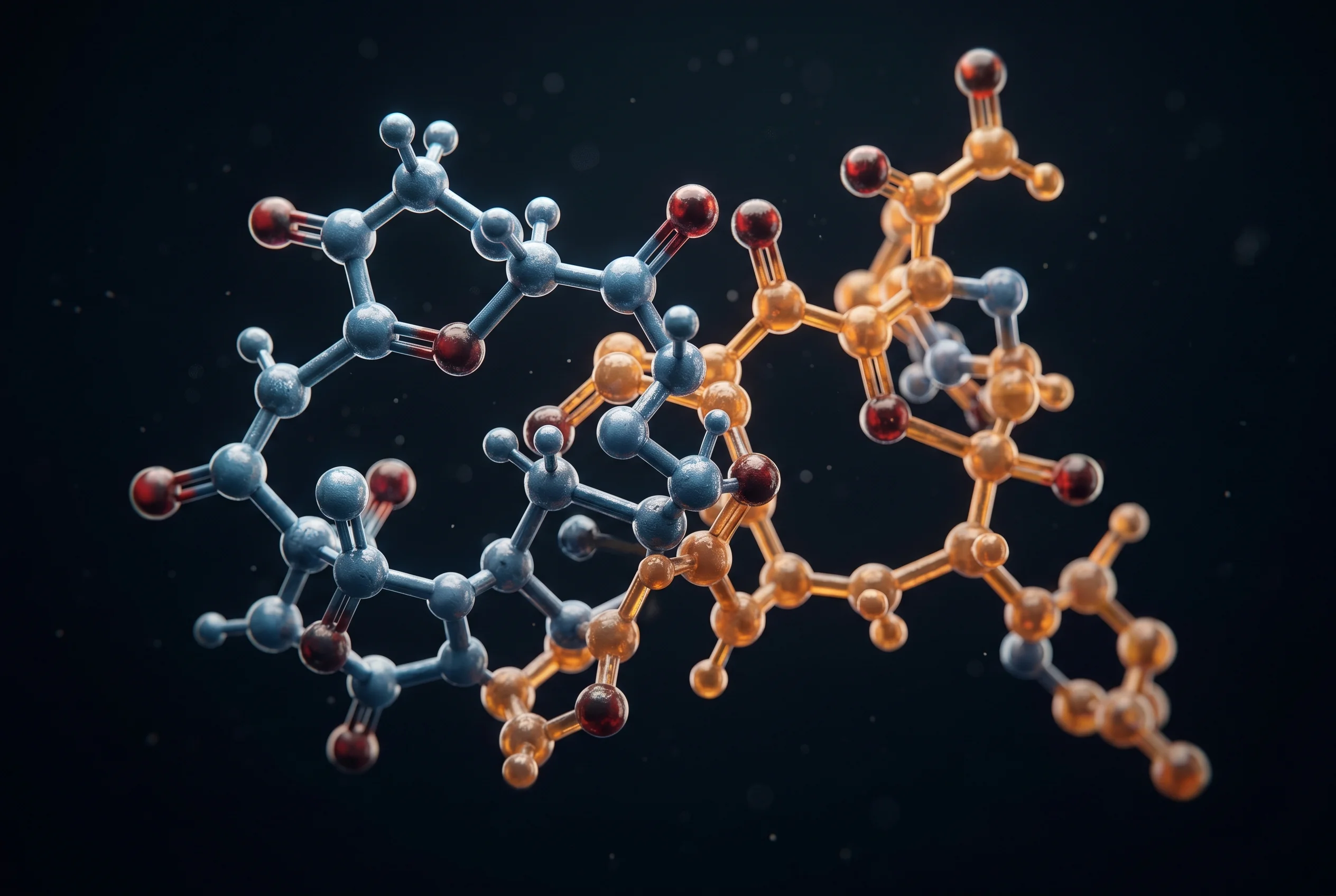
Complementary mechanisms mean that two peptides have different molecular targets that converge on the same biological endpoint. Tissue regeneration illustrates this well. In studies, BPC-157 modulates the VEGFR2 signalling cascade and activates endothelial nitric oxide synthase via the Src-Caveolin-1-eNOS pathway, driving new vessel formation (Hsieh et al., 2020). In addition, it raises growth hormone receptor expression in tendon fibroblasts up to two- to threefold (Chang et al., 2014).
Thymosin beta-4 acts at a different point: it binds G-actin and thereby regulates the cytoskeleton, promoting cell migration, adhesion and tubule formation in endothelial cells (Philp et al., 2003). A third example is the copper peptide GHK-Cu, which according to gene expression analyses modulates the activity of more than 4,000 human genes, upregulating regenerative programmes and downregulating inflammatory ones (Pickart & Margolina, 2018). These three molecules address vessels, cytoskeleton and gene expression: three different levels that theoretically interlock.
Several recurring combinations appear in preclinical literature. The most frequently documented is BPC-157 together with thymosin beta-4. Both are used in soft-tissue and tendon repair models because BPC-157 improves angiogenesis and collagen organisation in transected rat Achilles tendons (Krivic et al., 2006) while thymosin beta-4 complements cell migration. This pairing forms the basis for the pre-mixed TB-500 + BPC-157 Blend.
A second group concerns regenerative and cosmetic research models. Here GHK-Cu is studied, a copper-binding tripeptide with documented effects on collagen, elastin and glycosaminoglycan synthesis (Pickart & Margolina, 2018). In combination with other regenerative peptides it forms the basis of the Glow Stack, whose composition and research background are described in detail in the Glow Stack guide. A third category includes growth hormone secretagogues such as CJC-1295 and Ipamorelin, often considered together in the literature because they act on different receptors of the GH axis. Which peptides actually appear combinable can be checked systematically in the Stack Builder.

Published literature on co-administration is noticeably thinner than that on single peptides, and that is a central finding. Most robust data come from studies in which a single peptide was tested against placebo or control. For BPC-157, numerous animal models on tendon, ligament and muscle healing exist (Chang et al., 2011). For thymosin beta-4, angiogenic and wound-healing activity is documented in mouse and cell models (Goldstein et al., 2005).
Direct comparative studies that systematically pit combined administration against single administrations, however, are largely absent from the peer-reviewed literature. Much of what is described as "synergistic" rests on the plausible assumption of complementary mechanisms, not on controlled data about the combination itself. Reviews of orthopaedic peptide research point out explicitly that the evidence base is predominantly preclinical and that controlled combination studies are still pending. For research planning this means: a combination is a hypothesis, not an established fact. Anyone studying stacks should treat the single-peptide data as a starting point and combination effects as a question to be tested, not as a given.
Overlapping signalling pathways are the mirror image of complementary mechanisms and an important caveat when stacking. When two peptides address the same molecular path, their effects do not necessarily add up; they may overlap, attenuate, or shift in unexpected directions. An example: both BPC-157 and thymosin beta-4 promote angiogenesis in models (Hsieh et al., 2020; Philp et al., 2003). If both intervene simultaneously in the same vessel-formation cascade, it is unclear whether the effect is actually amplified or whether a saturation effect occurs.
This is why identifying overlapping paths is a central step before any combination study. In research practice, this means contrasting the documented mechanisms of action of each candidate and asking: do they truly address different levels, or do they compete for the same receptor and the same downstream cascade? The Stack Builder places the mechanism profiles side by side and makes such overlaps visible. A well-thought-out combination pairs peptides with clearly separated targets instead of redundantly hitting the same path multiple times.
Dosing is a methodologically delicate point in combinations because variables multiply. In single-peptide studies, dose-response curves are carefully established. BPC-157 showed effects across several orders of magnitude in Achilles tendon models, tested in the range of micrograms to picograms per administration (Krivic et al., 2006). As soon as two peptides are combined, the number of possible dose ratios multiplies, and the individual curves cannot simply be superimposed.
In preclinical research practice, the principle therefore holds that the dosing ranges established for single peptides provide the most sensible starting point. Pre-mixed blends like the TB-500 + BPC-157 Blend use fixed ratios derived from the published single-peptide literature, which reduces the number of variables in a model. A further aspect is differing pharmacokinetics: peptides with a short half-life and those with a longer residence in the system behave in a temporally staggered manner within a combination. Concrete dosing considerations for an example protocol are presented in the Glow Stack guide. All figures refer exclusively to research models.
Pre-mixed blends and self-assembled stacks differ above all in reproducibility and flexibility. A blend delivers a fixed mixing ratio in one vial. The TB-500 + BPC-157 Blend, for instance, combines both peptides in a defined ratio derived from the single-peptide literature. The advantage lies in consistency: every reconstitution yields the same composition, which improves comparability across multiple studies and reduces handling errors.
A self-assembled stack of single peptides, by contrast, offers maximum flexibility: the ratio can be adjusted, individual components can be varied deliberately, and new combinations can be tested without delay. The price is greater methodological effort, because each component must be reconstituted, stored and documented separately, and the sources of error increase. The Glow Stack shows what a regenerative multi-component approach can look like as a curated set. Which path makes sense depends on the research question: if reproducibility of an established ratio matters, blends are more practical; if the exploration of new ratios is the goal, single peptides are more flexible. The Stack Builder helps plan both routes in advance.
When planning a peptide stack in a research context, several points should be checked systematically. First, mechanism complementarity: do the candidates address different, complementary paths, or do they overlap heavily? Second, the evidence situation: does robust preclinical data exist for each single peptide, or does the selection rest on speculation? BPC-157 and thymosin beta-4 are both well documented (Chang et al., 2011; Goldstein et al., 2005), which makes them frequently studied candidates.
Third, pharmacokinetics: different half-lives influence how the peptides behave over time in the model. Fourth, purity and reconstitution: each component should be stored and handled properly, since impurities or degradation distort results. Fifth, documentation: in combinations, complete logging of ratios, concentrations and time points is essential to attribute effects to a factor at all. Structured advance planning succeeds best with the Stack Builder, which contrasts the documented profiles. The basic rule: a combination is only as informative as the experimental design that controls it. All considerations serve research purposes exclusively.
No. The evidence base is considerably broader for single peptides. Most controlled preclinical studies test one peptide in isolation, while combination effects are largely derived from plausible mechanistic reasoning rather than confirmed in direct comparative studies.
A blend is a pre-mixed preparation of several peptides in one vial with a fixed ratio. A stack can also consist of separately stored single peptides combined only within the protocol. Blends offer consistency, stacks offer flexibility.
When two peptides address the same molecular path, their effects do not necessarily add up. Saturation or unexpected interactions can occur. Sensible combinations therefore address targets that are as separate as possible.
The Stack Builder contrasts documented mechanism and profile data of peptides to plan combinations. Concrete dosing examples for individual research protocols can be found in the respective product guides, such as the Glow Stack guide.
For research purposes only. Not intended for human consumption. Scientific editor: Dr. Sieglinde Klaus
A peptide stack refers to the combined study of several peptides within one research protocol. The scientific logic behind it: different peptides address distinct, often complementary signalling pathways. Preclinical literature examines combinations such as BPC-157 with thymosin beta-4 or regenerative copper peptides because their mechanisms can complement one another. This guide explains the foundations, strictly in a research context and without any recommendation for human use.
The term "stacking" originally comes from training physiology and, in a peptide research context, describes using two or more peptides in parallel within the same experimental design. The underlying idea is not simply to add effects together but to address signalling pathways that complement each other biologically. A classic example from preclinical tissue regeneration research is combining an angiogenesis-promoting peptide with a cell-migration-promoting peptide: in animal models, one molecule improves new vessel formation while the other improves cell migration to the study site.
A terminological distinction matters here. A "blend" is a pre-mixed preparation of several peptides in one vial, such as the TB-500 + BPC-157 Blend. A "stack," by contrast, can also consist of separately stored single peptides that are combined within the protocol. Both concepts pursue the same goal: capturing complementary mechanisms in one model. For planning such combinations, the Stack Builder is useful, comparing documented peptide profiles side by side. All concepts described here apply exclusively to in vitro and animal model research.
The scientific rationale for combinations lies in the observation that complex biological processes such as tissue regeneration consist of several temporally staggered phases: inflammation, proliferation and remodelling. Single peptides often intervene in only one of these phases. BPC-157, for instance, shows pronounced promotion of angiogenesis via the nitric oxide pathway in rat models (Hsieh et al., 2020). Thymosin beta-4, the active principle behind TB-500, by contrast acts primarily as an actin-sequestering protein and promotes cell migration and endothelial cell differentiation (Goldstein et al., 2005).
The hypothesis in preclinical literature therefore reads: if one peptide improves vascular supply and a second the migration of repair-relevant cells, both processes might run in parallel within the same model. It is crucial to stress, however, that synergistic effects from stacking are still insufficiently demonstrated in controlled comparative studies. Most published data concern single peptides. Combination data come predominantly from observations and reviews, not from randomised comparisons of single versus combined administration. This gap is an important caveat for any research planning.
Complementary mechanisms mean that two peptides have different molecular targets that converge on the same biological endpoint. Tissue regeneration illustrates this well. In studies, BPC-157 modulates the VEGFR2 signalling cascade and activates endothelial nitric oxide synthase via the Src-Caveolin-1-eNOS pathway, driving new vessel formation (Hsieh et al., 2020). In addition, it raises growth hormone receptor expression in tendon fibroblasts up to two- to threefold (Chang et al., 2014).
Thymosin beta-4 acts at a different point: it binds G-actin and thereby regulates the cytoskeleton, promoting cell migration, adhesion and tubule formation in endothelial cells (Philp et al., 2003). A third example is the copper peptide GHK-Cu, which according to gene expression analyses modulates the activity of more than 4,000 human genes, upregulating regenerative programmes and downregulating inflammatory ones (Pickart & Margolina, 2018). These three molecules address vessels, cytoskeleton and gene expression: three different levels that theoretically interlock.
Several recurring combinations appear in preclinical literature. The most frequently documented is BPC-157 together with thymosin beta-4. Both are used in soft-tissue and tendon repair models because BPC-157 improves angiogenesis and collagen organisation in transected rat Achilles tendons (Krivic et al., 2006) while thymosin beta-4 complements cell migration. This pairing forms the basis for the pre-mixed TB-500 + BPC-157 Blend.
A second group concerns regenerative and cosmetic research models. Here GHK-Cu is studied, a copper-binding tripeptide with documented effects on collagen, elastin and glycosaminoglycan synthesis (Pickart & Margolina, 2018). In combination with other regenerative peptides it forms the basis of the Glow Stack, whose composition and research background are described in detail in the Glow Stack guide. A third category includes growth hormone secretagogues such as CJC-1295 and Ipamorelin, often considered together in the literature because they act on different receptors of the GH axis. Which peptides actually appear combinable can be checked systematically in the Stack Builder.
Published literature on co-administration is noticeably thinner than that on single peptides, and that is a central finding. Most robust data come from studies in which a single peptide was tested against placebo or control. For BPC-157, numerous animal models on tendon, ligament and muscle healing exist (Chang et al., 2011). For thymosin beta-4, angiogenic and wound-healing activity is documented in mouse and cell models (Goldstein et al., 2005).
Direct comparative studies that systematically pit combined administration against single administrations, however, are largely absent from the peer-reviewed literature. Much of what is described as "synergistic" rests on the plausible assumption of complementary mechanisms, not on controlled data about the combination itself. Reviews of orthopaedic peptide research point out explicitly that the evidence base is predominantly preclinical and that controlled combination studies are still pending. For research planning this means: a combination is a hypothesis, not an established fact. Anyone studying stacks should treat the single-peptide data as a starting point and combination effects as a question to be tested, not as a given.
Overlapping signalling pathways are the mirror image of complementary mechanisms and an important caveat when stacking. When two peptides address the same molecular path, their effects do not necessarily add up; they may overlap, attenuate, or shift in unexpected directions. An example: both BPC-157 and thymosin beta-4 promote angiogenesis in models (Hsieh et al., 2020; Philp et al., 2003). If both intervene simultaneously in the same vessel-formation cascade, it is unclear whether the effect is actually amplified or whether a saturation effect occurs.
This is why identifying overlapping paths is a central step before any combination study. In research practice, this means contrasting the documented mechanisms of action of each candidate and asking: do they truly address different levels, or do they compete for the same receptor and the same downstream cascade? The Stack Builder places the mechanism profiles side by side and makes such overlaps visible. A well-thought-out combination pairs peptides with clearly separated targets instead of redundantly hitting the same path multiple times.
Dosing is a methodologically delicate point in combinations because variables multiply. In single-peptide studies, dose-response curves are carefully established. BPC-157 showed effects across several orders of magnitude in Achilles tendon models, tested in the range of micrograms to picograms per administration (Krivic et al., 2006). As soon as two peptides are combined, the number of possible dose ratios multiplies, and the individual curves cannot simply be superimposed.
In preclinical research practice, the principle therefore holds that the dosing ranges established for single peptides provide the most sensible starting point. Pre-mixed blends like the TB-500 + BPC-157 Blend use fixed ratios derived from the published single-peptide literature, which reduces the number of variables in a model. A further aspect is differing pharmacokinetics: peptides with a short half-life and those with a longer residence in the system behave in a temporally staggered manner within a combination. Concrete dosing considerations for an example protocol are presented in the Glow Stack guide. All figures refer exclusively to research models.
Pre-mixed blends and self-assembled stacks differ above all in reproducibility and flexibility. A blend delivers a fixed mixing ratio in one vial. The TB-500 + BPC-157 Blend, for instance, combines both peptides in a defined ratio derived from the single-peptide literature. The advantage lies in consistency: every reconstitution yields the same composition, which improves comparability across multiple studies and reduces handling errors.
A self-assembled stack of single peptides, by contrast, offers maximum flexibility: the ratio can be adjusted, individual components can be varied deliberately, and new combinations can be tested without delay. The price is greater methodological effort, because each component must be reconstituted, stored and documented separately, and the sources of error increase. The Glow Stack shows what a regenerative multi-component approach can look like as a curated set. Which path makes sense depends on the research question: if reproducibility of an established ratio matters, blends are more practical; if the exploration of new ratios is the goal, single peptides are more flexible. The Stack Builder helps plan both routes in advance.
When planning a peptide stack in a research context, several points should be checked systematically. First, mechanism complementarity: do the candidates address different, complementary paths, or do they overlap heavily? Second, the evidence situation: does robust preclinical data exist for each single peptide, or does the selection rest on speculation? BPC-157 and thymosin beta-4 are both well documented (Chang et al., 2011; Goldstein et al., 2005), which makes them frequently studied candidates.
Third, pharmacokinetics: different half-lives influence how the peptides behave over time in the model. Fourth, purity and reconstitution: each component should be stored and handled properly, since impurities or degradation distort results. Fifth, documentation: in combinations, complete logging of ratios, concentrations and time points is essential to attribute effects to a factor at all. Structured advance planning succeeds best with the Stack Builder, which contrasts the documented profiles. The basic rule: a combination is only as informative as the experimental design that controls it. All considerations serve research purposes exclusively.
No. The evidence base is considerably broader for single peptides. Most controlled preclinical studies test one peptide in isolation, while combination effects are largely derived from plausible mechanistic reasoning rather than confirmed in direct comparative studies.
A blend is a pre-mixed preparation of several peptides in one vial with a fixed ratio. A stack can also consist of separately stored single peptides combined only within the protocol. Blends offer consistency, stacks offer flexibility.
When two peptides address the same molecular path, their effects do not necessarily add up. Saturation or unexpected interactions can occur. Sensible combinations therefore address targets that are as separate as possible.
The Stack Builder contrasts documented mechanism and profile data of peptides to plan combinations. Concrete dosing examples for individual research protocols can be found in the respective product guides, such as the Glow Stack guide.
For research purposes only. Not intended for human consumption. Scientific editor: Dr. Sieglinde Klaus
