
Tesamorelin: A GHRH Analogue Research Monograph
Dr. Sieglinde Klaus
Scientific Editorial Team · Bergdorf Bioscience
Table of Contents
- 01What is tesamorelin chemically and structurally?
- 02How does tesamorelin act on the GH/GHRH axis?
- 03What is tesamorelin's half-life?
- 04Which dosages are documented in the research literature?
- 05How do the GH and IGF-1 responses unfold over time?
- 06How is tesamorelin stored in the laboratory?
- 07What is documented about the safety and tolerability profile?
- 08How does tesamorelin differ from other GH-axis peptides?
- 09What legal and research status applies to tesamorelin?
- 10Which pharmacokinetic metrics are central to experimental design?
- 11Frequently asked questions about tesamorelin
- Why is tesamorelin's half-life so short?
- How does tesamorelin differ from sermorelin?
- Does tesamorelin affect glucose metabolism in studies?
- How is tesamorelin stored correctly?
Tesamorelin is a synthetic 44-amino-acid analogue of growth hormone-releasing hormone (GHRH) with the molecular formula C221H366N72O67S and a molecular mass of roughly 5136 Da. In preclinical and clinical research models it stimulates the endogenous GH/GHRH axis. This monograph summarizes mechanism, pharmacokinetics, documented research dosing, storage and peptide distinctions, strictly for research purposes.
What is tesamorelin chemically and structurally?
Tesamorelin is a synthetic polypeptide of 44 amino acids carrying the full sequence of human growth hormone-releasing factor (GRF 1-44). A trans-3-hexenoyl group is attached to the N-terminal tyrosine residue. The molecular formula is C221H366N72O67S, the molecular mass is approximately 5136 Da, and the CAS number is 218949-48-5. This N-terminal modification distinguishes the molecule from native GHRH: it increases stability against enzymatic breakdown, particularly against dipeptidyl peptidase-4 (DPP-4), which cleaves native GHRH within minutes.
In research contexts tesamorelin is handled as a lyophilized powder and reconstituted before experiments. The high nitrogen content of around 19.6 percent and the single sulfur atom from one methionine residue reflect the typical amino-acid composition of a GRF analogue. Wang and Tomlinson described tesamorelin in their review as a human GRF analogue with an improved pharmacokinetic profile relative to the endogenous peptide Wang & Tomlinson, 2009. For research practice it is relevant that structural stability eases handling, while the intrinsic plasma half-life nonetheless remains short. The literature classifies the substance strictly as a research tool for studying the somatotropic axis, not as a consumer product.
How does tesamorelin act on the GH/GHRH axis?
In research models tesamorelin binds GHRH receptors on the somatotroph cells of the anterior pituitary, triggering the synthesis and pulsatile release of endogenous growth hormone (GH). The released GH then acts on peripheral tissues, including hepatocytes, where it stimulates the production of insulin-like growth factor 1 (IGF-1). A defining feature is that tesamorelin leverages the body's own pulsatility rather than imposing an external GH level.
In a controlled study in healthy men, a research dose of 2 mg daily over two weeks significantly increased mean overnight GH secretion (plus 0.5 micrograms per liter, P = 0.004) and raised IGF-1 by 181 micrograms per liter (P less than 0.0001). Notably, insulin sensitivity was unchanged: neither fasting glucose (P = 0.93) nor insulin-stimulated glucose uptake (P = 0.61) was affected Stanley et al., 2011. This finding methodologically distinguishes GHRH-mediated stimulation from the direct administration of recombinant growth hormone. The LiverTox monograph summarizes the mechanism consistently: activation of pituitary GHRH receptors, GH release and downstream IGF-1 formation in hepatocytes LiverTox, 2020. These data derive from clinical and animal-experiment settings and serve mechanistic understanding only.
What is tesamorelin's half-life?
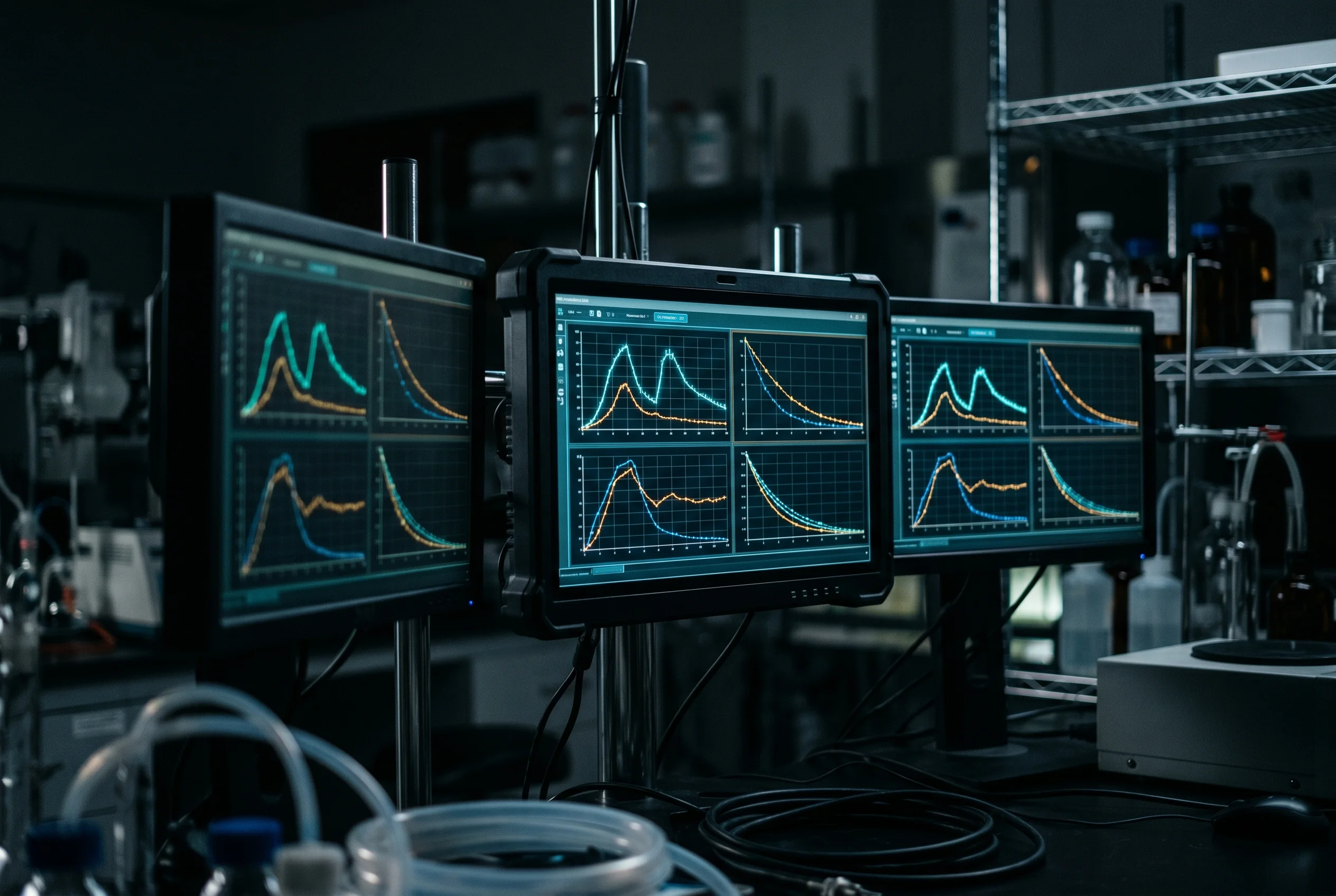
The plasma half-life of tesamorelin is short. In pharmacokinetic analyses after subcutaneous administration, the mean elimination half-life was about 26 minutes in healthy subjects and 38 minutes in HIV research cohorts, roughly in the range of half an hour. Peak plasma concentration is reached very early: median Tmax was around 0.15 hours, about nine minutes after subcutaneous administration of a 2 mg dose. Absolute bioavailability after subcutaneous administration was below 4 percent.
This short half-life is mechanistically sensible and not a drawback: tesamorelin functions as a trigger of a GH pulse, not as a depot. After rapid breakdown of the peptide, the downstream effect via the GH/IGF-1 axis remains measurable far longer, because IGF-1 itself has a half-life on the order of hours. For experimental design, the short intrinsic half-life means dosing frequency and timing of administration must be documented carefully, because the peptide level falls quickly while the hormonal response lags behind. Researchers wanting to systematically grasp the difference between a peptide's intrinsic half-life and the duration of its biological effect will find the fundamentals in the guide understanding half-life. Quantitative modeling of decay curves can be reproduced with the peptide calculator.
Which dosages are documented in the research literature?
A subcutaneous dose of 2 mg once daily dominates the published research. This dose forms the reference point of most controlled investigations. In the placebo-controlled study by Falutz and colleagues in HIV patients with abdominal fat accumulation, the study cohorts received 2 mg subcutaneously daily; in this specific patient population, a reduction of visceral adipose tissue of about 10.9 percent over six months versus 0.6 percent under placebo was observed, with a cumulative effect of roughly 18 percent over twelve months, while IGF-1 rose significantly (P less than 0.001) and glucose parameters remained unchanged Falutz et al., 2010. These figures derive from a clinical trial context in that indication population and describe a research finding reported there, not a general fat-loss effect of the substance.
A dose-finding arm also compared 1 mg against 2 mg daily: in the 2 mg cohort, more pronounced IGF-1 increases and greater reductions in visceral fat depots were reported than in the 1 mg cohort, establishing the 2 mg dose as the standard in the research literature. The mechanistic study in healthy men used the same 2 mg daily dose over two weeks Stanley et al., 2011. These figures describe study protocols exclusively and do not constitute a usage recommendation. For experimental reconstitution and dilution, the short half-life must be taken into account; concentration and volume calculations can be reproduced via the peptide calculator. Every dosing figure in this monograph refers to documented in-vivo research models, not to human consumption.
How do the GH and IGF-1 responses unfold over time?
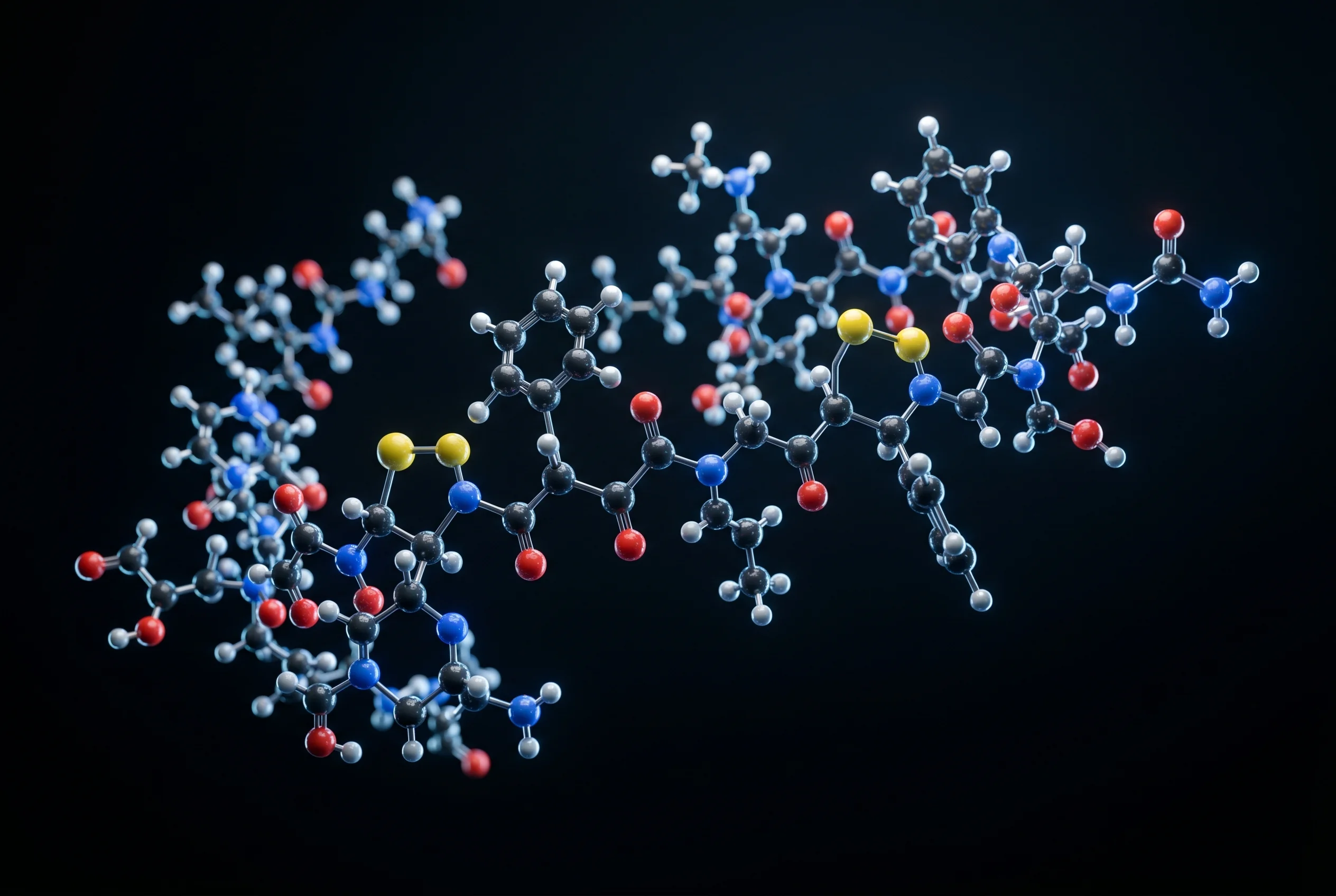
The temporal dynamics of the tesamorelin response are two-stage. First, after subcutaneous administration the peptide level rises within minutes, followed by a GH pulse from the pituitary. In animal models, GH levels remained elevated for several hours after a single administration, even though the peptide itself had long been eliminated. This decoupling between short peptide half-life and a longer hormonal response is the central pharmacodynamic finding.
The second stage concerns IGF-1. Because GH stimulates hepatic IGF-1 synthesis, IGF-1 accumulates more slowly and persists longer. In the mechanistic study, IGF-1 rose by 181 micrograms per liter after two weeks of administration and returned to baseline after a two-week washout, documenting the reversibility of the effect Stanley et al., 2011. In the placebo-controlled JAMA study by Stanley and colleagues in HIV patients with abdominal fat accumulation, a reduction of visceral adipose tissue by a net of about 42 cm² was observed under 2 mg daily over six months (minus 9.9 percent versus plus 6.6 percent under placebo), with a simultaneously significant lowering of hepatic fat fraction (P = 0.005) Stanley et al., 2014. These values too are a study finding reported in that specific patient population and not a generalizable fat-loss effect. These time courses clarify why the intrinsic half-life alone does not capture the duration of effect. The findings derive from controlled research settings and serve mechanistic characterization.
How is tesamorelin stored in the laboratory?
Lyophilized, non-reconstituted tesamorelin is stored in the reference literature at refrigerated temperature between 2 °C and 8 °C. The powder is light-sensitive and should be kept protected from moisture in the sealed original container. Under these conditions the solid substance is comparatively stable, because the dry lyophilizate is largely shielded from enzymatic and hydrolytic degradation pathways.
After reconstitution with a suitable solvent the stability situation changes markedly. In dissolved form the peptide is more sensitive to temperature, pH fluctuations and microbial contamination, which is why reconstituted preparations should be stored cold and used promptly. Repeated freezing and thawing should be avoided, since freeze-thaw cycles promote aggregation and loss of activity. For longer-term storage of dissolved aliquots, general peptide practice recommends low temperatures and protection from light. The exact storage parameters should be documented in each experimental protocol and adapted to the respective buffer composition. The conditions stated here derive from pharmaceutical reference data for the lyophilized substance and serve the preservation of peptide integrity in a research context. A consistent cold chain is the basic prerequisite for reproducible pharmacokinetic comparison data across experimental series.
What is documented about the safety and tolerability profile?
The research literature describes tesamorelin as comparatively well tolerated, with all statements referring to documented study cohorts and not to a usage recommendation. The LiverTox monograph lists injection-site reactions, itching, arthralgia, myalgia and peripheral edema as more frequently reported effects. Rarer potential events include glucose intolerance and hypersensitivity reactions LiverTox, 2020.
Regarding the liver the data are notable: clinically apparent liver injury attributable to tesamorelin has not been reported in the literature, and the substance was not associated with de novo elevations in serum enzymes; the likelihood score E indicates unlikely hepatotoxicity LiverTox, 2020. In the studies by Falutz and Stanley, glucose parameters remained stable under 2 mg daily, underscoring the metabolic neutrality of GHRH-mediated stimulation Falutz et al., 2010. These tolerability data characterize the profile in controlled research settings. They do not replace a full toxicological evaluation and are not transferable to contexts outside research. For every new experimental series, independent safety assessments and the applicable laboratory protection regulations are decisive.
How does tesamorelin differ from other GH-axis peptides?
Tesamorelin belongs to the class of GHRH analogues and shares its mechanism with sermorelin and CJC-1295: all bind the GHRH receptor on somatotroph pituitary cells and stimulate endogenous GH release. The differences lie in structure and pharmacokinetics. Sermorelin is a truncated GRF fragment (1-29) with a very short duration of action of around 15 minutes. CJC-1295 without DAC introduces a D-alanine substitution at position 2 that protects the N-terminal dipeptide against DPP-4 cleavage and doubles the half-life.
Tesamorelin, by contrast, uses the trans-3-hexenoyl modification on the complete 44-amino-acid scaffold, making it more enzymatically stable than native GHRH without fundamentally extending the short plasma half-life of about half an hour Wang & Tomlinson, 2009. A separate drug class is formed by the ghrelin mimetics or GH secretagogues such as ipamorelin, which act not at the GHRH receptor but at the ghrelin receptor (GHS-R) via a complementary signaling pathway. Tesamorelin therefore distinguishes itself doubly: from GHRH fragments through the complete scaffold and N-terminal acylation, and from secretagogues through the receptor type. This classification matters for experimental design because it determines which axis a given model addresses.
What legal and research status applies to tesamorelin?
This monograph treats tesamorelin exclusively as a research substance. The data compiled here derive from peer-reviewed literature and pharmaceutical reference sources and serve the scientific characterization of the somatotropic axis in vitro and in animal models as well as controlled clinical research settings. Statements about effect and tolerability consistently refer to these documented study contexts.
For procurement and handling the following applies: tesamorelin as a material is to be classified for research purposes only and is not intended for human consumption. Researchers are responsible for complying with the nationally applicable regulations for handling peptide research chemicals, including documentation, storage and disposal obligations. Use outside approved research protocols is not the subject of this monograph. Those wishing to obtain tesamorelin for documented laboratory purposes can request the product via order tesamorelin. The legal classification can vary by jurisdiction; the locally applicable provisions and the institutional requirements of the respective research facility are always decisive. This monograph makes no statement about any therapeutic application and is not to be understood as such.
Which pharmacokinetic metrics are central to experimental design?
For the experimental design of tesamorelin studies, several metrics are decisive. The mean elimination half-life of around 26 to 38 minutes defines the window in which the peptide itself is detectable. The early Tmax of about nine minutes indicates rapid subcutaneous absorption, while the low absolute bioavailability of below 4 percent explains the limited systemic persistence of the intact peptide.
These parameters imply that blood draws to capture the peptide level must occur very early after administration, while the downstream GH and IGF-1 response is sampled over considerably longer windows. The reversibility of the IGF-1 response after washout, documented by the return to baseline after two weeks, is a useful internal control point in crossover designs Stanley et al., 2011. The metabolic neutrality, namely unchanged glucose and insulin-sensitivity parameters, makes it possible to separate GH-axis-specific effects from glucose-regulatory confounders Falutz et al., 2010. Quantitative modeling of these decay curves and accumulation factors can be reproduced with the peptide calculator, complementing the fundamentals text understanding half-life. All metrics derive from controlled research data and are to be understood as methodological orientation, not as a usage instruction.
Frequently asked questions about tesamorelin
Why is tesamorelin's half-life so short?
Tesamorelin is designed as a trigger of a GH pulse, not as a depot. With an elimination half-life of around 26 to 38 minutes, the peptide is broken down rapidly, while the downstream GH/IGF-1 response persists for hours. The short intrinsic half-life is therefore mechanistically intended and not a deficiency.
How does tesamorelin differ from sermorelin?
Sermorelin is a truncated GRF fragment (1-29) with about 15 minutes duration of action. Tesamorelin carries the full 44-amino-acid sequence plus a trans-3-hexenoyl modification that makes it more enzymatically stable. Both address the same GHRH receptor but differ in structure and stability Wang & Tomlinson, 2009.
Does tesamorelin affect glucose metabolism in studies?
In controlled research settings, insulin sensitivity remained unchanged under 2 mg daily: neither fasting glucose nor insulin-stimulated glucose uptake was significantly affected Stanley et al., 2011. This methodologically distinguishes GHRH-mediated stimulation from direct GH administration.
How is tesamorelin stored correctly?
The lyophilized powder is stored cold, dry and protected from light at 2 °C to 8 °C. Reconstituted solutions are more sensitive and should be kept cold, used promptly and not repeatedly frozen and thawed.
For research purposes only. Not intended for human consumption. Scientific editor: Dr. Sieglinde Klaus
References
- Wang Y., Tomlinson B.. Tesamorelin, a human growth hormone releasing factor analogue. Expert Opinion on Investigational Drugs. 2009.DOI
- Stanley T., et al. Effects of a Growth Hormone-Releasing Hormone Analog on Endogenous GH Pulsatility and Insulin Sensitivity in Healthy Men. The Journal of Clinical Endocrinology & Metabolism. 2011.DOI
- Falutz J., et al. Effects of Tesamorelin, a Growth Hormone–Releasing Factor, in HIV-Infected Patients With Abdominal Fat Accumulation: A Randomized Placebo-Controlled Trial With a Safety Extension. JAIDS Journal of Acquired Immune Deficiency Syndromes. 2010.DOI
- Stanley T., et al. Effect of Tesamorelin on Visceral Fat and Liver Fat in HIV-Infected Patients With Abdominal Fat Accumulation. JAMA. 2014.DOI
- https://www.ncbi.nlm.nih.gov/books/NBK548730/