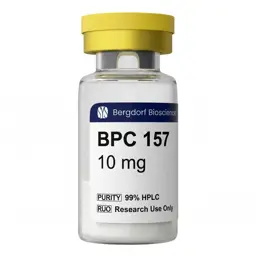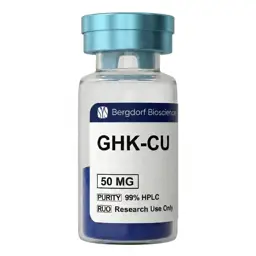
BPC-157 is studied as a systemic soft-tissue and gastrointestinal repair peptide, GHK-Cu as a copper-carrying matrix-remodelling peptide for skin and dermal regeneration. This comparison frames mechanism, evidence base, and safety profile strictly from a research perspective.
 Medically reviewed by Dr. Sieglinde Klaus · Last reviewed June 2026
BPC-157 and GHK-Cu pursue different goals in research and do not compete directly with each other. BPC-157 is a pentadecapeptide (15 amino acids) that, in preclinical models, promotes the healing of tendons, ligaments, muscles, and gastrointestinal mucosa via VEGF/EGR-1-driven angiogenesis and modulation of the nitric oxide system 1. GHK-Cu is a naturally occurring copper tripeptide (Gly-His-Lys) that acts as a Cu2+ carrier and modulates the expression of more than 4000 genes related to the remodelling of the extracellular matrix; the focus lies on collagen, elastin, and glycosaminoglycan synthesis as well as antioxidant research 4. Both are short-acting, are dosed daily in research, and hold no systemic marketing authorisation as a medicine. The choice depends on the research goal, not on a blanket superiority.
BPC-157 is studied as a systemic soft-tissue and gastrointestinal repair peptide, GHK-Cu as a copper-carrying matrix-remodelling peptide for skin and dermal regeneration. This comparison frames mechanism, evidence base, and safety profile strictly from a research perspective.
Medically reviewed by Dr. Sieglinde Klaus · Last reviewed June 2026BPC-157 and GHK-Cu pursue different goals in research and do not compete directly with each other. BPC-157 is a pentadecapeptide (15 amino acids) that, in preclinical models, promotes the healing of tendons, ligaments, muscles, and gastrointestinal mucosa via VEGF/EGR-1-driven angiogenesis and modulation of the nitric oxide system 1. GHK-Cu is a naturally occurring copper tripeptide (Gly-His-Lys) that acts as a Cu2+ carrier and modulates the expression of more than 4000 genes related to the remodelling of the extracellular matrix; the focus lies on collagen, elastin, and glycosaminoglycan synthesis as well as antioxidant research 4. Both are short-acting, are dosed daily in research, and hold no systemic marketing authorisation as a medicine. The choice depends on the research goal, not on a blanket superiority.
Pentadecapeptide (15 amino acids), 1420 g/mol
Copper-binding tripeptide (3 amino acids), 403 g/mol
Cytoprotective body-protection compound; VEGF/EGR-1 angiogenesis, NO system, gut-brain axis; no single classical receptor
Cu2+ carrier and broad gene-expression modulator (>4000 genes), drives remodelling of the extracellular matrix
Systemic soft-tissue and gastrointestinal repair: tendons, ligaments, muscles, intestinal mucosa, NSAID damage
Dermal and cosmetic regeneration: collagen and elastin synthesis, skin remodelling, anti-aging, wound healing, hair
0.25 mg/day (range 0.2-0.5 mg)
2 mg/day (range 1-4 mg)
Subcutaneous; also studied orally/intragastrically in gastrointestinal animal models
Subcutaneous; in dermatology additionally researched extensively topically
Daily
Daily
~4 hours (Sikiric et al., animal PK)
~2 hours (Pickart et al., plasma PK)
Extensive preclinical (rodent) literature on gastrointestinal and tendon healing; early human gastrointestinal work as PL 14736/PL-10; no approved systemic indication
Over five decades of research since 1973; well-characterised molecular and gene-expression biology; established as a cosmetic ingredient (copper tripeptide-1); no approved systemic therapy
No boxed warnings; well tolerated in animal models; human safety data limited; long-term data unknown
Long topical safety history; for injectable research use the copper load is the central aspect (risk of copper accumulation with overdosing)
Lyophilised, refrigerated/frozen; reconstituted solution refrigerated (2-8 C)
Lyophilised, cool and dark; the copper complex is light-sensitive, the reconstituted solution must be protected from light
Vials of 2 / 5 / 10 mg (standard 5 mg); low mg dose (0.25 mg) yields many doses per small vial
Vials of 10 / 20 / 50 mg (standard 50 mg); higher mg dose (2 mg) consumes more material per dose, hence larger vials
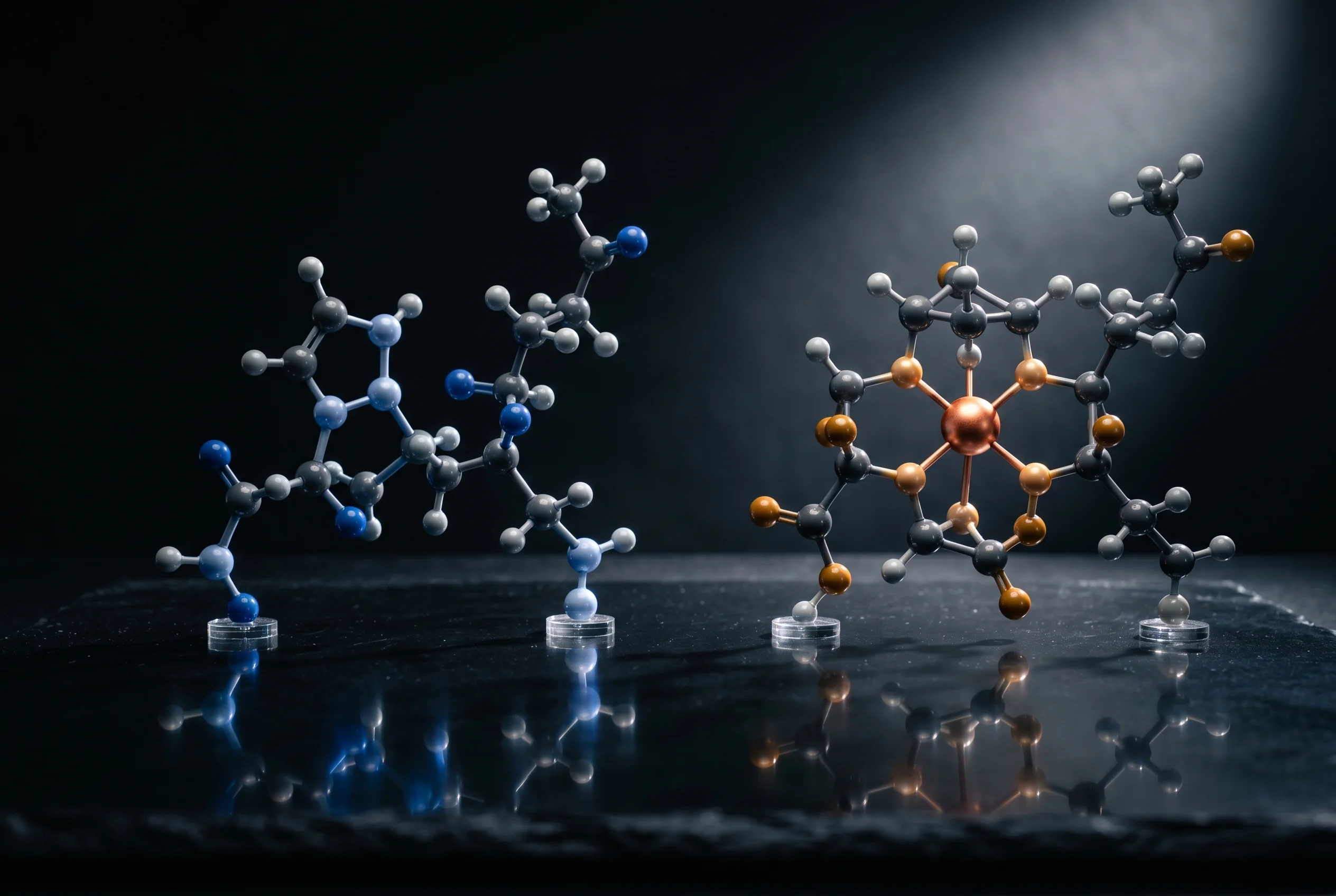
BPC-157 is a pentadecapeptide of 15 amino acids derived from a sequence in human gastric juice. In preclinical models it acts cytoprotectively as a so-called body protection compound and has no single classical receptor. Its mechanism rests on the upregulation of angiogenic growth factors (VEGF, EGR-1), modulation of the nitric oxide system, as well as interactions with the dopaminergic, serotonergic, and GABAergic systems and stabilisation of the gut-brain axis 1. In animal models it promotes the formation of new blood vessels and granulation tissue, thereby supporting the healing of tendons, ligaments, muscles, and gastrointestinal mucosa 2.
GHK-Cu is a naturally occurring copper tripeptide (glycyl-L-histidyl-L-lysine) isolated from human plasma by Pickart in 1973. It acts as a copper(II) carrier that delivers Cu2+ to tissue and modulates the expression of more than 4000 genes related to tissue remodelling 4. In cell and gene-expression studies it stimulates the synthesis of collagen (types I, III, V), elastin, decorin, and glycosaminoglycans, modulates antioxidant and anti-inflammatory genes, and supports regeneration of the extracellular matrix 6. The body's own plasma levels (~200 ng/mL in youth) decline with age.
The two peptides act at different points of tissue regeneration: BPC-157 works predominantly via angiogenesis and cytoprotection in soft tissue and the gastrointestinal tract, GHK-Cu via copper transport and broad gene-expression modulation in the remodelling of the skin's extracellular matrix. In research they should therefore be regarded as complementary rather than competing.
Both peptides rest predominantly on preclinical evidence (animal models, cell and gene-expression studies, as well as reviews). BPC-157 has broader animal data on soft-tissue and gastrointestinal healing, GHK-Cu a deeper, decades-long molecular- and dermatology-oriented literature. For neither agent are there large randomised controlled trials with systemic authorisation.
Placing BPC-157 and GHK-Cu side by side, it becomes clear that they hardly address the same research question. BPC-157 is studied when the focus is systemic soft-tissue and gastrointestinal repair: tendon, ligament, and muscle healing, protection of the intestinal mucosa, and mitigation of NSAID-induced damage 13. GHK-Cu is studied when dermal matrix remodelling and anti-aging are in the foreground: collagen, elastin, and decorin synthesis, skin regeneration, and antioxidant gene modulation 46. They also differ in handling: BPC-157 is dosed low (0.25 mg) from small vials, while GHK-Cu requires a higher mg dose (2 mg) and light-protected storage of the copper chelate.
No classic head-to-head race: the two peptides address orthogonal research goals, which is why the comparison serves mainly to provide orientation.
BPC-157 shows a favourable tolerability profile in animal models without boxed warnings, yet human safety and long-term data are limited. All statements refer to research contexts.
GHK-Cu has a long topical safety history in dermatology; for injectable research use the copper load is in the foreground. All statements refer to research contexts.
This comparison serves solely for scientific information and does not constitute medical, therapeutic, or dosage advice for humans. All effects, doses, and safety aspects mentioned derive from preclinical or laboratory research. For research purposes only. Not intended for human consumption.
BPC-157 has the more extensive preclinical data on soft-tissue healing, including improved functional recovery of the Achilles tendon-to-bone unit in the rat model [2](#ref-2).
BPC-157 has been specifically studied for gastrointestinal cytoprotection and stabilisation of intestinal permeability and is itself derived from a gastric-juice sequence [3](#ref-3).
GHK-Cu is the mechanistically best-characterised peptide for ECM remodelling and stimulates collagen, elastin, and glycosaminoglycan synthesis in skin models [6](#ref-6).
GHK-Cu modulates antioxidant and age-associated genes and has a decades-long literature on degenerative aging processes [5](#ref-5).
Because the mechanisms are orthogonal (angiogenesis/cytoprotection vs. copper transport/ECM modulation), both peptides can be used complementarily in separate research strands; the choice follows the respective endpoint.
BPC-157 is a pentadecapeptide (15 amino acids) that, in research, addresses the healing of soft tissue and gastrointestinal mucosa via angiogenesis and cytoprotection 1. GHK-Cu is a copper tripeptide (3 amino acids) that, as a Cu2+ carrier, modulates the remodelling of the skin's extracellular matrix and collagen synthesis 4. They thus pursue orthogonal research goals.
Both rest predominantly on preclinical evidence. BPC-157 has broader animal data on soft-tissue and gastrointestinal healing, GHK-Cu a deeper, decades-long molecular- and dermatology-oriented literature since 1973 4. For neither are there large randomised human studies with systemic authorisation.
In research, BPC-157 is dosed considerably lower at about 0.25 mg/day (range 0.2-0.5 mg) than GHK-Cu at around 2 mg/day (range 1-4 mg). The higher mg dose of GHK-Cu is reflected in larger vials (50 mg vs. 5 mg). These figures are not a dosage recommendation for humans.
GHK-Cu is the mechanistically best-characterised peptide for dermal regeneration. In skin models it stimulates the synthesis of collagen, elastin, decorin, and glycosaminoglycans and modulates antioxidant genes 6. BPC-157 is more oriented toward systemic soft-tissue and gastrointestinal research.
Both are lyophilised and stored refrigerated. GHK-Cu has the stricter requirements, since the copper complex is light-sensitive and the reconstituted solution must be protected from light to preserve the copper chelate. BPC-157 is kept refrigerated (2-8 C) and used within weeks.
The central topic of GHK-Cu in injectable research use is the copper load: since the peptide carries Cu2+ into tissue, there is a theoretical risk of copper accumulation with systemic overdosing. Topically, GHK-Cu has a long safety history. This is not medical advice.
No. Neither peptide holds a systemic marketing authorisation as a medicine, and both are intended solely for research purposes. GHK-Cu is established as a cosmetic ingredient (copper tripeptide-1), which, however, does not constitute a systemic therapy approval.
BPC-157 and GHK-Cu cannot be condensed into a single winner, because they answer different research questions. BPC-157 is the stronger candidate for research into systemic soft-tissue and gastrointestinal repair: angiogenesis, tendon, ligament, and muscle healing, as well as protection of the intestinal mucosa and mitigation of NSAID-induced damage 13. GHK-Cu is the stronger candidate for research into dermal ECM remodelling and anti-aging: collagen, elastin, and decorin synthesis, broad gene-expression modulation, and a decades-long dermatological history 46. Neither holds a systemic authorisation; both are research agents only. The choice follows the research goal, not a blanket superiority.
The two peptides are orthogonal: BPC-157 addresses systemic soft-tissue and gastrointestinal repair via angiogenesis and cytoprotection, GHK-Cu dermal matrix remodelling via copper transport and gene-expression modulation. Neither has a systemic authorisation or a consistently superior evidence base; the appropriate choice depends entirely on the respective research endpoint, which is why the verdict is context-dependent.
Pentadecapeptide (15 amino acids), 1420 g/mol
Copper-binding tripeptide (3 amino acids), 403 g/mol
Cytoprotective body-protection compound; VEGF/EGR-1 angiogenesis, NO system, gut-brain axis; no single classical receptor
Cu2+ carrier and broad gene-expression modulator (>4000 genes), drives remodelling of the extracellular matrix
Systemic soft-tissue and gastrointestinal repair: tendons, ligaments, muscles, intestinal mucosa, NSAID damage
Dermal and cosmetic regeneration: collagen and elastin synthesis, skin remodelling, anti-aging, wound healing, hair
0.25 mg/day (range 0.2-0.5 mg)
2 mg/day (range 1-4 mg)
Subcutaneous; also studied orally/intragastrically in gastrointestinal animal models
Subcutaneous; in dermatology additionally researched extensively topically
Daily
Daily
~4 hours (Sikiric et al., animal PK)
~2 hours (Pickart et al., plasma PK)
Extensive preclinical (rodent) literature on gastrointestinal and tendon healing; early human gastrointestinal work as PL 14736/PL-10; no approved systemic indication
Over five decades of research since 1973; well-characterised molecular and gene-expression biology; established as a cosmetic ingredient (copper tripeptide-1); no approved systemic therapy
No boxed warnings; well tolerated in animal models; human safety data limited; long-term data unknown
Long topical safety history; for injectable research use the copper load is the central aspect (risk of copper accumulation with overdosing)
Lyophilised, refrigerated/frozen; reconstituted solution refrigerated (2-8 C)
Lyophilised, cool and dark; the copper complex is light-sensitive, the reconstituted solution must be protected from light
Vials of 2 / 5 / 10 mg (standard 5 mg); low mg dose (0.25 mg) yields many doses per small vial
Vials of 10 / 20 / 50 mg (standard 50 mg); higher mg dose (2 mg) consumes more material per dose, hence larger vials
BPC-157 is a pentadecapeptide of 15 amino acids derived from a sequence in human gastric juice. In preclinical models it acts cytoprotectively as a so-called body protection compound and has no single classical receptor. Its mechanism rests on the upregulation of angiogenic growth factors (VEGF, EGR-1), modulation of the nitric oxide system, as well as interactions with the dopaminergic, serotonergic, and GABAergic systems and stabilisation of the gut-brain axis 1. In animal models it promotes the formation of new blood vessels and granulation tissue, thereby supporting the healing of tendons, ligaments, muscles, and gastrointestinal mucosa 2.
GHK-Cu is a naturally occurring copper tripeptide (glycyl-L-histidyl-L-lysine) isolated from human plasma by Pickart in 1973. It acts as a copper(II) carrier that delivers Cu2+ to tissue and modulates the expression of more than 4000 genes related to tissue remodelling 4. In cell and gene-expression studies it stimulates the synthesis of collagen (types I, III, V), elastin, decorin, and glycosaminoglycans, modulates antioxidant and anti-inflammatory genes, and supports regeneration of the extracellular matrix 6. The body's own plasma levels (~200 ng/mL in youth) decline with age.
The two peptides act at different points of tissue regeneration: BPC-157 works predominantly via angiogenesis and cytoprotection in soft tissue and the gastrointestinal tract, GHK-Cu via copper transport and broad gene-expression modulation in the remodelling of the skin's extracellular matrix. In research they should therefore be regarded as complementary rather than competing.
Both peptides rest predominantly on preclinical evidence (animal models, cell and gene-expression studies, as well as reviews). BPC-157 has broader animal data on soft-tissue and gastrointestinal healing, GHK-Cu a deeper, decades-long molecular- and dermatology-oriented literature. For neither agent are there large randomised controlled trials with systemic authorisation.
Placing BPC-157 and GHK-Cu side by side, it becomes clear that they hardly address the same research question. BPC-157 is studied when the focus is systemic soft-tissue and gastrointestinal repair: tendon, ligament, and muscle healing, protection of the intestinal mucosa, and mitigation of NSAID-induced damage 13. GHK-Cu is studied when dermal matrix remodelling and anti-aging are in the foreground: collagen, elastin, and decorin synthesis, skin regeneration, and antioxidant gene modulation 46. They also differ in handling: BPC-157 is dosed low (0.25 mg) from small vials, while GHK-Cu requires a higher mg dose (2 mg) and light-protected storage of the copper chelate.
No classic head-to-head race: the two peptides address orthogonal research goals, which is why the comparison serves mainly to provide orientation.
BPC-157 shows a favourable tolerability profile in animal models without boxed warnings, yet human safety and long-term data are limited. All statements refer to research contexts.
GHK-Cu has a long topical safety history in dermatology; for injectable research use the copper load is in the foreground. All statements refer to research contexts.
This comparison serves solely for scientific information and does not constitute medical, therapeutic, or dosage advice for humans. All effects, doses, and safety aspects mentioned derive from preclinical or laboratory research. For research purposes only. Not intended for human consumption.
BPC-157 has the more extensive preclinical data on soft-tissue healing, including improved functional recovery of the Achilles tendon-to-bone unit in the rat model [2](#ref-2).
BPC-157 has been specifically studied for gastrointestinal cytoprotection and stabilisation of intestinal permeability and is itself derived from a gastric-juice sequence [3](#ref-3).
GHK-Cu is the mechanistically best-characterised peptide for ECM remodelling and stimulates collagen, elastin, and glycosaminoglycan synthesis in skin models [6](#ref-6).
GHK-Cu modulates antioxidant and age-associated genes and has a decades-long literature on degenerative aging processes [5](#ref-5).
Because the mechanisms are orthogonal (angiogenesis/cytoprotection vs. copper transport/ECM modulation), both peptides can be used complementarily in separate research strands; the choice follows the respective endpoint.
BPC-157 is a pentadecapeptide (15 amino acids) that, in research, addresses the healing of soft tissue and gastrointestinal mucosa via angiogenesis and cytoprotection 1. GHK-Cu is a copper tripeptide (3 amino acids) that, as a Cu2+ carrier, modulates the remodelling of the skin's extracellular matrix and collagen synthesis 4. They thus pursue orthogonal research goals.
Both rest predominantly on preclinical evidence. BPC-157 has broader animal data on soft-tissue and gastrointestinal healing, GHK-Cu a deeper, decades-long molecular- and dermatology-oriented literature since 1973 4. For neither are there large randomised human studies with systemic authorisation.
In research, BPC-157 is dosed considerably lower at about 0.25 mg/day (range 0.2-0.5 mg) than GHK-Cu at around 2 mg/day (range 1-4 mg). The higher mg dose of GHK-Cu is reflected in larger vials (50 mg vs. 5 mg). These figures are not a dosage recommendation for humans.
GHK-Cu is the mechanistically best-characterised peptide for dermal regeneration. In skin models it stimulates the synthesis of collagen, elastin, decorin, and glycosaminoglycans and modulates antioxidant genes 6. BPC-157 is more oriented toward systemic soft-tissue and gastrointestinal research.
Both are lyophilised and stored refrigerated. GHK-Cu has the stricter requirements, since the copper complex is light-sensitive and the reconstituted solution must be protected from light to preserve the copper chelate. BPC-157 is kept refrigerated (2-8 C) and used within weeks.
The central topic of GHK-Cu in injectable research use is the copper load: since the peptide carries Cu2+ into tissue, there is a theoretical risk of copper accumulation with systemic overdosing. Topically, GHK-Cu has a long safety history. This is not medical advice.
No. Neither peptide holds a systemic marketing authorisation as a medicine, and both are intended solely for research purposes. GHK-Cu is established as a cosmetic ingredient (copper tripeptide-1), which, however, does not constitute a systemic therapy approval.
BPC-157 and GHK-Cu cannot be condensed into a single winner, because they answer different research questions. BPC-157 is the stronger candidate for research into systemic soft-tissue and gastrointestinal repair: angiogenesis, tendon, ligament, and muscle healing, as well as protection of the intestinal mucosa and mitigation of NSAID-induced damage 13. GHK-Cu is the stronger candidate for research into dermal ECM remodelling and anti-aging: collagen, elastin, and decorin synthesis, broad gene-expression modulation, and a decades-long dermatological history 46. Neither holds a systemic authorisation; both are research agents only. The choice follows the research goal, not a blanket superiority.
The two peptides are orthogonal: BPC-157 addresses systemic soft-tissue and gastrointestinal repair via angiogenesis and cytoprotection, GHK-Cu dermal matrix remodelling via copper transport and gene-expression modulation. Neither has a systemic authorisation or a consistently superior evidence base; the appropriate choice depends entirely on the respective research endpoint, which is why the verdict is context-dependent.