The four-peptide healing stack (GHK-Cu, TB-500, BPC-157, KPV) in scientific comparison with the classic two-peptide regeneration blend of TB-500 and BPC-157.
 Medically reviewed by Dr. Sieglinde Klaus · Last reviewed June 2026
Both preparations are research blends that target soft-tissue regeneration. The TB-500/BPC-157 Blend (B) combines two of the best preclinically characterized repair peptides and is regarded as a focused, widely studied standard for tendon, muscle, and connective-tissue models. The KLOW Stack (A) extends this framework with GHK-Cu (collagen synthesis, skin matrix) and KPV (anti-inflammatory melanocortin derivative), thereby additionally addressing skin, matrix, and inflammation endpoints. The direct evidence base for the fixed quadruple combination is limited; the data come predominantly from single-peptide studies. The choice depends on the research endpoint: narrower and better supported (B) versus broader and multimodal (A).
The four-peptide healing stack (GHK-Cu, TB-500, BPC-157, KPV) in scientific comparison with the classic two-peptide regeneration blend of TB-500 and BPC-157.
Medically reviewed by Dr. Sieglinde Klaus · Last reviewed June 2026Both preparations are research blends that target soft-tissue regeneration. The TB-500/BPC-157 Blend (B) combines two of the best preclinically characterized repair peptides and is regarded as a focused, widely studied standard for tendon, muscle, and connective-tissue models. The KLOW Stack (A) extends this framework with GHK-Cu (collagen synthesis, skin matrix) and KPV (anti-inflammatory melanocortin derivative), thereby additionally addressing skin, matrix, and inflammation endpoints. The direct evidence base for the fixed quadruple combination is limited; the data come predominantly from single-peptide studies. The choice depends on the research endpoint: narrower and better supported (B) versus broader and multimodal (A).
4 peptides: GHK-Cu, TB-500, BPC-157, KPV
2 peptides: TB-500, BPC-157
Multimodal: soft tissue, skin matrix, inflammation
Soft tissue: tendon, muscle, connective tissue
Directly addressed via GHK-Cu
Indirectly via fibroblast migration
Explicitly via KPV (melanocortin derivative)
Concomitantly via BPC-157
Heterogeneous; KPV/GHK-Cu tissue-specific
High and convergent for soft tissue
Very limited (quadruple barely studied)
Limited (pairing barely studied as a blend)
None for the stack
None for the blend
High (4 active agents, many covariates)
Moderate (2 active agents)
Research reagent only, not approved
Research reagent only, not approved
The KLOW Stack combines four peptides with complementary, partly overlapping pathways. GHK-Cu is a copper-binding tripeptide complex that stimulates collagen synthesis in fibroblast cultures as low as the nanomolar range 1 and modulates numerous regenerative and antioxidant programs in gene-expression analyses 2. KPV is the C-terminal segment of alpha-MSH and acts as an anti-inflammatory melanocortin derivative whose uptake via the transporter PepT1 dampens the release of proinflammatory cytokines 3. TB-500 and BPC-157 contribute, as in blend B, to cell migration, survival, and tissue regeneration. In theory, A thereby simultaneously covers matrix building, inflammation control, and cell migration.
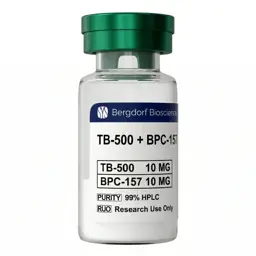
The TB-500/BPC-157 Blend bundles two of the best-characterized repair peptides. TB-500 contains the actin-binding domain of thymosin beta-4; via G-actin sequestration it promotes the migration of keratinocytes and fibroblasts, angiogenesis, and accelerates wound healing in preclinical models 7. BPC-157 is a stable gastric pentadecapeptide that, in tendon models, increases the outgrowth of explants, cell survival under oxidative stress, and fibroblast migration 6 and raises the expression of the growth hormone receptor in tendon fibroblasts 5. The two peptides are considered mechanistically synergistic for tendon, muscle, and connective-tissue endpoints.
The central difference is the breadth of the activity profile. B is focused on soft-tissue regeneration and rests on the densest, most convergent single-peptide evidence. A contains the same base but supplements it with an explicit collagen/matrix arm (GHK-Cu) and an inflammation arm (KPV). This breadth is attractive from a research logic standpoint but increases the number of variables to control and makes it harder to attribute effects to individual components.
The evidence for both preparations is preclinical and stems almost exclusively from single-peptide studies in cell cultures and animal models, not from controlled human studies of the respective fixed combination. B benefits from a particularly dense and convergent body of data on tendon and soft tissue, while A draws its additional breadth from tissue-specific GHK-Cu and KPV data. Transfer of these findings to humans is not established.
The KLOW Stack combines four peptides, each with only preclinically described safety data. The combination has not been systematically studied for tolerability as a fixed mixture; the added risk of multiple active agents and possible interactions is unknown.
The TB-500/BPC-157 Blend rests on two broadly preclinically characterized peptides. Here, too, no controlled human safety data exist for the blend; the profile is, however, considered more narrowly defined than with four components.
This comparison serves exclusively for scientific information. None of the substances or combinations mentioned is approved as a medicine for human use, and none of the cited studies demonstrates safety or efficacy in humans. All data stem from preclinical models. For research purposes only. Not intended for human consumption.
For soft-tissue endpoints, the TB-500/BPC-157 Blend is the focused choice with the densest and most convergent preclinical single-peptide evidence.
GHK-Cu addresses collagen and matrix synthesis directly; in this context the KLOW Stack brings a relevant additional arm that B lacks.
The KPV component adds an explicit anti-inflammatory melanocortin pathway that is of interest for models with an inflammatory component.
With only two components, effects can be attributed to individual peptides far more easily than with the quadruple KLOW Stack.
Both are suitable as a starting point; A maximizes the pathways covered, B maximizes interpretability. The decision follows the specific endpoint and the budget for control arms.
The TB-500/BPC-157 Blend consists of two repair peptides focused on soft tissue. The KLOW Stack contains the same two peptides and supplements them with GHK-Cu (collagen/matrix synthesis) and KPV (inflammation suppression). A is therefore broader and multimodal, while B is more focused and better supported for soft tissue.
For soft-tissue endpoints, the evidence for B is particularly dense and convergent, because TB-500 and BPC-157 are among the best preclinically studied repair peptides 67. A draws its additional breadth from tissue-specific GHK-Cu 1 and KPV data 3. For neither of the two fixed combinations do controlled human studies exist.
Mechanistically, GHK-Cu and KPV address pathways that are barely represented in the pure TB-500/BPC-157 Blend, namely direct collagen synthesis 1 and anti-inflammatory melanocortin signaling pathways 3. Whether this produces a measurable additional benefit in a specific model is not demonstrated by combination studies and remains a research hypothesis.
Generally yes. With only two components, observed effects can be attributed to individual peptides far more easily. The quadruple KLOW Stack increases the number of covariates and thereby complicates clean mechanistic interpretation.
No. Neither the KLOW Stack nor the TB-500/BPC-157 Blend is approved as a medicine. Both are exclusively research reagents. All cited data stem from preclinical cell and animal models.
Since these are not pharmaceutically approved products, purity analyses (e.g. HPLC), batch certificates, and correct storage are decisive for ruling out contamination and incorrect dosing. With A, GHK-Cu adds a copper-containing component whose stability and concentration warrant particular attention.
No, not readily. Preclinical results are important hypothesis generators, but they cannot be transferred directly to humans. For both blends, controlled human studies are entirely lacking.
Both preparations pursue the same goal of tissue regeneration, but with a different strategy. The TB-500/BPC-157 Blend (B) is the focused, more evidence-dense standard for tendon, muscle, and connective-tissue research and scores with the best interpretability. The KLOW Stack (A) is the broader, multimodal hypothesis, which adds a matrix arm with GHK-Cu and an inflammation arm with KPV, thereby becoming more attractive for skin, matrix, and inflammation endpoints. Which preparation is superior depends entirely on the research endpoint. For pure soft-tissue models and clean mechanistic work, much speaks in favor of B; for exploratory, multidimensional repair questions, A is the more comprehensive option. Since no controlled human studies exist for either of the two fixed combinations, the decision remains context-dependent.
B is superior for soft-tissue focus and variable control, A for multimodal matrix and inflammation endpoints; without combination studies there is no universal winner.
4 peptides: GHK-Cu, TB-500, BPC-157, KPV
2 peptides: TB-500, BPC-157
Multimodal: soft tissue, skin matrix, inflammation
Soft tissue: tendon, muscle, connective tissue
Directly addressed via GHK-Cu
Indirectly via fibroblast migration
Explicitly via KPV (melanocortin derivative)
Concomitantly via BPC-157
Heterogeneous; KPV/GHK-Cu tissue-specific
High and convergent for soft tissue
Very limited (quadruple barely studied)
Limited (pairing barely studied as a blend)
None for the stack
None for the blend
High (4 active agents, many covariates)
Moderate (2 active agents)
Research reagent only, not approved
Research reagent only, not approved
The KLOW Stack combines four peptides with complementary, partly overlapping pathways. GHK-Cu is a copper-binding tripeptide complex that stimulates collagen synthesis in fibroblast cultures as low as the nanomolar range 1 and modulates numerous regenerative and antioxidant programs in gene-expression analyses 2. KPV is the C-terminal segment of alpha-MSH and acts as an anti-inflammatory melanocortin derivative whose uptake via the transporter PepT1 dampens the release of proinflammatory cytokines 3. TB-500 and BPC-157 contribute, as in blend B, to cell migration, survival, and tissue regeneration. In theory, A thereby simultaneously covers matrix building, inflammation control, and cell migration.
The TB-500/BPC-157 Blend bundles two of the best-characterized repair peptides. TB-500 contains the actin-binding domain of thymosin beta-4; via G-actin sequestration it promotes the migration of keratinocytes and fibroblasts, angiogenesis, and accelerates wound healing in preclinical models 7. BPC-157 is a stable gastric pentadecapeptide that, in tendon models, increases the outgrowth of explants, cell survival under oxidative stress, and fibroblast migration 6 and raises the expression of the growth hormone receptor in tendon fibroblasts 5. The two peptides are considered mechanistically synergistic for tendon, muscle, and connective-tissue endpoints.
The central difference is the breadth of the activity profile. B is focused on soft-tissue regeneration and rests on the densest, most convergent single-peptide evidence. A contains the same base but supplements it with an explicit collagen/matrix arm (GHK-Cu) and an inflammation arm (KPV). This breadth is attractive from a research logic standpoint but increases the number of variables to control and makes it harder to attribute effects to individual components.
The evidence for both preparations is preclinical and stems almost exclusively from single-peptide studies in cell cultures and animal models, not from controlled human studies of the respective fixed combination. B benefits from a particularly dense and convergent body of data on tendon and soft tissue, while A draws its additional breadth from tissue-specific GHK-Cu and KPV data. Transfer of these findings to humans is not established.
The KLOW Stack combines four peptides, each with only preclinically described safety data. The combination has not been systematically studied for tolerability as a fixed mixture; the added risk of multiple active agents and possible interactions is unknown.
The TB-500/BPC-157 Blend rests on two broadly preclinically characterized peptides. Here, too, no controlled human safety data exist for the blend; the profile is, however, considered more narrowly defined than with four components.
This comparison serves exclusively for scientific information. None of the substances or combinations mentioned is approved as a medicine for human use, and none of the cited studies demonstrates safety or efficacy in humans. All data stem from preclinical models. For research purposes only. Not intended for human consumption.
For soft-tissue endpoints, the TB-500/BPC-157 Blend is the focused choice with the densest and most convergent preclinical single-peptide evidence.
GHK-Cu addresses collagen and matrix synthesis directly; in this context the KLOW Stack brings a relevant additional arm that B lacks.
The KPV component adds an explicit anti-inflammatory melanocortin pathway that is of interest for models with an inflammatory component.
With only two components, effects can be attributed to individual peptides far more easily than with the quadruple KLOW Stack.
Both are suitable as a starting point; A maximizes the pathways covered, B maximizes interpretability. The decision follows the specific endpoint and the budget for control arms.
The TB-500/BPC-157 Blend consists of two repair peptides focused on soft tissue. The KLOW Stack contains the same two peptides and supplements them with GHK-Cu (collagen/matrix synthesis) and KPV (inflammation suppression). A is therefore broader and multimodal, while B is more focused and better supported for soft tissue.
For soft-tissue endpoints, the evidence for B is particularly dense and convergent, because TB-500 and BPC-157 are among the best preclinically studied repair peptides 67. A draws its additional breadth from tissue-specific GHK-Cu 1 and KPV data 3. For neither of the two fixed combinations do controlled human studies exist.
Mechanistically, GHK-Cu and KPV address pathways that are barely represented in the pure TB-500/BPC-157 Blend, namely direct collagen synthesis 1 and anti-inflammatory melanocortin signaling pathways 3. Whether this produces a measurable additional benefit in a specific model is not demonstrated by combination studies and remains a research hypothesis.
Generally yes. With only two components, observed effects can be attributed to individual peptides far more easily. The quadruple KLOW Stack increases the number of covariates and thereby complicates clean mechanistic interpretation.
No. Neither the KLOW Stack nor the TB-500/BPC-157 Blend is approved as a medicine. Both are exclusively research reagents. All cited data stem from preclinical cell and animal models.
Since these are not pharmaceutically approved products, purity analyses (e.g. HPLC), batch certificates, and correct storage are decisive for ruling out contamination and incorrect dosing. With A, GHK-Cu adds a copper-containing component whose stability and concentration warrant particular attention.
No, not readily. Preclinical results are important hypothesis generators, but they cannot be transferred directly to humans. For both blends, controlled human studies are entirely lacking.
Both preparations pursue the same goal of tissue regeneration, but with a different strategy. The TB-500/BPC-157 Blend (B) is the focused, more evidence-dense standard for tendon, muscle, and connective-tissue research and scores with the best interpretability. The KLOW Stack (A) is the broader, multimodal hypothesis, which adds a matrix arm with GHK-Cu and an inflammation arm with KPV, thereby becoming more attractive for skin, matrix, and inflammation endpoints. Which preparation is superior depends entirely on the research endpoint. For pure soft-tissue models and clean mechanistic work, much speaks in favor of B; for exploratory, multidimensional repair questions, A is the more comprehensive option. Since no controlled human studies exist for either of the two fixed combinations, the decision remains context-dependent.
B is superior for soft-tissue focus and variable control, A for multimodal matrix and inflammation endpoints; without combination studies there is no universal winner.