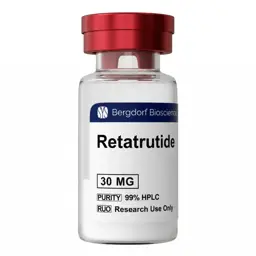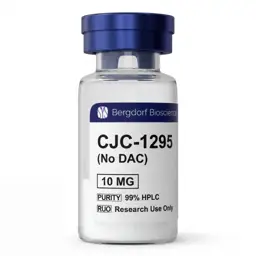
Incretin triple agonist (GLP-1R/GIPR/GCGR) for weight reduction versus short-acting GHRH analog (GH/IGF-1 recomposition). Two fundamentally different research axes in direct comparison.
 Medically reviewed by Dr. Sieglinde Klaus · Last reviewed June 2026
Retatrutide and CJC-1295 (No DAC) pursue completely different research goals and are not interchangeable substances. Retatrutide is a once-weekly injectable triple agonist at the receptors for GLP-1, GIP and glucagon, and showed a mean weight reduction of up to 24.2 percent over 48 weeks in Phase 2 studies 1. CJC-1295 (No DAC), also called Modified GRF (1-29), is a short-acting GHRH analog with a half-life of about 30 minutes that is intended to stimulate the pulsatile release of growth hormone (GH) and, downstream, IGF-1 4.
Incretin triple agonist (GLP-1R/GIPR/GCGR) for weight reduction versus short-acting GHRH analog (GH/IGF-1 recomposition). Two fundamentally different research axes in direct comparison.
Medically reviewed by Dr. Sieglinde Klaus · Last reviewed June 2026Retatrutide and CJC-1295 (No DAC) pursue completely different research goals and are not interchangeable substances. Retatrutide is a once-weekly injectable triple agonist at the receptors for GLP-1, GIP and glucagon, and showed a mean weight reduction of up to 24.2 percent over 48 weeks in Phase 2 studies 1. CJC-1295 (No DAC), also called Modified GRF (1-29), is a short-acting GHRH analog with a half-life of about 30 minutes that is intended to stimulate the pulsatile release of growth hormone (GH) and, downstream, IGF-1 4.
Incretin triple agonist (GLP-1R/GIPR/GCGR)
Short-acting GHRH analog (Modified GRF 1-29)
Energy balance, weight, glucose metabolism
GH/IGF-1 axis, tissue recomposition
GLP-1, GIP and glucagon receptor
GHRH receptor of the pituitary
approx. 6 days (once weekly)
approx. 30 minutes (multiple times daily)
Once weekly, subcutaneous
One to three times daily, subcutaneous
Several randomized Phase 2 studies (obesity, T2D)
None; pharmacological GH pulsatility studies
up to approx. 24.2% over 48 weeks (12 mg)
Not a primary endpoint; indirect via body composition
No direct GH/IGF-1 mechanism
Raises basal and mean GH levels as well as IGF-1
Not applicable (no GH mechanism)
Pulsatile GH secretion is preserved
Predominantly gastrointestinal, dose-dependent
Local reactions, well tolerated in pharmacology studies
Clinical trial phase (not approved)
Research chemical only; not approved
Retatrutide is a synthetic peptide that acts simultaneously as an agonist at three receptors: the GLP-1 receptor, the GIP receptor and the glucagon receptor 1. In models, the GLP-1 and GIP components promote glucose-dependent insulin secretion and slow gastric emptying, which leads to reduced food intake. The additional glucagon receptor activation distinguishes Retatrutide from pure GLP-1 or dual agonists: it is associated with increased energy expenditure and enhanced lipid mobilization in the liver 2. This triple action explains the pronounced effects on body weight and metabolic parameters observed in Phase 2 studies.
CJC-1295 (No DAC), pharmacologically referred to as Modified GRF (1-29), is a shortened and stabilized analog of human growth hormone releasing hormone (GHRH). It binds to the GHRH receptor of the pituitary and stimulates the release of endogenous growth hormone there 4. In contrast to the DAC variant, the Drug Affinity Complex that binds the molecule to albumin is absent; as a result, the half-life is only about 30 minutes. This short window of action mimics the body's natural, pulsatile GHRH signal. In pharmacological investigations, the physiological frequency and amplitude of GH pulses were preserved, while basal and mean GH levels and, downstream, IGF-1 increased 4.
The mechanisms do not overlap: Retatrutide acts on energy and glucose metabolism, CJC-1295 (No DAC) on the somatotropic axis (GH/IGF-1). A central conceptual difference is the pharmacokinetics: Retatrutide relies on a long, steady signal with weekly dosing, while CJC-1295 (No DAC) deliberately acts short and pulsatile so as not to override the body's own GH rhythm.
The evidence base is asymmetric: for Retatrutide there are several randomized, placebo-controlled Phase 2 human studies with hard metabolic endpoints 123. For CJC-1295 (No DAC), predominantly mechanistic pharmacology studies of GH pulsatility are available 4; robust data on the class derive in part from investigations of the longer-acting DAC variant 5. A direct head-to-head comparison of the two substances has never been conducted, as they address different research questions.
In the Phase 2 studies, Retatrutide was predominantly well tolerated; the most frequent events were dose-dependent, mostly mild to moderate gastrointestinal complaints, which were partly mitigated by a low starting dose [1](#ref-1).
In the available pharmacological investigations, CJC-1295 (No DAC) was tolerated without serious adverse reactions; however, the data base is limited and concerns small participant groups [4](#ref-4)[5](#ref-5).
The information provided summarizes the state of published research and does not constitute medical advice. Neither substance is approved as a medicinal product for use in humans. All statements serve solely scientific information purposes. For research purposes only. Not intended for human consumption.
As a triple agonist, Retatrutide is designed for models of weight reduction and energy expenditure and is supported by Phase 2 data with pronounced effects [1](#ref-1).
CJC-1295 (No DAC) specifically stimulates pulsatile GH release and is suitable for models of the somatotropic axis without interfering with glucose metabolism [4](#ref-4).
The GLP-1 and GIP components of Retatrutide directly address glucose-dependent insulin secretion; Phase 2 data show clear HbA1c reductions [2](#ref-2).
The short window of action of CJC-1295 (No DAC) preserves the natural GH pulse frequency and is therefore suited to studies of pituitary rhythm [4](#ref-4).
Since both substances address completely separate axes (energy balance vs. GH/IGF-1), a research design can use both separately depending on the hypothesis; substituting one for the other, however, is not meaningful.
No. The two peptides address completely different research axes. Retatrutide acts on energy and glucose metabolism via GLP-1, GIP and glucagon receptors 1, while CJC-1295 (No DAC) addresses exclusively the GH/IGF-1 axis via the GHRH receptor 4. A substitution is therefore not meaningful for any research question.
Not by the same mechanism. CJC-1295 (No DAC) can influence body composition via an elevated GH/IGF-1 axis, but was never designed for weight reduction as a primary endpoint in the studies. Retatrutide, by contrast, showed direct, pronounced weight reductions of up to 24.2 percent 1.
Owing to the short half-life of about 30 minutes, the signal fades quickly and does not override the body's own pituitary rhythm. In a pharmacological investigation, the frequency and amplitude of GH pulses remained unchanged, while basal GH levels and IGF-1 rose 4.
No. Retatrutide is in the clinical trial phase and is not approved; CJC-1295 (No DAC) is solely a research chemical without pharmaceutical approval. Both are intended for research purposes only.
A direct winner cannot be named, since Retatrutide and CJC-1295 (No DAC) cover two completely separate research fields. Anyone studying metabolic models of weight, glucose control or organ parameters will find in Retatrutide a substance supported by robust Phase 2 human data 123. Anyone, on the other hand, researching the somatotropic axis (GH/IGF-1) and physiological hormone pulsatility turns to CJC-1295 (No DAC), which delivers a short, near-natural GHRH signal 4. Both substances are not interchangeable; the choice is determined solely by the research hypothesis.
Retatrutide has stronger evidence and is superior for metabolic models, CJC-1295 (No DAC) is the only meaningful choice for models of the GH/IGF-1 axis. The suitable candidate depends entirely on the research goal.
Incretin triple agonist (GLP-1R/GIPR/GCGR)
Short-acting GHRH analog (Modified GRF 1-29)
Energy balance, weight, glucose metabolism
GH/IGF-1 axis, tissue recomposition
GLP-1, GIP and glucagon receptor
GHRH receptor of the pituitary
approx. 6 days (once weekly)
approx. 30 minutes (multiple times daily)
Once weekly, subcutaneous
One to three times daily, subcutaneous
Several randomized Phase 2 studies (obesity, T2D)
None; pharmacological GH pulsatility studies
up to approx. 24.2% over 48 weeks (12 mg)
Not a primary endpoint; indirect via body composition
No direct GH/IGF-1 mechanism
Raises basal and mean GH levels as well as IGF-1
Not applicable (no GH mechanism)
Pulsatile GH secretion is preserved
Predominantly gastrointestinal, dose-dependent
Local reactions, well tolerated in pharmacology studies
Clinical trial phase (not approved)
Research chemical only; not approved
Retatrutide is a synthetic peptide that acts simultaneously as an agonist at three receptors: the GLP-1 receptor, the GIP receptor and the glucagon receptor 1. In models, the GLP-1 and GIP components promote glucose-dependent insulin secretion and slow gastric emptying, which leads to reduced food intake. The additional glucagon receptor activation distinguishes Retatrutide from pure GLP-1 or dual agonists: it is associated with increased energy expenditure and enhanced lipid mobilization in the liver 2. This triple action explains the pronounced effects on body weight and metabolic parameters observed in Phase 2 studies.
CJC-1295 (No DAC), pharmacologically referred to as Modified GRF (1-29), is a shortened and stabilized analog of human growth hormone releasing hormone (GHRH). It binds to the GHRH receptor of the pituitary and stimulates the release of endogenous growth hormone there 4. In contrast to the DAC variant, the Drug Affinity Complex that binds the molecule to albumin is absent; as a result, the half-life is only about 30 minutes. This short window of action mimics the body's natural, pulsatile GHRH signal. In pharmacological investigations, the physiological frequency and amplitude of GH pulses were preserved, while basal and mean GH levels and, downstream, IGF-1 increased 4.
The mechanisms do not overlap: Retatrutide acts on energy and glucose metabolism, CJC-1295 (No DAC) on the somatotropic axis (GH/IGF-1). A central conceptual difference is the pharmacokinetics: Retatrutide relies on a long, steady signal with weekly dosing, while CJC-1295 (No DAC) deliberately acts short and pulsatile so as not to override the body's own GH rhythm.
The evidence base is asymmetric: for Retatrutide there are several randomized, placebo-controlled Phase 2 human studies with hard metabolic endpoints 123. For CJC-1295 (No DAC), predominantly mechanistic pharmacology studies of GH pulsatility are available 4; robust data on the class derive in part from investigations of the longer-acting DAC variant 5. A direct head-to-head comparison of the two substances has never been conducted, as they address different research questions.
In the Phase 2 studies, Retatrutide was predominantly well tolerated; the most frequent events were dose-dependent, mostly mild to moderate gastrointestinal complaints, which were partly mitigated by a low starting dose [1](#ref-1).
In the available pharmacological investigations, CJC-1295 (No DAC) was tolerated without serious adverse reactions; however, the data base is limited and concerns small participant groups [4](#ref-4)[5](#ref-5).
The information provided summarizes the state of published research and does not constitute medical advice. Neither substance is approved as a medicinal product for use in humans. All statements serve solely scientific information purposes. For research purposes only. Not intended for human consumption.
As a triple agonist, Retatrutide is designed for models of weight reduction and energy expenditure and is supported by Phase 2 data with pronounced effects [1](#ref-1).
CJC-1295 (No DAC) specifically stimulates pulsatile GH release and is suitable for models of the somatotropic axis without interfering with glucose metabolism [4](#ref-4).
The GLP-1 and GIP components of Retatrutide directly address glucose-dependent insulin secretion; Phase 2 data show clear HbA1c reductions [2](#ref-2).
The short window of action of CJC-1295 (No DAC) preserves the natural GH pulse frequency and is therefore suited to studies of pituitary rhythm [4](#ref-4).
Since both substances address completely separate axes (energy balance vs. GH/IGF-1), a research design can use both separately depending on the hypothesis; substituting one for the other, however, is not meaningful.
No. The two peptides address completely different research axes. Retatrutide acts on energy and glucose metabolism via GLP-1, GIP and glucagon receptors 1, while CJC-1295 (No DAC) addresses exclusively the GH/IGF-1 axis via the GHRH receptor 4. A substitution is therefore not meaningful for any research question.
Not by the same mechanism. CJC-1295 (No DAC) can influence body composition via an elevated GH/IGF-1 axis, but was never designed for weight reduction as a primary endpoint in the studies. Retatrutide, by contrast, showed direct, pronounced weight reductions of up to 24.2 percent 1.
Owing to the short half-life of about 30 minutes, the signal fades quickly and does not override the body's own pituitary rhythm. In a pharmacological investigation, the frequency and amplitude of GH pulses remained unchanged, while basal GH levels and IGF-1 rose 4.
No. Retatrutide is in the clinical trial phase and is not approved; CJC-1295 (No DAC) is solely a research chemical without pharmaceutical approval. Both are intended for research purposes only.
A direct winner cannot be named, since Retatrutide and CJC-1295 (No DAC) cover two completely separate research fields. Anyone studying metabolic models of weight, glucose control or organ parameters will find in Retatrutide a substance supported by robust Phase 2 human data 123. Anyone, on the other hand, researching the somatotropic axis (GH/IGF-1) and physiological hormone pulsatility turns to CJC-1295 (No DAC), which delivers a short, near-natural GHRH signal 4. Both substances are not interchangeable; the choice is determined solely by the research hypothesis.
Retatrutide has stronger evidence and is superior for metabolic models, CJC-1295 (No DAC) is the only meaningful choice for models of the GH/IGF-1 axis. The suitable candidate depends entirely on the research goal.