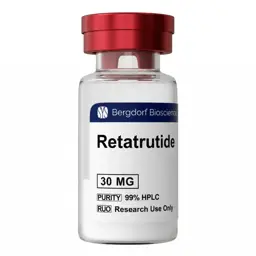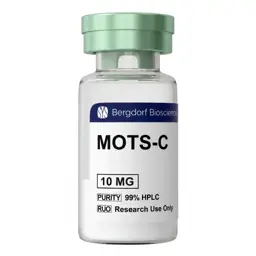
Two research peptides filed under the metabolism umbrella that share nothing biologically: a synthetic triple-receptor agonist with robust human data versus a mitochondrially encoded AMPK activator at an early research stage.
 Medically reviewed by Dr. Sieglinde Klaus · Last reviewed June 2026
Retatrutide (LY3437943) is a synthetic 39-amino-acid triple agonist that simultaneously binds the GLP-1, GIP and glucagon receptors. In research it stands for appetite regulation, glycemic control and very pronounced weight reduction, with a deep human Phase 2 evidence base from Eli Lilly's Phase 2 obesity trial (Jastreboff et al., NEJM 2023) 13.
MOTS-c is an endogenous, mitochondrially encoded 16-amino-acid peptide that acts not at a surface receptor but within the metabolic machinery, via the AMPK energy sensor, and is studied as a so-called exercise mimetic 45. Its evidence is predominantly preclinical (mouse + cell); human data are limited to observations of tissue samples .
Two research peptides filed under the metabolism umbrella that share nothing biologically: a synthetic triple-receptor agonist with robust human data versus a mitochondrially encoded AMPK activator at an early research stage.
Medically reviewed by Dr. Sieglinde Klaus · Last reviewed June 2026Retatrutide (LY3437943) is a synthetic 39-amino-acid triple agonist that simultaneously binds the GLP-1, GIP and glucagon receptors. In research it stands for appetite regulation, glycemic control and very pronounced weight reduction, with a deep human Phase 2 evidence base from Eli Lilly's Phase 2 obesity trial (Jastreboff et al., NEJM 2023) 13.
MOTS-c is an endogenous, mitochondrially encoded 16-amino-acid peptide that acts not at a surface receptor but within the metabolic machinery, via the AMPK energy sensor, and is studied as a so-called exercise mimetic 45. Its evidence is predominantly preclinical (mouse + cell); human data are limited to observations of tissue samples .
The two are not direct substitutes. They are mechanistically orthogonal tools for different research questions: receptor signaling targeting the appetite/glucose/weight axis versus mitochondrial energy regulation.
Synthetic 39-amino-acid triple agonist (receptor signaling)
Endogenous 16-amino-acid peptide, mitochondrially encoded
Agonism at GLP-1R, GIPR and the glucagon receptor (GCG-R) simultaneously
Activation of the AMPK energy sensor; regulation of the folate-methionine cycle
Obesity, type 2 diabetes, weight reduction, liver fat, cardiometabolic markers
Mitochondrial homeostasis, insulin sensitivity, exercise mimicry, muscle and aging
~6 days (144 h)
~12 hours
Weekly subcutaneous; multi-stage 6-step titration 0.5 to 12 mg over approx. 24 weeks
Weekly; flat research range 5 to 10 mg, no formal titration schedule
Several completed Phase 2 RCTs (obesity + T2D), advancing into the TRIUMPH program (Phase 3)
Preclinical (mouse + cell) plus observational human-tissue studies; no interventional human trials
Randomized, double-blind, placebo-controlled trials (n up to 338)
Observational tissue expression only (healthy men across three age groups); no administration data
Well-characterized, gastrointestinally dominated, dose-dependent side effects; incretin class signals
Human risk profile essentially uncharacterized; no controlled human trials
Lyophilized, shelf-stable unmixed; refrigerate after reconstitution (2 to 8 degrees C)
Lyophilized, store cool/dry; refrigerate after reconstitution (2 to 8 degrees C)
from 119.99 EUR (10 mg) to 325.99 EUR (50 mg)
from 66.99 EUR (10 mg, single pack) to 179.99 EUR (3-pack)
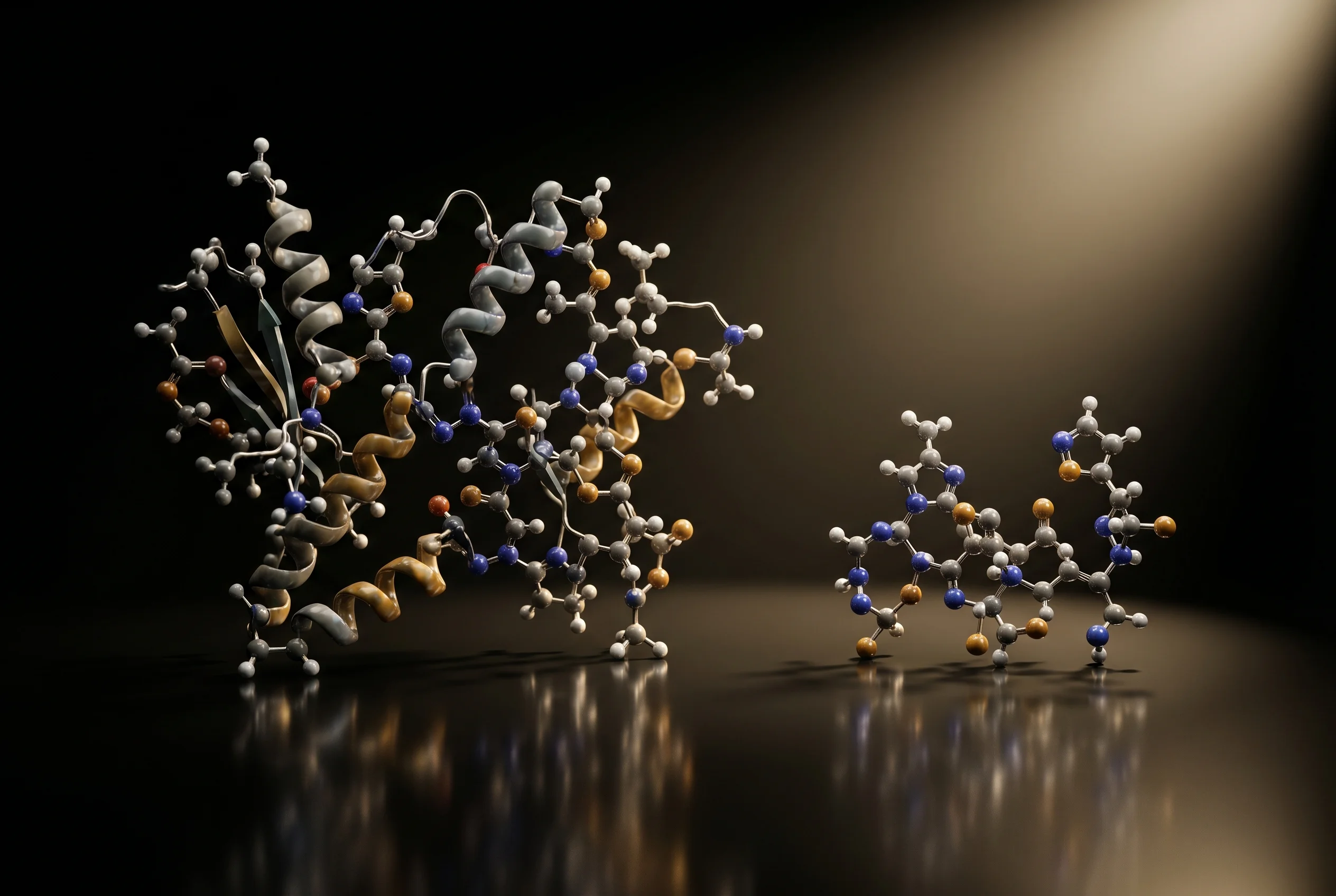
Retatrutide is a synthetic single peptide of 39 amino acids, described in research as the first triple agonist of its class. It simultaneously binds three G-protein-coupled receptors: the GLP-1 receptor (satiety via the central nervous system, glucose-dependent insulin secretion), the GIP receptor (insulin modulation) and the glucagon receptor (GCG-R). The glucagon component distinguishes Retatrutide from mono- and dual agonists: it raises basal energy expenditure and promotes hepatic lipid oxidation 2. Downstream effects include reduced appetite, slowed gastric emptying, improved glycemic control and pronounced weight reduction. It is a classic receptor-signaling molecule acting on the appetite, insulin and energy-expenditure axes.
MOTS-c pursues a fundamentally different approach. It is an endogenous, mitochondrially encoded peptide of just 16 amino acids, read from the 12S rRNA gene of the mitochondrial genome 4. Rather than engaging a surface receptor, it acts upstream within the cellular energy machinery: it activates the AMPK energy sensor, regulates the folate-methionine cycle and is studied as an exercise mimetic that improves glucose utilization and metabolic flexibility 5. Downstream effects in preclinical models include improved insulin sensitivity, glucose homeostasis and effects on skeletal muscle and age-dependent physical capacity. MOTS-c is therefore an intracellular metabolic regulator, not an appetite-controlling incretin agent.
The two mechanisms are mechanistically orthogonal: incretin/glucagon receptor agonism at the cell surface versus mitochondrial AMPK regulation inside the cell. There is no shared pathway. Anyone seeking to address the appetite, glucose or weight axis looks at Retatrutide; anyone researching mitochondrial energy and exercise physiology looks at MOTS-c. Substituting one for the other makes no biological sense.
The evidence asymmetry is considerable. Retatrutide draws on several completed, randomized and placebo-controlled Phase 2 human trials with hundreds of participants and reproducible weight and glucose endpoints. MOTS-c, by contrast, has not a single interventional human trial: the interventional data come from mouse and cell models, and the only human study (D'Souza, healthy men across three age groups) is a non-interventional observation of endogenous expression in tissue samples. A direct efficacy comparison is therefore not possible.
Placing the two peptides side by side makes clear that they share only the metabolism umbrella term, not the biology. Retatrutide is the heavyweight for appetite, glucose and weight endpoints: three receptors addressed simultaneously, a roughly six-day half-life for stable weekly plasma levels, and a well-documented, gastrointestinally dominated side-effect profile managed through the structured 6-step titration 13.
MOTS-c occupies an entirely different niche: mitochondrial energy regulation, insulin sensitivity and exercise mimicry with relevance to muscle and aging. It is cheaper to start with, simpler in its flat-dose logistics and mechanistically fascinating, but its evidence base is early-stage: predominantly animal and cell data, supplemented by a single observational human-tissue study 456.
Anyone wishing to investigate hard weight or glucose outcomes with robust human evidence will find it exclusively with Retatrutide. Anyone researching mitochondrial mechanisms, AMPK signaling or exercise physiology regards MOTS-c as a specialized, early tool. Cross-use as a replacement is not indicated.
Retatrutide wins on outcome ceiling and human evidence; MOTS-c wins on mechanistic specialization in mitochondrial/AMPK research and on entry price. Different mechanisms, different evidence maturity, no substitution relationship.
Retatrutide has a well-characterized, gastrointestinally dominated and dose-dependent side-effect pattern observed in the Phase 2 trials. The multi-stage titration serves to mitigate GI burden.
The human safety profile of MOTS-c is essentially uncharacterized, as no controlled human administration studies exist. Preclinical work has shown no major toxicity signals, which does not, however, substitute for clinical safety data.
All information serves exclusively to describe preclinical and clinical research findings and does not constitute medical advice, a dosing recommendation or any statement regarding use in humans. For research purposes only. Not intended for human consumption.
Retatrutide has the only robust human evidence base for pronounced, dose-dependent weight reduction (up to ~24.2 percent at 12 mg over 48 weeks) [1](#ref-1). MOTS-c offers only preclinical obesity data for this.
The Phase 2 T2D trial by Rosenstock et al. shows clinically meaningful HbA1c reductions in humans [3](#ref-3). For MOTS-c, only preclinical and observational data on insulin sensitivity are available.
This is precisely what MOTS-c was discovered and described for: AMPK activation, the folate-methionine cycle and exercise-induced expression [4](#ref-4)[5](#ref-5). Retatrutide does not address this intracellular axis.
Reynolds et al. position MOTS-c against age-related loss of capacity, and D'Souza et al. provide human tissue-expression data on myofiber composition [5](#ref-5)[6](#ref-6). This is not Retatrutide's research field.
MOTS-c starts at 66.99 EUR per 10-mg vial, making it considerably cheaper to begin with. Those who prioritize depth of evidence over acquisition cost, however, choose Retatrutide despite the higher cost.
Clearly Retatrutide. It has several completed, randomized and placebo-controlled Phase 2 trials in obesity and type 2 diabetes 13. MOTS-c has no interventional human trial; the only human data source is an observational study of tissue expression in healthy men across three age groups (no administration) 6.
Because its expression is induced by physical activity and, in preclinical models, it improves glucose utilization and metabolic flexibility via the AMPK energy sensor, thereby mimicking effects otherwise associated with exercise 5. This is a research description, not a confirmed effect in humans.
Retatrutide has a half-life of roughly six days (144 hours), supporting a stable weekly plasma concentration 1. MOTS-c is eliminated much faster, at roughly 12 hours 4, although weekly dosing is also common in the research model. Retatrutide therefore has an approximately 12-fold longer systemic residence time.
Retatrutide. Its side-effect pattern is well characterized, gastrointestinally dominated and dose-dependent; the structured titration serves to mitigate it. For MOTS-c, the human risk profile is essentially unknown for lack of controlled trials. Known, manageable risks thus stand against simply unknown risks.
MOTS-c has the lower entry price (from 66.99 EUR per 10-mg vial) versus Retatrutide (from 119.99 EUR). At low research doses, however, the difference narrows, since large Retatrutide vials and the long half-life cover many research weeks per vial.
Yes, both are live and orderable. You can find the product pages at Retatrutide and MOTS-c. Both are supplied as high-purity lyophilized powder with batch documentation.
A direct winner cannot be crowned credibly here, because the two peptides answer different questions. Retatrutide is the evidence-rich heavyweight: three receptors addressed simultaneously, a deep human Phase 2 foundation from the Phase 2 obesity trial (Jastreboff et al., NEJM 2023) and reproducible weight and glucose endpoints make it the first choice when robust human evidence for appetite, glucose or weight research is required 123.
MOTS-c is a mechanistically fascinating but early-stage tool for an entirely different axis: mitochondrial energy, AMPK signaling, exercise mimicry, and muscle and aging research. Its evidence, however, remains predominantly preclinical, with only a single observational human study 456.
The choice therefore depends entirely on the research question, not on a ranking of superiority. Those who need depth of outcome and human evidence choose Retatrutide; those researching mitochondrial mechanisms choose MOTS-c. Replacing one with the other is not biologically justified.
Mechanistically orthogonal (incretin/glucagon receptor agonism versus mitochondrial AMPK regulation) and markedly different evidence maturity (human Phase 2 RCTs versus preclinical/observational). Retatrutide dominates on weight and glucose outcomes and human evidence; MOTS-c occupies the separate niche of mitochondrial energy and muscle research. Neither substitutes for the other, hence a context-dependent verdict.
The two are not direct substitutes. They are mechanistically orthogonal tools for different research questions: receptor signaling targeting the appetite/glucose/weight axis versus mitochondrial energy regulation.
Synthetic 39-amino-acid triple agonist (receptor signaling)
Endogenous 16-amino-acid peptide, mitochondrially encoded
Agonism at GLP-1R, GIPR and the glucagon receptor (GCG-R) simultaneously
Activation of the AMPK energy sensor; regulation of the folate-methionine cycle
Obesity, type 2 diabetes, weight reduction, liver fat, cardiometabolic markers
Mitochondrial homeostasis, insulin sensitivity, exercise mimicry, muscle and aging
~6 days (144 h)
~12 hours
Weekly subcutaneous; multi-stage 6-step titration 0.5 to 12 mg over approx. 24 weeks
Weekly; flat research range 5 to 10 mg, no formal titration schedule
Several completed Phase 2 RCTs (obesity + T2D), advancing into the TRIUMPH program (Phase 3)
Preclinical (mouse + cell) plus observational human-tissue studies; no interventional human trials
Randomized, double-blind, placebo-controlled trials (n up to 338)
Observational tissue expression only (healthy men across three age groups); no administration data
Well-characterized, gastrointestinally dominated, dose-dependent side effects; incretin class signals
Human risk profile essentially uncharacterized; no controlled human trials
Lyophilized, shelf-stable unmixed; refrigerate after reconstitution (2 to 8 degrees C)
Lyophilized, store cool/dry; refrigerate after reconstitution (2 to 8 degrees C)
from 119.99 EUR (10 mg) to 325.99 EUR (50 mg)
from 66.99 EUR (10 mg, single pack) to 179.99 EUR (3-pack)
Retatrutide is a synthetic single peptide of 39 amino acids, described in research as the first triple agonist of its class. It simultaneously binds three G-protein-coupled receptors: the GLP-1 receptor (satiety via the central nervous system, glucose-dependent insulin secretion), the GIP receptor (insulin modulation) and the glucagon receptor (GCG-R). The glucagon component distinguishes Retatrutide from mono- and dual agonists: it raises basal energy expenditure and promotes hepatic lipid oxidation 2. Downstream effects include reduced appetite, slowed gastric emptying, improved glycemic control and pronounced weight reduction. It is a classic receptor-signaling molecule acting on the appetite, insulin and energy-expenditure axes.
MOTS-c pursues a fundamentally different approach. It is an endogenous, mitochondrially encoded peptide of just 16 amino acids, read from the 12S rRNA gene of the mitochondrial genome 4. Rather than engaging a surface receptor, it acts upstream within the cellular energy machinery: it activates the AMPK energy sensor, regulates the folate-methionine cycle and is studied as an exercise mimetic that improves glucose utilization and metabolic flexibility 5. Downstream effects in preclinical models include improved insulin sensitivity, glucose homeostasis and effects on skeletal muscle and age-dependent physical capacity. MOTS-c is therefore an intracellular metabolic regulator, not an appetite-controlling incretin agent.
The two mechanisms are mechanistically orthogonal: incretin/glucagon receptor agonism at the cell surface versus mitochondrial AMPK regulation inside the cell. There is no shared pathway. Anyone seeking to address the appetite, glucose or weight axis looks at Retatrutide; anyone researching mitochondrial energy and exercise physiology looks at MOTS-c. Substituting one for the other makes no biological sense.
The evidence asymmetry is considerable. Retatrutide draws on several completed, randomized and placebo-controlled Phase 2 human trials with hundreds of participants and reproducible weight and glucose endpoints. MOTS-c, by contrast, has not a single interventional human trial: the interventional data come from mouse and cell models, and the only human study (D'Souza, healthy men across three age groups) is a non-interventional observation of endogenous expression in tissue samples. A direct efficacy comparison is therefore not possible.
Placing the two peptides side by side makes clear that they share only the metabolism umbrella term, not the biology. Retatrutide is the heavyweight for appetite, glucose and weight endpoints: three receptors addressed simultaneously, a roughly six-day half-life for stable weekly plasma levels, and a well-documented, gastrointestinally dominated side-effect profile managed through the structured 6-step titration 13.
MOTS-c occupies an entirely different niche: mitochondrial energy regulation, insulin sensitivity and exercise mimicry with relevance to muscle and aging. It is cheaper to start with, simpler in its flat-dose logistics and mechanistically fascinating, but its evidence base is early-stage: predominantly animal and cell data, supplemented by a single observational human-tissue study 456.
Anyone wishing to investigate hard weight or glucose outcomes with robust human evidence will find it exclusively with Retatrutide. Anyone researching mitochondrial mechanisms, AMPK signaling or exercise physiology regards MOTS-c as a specialized, early tool. Cross-use as a replacement is not indicated.
Retatrutide wins on outcome ceiling and human evidence; MOTS-c wins on mechanistic specialization in mitochondrial/AMPK research and on entry price. Different mechanisms, different evidence maturity, no substitution relationship.
Retatrutide has a well-characterized, gastrointestinally dominated and dose-dependent side-effect pattern observed in the Phase 2 trials. The multi-stage titration serves to mitigate GI burden.
The human safety profile of MOTS-c is essentially uncharacterized, as no controlled human administration studies exist. Preclinical work has shown no major toxicity signals, which does not, however, substitute for clinical safety data.
All information serves exclusively to describe preclinical and clinical research findings and does not constitute medical advice, a dosing recommendation or any statement regarding use in humans. For research purposes only. Not intended for human consumption.
Retatrutide has the only robust human evidence base for pronounced, dose-dependent weight reduction (up to ~24.2 percent at 12 mg over 48 weeks) [1](#ref-1). MOTS-c offers only preclinical obesity data for this.
The Phase 2 T2D trial by Rosenstock et al. shows clinically meaningful HbA1c reductions in humans [3](#ref-3). For MOTS-c, only preclinical and observational data on insulin sensitivity are available.
This is precisely what MOTS-c was discovered and described for: AMPK activation, the folate-methionine cycle and exercise-induced expression [4](#ref-4)[5](#ref-5). Retatrutide does not address this intracellular axis.
Reynolds et al. position MOTS-c against age-related loss of capacity, and D'Souza et al. provide human tissue-expression data on myofiber composition [5](#ref-5)[6](#ref-6). This is not Retatrutide's research field.
MOTS-c starts at 66.99 EUR per 10-mg vial, making it considerably cheaper to begin with. Those who prioritize depth of evidence over acquisition cost, however, choose Retatrutide despite the higher cost.
Clearly Retatrutide. It has several completed, randomized and placebo-controlled Phase 2 trials in obesity and type 2 diabetes 13. MOTS-c has no interventional human trial; the only human data source is an observational study of tissue expression in healthy men across three age groups (no administration) 6.
Because its expression is induced by physical activity and, in preclinical models, it improves glucose utilization and metabolic flexibility via the AMPK energy sensor, thereby mimicking effects otherwise associated with exercise 5. This is a research description, not a confirmed effect in humans.
Retatrutide has a half-life of roughly six days (144 hours), supporting a stable weekly plasma concentration 1. MOTS-c is eliminated much faster, at roughly 12 hours 4, although weekly dosing is also common in the research model. Retatrutide therefore has an approximately 12-fold longer systemic residence time.
Retatrutide. Its side-effect pattern is well characterized, gastrointestinally dominated and dose-dependent; the structured titration serves to mitigate it. For MOTS-c, the human risk profile is essentially unknown for lack of controlled trials. Known, manageable risks thus stand against simply unknown risks.
MOTS-c has the lower entry price (from 66.99 EUR per 10-mg vial) versus Retatrutide (from 119.99 EUR). At low research doses, however, the difference narrows, since large Retatrutide vials and the long half-life cover many research weeks per vial.
Yes, both are live and orderable. You can find the product pages at Retatrutide and MOTS-c. Both are supplied as high-purity lyophilized powder with batch documentation.
A direct winner cannot be crowned credibly here, because the two peptides answer different questions. Retatrutide is the evidence-rich heavyweight: three receptors addressed simultaneously, a deep human Phase 2 foundation from the Phase 2 obesity trial (Jastreboff et al., NEJM 2023) and reproducible weight and glucose endpoints make it the first choice when robust human evidence for appetite, glucose or weight research is required 123.
MOTS-c is a mechanistically fascinating but early-stage tool for an entirely different axis: mitochondrial energy, AMPK signaling, exercise mimicry, and muscle and aging research. Its evidence, however, remains predominantly preclinical, with only a single observational human study 456.
The choice therefore depends entirely on the research question, not on a ranking of superiority. Those who need depth of outcome and human evidence choose Retatrutide; those researching mitochondrial mechanisms choose MOTS-c. Replacing one with the other is not biologically justified.
Mechanistically orthogonal (incretin/glucagon receptor agonism versus mitochondrial AMPK regulation) and markedly different evidence maturity (human Phase 2 RCTs versus preclinical/observational). Retatrutide dominates on weight and glucose outcomes and human evidence; MOTS-c occupies the separate niche of mitochondrial energy and muscle research. Neither substitutes for the other, hence a context-dependent verdict.