
The triple-agonist that set a new ceiling against the dual-agonist that built the category. A comparison for research protocols that want to understand which molecule is the frontier, which is the standard, and why the distinction matters.
 Medically reviewed by Dr. Sieglinde Klaus · Last reviewed April 2026
Tirzepatide (Eli Lilly’s Mounjaro/Zepbound) is a dual GLP-1/GIP receptor agonist with four years of Phase 3 data, three FDA approvals, and a published cardiovascular outcomes trial. Retatrutide, Lilly’s follow-on molecule, is a triple agonist that adds the glucagon receptor to the same dual backbone and, in its first Phase 3 readout, produced the deepest weight reduction ever reported in a registrational obesity trial: about 28.7% at 68 weeks 5 vs tirzepatide’s SURMOUNT-1 peak of roughly 22.5% at 72 weeks 13.
The evidence bases are not symmetric. Tirzepatide has the mature, peer-reviewed case. Retatrutide has the higher observed ceiling, a mechanistically broader target profile, and two network meta-analyses that point in its direction 20 21. For research protocols prioritising maximum therapeutic ceiling and mechanism breadth, our editorial pick is retatrutide. For protocols that value regulatory-grade evidence depth and a settled safety label, tirzepatide remains the reference molecule.
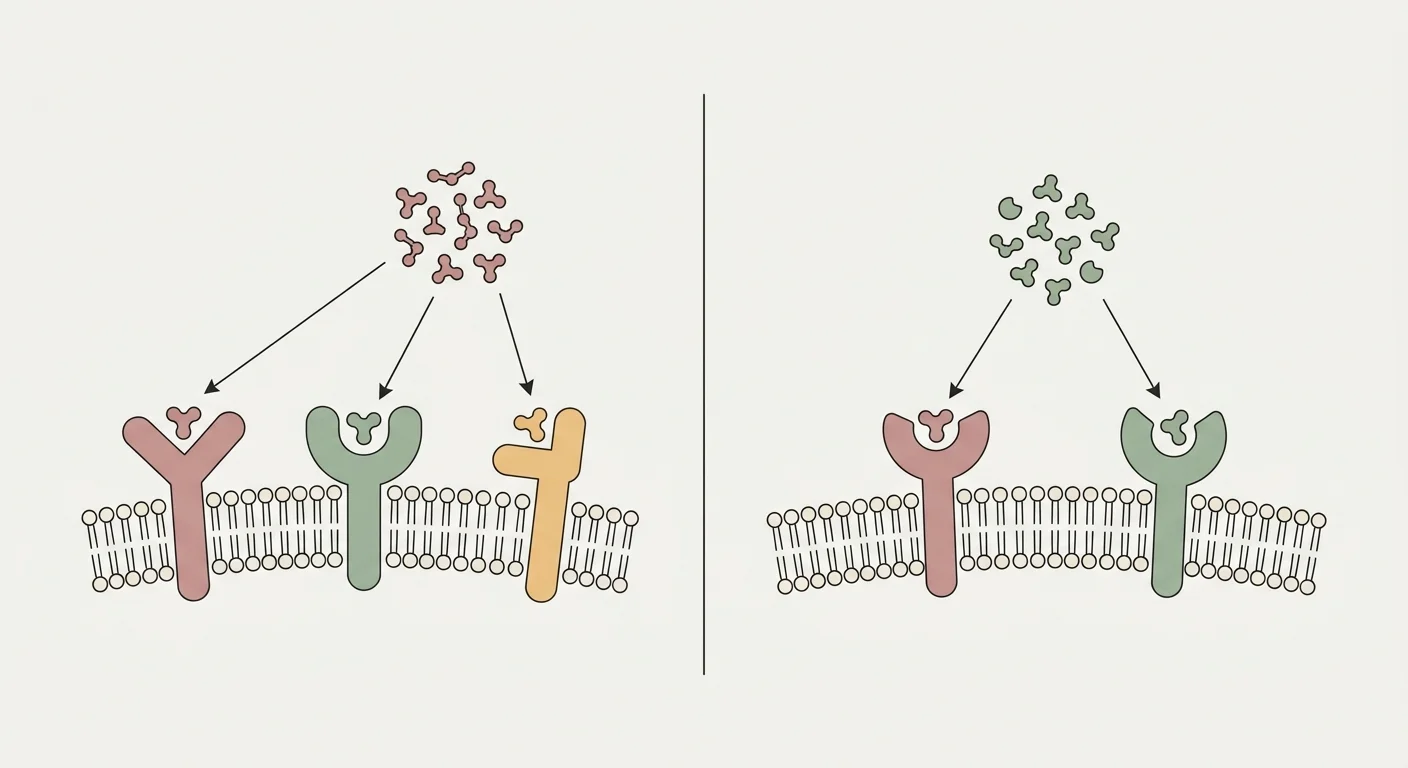
Retatrutide (LY3437943) is a single peptide engineered to agonise three incretin-family receptors at once: the glucagon-like peptide-1 receptor (GLP-1R), the glucose-dependent insulinotropic polypeptide receptor (GIPR), and the glucagon receptor (GCGR) 26. The GLP-1R arm drives the central appetite suppression, delayed gastric emptying, and glucose-dependent insulin secretion familiar from semaglutide and tirzepatide 24. The GIPR arm adds synergistic insulinotropic activity and, in adipose tissue, enhances healthy lipid buffering, reducing ectopic fat deposition in liver and muscle 25.
The distinctive arm is GCGR. Glucagon is usually framed as the counter-regulatory hormone that raises blood glucose; in the context of a balanced triple agonist, its classical effect on hepatic glucose production is offset by the simultaneous GLP-1R/GIPR insulinotropic action, while the metabolic effects that peptide designers actually want from GCGR are retained: increased energy expenditure via brown-adipose thermogenesis and skeletal-muscle oxidation, adipose lipolysis with free-fatty-acid release for beta-oxidation, and hepatic fatty-acid oxidation that clears triglyceride from the liver 27. In Phase 2a MASLD data, retatrutide produced roughly 85–90% liver fat reduction at the top dose; about 90% of 12 mg participants reached liver fat below 5% at 48 weeks, a magnitude that dual agonism has not demonstrated 3.
No direct retatrutide-versus-tirzepatide randomised controlled trial has been published or announced as of April 2026. A registrational head-to-head trial (NCT06662383) is visible on Lilly’s pipeline tracker, but no readout has been reported. Every comparative claim in this article therefore carries a caveat: it is either an indirect comparison across trials with different populations, dosing schedules, and endpoints, or it is a mechanistic extrapolation from preclinical and Phase 2 data. That is not a reason to ignore the signal — it is a reason to qualify it.
Two network meta-analyses have attempted to place the molecules on the same scale. The October 2025 analysis published in the Journal of the Endocrine Society (abstract SUN-659, with full peer-reviewed article at PMC12544991) reported retatrutide at a mean absolute reduction of −16.34 kg and −23.77% body weight versus −11.82 kg and −16.79% for tirzepatide, an indirect advantage in retatrutide’s favour 20. The same analysis flagged a higher adverse-event relative risk for retatrutide (RR 4.10 vs 2.78), consistent with a higher gastrointestinal burden at the top doses. A broader seven-agent network meta-analysis published in Metabolism (2024) ranked molecules for weight loss as retatrutide 12 mg > retatrutide 8 mg > tirzepatide 15 mg, with consistent rankings across waist circumference, HbA1c, and fasting plasma glucose 21.
Both network meta-analyses favour retatrutide numerically and directionally, but the absence of direct RCT evidence means any comparative claim must carry a caveat. For research purposes, this is a reason for further investigation, not a reason to dismiss the signal.
Phase 2 safety profile is consistent with the GLP-1 receptor agonist class, dominated by dose-dependent gastrointestinal adverse events that concentrate in the first one to two weeks of each escalation step. Phase 3 safety (TRIUMPH-4) is available only as press-release top-line as of April 2026 and has not yet been peer-reviewed at full-dataset resolution.
TRIUMPH-4 top-line reports ~28.7% reduction at 68 weeks, exceeding tirzepatide’s SURMOUNT-1 peak at 72 weeks by roughly six percentage points. Both published network meta-analyses point in the same direction.
The GCGR arm adds pathways tirzepatide lacks: hepatic fatty-acid oxidation (~85–90% liver fat reduction in Phase 2a MASLD), adipose lipolysis, and thermogenic energy expenditure.
Twelve+ Phase 3 trials, three FDA approvals, a published CVOT in 13,165 patients, and a mature prescribing-information safety envelope. The reference molecule for GLP-1/GIP research today.
SURPASS-2 beat semaglutide 1 mg head-to-head on HbA1c; SURPASS-CVOT is the only published cardiovascular outcomes trial across either molecule. Retatrutide T2D evidence remains Phase 2 (Rosenstock 2023).
Tirzepatide, unambiguously. Twelve+ Phase 3 trials, three FDA approvals, and a published cardiovascular outcomes trial in 13,165 patients 12. Retatrutide has one Phase 3 top-line (TRIUMPH-4) and a Phase 2 programme of roughly six peer-reviewed publications 1 5. The gap will narrow through 2026 as TRIUMPH-1, TRIUMPH-2 and TRIUMPH-3 read out.
Retatrutide is our pick. Not because it has more trial data — it does not. Tirzepatide’s Phase 3 programme is four years deeper, its three FDA approvals span type 2 diabetes, chronic weight management and obstructive sleep apnoea, and its published cardiovascular outcomes trial in more than thirteen thousand patients is a fact we do not dispute 12 28. For research protocols that need the deepest, most scrutinised evidence base available in the incretin class today, tirzepatide is the reference molecule and will remain so until the TRIUMPH programme completes.
But for research protocols pursuing the highest therapeutic ceiling, the numbers favour retatrutide. Its first Phase 3 readout reported roughly 28.7% weight reduction at 12 mg over 68 weeks 5— a meaningful six-percentage-point ceiling advantage over tirzepatide’s SURMOUNT-1 peak of 22.5% over 72 weeks 13. The mechanistic explanation is not speculative: the glucagon receptor adds hepatic fatty-acid oxidation, adipose lipolysis and thermogenic energy expenditure that dual agonism cannot engage by design 27, and the Phase 2a MASLD readout’s 85–90% liver-fat reduction is a direct signature of that pathway 3. Both published network meta-analyses point in retatrutide’s direction 20 21. The evidence base will mature; the ceiling, by design, will not move down.
For the research frontier of metabolic peptide therapy, retatrutide is the winner. For protocols that value regulatory-grade depth above all, tirzepatide remains the standard. That is a clearer division of roles than most “X vs Y” comparisons can offer, and honesty about the division is more useful than a forced single winner.
Retatrutide wins on the dimensions that matter most for frontier research: higher observed ceiling in TRIUMPH-4, triple-agonist mechanism breadth, and consistent direction across both published network meta-analyses. Tirzepatide remains the reference molecule for protocols that need the deepest published evidence base today.
The triple-agonist that set a new ceiling against the dual-agonist that built the category. A comparison for research protocols that want to understand which molecule is the frontier, which is the standard, and why the distinction matters.
Medically reviewed by Dr. Sieglinde Klaus · Last reviewed April 2026Tirzepatide (Eli Lilly’s Mounjaro/Zepbound) is a dual GLP-1/GIP receptor agonist with four years of Phase 3 data, three FDA approvals, and a published cardiovascular outcomes trial. Retatrutide, Lilly’s follow-on molecule, is a triple agonist that adds the glucagon receptor to the same dual backbone and, in its first Phase 3 readout, produced the deepest weight reduction ever reported in a registrational obesity trial: about 28.7% at 68 weeks 5 vs tirzepatide’s SURMOUNT-1 peak of roughly 22.5% at 72 weeks 13.
The evidence bases are not symmetric. Tirzepatide has the mature, peer-reviewed case. Retatrutide has the higher observed ceiling, a mechanistically broader target profile, and two network meta-analyses that point in its direction 20 21. For research protocols prioritising maximum therapeutic ceiling and mechanism breadth, our editorial pick is retatrutide. For protocols that value regulatory-grade evidence depth and a settled safety label, tirzepatide remains the reference molecule.
Retatrutide (LY3437943) is a single peptide engineered to agonise three incretin-family receptors at once: the glucagon-like peptide-1 receptor (GLP-1R), the glucose-dependent insulinotropic polypeptide receptor (GIPR), and the glucagon receptor (GCGR) 26. The GLP-1R arm drives the central appetite suppression, delayed gastric emptying, and glucose-dependent insulin secretion familiar from semaglutide and tirzepatide 24. The GIPR arm adds synergistic insulinotropic activity and, in adipose tissue, enhances healthy lipid buffering, reducing ectopic fat deposition in liver and muscle 25.
The distinctive arm is GCGR. Glucagon is usually framed as the counter-regulatory hormone that raises blood glucose; in the context of a balanced triple agonist, its classical effect on hepatic glucose production is offset by the simultaneous GLP-1R/GIPR insulinotropic action, while the metabolic effects that peptide designers actually want from GCGR are retained: increased energy expenditure via brown-adipose thermogenesis and skeletal-muscle oxidation, adipose lipolysis with free-fatty-acid release for beta-oxidation, and hepatic fatty-acid oxidation that clears triglyceride from the liver 27. In Phase 2a MASLD data, retatrutide produced roughly 85–90% liver fat reduction at the top dose; about 90% of 12 mg participants reached liver fat below 5% at 48 weeks, a magnitude that dual agonism has not demonstrated 3.
No direct retatrutide-versus-tirzepatide randomised controlled trial has been published or announced as of April 2026. A registrational head-to-head trial (NCT06662383) is visible on Lilly’s pipeline tracker, but no readout has been reported. Every comparative claim in this article therefore carries a caveat: it is either an indirect comparison across trials with different populations, dosing schedules, and endpoints, or it is a mechanistic extrapolation from preclinical and Phase 2 data. That is not a reason to ignore the signal — it is a reason to qualify it.
Two network meta-analyses have attempted to place the molecules on the same scale. The October 2025 analysis published in the Journal of the Endocrine Society (abstract SUN-659, with full peer-reviewed article at PMC12544991) reported retatrutide at a mean absolute reduction of −16.34 kg and −23.77% body weight versus −11.82 kg and −16.79% for tirzepatide, an indirect advantage in retatrutide’s favour 20. The same analysis flagged a higher adverse-event relative risk for retatrutide (RR 4.10 vs 2.78), consistent with a higher gastrointestinal burden at the top doses. A broader seven-agent network meta-analysis published in Metabolism (2024) ranked molecules for weight loss as retatrutide 12 mg > retatrutide 8 mg > tirzepatide 15 mg, with consistent rankings across waist circumference, HbA1c, and fasting plasma glucose 21.
Both network meta-analyses favour retatrutide numerically and directionally, but the absence of direct RCT evidence means any comparative claim must carry a caveat. For research purposes, this is a reason for further investigation, not a reason to dismiss the signal.
Phase 2 safety profile is consistent with the GLP-1 receptor agonist class, dominated by dose-dependent gastrointestinal adverse events that concentrate in the first one to two weeks of each escalation step. Phase 3 safety (TRIUMPH-4) is available only as press-release top-line as of April 2026 and has not yet been peer-reviewed at full-dataset resolution.
TRIUMPH-4 top-line reports ~28.7% reduction at 68 weeks, exceeding tirzepatide’s SURMOUNT-1 peak at 72 weeks by roughly six percentage points. Both published network meta-analyses point in the same direction.
The GCGR arm adds pathways tirzepatide lacks: hepatic fatty-acid oxidation (~85–90% liver fat reduction in Phase 2a MASLD), adipose lipolysis, and thermogenic energy expenditure.
Twelve+ Phase 3 trials, three FDA approvals, a published CVOT in 13,165 patients, and a mature prescribing-information safety envelope. The reference molecule for GLP-1/GIP research today.
SURPASS-2 beat semaglutide 1 mg head-to-head on HbA1c; SURPASS-CVOT is the only published cardiovascular outcomes trial across either molecule. Retatrutide T2D evidence remains Phase 2 (Rosenstock 2023).
Tirzepatide, unambiguously. Twelve+ Phase 3 trials, three FDA approvals, and a published cardiovascular outcomes trial in 13,165 patients 12. Retatrutide has one Phase 3 top-line (TRIUMPH-4) and a Phase 2 programme of roughly six peer-reviewed publications 1 5. The gap will narrow through 2026 as TRIUMPH-1, TRIUMPH-2 and TRIUMPH-3 read out.
Retatrutide is our pick. Not because it has more trial data — it does not. Tirzepatide’s Phase 3 programme is four years deeper, its three FDA approvals span type 2 diabetes, chronic weight management and obstructive sleep apnoea, and its published cardiovascular outcomes trial in more than thirteen thousand patients is a fact we do not dispute 12 28. For research protocols that need the deepest, most scrutinised evidence base available in the incretin class today, tirzepatide is the reference molecule and will remain so until the TRIUMPH programme completes.
But for research protocols pursuing the highest therapeutic ceiling, the numbers favour retatrutide. Its first Phase 3 readout reported roughly 28.7% weight reduction at 12 mg over 68 weeks 5— a meaningful six-percentage-point ceiling advantage over tirzepatide’s SURMOUNT-1 peak of 22.5% over 72 weeks 13. The mechanistic explanation is not speculative: the glucagon receptor adds hepatic fatty-acid oxidation, adipose lipolysis and thermogenic energy expenditure that dual agonism cannot engage by design 27, and the Phase 2a MASLD readout’s 85–90% liver-fat reduction is a direct signature of that pathway 3. Both published network meta-analyses point in retatrutide’s direction 20 21. The evidence base will mature; the ceiling, by design, will not move down.
For the research frontier of metabolic peptide therapy, retatrutide is the winner. For protocols that value regulatory-grade depth above all, tirzepatide remains the standard. That is a clearer division of roles than most “X vs Y” comparisons can offer, and honesty about the division is more useful than a forced single winner.
Retatrutide wins on the dimensions that matter most for frontier research: higher observed ceiling in TRIUMPH-4, triple-agonist mechanism breadth, and consistent direction across both published network meta-analyses. Tirzepatide remains the reference molecule for protocols that need the deepest published evidence base today.
Present; ~85–90% liver-fat reduction in Phase 2a MASLD 3
Absent by design
~144 h (~6 days)
~120 h (~5 days)
1 top-line (TRIUMPH-4); TRIUMPH-1/2/3 pending 4
12+ (SURPASS 1–6, CVOT, PEDS; SURMOUNT 1–5, OSA)
None (no CVOT initiated)
SURPASS-CVOT (n=13,165; NEJM Dec 2025) 12
None (no approved label)
MTC thyroid C-cell (rodent, human relevance unestablished) 28
None published
None published
Once weekly, subcutaneous
Once weekly, subcutaneous
US: late 2027 earliest (NDA Q4 2026 at soonest) 22
Already approved (US: 2022/2023/2024; EU: 2022/2024)
Lyophilised; BAC water reconstitution; 2–8 °C
Lyophilised; BAC water reconstitution; 2–8 °C
Higher ceiling + glucagon-receptor breadth
Lower ceiling; best-characterised safety envelope
Tirzepatide (LY3298176) is a dual GLP-1R / GIPR agonist — a single 39-residue peptide tuned to engage both incretin receptors with comparable potency. The GLP-1R arm contributes the same core mechanism familiar from the first generation of GLP-1 analogues: glucose-dependent insulin secretion, alpha-cell glucagon suppression, hypothalamic appetite regulation, and slowed gastric emptying 24.
What distinguishes tirzepatide from pure GLP-1 agonists is the added GIPR activity. Preclinically, co-administration of GIP with GLP-1 produces additive and in some measures synergistic reductions in body weight and glucose, more than either alone 25. Central GIPR activation appears to potentiate GLP-1-induced anorexia through hypothalamic POMC signalling; peripheral GIPR activation in white adipose tissue enhances the buffering capacity of the depot and reduces the need for ectopic deposition. The observable consequence is the most potent weight- and glucose-lowering profile of any molecule approved before retatrutide: SURMOUNT-1 reported roughly 22.5% weight reduction at the 15 mg dose over 72 weeks 13, and SURMOUNT-5 showed tirzepatide superior to semaglutide 2.4 mg head-to-head at 72 weeks (−20.2% vs −13.7%) 18.
The glucagon-receptor arm is retatrutide’s mechanistic differentiator. Pre-clinical and Phase 2 data suggest this translates into lipid-lowering, hepatic-fat-reducing, and energy-expenditure effects that tirzepatide, by design, lacks. Whether this translates into the direct-comparison advantage implied by network meta-analyses will remain open until a head-to-head RCT reads out — which, as of April 2026, none has been announced.
Tirzepatide’s evidence depth is unmatched today — twelve Phase 3 trials across two disease programmes, a published cardiovascular outcomes trial in more than thirteen thousand patients, and three FDA approvals on label. Retatrutide’s available readout, though singular, outperforms tirzepatide’s best Phase-3 ceiling at a shorter observation window. That is a signal worth serious attention as TRIUMPH-1, TRIUMPH-2 and TRIUMPH-3 mature through 2026 and 2027.
Mature prescribing-information safety envelope across Mounjaro and Zepbound. Common AEs mirror the GLP-1 class and concentrate at dose escalation; serious risks are captured in a boxed warning and a set of warnings and precautions refined through post-marketing surveillance (FAERS 2024 analysis and EMA pharmacovigilance).
This article is an editorial comparison prepared for research-context readers. Neither retatrutide nor tirzepatide is offered or recommended for human self-administration through this site. Where tirzepatide is prescribed it is available only under a physician’s supervision in jurisdictions where it has been approved (Mounjaro for T2D; Zepbound for chronic weight management and obstructive sleep apnoea). Retatrutide is investigational globally as of April 2026 and should be handled only within appropriate research protocols.
Safety data summarised here reflect published Phase 2 and Phase 3 datasets and current prescribing information. New signals can emerge at any time; the lastUpdated date on this page indicates the cut-off for our review. Nothing on this page constitutes medical advice or a substitute for consultation with a qualified clinician.
Tirzepatide is approved under two brand names: Mounjaro for type 2 diabetes (FDA May 2022) and Zepbound for chronic weight management (November 2023) and moderate-to-severe obstructive sleep apnoea with obesity (December 2024) 28. Retatrutide is investigational everywhere; no NDA has been filed as of April 2026 22.
At the class level, both have a GI-dominant profile (nausea, vomiting, diarrhoea) that concentrates at dose escalation. The October 2025 network meta-analysis reported a higher adverse-event relative risk for retatrutide (RR 4.10) than for tirzepatide (RR 2.78), consistent with higher GI burden at top doses 20. Tirzepatide carries a boxed MTC warning and a characterised pancreatitis / gallbladder / hypersensitivity profile 28 29; retatrutide’s analogous long-term safety envelope has not been established.
Published Phase 2 and Phase 3 trials for both molecules enrol as monotherapy (with or without background T2D therapy such as metformin or insulin). There is no published evidence on stacking either with other research peptides. Any combination protocol is strictly investigational and outside the evidence base summarised in this article.
Retatrutide’s ~144-hour half-life and tirzepatide’s ~120-hour half-life both support a single weekly subcutaneous dose, the schedule used in every registrational trial. The slightly longer retatrutide half-life provides a modest buffer against missed-dose variability but does not change the fundamental once-weekly cadence.
Yes. Both retatrutide and tirzepatide are listed for research use in both the EU and US channels. Availability, vial sizes and channel-specific pricing are shown on each product’s detail page.
The TRIUMPH-1 (obesity without T2D), TRIUMPH-2 (obesity with T2D) and TRIUMPH-3 (obesity with established cardiovascular disease) readouts are expected through 2026 per Lilly guidance 4. Each will materially expand the retatrutide evidence base; collectively they will determine whether the TRIUMPH-4 ceiling generalises across populations and whether an NDA filing moves up from the current Q4 2026 earliest window.
Present; ~85–90% liver-fat reduction in Phase 2a MASLD 3
Absent by design
~144 h (~6 days)
~120 h (~5 days)
1 top-line (TRIUMPH-4); TRIUMPH-1/2/3 pending 4
12+ (SURPASS 1–6, CVOT, PEDS; SURMOUNT 1–5, OSA)
None (no CVOT initiated)
SURPASS-CVOT (n=13,165; NEJM Dec 2025) 12
None (no approved label)
MTC thyroid C-cell (rodent, human relevance unestablished) 28
None published
None published
Once weekly, subcutaneous
Once weekly, subcutaneous
US: late 2027 earliest (NDA Q4 2026 at soonest) 22
Already approved (US: 2022/2023/2024; EU: 2022/2024)
Lyophilised; BAC water reconstitution; 2–8 °C
Lyophilised; BAC water reconstitution; 2–8 °C
Higher ceiling + glucagon-receptor breadth
Lower ceiling; best-characterised safety envelope
Tirzepatide (LY3298176) is a dual GLP-1R / GIPR agonist — a single 39-residue peptide tuned to engage both incretin receptors with comparable potency. The GLP-1R arm contributes the same core mechanism familiar from the first generation of GLP-1 analogues: glucose-dependent insulin secretion, alpha-cell glucagon suppression, hypothalamic appetite regulation, and slowed gastric emptying 24.
What distinguishes tirzepatide from pure GLP-1 agonists is the added GIPR activity. Preclinically, co-administration of GIP with GLP-1 produces additive and in some measures synergistic reductions in body weight and glucose, more than either alone 25. Central GIPR activation appears to potentiate GLP-1-induced anorexia through hypothalamic POMC signalling; peripheral GIPR activation in white adipose tissue enhances the buffering capacity of the depot and reduces the need for ectopic deposition. The observable consequence is the most potent weight- and glucose-lowering profile of any molecule approved before retatrutide: SURMOUNT-1 reported roughly 22.5% weight reduction at the 15 mg dose over 72 weeks 13, and SURMOUNT-5 showed tirzepatide superior to semaglutide 2.4 mg head-to-head at 72 weeks (−20.2% vs −13.7%) 18.
The glucagon-receptor arm is retatrutide’s mechanistic differentiator. Pre-clinical and Phase 2 data suggest this translates into lipid-lowering, hepatic-fat-reducing, and energy-expenditure effects that tirzepatide, by design, lacks. Whether this translates into the direct-comparison advantage implied by network meta-analyses will remain open until a head-to-head RCT reads out — which, as of April 2026, none has been announced.
Tirzepatide’s evidence depth is unmatched today — twelve Phase 3 trials across two disease programmes, a published cardiovascular outcomes trial in more than thirteen thousand patients, and three FDA approvals on label. Retatrutide’s available readout, though singular, outperforms tirzepatide’s best Phase-3 ceiling at a shorter observation window. That is a signal worth serious attention as TRIUMPH-1, TRIUMPH-2 and TRIUMPH-3 mature through 2026 and 2027.
Mature prescribing-information safety envelope across Mounjaro and Zepbound. Common AEs mirror the GLP-1 class and concentrate at dose escalation; serious risks are captured in a boxed warning and a set of warnings and precautions refined through post-marketing surveillance (FAERS 2024 analysis and EMA pharmacovigilance).
This article is an editorial comparison prepared for research-context readers. Neither retatrutide nor tirzepatide is offered or recommended for human self-administration through this site. Where tirzepatide is prescribed it is available only under a physician’s supervision in jurisdictions where it has been approved (Mounjaro for T2D; Zepbound for chronic weight management and obstructive sleep apnoea). Retatrutide is investigational globally as of April 2026 and should be handled only within appropriate research protocols.
Safety data summarised here reflect published Phase 2 and Phase 3 datasets and current prescribing information. New signals can emerge at any time; the lastUpdated date on this page indicates the cut-off for our review. Nothing on this page constitutes medical advice or a substitute for consultation with a qualified clinician.
Tirzepatide is approved under two brand names: Mounjaro for type 2 diabetes (FDA May 2022) and Zepbound for chronic weight management (November 2023) and moderate-to-severe obstructive sleep apnoea with obesity (December 2024) 28. Retatrutide is investigational everywhere; no NDA has been filed as of April 2026 22.
At the class level, both have a GI-dominant profile (nausea, vomiting, diarrhoea) that concentrates at dose escalation. The October 2025 network meta-analysis reported a higher adverse-event relative risk for retatrutide (RR 4.10) than for tirzepatide (RR 2.78), consistent with higher GI burden at top doses 20. Tirzepatide carries a boxed MTC warning and a characterised pancreatitis / gallbladder / hypersensitivity profile 28 29; retatrutide’s analogous long-term safety envelope has not been established.
Published Phase 2 and Phase 3 trials for both molecules enrol as monotherapy (with or without background T2D therapy such as metformin or insulin). There is no published evidence on stacking either with other research peptides. Any combination protocol is strictly investigational and outside the evidence base summarised in this article.
Retatrutide’s ~144-hour half-life and tirzepatide’s ~120-hour half-life both support a single weekly subcutaneous dose, the schedule used in every registrational trial. The slightly longer retatrutide half-life provides a modest buffer against missed-dose variability but does not change the fundamental once-weekly cadence.
Yes. Both retatrutide and tirzepatide are listed for research use in both the EU and US channels. Availability, vial sizes and channel-specific pricing are shown on each product’s detail page.
The TRIUMPH-1 (obesity without T2D), TRIUMPH-2 (obesity with T2D) and TRIUMPH-3 (obesity with established cardiovascular disease) readouts are expected through 2026 per Lilly guidance 4. Each will materially expand the retatrutide evidence base; collectively they will determine whether the TRIUMPH-4 ceiling generalises across populations and whether an NDA filing moves up from the current Q4 2026 earliest window.

