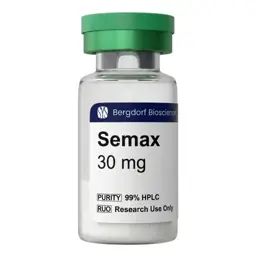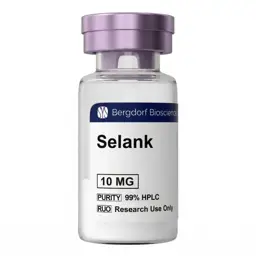
Both are intranasal heptapeptides with an ultra-short plasma half-life, yet they pursue different research goals: Semax is associated with cognition and neuroprotection via BDNF/NGF, Selank with anxiolysis and stress modulation via GABAergic and immunomodulatory signaling pathways.
 Medically reviewed by Dr. Sieglinde Klaus · Last reviewed June 2026
Semax and Selank are two regulatory peptides developed at the Institute of Molecular Genetics of the Russian Academy of Sciences. Both are used intranasally in research, have a plasma half-life in the range of minutes, and exert their biological effect well beyond their residence time in the blood. Despite this structural and pharmacokinetic proximity, they address different research fields:
Both are intranasal heptapeptides with an ultra-short plasma half-life, yet they pursue different research goals: Semax is associated with cognition and neuroprotection via BDNF/NGF, Selank with anxiolysis and stress modulation via GABAergic and immunomodulatory signaling pathways.
Medically reviewed by Dr. Sieglinde Klaus · Last reviewed June 2026Semax and Selank are two regulatory peptides developed at the Institute of Molecular Genetics of the Russian Academy of Sciences. Both are used intranasally in research, have a plasma half-life in the range of minutes, and exert their biological effect well beyond their residence time in the blood. Despite this structural and pharmacokinetic proximity, they address different research fields:
Price, route, half-life, application frequency, and clinical maturity are nearly identical in both cases. The decision is therefore determined almost entirely by the research goal, not by a superiority of one peptide over the other.
ACTH(4-7)/ACTH(4-10) melanocortin fragment analog (MEHFPGP), non-hormonal
Tuftsin analog (TKPR), extended with PGP to TKPRPGP; immunomodulatory origin
Cognition / nootropic + neuroprotection (cerebral ischemia, stroke)
Anxiolysis / stress and anxiety; adjuvant in withdrawal states
BDNF/TrkB and NGF upregulation; monoaminergic and melanocortin fragment modulation
GABAergic (GABA-A subunits) + serotonergic + immunomodulatory action; potentiates benzodiazepines
0.3 mg/day (range 0.1 to 1 mg)
0.25 mg/day (range 0.15 to 0.5 mg)
Intranasal (primary research route)
Intranasal (primary research route)
Daily
Daily
~minutes (approx. 2 to 3 min); effect persists via BDNF/NGF cascade
~minutes (intranasal); effect persists beyond plasma residence time
Registered clinical use in Russia (stroke/cognition); Western evidence preclinical
Registered clinical use in Russia (anxiety); Western evidence preclinical/early clinical
Well tolerated; possible local nasal irritation; limited Western long-term data
Well tolerated, low sedation, no reported dependence/withdrawal (advantageous over benzodiazepines)
Lyophilized, stable at room temperature; reconstituted refrigerated at 2 to 8 degrees C
Lyophilized, long shelf life; reconstituted refrigerated at 2 to 8 degrees C
3 verified sources: 2 preclinical (BDNF/TrkB, ischemia) + 1 controlled clinical stroke study (110 patients)
3 verified sources: 1 in vitro receptor binding study + 2 preclinical (diazepam combination, alcohol withdrawal)

Semax is a synthetic heptapeptide with the sequence Met-Glu-His-Phe-Pro-Gly-Pro (MEHFPGP), derived from the fragment ACTH(4-10) of adrenocorticotropic hormone but without hormonal ACTH activity. In preclinical studies, Semax upregulates the expression of Brain-Derived Neurotrophic Factor (BDNF) and its receptor TrkB as well as Nerve Growth Factor (NGF) in the hippocampus 1. This neurotrophic cascade is considered the basis of the nootropic and neuroprotective effects observed in research. In addition, Semax modulates monoaminergic systems (dopaminergic, serotonergic) as well as the melanocortin/ACTH fragment pathway. Notably, the biological effect significantly outlasts the plasma residence time of only a few minutes, because the downstream neurotrophin signaling persists.
Selank is a synthetic heptapeptide with the sequence Thr-Lys-Pro-Arg-Pro-Gly-Pro (TKPRPGP), an analog of the endogenous immunomodulatory tetrapeptide Tuftsin stabilized by Pro-Gly-Pro. In research models, Selank acts via the GABAergic system (modulation of GABA-A receptor subunit expression) and the serotonergic system; at the same time it influences the balance of pro- and anti-inflammatory cytokines (immunomodulation) as well as BDNF and monoamine systems 5. A characteristic finding: Selank potentiates and prolongs the anxiolytic effect of benzodiazepines such as diazepam, without the typical sedating or amnestic side effects 6. As with Semax, the biological effect outlasts the short plasma residence time.
Despite similar origin and pharmacokinetics, the mechanistic emphases are orthogonal to each other: Semax is neurotrophically oriented (BDNF/NGF, cognitive and neuroprotective endpoints), Selank neuromodulatory-immunological (GABA, serotonin, cytokines, anxiolytic endpoints). They are therefore not direct substitutes in research, but are also sometimes considered as a combination (stack).
The evidence for both peptides is predominantly based on preclinical work and Russian clinical use. For Semax, the sources consistently document a BDNF/TrkB-driven neuroprotective mechanism 1 2 3. For Selank, they demonstrate a GABAergic-anxiolytic profile with benzodiazepine potentiation and favorable tolerability 5 6 7. Neither of the peptides has a large Western randomized controlled Phase 3 trial in this set.
Placing Semax and Selank side by side, the symmetry is striking at first: same place of development (Russian Academy of Sciences), same substance class (intranasal heptapeptides with PGP stabilization), same pharmacokinetics (plasma half-life in the range of minutes, long-lasting effect), same application frequency (daily), and at Bergdorf identical price and identical pack structure. At the level of action, however, the paths clearly diverge: Semax is a neurotrophic, cognition- and neuroprotection-oriented peptide, Selank a neuromodulatory-immunological, anxiolytically oriented peptide. Anyone studying cognitive or neuroprotective endpoints will find the direct mechanistic rationale in Semax; anyone studying anxiety, stress, or benzodiazepine interaction will find it in Selank.
Identical in origin, route, kinetics, frequency, and price; orthogonal in mechanism and indication. The difference lies not in quality, but in the research goal.
Semax is considered well tolerated in the research literature and without hormonal ACTH activity. The intranasal route can cause local irritation. Western long-term and safety data are limited.
Selank is considered well tolerated in the research literature, with low sedation and without a reported dependence or withdrawal profile, which sets it apart favorably from benzodiazepines. Western long-term data are limited.
This comparison summarizes exclusively preclinical and observational research findings and does not constitute medical advice, a dosing recommendation, or an invitation to use in humans. Neither Semax nor Selank is approved by the FDA or EMA; the doses mentioned here refer to research protocols. For research purposes only. Not intended for human consumption.
Through BDNF/TrkB and NGF upregulation, Semax directly addresses the neurotrophic pathways that underlie cognitive endpoints [1](#ref-1).
Semax has a preclinical ischemia dataset and a clinical use registered in Russia for acute ischemic stroke [2](#ref-2) [3](#ref-3).
As a Tuftsin analog, Selank is specifically directed at GABAergic and serotonergic anxiolysis and shows consistent anxiety reduction in stress models [5](#ref-5) [7](#ref-7).
Selank potentiates and prolongs the anxiolytic effect of diazepam without typical sedation or amnesia and without a reported dependence profile [6](#ref-6).
Because the mechanisms are orthogonal (BDNF/NGF in Semax, GABA/serotonin/immune in Selank), both peptides are also considered together in research; the choice depends on the specific endpoint under investigation.
Semax is studied primarily for cognition and neuroprotection and upregulates BDNF, TrkB, and NGF 1. Selank is studied primarily for anxiolysis and stress modulation and acts via GABAergic, serotonergic, and immunomodulatory pathways 5. Structurally and pharmacokinetically they are similar, but complementary in their research orientation.
No. Their mechanisms of action are orthogonal: Semax is neurotrophically oriented (BDNF/NGF), Selank neuromodulatory-immunological (GABA/serotonin/cytokines). They address different research endpoints and are also sometimes considered as a combination, but they are not direct substitutes.
In this set, both rely on three verified, PubMed-indexed sources each and on a clinical use registered in Russia. Neither has a large Western Phase 3 trial. The evidence is therefore predominantly preclinical and should be distinguished by indication, not by maturity.
Both have a plasma half-life in the range of minutes, yet their biological effect is decoupled from it. For Semax, the downstream BDNF/NGF signaling cascade persists 1; for Selank, the GABAergic and serotonergic modulation outlasts the short plasma residence time. The duration of action results from the downstream signals, not from the residence time of the peptide itself.
Both are used intranasally and daily in standard research protocols, in low milligram microdoses (Semax typically 0.3 mg/day, Selank 0.25 mg/day in the data referenced here). These figures describe research protocols and are not a usage recommendation.
In the research literature, Selank is described as non-sedating and without a reported dependence or withdrawal profile, which sets it apart favorably from benzodiazepines; at the same time, it can potentiate their effect 6. However, Western long-term safety data are limited.
Because the mechanisms are orthogonal, both peptides are also considered as a stack in research, to study neurotrophic and anxiolytic effects together. Robust Western data on a combination are not available in this source set; the interaction profile, in particular Selank's benzodiazepine potentiation, must be taken into account.
Semax and Selank are complementary, not competing. On nearly every structural, pharmacokinetic, and commercial axis - origin, intranasal route, half-life in the range of minutes, daily frequency, clinical maturity, and price - they are practically equivalent. The one decisive difference is the research goal: Semax addresses cognition and neuroprotection via BDNF/NGF 1 2, Selank addresses anxiolysis and stress modulation via GABAergic and immunomodulatory pathways 5 6. There is therefore no blanket overall winner: choose Semax for cognitive and neuroprotective endpoints, Selank for anxiolytic and stress-related endpoints; for combined questions, both are also studied together.
The verdict is context-dependent because the peptides differ not in quality or maturity, but in indication. Price, route, half-life, frequency, storage, and clinical maturity are essentially identical (all 'tie' in the comparison matrix), while indication, mechanism, and risk angle are orthogonal. A forced single winner would be misleading; the choice follows solely from the endpoint under investigation.
Price, route, half-life, application frequency, and clinical maturity are nearly identical in both cases. The decision is therefore determined almost entirely by the research goal, not by a superiority of one peptide over the other.
ACTH(4-7)/ACTH(4-10) melanocortin fragment analog (MEHFPGP), non-hormonal
Tuftsin analog (TKPR), extended with PGP to TKPRPGP; immunomodulatory origin
Cognition / nootropic + neuroprotection (cerebral ischemia, stroke)
Anxiolysis / stress and anxiety; adjuvant in withdrawal states
BDNF/TrkB and NGF upregulation; monoaminergic and melanocortin fragment modulation
GABAergic (GABA-A subunits) + serotonergic + immunomodulatory action; potentiates benzodiazepines
0.3 mg/day (range 0.1 to 1 mg)
0.25 mg/day (range 0.15 to 0.5 mg)
Intranasal (primary research route)
Intranasal (primary research route)
Daily
Daily
~minutes (approx. 2 to 3 min); effect persists via BDNF/NGF cascade
~minutes (intranasal); effect persists beyond plasma residence time
Registered clinical use in Russia (stroke/cognition); Western evidence preclinical
Registered clinical use in Russia (anxiety); Western evidence preclinical/early clinical
Well tolerated; possible local nasal irritation; limited Western long-term data
Well tolerated, low sedation, no reported dependence/withdrawal (advantageous over benzodiazepines)
Lyophilized, stable at room temperature; reconstituted refrigerated at 2 to 8 degrees C
Lyophilized, long shelf life; reconstituted refrigerated at 2 to 8 degrees C
3 verified sources: 2 preclinical (BDNF/TrkB, ischemia) + 1 controlled clinical stroke study (110 patients)
3 verified sources: 1 in vitro receptor binding study + 2 preclinical (diazepam combination, alcohol withdrawal)
Semax is a synthetic heptapeptide with the sequence Met-Glu-His-Phe-Pro-Gly-Pro (MEHFPGP), derived from the fragment ACTH(4-10) of adrenocorticotropic hormone but without hormonal ACTH activity. In preclinical studies, Semax upregulates the expression of Brain-Derived Neurotrophic Factor (BDNF) and its receptor TrkB as well as Nerve Growth Factor (NGF) in the hippocampus 1. This neurotrophic cascade is considered the basis of the nootropic and neuroprotective effects observed in research. In addition, Semax modulates monoaminergic systems (dopaminergic, serotonergic) as well as the melanocortin/ACTH fragment pathway. Notably, the biological effect significantly outlasts the plasma residence time of only a few minutes, because the downstream neurotrophin signaling persists.
Selank is a synthetic heptapeptide with the sequence Thr-Lys-Pro-Arg-Pro-Gly-Pro (TKPRPGP), an analog of the endogenous immunomodulatory tetrapeptide Tuftsin stabilized by Pro-Gly-Pro. In research models, Selank acts via the GABAergic system (modulation of GABA-A receptor subunit expression) and the serotonergic system; at the same time it influences the balance of pro- and anti-inflammatory cytokines (immunomodulation) as well as BDNF and monoamine systems 5. A characteristic finding: Selank potentiates and prolongs the anxiolytic effect of benzodiazepines such as diazepam, without the typical sedating or amnestic side effects 6. As with Semax, the biological effect outlasts the short plasma residence time.
Despite similar origin and pharmacokinetics, the mechanistic emphases are orthogonal to each other: Semax is neurotrophically oriented (BDNF/NGF, cognitive and neuroprotective endpoints), Selank neuromodulatory-immunological (GABA, serotonin, cytokines, anxiolytic endpoints). They are therefore not direct substitutes in research, but are also sometimes considered as a combination (stack).
The evidence for both peptides is predominantly based on preclinical work and Russian clinical use. For Semax, the sources consistently document a BDNF/TrkB-driven neuroprotective mechanism 1 2 3. For Selank, they demonstrate a GABAergic-anxiolytic profile with benzodiazepine potentiation and favorable tolerability 5 6 7. Neither of the peptides has a large Western randomized controlled Phase 3 trial in this set.
Placing Semax and Selank side by side, the symmetry is striking at first: same place of development (Russian Academy of Sciences), same substance class (intranasal heptapeptides with PGP stabilization), same pharmacokinetics (plasma half-life in the range of minutes, long-lasting effect), same application frequency (daily), and at Bergdorf identical price and identical pack structure. At the level of action, however, the paths clearly diverge: Semax is a neurotrophic, cognition- and neuroprotection-oriented peptide, Selank a neuromodulatory-immunological, anxiolytically oriented peptide. Anyone studying cognitive or neuroprotective endpoints will find the direct mechanistic rationale in Semax; anyone studying anxiety, stress, or benzodiazepine interaction will find it in Selank.
Identical in origin, route, kinetics, frequency, and price; orthogonal in mechanism and indication. The difference lies not in quality, but in the research goal.
Semax is considered well tolerated in the research literature and without hormonal ACTH activity. The intranasal route can cause local irritation. Western long-term and safety data are limited.
Selank is considered well tolerated in the research literature, with low sedation and without a reported dependence or withdrawal profile, which sets it apart favorably from benzodiazepines. Western long-term data are limited.
This comparison summarizes exclusively preclinical and observational research findings and does not constitute medical advice, a dosing recommendation, or an invitation to use in humans. Neither Semax nor Selank is approved by the FDA or EMA; the doses mentioned here refer to research protocols. For research purposes only. Not intended for human consumption.
Through BDNF/TrkB and NGF upregulation, Semax directly addresses the neurotrophic pathways that underlie cognitive endpoints [1](#ref-1).
Semax has a preclinical ischemia dataset and a clinical use registered in Russia for acute ischemic stroke [2](#ref-2) [3](#ref-3).
As a Tuftsin analog, Selank is specifically directed at GABAergic and serotonergic anxiolysis and shows consistent anxiety reduction in stress models [5](#ref-5) [7](#ref-7).
Selank potentiates and prolongs the anxiolytic effect of diazepam without typical sedation or amnesia and without a reported dependence profile [6](#ref-6).
Because the mechanisms are orthogonal (BDNF/NGF in Semax, GABA/serotonin/immune in Selank), both peptides are also considered together in research; the choice depends on the specific endpoint under investigation.
Semax is studied primarily for cognition and neuroprotection and upregulates BDNF, TrkB, and NGF 1. Selank is studied primarily for anxiolysis and stress modulation and acts via GABAergic, serotonergic, and immunomodulatory pathways 5. Structurally and pharmacokinetically they are similar, but complementary in their research orientation.
No. Their mechanisms of action are orthogonal: Semax is neurotrophically oriented (BDNF/NGF), Selank neuromodulatory-immunological (GABA/serotonin/cytokines). They address different research endpoints and are also sometimes considered as a combination, but they are not direct substitutes.
In this set, both rely on three verified, PubMed-indexed sources each and on a clinical use registered in Russia. Neither has a large Western Phase 3 trial. The evidence is therefore predominantly preclinical and should be distinguished by indication, not by maturity.
Both have a plasma half-life in the range of minutes, yet their biological effect is decoupled from it. For Semax, the downstream BDNF/NGF signaling cascade persists 1; for Selank, the GABAergic and serotonergic modulation outlasts the short plasma residence time. The duration of action results from the downstream signals, not from the residence time of the peptide itself.
Both are used intranasally and daily in standard research protocols, in low milligram microdoses (Semax typically 0.3 mg/day, Selank 0.25 mg/day in the data referenced here). These figures describe research protocols and are not a usage recommendation.
In the research literature, Selank is described as non-sedating and without a reported dependence or withdrawal profile, which sets it apart favorably from benzodiazepines; at the same time, it can potentiate their effect 6. However, Western long-term safety data are limited.
Because the mechanisms are orthogonal, both peptides are also considered as a stack in research, to study neurotrophic and anxiolytic effects together. Robust Western data on a combination are not available in this source set; the interaction profile, in particular Selank's benzodiazepine potentiation, must be taken into account.
Semax and Selank are complementary, not competing. On nearly every structural, pharmacokinetic, and commercial axis - origin, intranasal route, half-life in the range of minutes, daily frequency, clinical maturity, and price - they are practically equivalent. The one decisive difference is the research goal: Semax addresses cognition and neuroprotection via BDNF/NGF 1 2, Selank addresses anxiolysis and stress modulation via GABAergic and immunomodulatory pathways 5 6. There is therefore no blanket overall winner: choose Semax for cognitive and neuroprotective endpoints, Selank for anxiolytic and stress-related endpoints; for combined questions, both are also studied together.
The verdict is context-dependent because the peptides differ not in quality or maturity, but in indication. Price, route, half-life, frequency, storage, and clinical maturity are essentially identical (all 'tie' in the comparison matrix), while indication, mechanism, and risk angle are orthogonal. A forced single winner would be misleading; the choice follows solely from the endpoint under investigation.