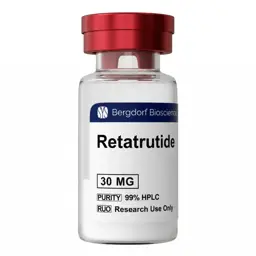
Incretin triple agonist (GLP-1R / GIPR / GCGR) versus GHRH analog (GH / IGF-1 axis): two fundamentally different research paths toward weight reduction and improved body composition.
 Medically reviewed by Dr. Sieglinde Klaus · Last reviewed June 2026
Retatrutide and Tesamorelin pursue completely different approaches. Retatrutide is a once-weekly injected triple agonist at the receptors for GLP-1, GIP, and glucagon, and in the phase 2 trial it achieved a mean weight reduction of around 24.2 % after 48 weeks 1. Tesamorelin is a daily injected GHRH analog that pulsatilely stimulates the body's own growth hormone secretion and, in the pivotal trial, lowered visceral adipose tissue by about 15.2 % without substantially affecting subcutaneous fat 4.
In short: in research, Retatrutide addresses the global weight and metabolic burden, while Tesamorelin targets visceral (abdominal) fat and hepatic steatosis. The clinical maturity also differs markedly: Tesamorelin has extensive phase 3 evidence with Falutz et al., whereas Retatrutide is still a compound in late development (TRIUMPH program).
Incretin triple agonist (GLP-1R / GIPR / GCGR) versus GHRH analog (GH / IGF-1 axis): two fundamentally different research paths toward weight reduction and improved body composition.
Medically reviewed by Dr. Sieglinde Klaus · Last reviewed June 2026Retatrutide and Tesamorelin pursue completely different approaches. Retatrutide is a once-weekly injected triple agonist at the receptors for GLP-1, GIP, and glucagon, and in the phase 2 trial it achieved a mean weight reduction of around 24.2 % after 48 weeks 1. Tesamorelin is a daily injected GHRH analog that pulsatilely stimulates the body's own growth hormone secretion and, in the pivotal trial, lowered visceral adipose tissue by about 15.2 % without substantially affecting subcutaneous fat 4.
In short: in research, Retatrutide addresses the global weight and metabolic burden, while Tesamorelin targets visceral (abdominal) fat and hepatic steatosis. The clinical maturity also differs markedly: Tesamorelin has extensive phase 3 evidence with Falutz et al., whereas Retatrutide is still a compound in late development (TRIUMPH program).
Synthetic triple incretin agonist; simultaneously mimics GLP-1, GIP, and glucagon (appetite, insulin secretion, energy expenditure).
GHRH analog (tetradecapeptide derivative); stimulates the pituitary to pulsatilely release the body's own growth hormone.
GLP-1 receptor, GIP receptor, glucagon receptor (three targets).
GHRH receptor on the somatotropic cells of the pituitary (one target).
Whole-body weight reduction, obesity, type 2 diabetes, hepatic steatosis (MASLD).
Selective reduction of visceral abdominal fat and liver fat; HIV-associated lipodystrophy.
1 to 12 mg once weekly subcutaneously, with dose escalation.
2 mg once daily subcutaneously.
Once weekly.
Once daily.
Long plasma half-life of around 6 days, which enables weekly administration.
Very short half-life (approx. 26 to 38 minutes); the GH effect is mediated via the pulsatile stimulus, not via the residence time of the peptide.
Phase 2 completed (obesity, diabetes, MASLD); phase 3 program TRIUMPH ongoing, not yet approved.
Phase 3 completed; approved in several markets for HIV-associated lipodystrophy, with a long safety data record.
Predominantly gastrointestinal (nausea, vomiting, diarrhea); dose-dependent increases in heart rate.
Joint pain, fluid retention, injection-site reactions; possible glucose/IGF-1 changes.
Store lyophilized powder cold; reconstituted, refrigerated and protected from light.
Store lyophilized powder cold; reconstituted, refrigerated, use promptly.
Broadly available as a pure research compound; usually cheaper per mg, total cost depending on the high dosage.
Available as a research compound; more complex synthesis, daily administration increases the quantity required.
Retatrutide is a single synthetic peptide with agonist activity at three receptors at once: the GLP-1 receptor, the GIP receptor, and the glucagon receptor 1. The GLP-1 and GIP components delay gastric emptying, suppress appetite, and improve glucose-dependent insulin secretion. The glucagon component is the distinguishing feature: in preclinical and clinical models it increases energy expenditure and lipolysis, which partly explains the pronounced reduction in weight and liver fat 3.
In research, Retatrutide is therefore described as a metabolically broad-acting candidate that simultaneously lowers energy intake and increases energy output.
Tesamorelin is a stabilized analog of growth hormone-releasing hormone (GHRH). Rather than supplying growth hormone, it binds to the GHRH receptor of the somatotropic cells in the pituitary and stimulates them to release the body's own growth hormone in its natural, pulsatile pattern 4. The increased GH in turn raises IGF-1 and promotes lipolysis, especially in the metabolically active visceral fat depot.
Because the stimulus remains physiologically pulsatile and feedback via somatostatin is preserved, studies observe a comparatively selective reduction of abdominal and liver fat while subcutaneous fat is largely preserved 5.
The central difference: Retatrutide acts directly from the outside on several metabolic receptors and reduces body weight globally. Tesamorelin acts indirectly via the body's own GH axis and targets visceral and hepatic fat selectively. A direct head-to-head comparison in the same population does not exist in the published literature.
The evidence base shows different levels of maturity and endpoints. Tesamorelin has robust, long-standing data from a 412-participant phase 3 trial, but consistently focuses on visceral and hepatic fat in a specific population (HIV lipodystrophy) 45. Retatrutide shows exceptionally large effects on total weight, blood glucose, and liver fat across several phase 2 programs, but is still in late clinical development without completed phase 3 efficacy data 123.
All data summarized here are drawn from published studies and serve scientific information purposes only. They constitute no medical advice, diagnosis, or treatment recommendation. The dosages mentioned are purely study parameters and not a usage recommendation. For research purposes only. Not intended for human consumption.
With around 24.2 % mean weight loss after 48 weeks, Retatrutide showed the strongest published effect on total body weight and is the obvious study object here [1](#ref-1).
Tesamorelin selectively reduces the visceral depot while subcutaneous fat is largely preserved, demonstrated by CT-based phase 3 data [4](#ref-4).
Both substantially lower liver fat: Retatrutide with very large relative effects in an obesity cohort [3](#ref-3), Tesamorelin with data on fibrosis progression in an HIV-NAFLD population [5](#ref-5). The choice depends on the model.
Only Tesamorelin acts via pulsatile release of the body's own growth hormone and is therefore suited to questions around the somatotropic axis [4](#ref-4).
With a plasma half-life of around 6 days, Retatrutide allows weekly administration, whereas Tesamorelin is administered daily.
Only to a limited extent. There is no head-to-head study in the same population. The peptides act via different axes (the incretin system vs GH/IGF-1) and were studied with different endpoints (total weight vs selective visceral fat). Comparisons therefore rest on separate studies.
Retatrutide and Tesamorelin are not direct competitors but tools for different research questions. Retatrutide is the choice when maximal global weight and metabolic effects are the focus, since its triple-receptor action delivered the largest published reductions in weight and liver fat 13. Tesamorelin is superior when it comes to selective reduction of visceral abdominal and liver fat via the body's own GH axis, supported by robust phase 3 evidence 45.
Anyone who needs completed, long-standing data and an established safety profile will more likely find these with Tesamorelin. Anyone researching the highest efficacy potential for total weight looks to Retatrutide, but accepts its earlier stage of development.
Superiority is context-dependent: Retatrutide for global weight reduction and metabolic breadth, Tesamorelin for selective visceral fat reduction and clinical maturity. A blanket ranking would not be scientifically defensible.
Synthetic triple incretin agonist; simultaneously mimics GLP-1, GIP, and glucagon (appetite, insulin secretion, energy expenditure).
GHRH analog (tetradecapeptide derivative); stimulates the pituitary to pulsatilely release the body's own growth hormone.
GLP-1 receptor, GIP receptor, glucagon receptor (three targets).
GHRH receptor on the somatotropic cells of the pituitary (one target).
Whole-body weight reduction, obesity, type 2 diabetes, hepatic steatosis (MASLD).
Selective reduction of visceral abdominal fat and liver fat; HIV-associated lipodystrophy.
1 to 12 mg once weekly subcutaneously, with dose escalation.
2 mg once daily subcutaneously.
Once weekly.
Once daily.
Long plasma half-life of around 6 days, which enables weekly administration.
Very short half-life (approx. 26 to 38 minutes); the GH effect is mediated via the pulsatile stimulus, not via the residence time of the peptide.
Phase 2 completed (obesity, diabetes, MASLD); phase 3 program TRIUMPH ongoing, not yet approved.
Phase 3 completed; approved in several markets for HIV-associated lipodystrophy, with a long safety data record.
Predominantly gastrointestinal (nausea, vomiting, diarrhea); dose-dependent increases in heart rate.
Joint pain, fluid retention, injection-site reactions; possible glucose/IGF-1 changes.
Store lyophilized powder cold; reconstituted, refrigerated and protected from light.
Store lyophilized powder cold; reconstituted, refrigerated, use promptly.
Broadly available as a pure research compound; usually cheaper per mg, total cost depending on the high dosage.
Available as a research compound; more complex synthesis, daily administration increases the quantity required.
Retatrutide is a single synthetic peptide with agonist activity at three receptors at once: the GLP-1 receptor, the GIP receptor, and the glucagon receptor 1. The GLP-1 and GIP components delay gastric emptying, suppress appetite, and improve glucose-dependent insulin secretion. The glucagon component is the distinguishing feature: in preclinical and clinical models it increases energy expenditure and lipolysis, which partly explains the pronounced reduction in weight and liver fat 3.
In research, Retatrutide is therefore described as a metabolically broad-acting candidate that simultaneously lowers energy intake and increases energy output.
Tesamorelin is a stabilized analog of growth hormone-releasing hormone (GHRH). Rather than supplying growth hormone, it binds to the GHRH receptor of the somatotropic cells in the pituitary and stimulates them to release the body's own growth hormone in its natural, pulsatile pattern 4. The increased GH in turn raises IGF-1 and promotes lipolysis, especially in the metabolically active visceral fat depot.
Because the stimulus remains physiologically pulsatile and feedback via somatostatin is preserved, studies observe a comparatively selective reduction of abdominal and liver fat while subcutaneous fat is largely preserved 5.
The central difference: Retatrutide acts directly from the outside on several metabolic receptors and reduces body weight globally. Tesamorelin acts indirectly via the body's own GH axis and targets visceral and hepatic fat selectively. A direct head-to-head comparison in the same population does not exist in the published literature.
The evidence base shows different levels of maturity and endpoints. Tesamorelin has robust, long-standing data from a 412-participant phase 3 trial, but consistently focuses on visceral and hepatic fat in a specific population (HIV lipodystrophy) 45. Retatrutide shows exceptionally large effects on total weight, blood glucose, and liver fat across several phase 2 programs, but is still in late clinical development without completed phase 3 efficacy data 123.
All data summarized here are drawn from published studies and serve scientific information purposes only. They constitute no medical advice, diagnosis, or treatment recommendation. The dosages mentioned are purely study parameters and not a usage recommendation. For research purposes only. Not intended for human consumption.
With around 24.2 % mean weight loss after 48 weeks, Retatrutide showed the strongest published effect on total body weight and is the obvious study object here [1](#ref-1).
Tesamorelin selectively reduces the visceral depot while subcutaneous fat is largely preserved, demonstrated by CT-based phase 3 data [4](#ref-4).
Both substantially lower liver fat: Retatrutide with very large relative effects in an obesity cohort [3](#ref-3), Tesamorelin with data on fibrosis progression in an HIV-NAFLD population [5](#ref-5). The choice depends on the model.
Only Tesamorelin acts via pulsatile release of the body's own growth hormone and is therefore suited to questions around the somatotropic axis [4](#ref-4).
With a plasma half-life of around 6 days, Retatrutide allows weekly administration, whereas Tesamorelin is administered daily.
Only to a limited extent. There is no head-to-head study in the same population. The peptides act via different axes (the incretin system vs GH/IGF-1) and were studied with different endpoints (total weight vs selective visceral fat). Comparisons therefore rest on separate studies.
Retatrutide and Tesamorelin are not direct competitors but tools for different research questions. Retatrutide is the choice when maximal global weight and metabolic effects are the focus, since its triple-receptor action delivered the largest published reductions in weight and liver fat 13. Tesamorelin is superior when it comes to selective reduction of visceral abdominal and liver fat via the body's own GH axis, supported by robust phase 3 evidence 45.
Anyone who needs completed, long-standing data and an established safety profile will more likely find these with Tesamorelin. Anyone researching the highest efficacy potential for total weight looks to Retatrutide, but accepts its earlier stage of development.
Superiority is context-dependent: Retatrutide for global weight reduction and metabolic breadth, Tesamorelin for selective visceral fat reduction and clinical maturity. A blanket ranking would not be scientifically defensible.