Research peptide · Vasoactive intestinal peptide
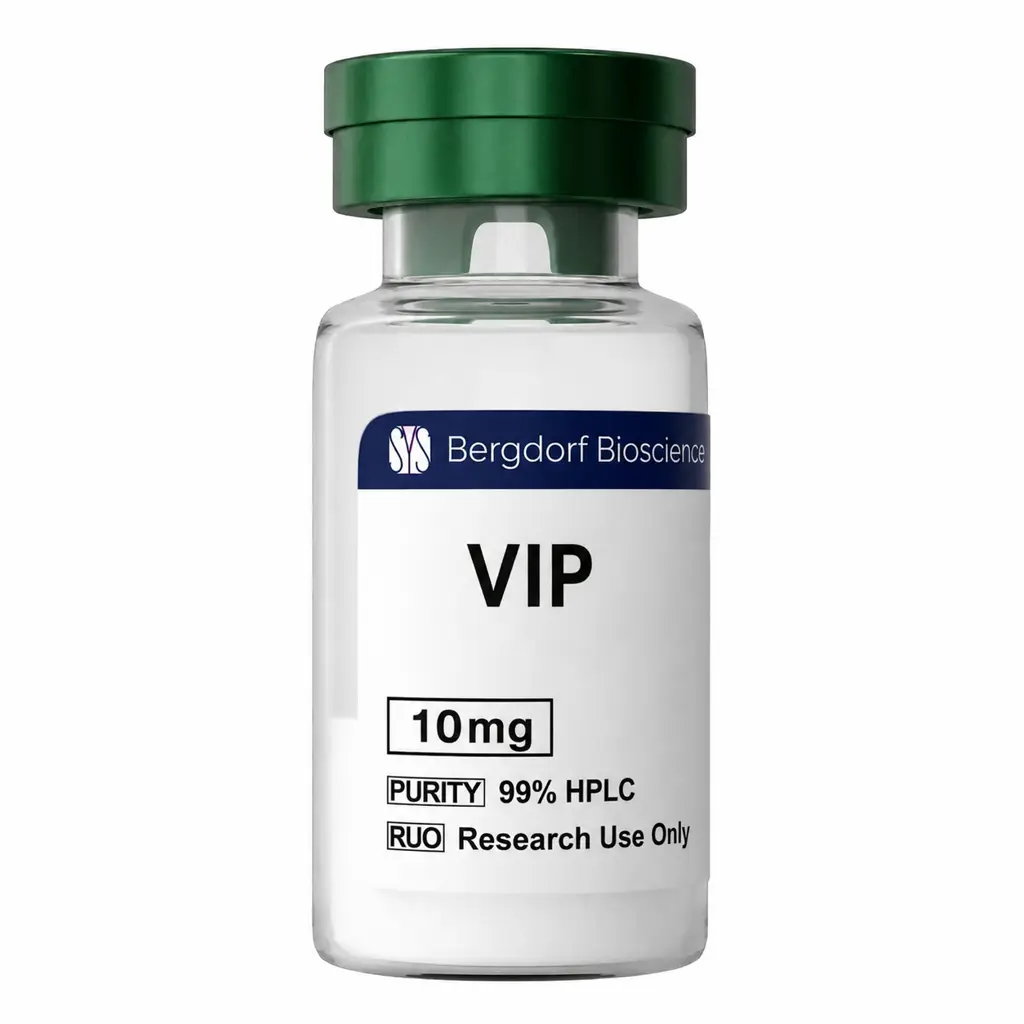
VIP 10 mg
VIP 10 mg lyophilized research vial with clear scientific context on VPAC signaling and route-specific human pharmacokinetics. Research use only.

Research peptide · Vasoactive intestinal peptide
VIP 10 mg lyophilized research vial with clear scientific context on VPAC signaling and route-specific human pharmacokinetics. Research use only.
Research peptide · Vasoactive intestinal peptide
VIP 10 mg lyophilized research vial with clear scientific context on VPAC signaling and route-specific human pharmacokinetics. Research use only.
No reviews yet. Be the first to share your experience.
No reviews yet. Be the first to share your experience.
/ vial
Order today → Delivery Tue, Sep 29 – Wed, Oct 07 to United States
Payment Methods





/ vial
Order today → Delivery Tue, Sep 29 – Wed, Oct 07 to United States
Payment Methods
3,000+
satisfied researchers
99.43%
Avg. purity 2026
4.8 ★
ProvenExpert
99.43%
Avg. purity 2026
4.8 ★
ProvenExpert
3,000+ satisfied researchers
Steady-state plasma level after ~ 4 weeks with weekly administration.
Scientific references
Domschke et al. · Gut, 1978
Vasoactive intestinal peptide in man: pharmacokinetics, metabolic and circulatory effects
Sreedharan et al. · Biochem Biophys Res Commun, 1993
Cloning and functional expression of a human VIP receptor
Nicole et al. · Peptides, 2000
Alanine scan of VIP interaction with human VPAC1 and VPAC2 receptors
Research details
Vasoactive intestinal peptide, commonly abbreviated VIP, is an endogenous signaling peptide composed of 28 amino acids and completed by a C-terminal amide. Sequence work established the compact peptide architecture that is now used as the reference identity for VIP research. Although its historical name points to one tissue context, VIP is studied more broadly as a member of the secretin-family signaling system. Its scientific identity should therefore be understood at the molecular and receptor level, not as a promise of a particular biological outcome.
This product contains 10 mg of lyophilized VIP in a research vial. The mass on the label describes the supplied research material; it is not a dosage recommendation. The format is intended for controlled laboratory workflows in which investigators define their own validated analytical or experimental protocol. It is not presented as a pharmaceutical preparation, a clinical substitute or a material suitable for administration to people or animals.
VIP is associated principally with the VPAC1 and VPAC2 receptors, which belong to the G-protein-coupled receptor family. Primary receptor-expression research demonstrated specific VIP binding and a corresponding rise in intracellular cyclic AMP. Later alanine-scanning work examined how individual positions in the 28-residue peptide contribute to binding and adenylyl-cyclase activation at human VPAC1 and VPAC2 receptors. Together, those studies provide a direct experimental foundation for describing VIP as a receptor ligand linked to cyclic AMP signaling.
That mechanism makes VIP useful as a reference molecule in receptor pharmacology, ligand-binding experiments, cellular signaling studies and assay-development work. The interpretation still depends on the system being studied: receptor expression, cell background, assay format, concentration range and observation window can all change the measured response. A signaling result in an engineered or isolated system should not be translated automatically into a whole-organism effect, a safety conclusion or a therapeutic claim.
A frequently cited human pharmacokinetic study evaluated graded intravenous VIP infusions in four healthy volunteers. After the infusion was stopped, plasma VIP declined in a first-order pattern with an average disappearance half-time of approximately one minute. The investigators also reported an apparent plasma clearance near 9 mL/kg/min and an apparent volume of distribution near 14 mL/kg. These observations document rapid disappearance from plasma under the specific intravenous conditions used in that small study.
The approximately one-minute figure is not a universal half-life for every route, matrix, formulation or experimental model. It should not be used to infer stability inside an unopened vial, storage life, behavior after another route of exposure or a human administration schedule. When the value is shown in a research calculator, it should be labeled as an intravenous disappearance estimate and accompanied by the original study context. Preserving that context is essential because the route and sampling design are part of the result.
The evidence supporting this overview comes from different levels of investigation. Sequence studies establish molecular identity; receptor-expression and structure-activity studies establish binding and cyclic AMP responses; the small intravenous study describes plasma disappearance in a narrowly defined human experiment. These findings complement one another, but they answer different questions and should not be blended into a claim about efficacy, clinical safety or an approved use.
The human study involved only four volunteers and predates modern large-trial reporting standards. It remains useful for the route-specific pharmacokinetic observation, yet its size limits generalization. Likewise, receptor activity is evidence of molecular function, not proof that a research vial will produce a desired outcome. This product page therefore keeps the claims narrow, names the experimental setting and links the underlying primary literature so that researchers can review methods and limitations directly.
VIP 10 mg is supplied as a lyophilized research material in a sealed vial. Lyophilization provides a practical dry format for laboratory inventory, but it does not imply sterility, pharmaceutical grade, a verified purity percentage or suitability for clinical use. Researchers should use institutionally approved methods, appropriate controls and documentation suited to their own assay. No reconstitution, injection or human dosing instructions are provided on this page.
Keep the unopened vial sealed, dry and protected from light, following the handling information supplied with the material. The parcel is sent with tracking in protective packaging. The product is strictly for research use only and is not intended for human or veterinary use, diagnosis, treatment, prevention or consumption.
Domschke et al. (1978), VIP pharmacokinetics in humans
Sreedharan et al. (1993), cloned human VIP receptor signaling
Nicole et al. (2000), VIP structure-activity at VPAC1 and VPAC2
Carlquist et al. (1982), VIP sequence characterization
For laboratory research use only. Not for human or veterinary use, diagnosis, treatment, prevention or consumption. No clinical equivalence, suitability for administration or therapeutic performance is represented.
VIP interacts with the VPAC1 and VPAC2 G-protein-coupled receptors. Human receptor-expression and peptide structure-activity studies show receptor binding followed by stimulation of intracellular cyclic AMP signaling; these molecular observations do not by themselves establish a therapeutic effect.
VIP stands for vasoactive intestinal peptide, an endogenous 28-residue, C-terminally amidated signaling peptide studied within the secretin-family peptide system.
3,000+
satisfied researchers
99.43%
Avg. purity 2026
4.8 ★
ProvenExpert
99.43%
Avg. purity 2026
4.8 ★
ProvenExpert
3,000+ satisfied researchers
Steady-state plasma level after ~ 4 weeks with weekly administration.
Scientific references
Domschke et al. · Gut, 1978
Vasoactive intestinal peptide in man: pharmacokinetics, metabolic and circulatory effects
Sreedharan et al. · Biochem Biophys Res Commun, 1993
Cloning and functional expression of a human VIP receptor
Nicole et al. · Peptides, 2000
Alanine scan of VIP interaction with human VPAC1 and VPAC2 receptors
Research details
Vasoactive intestinal peptide, commonly abbreviated VIP, is an endogenous signaling peptide composed of 28 amino acids and completed by a C-terminal amide. Sequence work established the compact peptide architecture that is now used as the reference identity for VIP research. Although its historical name points to one tissue context, VIP is studied more broadly as a member of the secretin-family signaling system. Its scientific identity should therefore be understood at the molecular and receptor level, not as a promise of a particular biological outcome.
This product contains 10 mg of lyophilized VIP in a research vial. The mass on the label describes the supplied research material; it is not a dosage recommendation. The format is intended for controlled laboratory workflows in which investigators define their own validated analytical or experimental protocol. It is not presented as a pharmaceutical preparation, a clinical substitute or a material suitable for administration to people or animals.
VIP is associated principally with the VPAC1 and VPAC2 receptors, which belong to the G-protein-coupled receptor family. Primary receptor-expression research demonstrated specific VIP binding and a corresponding rise in intracellular cyclic AMP. Later alanine-scanning work examined how individual positions in the 28-residue peptide contribute to binding and adenylyl-cyclase activation at human VPAC1 and VPAC2 receptors. Together, those studies provide a direct experimental foundation for describing VIP as a receptor ligand linked to cyclic AMP signaling.
That mechanism makes VIP useful as a reference molecule in receptor pharmacology, ligand-binding experiments, cellular signaling studies and assay-development work. The interpretation still depends on the system being studied: receptor expression, cell background, assay format, concentration range and observation window can all change the measured response. A signaling result in an engineered or isolated system should not be translated automatically into a whole-organism effect, a safety conclusion or a therapeutic claim.
A frequently cited human pharmacokinetic study evaluated graded intravenous VIP infusions in four healthy volunteers. After the infusion was stopped, plasma VIP declined in a first-order pattern with an average disappearance half-time of approximately one minute. The investigators also reported an apparent plasma clearance near 9 mL/kg/min and an apparent volume of distribution near 14 mL/kg. These observations document rapid disappearance from plasma under the specific intravenous conditions used in that small study.
The approximately one-minute figure is not a universal half-life for every route, matrix, formulation or experimental model. It should not be used to infer stability inside an unopened vial, storage life, behavior after another route of exposure or a human administration schedule. When the value is shown in a research calculator, it should be labeled as an intravenous disappearance estimate and accompanied by the original study context. Preserving that context is essential because the route and sampling design are part of the result.
The evidence supporting this overview comes from different levels of investigation. Sequence studies establish molecular identity; receptor-expression and structure-activity studies establish binding and cyclic AMP responses; the small intravenous study describes plasma disappearance in a narrowly defined human experiment. These findings complement one another, but they answer different questions and should not be blended into a claim about efficacy, clinical safety or an approved use.
The human study involved only four volunteers and predates modern large-trial reporting standards. It remains useful for the route-specific pharmacokinetic observation, yet its size limits generalization. Likewise, receptor activity is evidence of molecular function, not proof that a research vial will produce a desired outcome. This product page therefore keeps the claims narrow, names the experimental setting and links the underlying primary literature so that researchers can review methods and limitations directly.
VIP 10 mg is supplied as a lyophilized research material in a sealed vial. Lyophilization provides a practical dry format for laboratory inventory, but it does not imply sterility, pharmaceutical grade, a verified purity percentage or suitability for clinical use. Researchers should use institutionally approved methods, appropriate controls and documentation suited to their own assay. No reconstitution, injection or human dosing instructions are provided on this page.
Keep the unopened vial sealed, dry and protected from light, following the handling information supplied with the material. The parcel is sent with tracking in protective packaging. The product is strictly for research use only and is not intended for human or veterinary use, diagnosis, treatment, prevention or consumption.
Domschke et al. (1978), VIP pharmacokinetics in humans
Sreedharan et al. (1993), cloned human VIP receptor signaling
Nicole et al. (2000), VIP structure-activity at VPAC1 and VPAC2
Carlquist et al. (1982), VIP sequence characterization
For laboratory research use only. Not for human or veterinary use, diagnosis, treatment, prevention or consumption. No clinical equivalence, suitability for administration or therapeutic performance is represented.
VIP interacts with the VPAC1 and VPAC2 G-protein-coupled receptors. Human receptor-expression and peptide structure-activity studies show receptor binding followed by stimulation of intracellular cyclic AMP signaling; these molecular observations do not by themselves establish a therapeutic effect.
VIP stands for vasoactive intestinal peptide, an endogenous 28-residue, C-terminally amidated signaling peptide studied within the secretin-family peptide system.