
Izračunajte točne volumene rekonstitucije, inzulinske jedinice i doze po bočici za svaki peptid.
Bočica, voda i doza su poznati
5,5 IU teško je očitati. Uz 4,4 ml vode pogađate točno 8 IU.
Crtice mjere volumen, ne djelatnu tvar. 5 IU = 0.05 ml. Koliko je mg unutra ovisi o pripremi. To je kalkulator za Vas izračunao.
Gotovo sve inzulinske štrcaljke su U-100. U-40 odaberite samo ako na štrcaljki piše U-40.
The Klow Stack is BergdorfBio's proprietary anti-aging peptide blend engineered to target the deeper biological mechanisms that drive cellular aging. While many peptide protocols focus on structural regeneration at the tissue level, the Klow Stack operates at a more fundamental level: mitochondrial health, cellular repair signaling, and longevity pathway activation. It is designed for individuals seeking to address aging at the cellular source rather than simply managing its visible consequences.
The stack combines peptide components that work across complementary biological axes — oxidative stress reduction, mitochondrial biogenesis support, and the activation of repair pathways linked to extended cellular lifespan. This makes the Klow Stack particularly relevant for longevity-focused biohackers, athletes seeking accelerated recovery, and individuals in their 40s and beyond who want to maintain biological youth at the cellular level.
Unlike stacks targeting a single organ or tissue system, the Klow Stack's multi-target mechanism reflects the emerging understanding in geroscience that aging is not a single-pathway phenomenon. The hallmarks of aging — mitochondrial dysfunction, cellular senescence, impaired proteostasis, and epigenetic drift — require multi-vector interventions to meaningfully shift trajectory. The Klow Stack is formulated with this scientific framework in mind.
You can find the Klow Stack at BergdorfBio, available as a pre-formulated research combination for scientific purposes.
Mitochondrial dysfunction is one of the most well-characterized hallmarks of aging. As cells age, the efficiency of oxidative phosphorylation declines, reactive oxygen species (ROS) production increases, and the capacity for mitochondrial autophagy (mitophagy) decreases. The Klow Stack includes components that activate the PGC-1alpha pathway — the master regulator of mitochondrial biogenesis — which drives the production of new, functional mitochondria to replace aging ones. This process improves cellular energy production, reduces oxidative burden, and restores the metabolic capacity that declines with age.
Chronic oxidative stress accelerates nearly every aging phenotype: telomere shortening, protein misfolding, DNA strand breaks, and membrane lipid peroxidation. The Klow Stack targets the Nrf2-Keap1 pathway — the principal cellular defense against oxidative stress — upregulating the expression of antioxidant enzymes including superoxide dismutase (SOD), catalase, glutathione peroxidase, and heme oxygenase-1 (HO-1). This endogenous antioxidant activation is mechanistically superior to exogenous antioxidant supplementation, as it produces a sustained, enzymatic defense rather than a transient molecular scavenging effect.
The Klow Stack's tissue repair component supports the body's endogenous repair systems through multiple mechanisms:
At the gene-expression level, the Klow Stack engages signaling pathways associated with extended lifespan in multiple model organisms. The AMPK and SIRT1 pathways — both implicated in the caloric restriction response — are modulated by the stack's components. AMPK activation promotes mitophagy, inhibits mTORC1 (which drives cellular senescence when chronically elevated), and enhances cellular stress resistance. SIRT1 activation supports epigenetic maintenance and DNA repair fidelity, two processes that progressively deteriorate with aging.
The Klow Stack also demonstrates activity at the level of telomere-associated proteins, with preliminary research suggesting support for telomerase activity in certain cell types. While telomere extension in humans remains a complex and incompletely understood process, maintaining the integrity of telomere-binding proteins appears relevant to slowing the rate of age-associated cellular senescence.
Accurate dose calculation begins with knowing the concentration of your reconstituted vial. For a standard 10 mg Klow Stack vial reconstituted with 2 ml of bacteriostatic water (BAC water):
10 mg / 2 ml = 5 mg/ml
At this concentration, the most common research dose range of 0.5–2 mg per day translates to:
Use the Klow Stack calculator above to compute exact injection volumes for any vial size, BAC water volume, and target dose. The formula is always: Injection volume (ml) = Desired dose (mg) / Concentration (mg/ml).
If you prefer a more dilute solution for easier measurement of smaller doses, reconstitute with 4 ml BAC water (yielding 2.5 mg/ml). At this concentration, a 0.5 mg dose equals 0.20 ml — a volume that is easier to measure accurately in a standard insulin syringe.
The Klow Stack is designed for daily administration, reflecting the continuous nature of the biological processes it targets. Mitochondrial health, oxidative stress management, and longevity signaling are not episodic processes — they require consistent, sustained input to shift the cellular equilibrium toward repair and renewal.
Many users combine the Klow Stack with the Glow Stack (GHK-Cu + BPC-157) for a comprehensive anti-aging protocol. In this configuration, the Klow Stack addresses deep cellular and mitochondrial aging while the Glow Stack provides structural regeneration at the tissue and dermal level. The two stacks use complementary but non-overlapping mechanisms, making them ideal for concurrent use without competitive receptor interactions.
Proper reconstitution is essential for maintaining peptide integrity and ensuring accurate dosing. Follow these steps carefully:
Peptide potency is highly sensitive to storage conditions. Following these guidelines will preserve the Klow Stack's bioactivity throughout its usable window:
The Klow Stack components have been selected in part for their favorable safety profiles in preclinical research. The stack is generally well-tolerated, though individual responses vary and first-time users should begin at the lower end of the dose range.
The Klow Stack is frequently used as part of a broader anti-aging protocol. The following combinations are commonly explored in the research community:
The timeline for Klow Stack effects depends on the biological endpoint being assessed. Subjective improvements in energy levels and cognitive clarity are often reported within the first 2–3 weeks as mitochondrial function improves. Changes in skin quality and physical recovery speed typically become apparent at 4–6 weeks. More fundamental metrics — inflammatory biomarkers, oxidative stress markers, or biological age indicators if testing is undertaken — generally show movement at the 8–12 week mark. The Klow Stack is a long-term investment in cellular health rather than an acutely symptomatic intervention.
Yes. The two stacks are frequently used together precisely because they address aging through complementary mechanisms with no receptor overlap. The Klow Stack can be administered in the morning and the Glow Stack in the evening, or both can be taken at the same time of day. When starting both simultaneously, consider initiating at half the standard dose for each stack during the first week to assess individual tolerance before reaching full protocol doses.
Yes. The Klow Stack's mechanisms — mitochondrial biogenesis, oxidative stress defense, and cellular repair activation — are not sex-hormone dependent. Both men and women experience the same age-related mitochondrial decline, making the stack equally relevant across sexes. Women in perimenopause or post-menopause may find the stack particularly beneficial given the accelerated oxidative stress and mitochondrial dysfunction that accompanies estrogen decline.
A 0.3 ml (30-unit) insulin syringe with a 29–31 gauge, 6–8 mm needle is ideal for most doses in the 0.5–2 mg range when using a 5 mg/ml concentration. For doses approaching 2 mg (0.40 ml at 5 mg/ml), a 0.5 ml syringe provides more comfortable handling. Always use the shortest available needle for subcutaneous administration to ensure the injection remains in the subcutaneous fat layer rather than reaching muscle.
No. The Klow Stack does not suppress endogenous hormone production and does not interact with the hypothalamic-pituitary axis. It requires no post-cycle therapy. The recommended off-cycle periods (4 weeks after every 8–12 week cycle) serve to prevent receptor adaptation and maintain signaling responsiveness, not to restore hormonal function.
Yes, though the combination should be managed carefully in terms of total peptide load. Growth hormone secretagogues like CJC-1295 operate through the GHRH receptor pathway, which does not overlap with the Klow Stack's primary mechanisms. Some researchers combine these protocols to simultaneously address cellular aging (Klow Stack) and growth hormone pulse optimization (CJC-1295). When combining multiple protocols, always introduce one new compound at a time to establish individual response baselines before adding the next.
The Glow Stack (GHK-Cu + BPC-157) is primarily a tissue-level regeneration stack: it drives collagen synthesis, wound healing, angiogenesis, and dermal repair. Results are often visible externally in skin quality and texture. The Klow Stack operates at a deeper, sub-cellular level — targeting mitochondrial function, cellular energetics, oxidative stress resilience, and longevity signaling. Its effects are more systemic and fundamental, with benefits manifesting across multiple organ systems rather than primarily at the dermal level. The two stacks are designed to be complementary rather than competitive.
In the research context, doses above 2 mg per day have not demonstrated meaningfully superior outcomes compared to the 1–2 mg range and may increase the likelihood of minor side effects. The current evidence supports the 1–2 mg daily dose range as the optimal research window. Doses above 2 mg are considered experimental and should only be undertaken with appropriate research oversight.
Yes, and this may actually represent an optimal context for the stack. Caloric restriction and fasting activate many of the same pathways (AMPK, SIRT1, PGC-1alpha) that the Klow Stack engages. Using the Klow Stack during periods of caloric restriction may produce additive activation of these longevity pathways. Adequate hydration is important during fasting protocols, as peptide injection into dehydrated subcutaneous tissue can cause increased local irritation.
Medical Disclaimer: The information on this page is provided for educational and research purposes only. The Klow Stack is not an approved drug or medical treatment. It is sold strictly for research use. Nothing on this page constitutes medical advice, diagnosis, or a recommendation to use any specific compound. Always consult a qualified healthcare professional before beginning any peptide protocol. BergdorfBio assumes no liability for the use or misuse of the information presented here.
Od praha do gotove štrcaljke u pet koraka. Količine Vam kalkulator iznad daje automatski.
Dovedite bočicu i vodu na sobnu temperaturu. Oba gumena čepa obrišite tupferom s alkoholom.
Količinu BAC vode koju preporučuje kalkulator navucite većom štrcaljkom.
Pustite da voda klizi niz staklenu stijenku u bočicu s peptidom, ne prskajte je izravno na prah.
Bočicu nježno valjajte, ne tresite. Prah se bistro otopi za 1-2 minute.
Inzulinskom štrcaljkom navucite točno do izračunate crtice. Gotovo.
Tipične početne vrijednosti za orijentaciju. Svaki redak otvara kalkulator za odgovarajući peptid.
| Peptid | Kategorija | Uobičajena doza | Veličine bočica | BAC (početak) | Dostupno | Izračunaj |
|---|---|---|---|---|---|---|
| Retatrutide | GLP-1/GIP/GCG | 0,5-12 mg | 2 / 5 / 10 / 15 mg | 2 ml | Samo kalkulator | Izračunaj |
| Semaglutide | GLP-1 | 0,25-2,4 mg | 2 / 5 / 10 mg | 2 ml | Samo kalkulator | Izračunaj |
| Tirzepatide | GLP-1/GIP | 2,5-15 mg | 5 / 10 / 15 mg | 2 ml | Samo kalkulator | Izračunaj |
| GHK-Cu | Bakreni peptid | 1-4 mg | 10 / 20 / 50 mg | 5 ml | Samo kalkulator | Izračunaj |
| BPC-157 | Obnova tkiva | 200-500 mcg | 2 / 5 / 10 mg | 2 ml | Samo kalkulator | Izračunaj |
| TB-500 | Thymosin Beta-4 | 2-5 mg | 2 / 5 / 10 mg | 2 ml | Samo kalkulator | Izračunaj |
| CJC-1295 (bez DAC) | GHRH analog | 100-200 mcg | 2 / 5 / 10 mg | 2 ml | Samo kalkulator | Izračunaj |
| Ipamorelin | GHRP | 200-300 mcg | 2 / 5 mg | 2 ml | Samo kalkulator | Izračunaj |
| AOD-9604 | Gubitak masti | 250-500 mcg | 2 / 5 mg | 2 ml | Samo kalkulator | Izračunaj |
| PT-141 | Bremelanotide | 0,5-2 mg | 2 / 5 / 10 mg | 2 ml | Samo kalkulator | Izračunaj |
| MOTS-c | Mitohondrijski | 5-10 mg | 5 / 10 mg | 2 ml | Samo kalkulator | Izračunaj |
| Selank | Anksiolitik | 150-500 mcg | 2 / 5 mg | 2 ml | Samo kalkulator | Izračunaj |
| SS-31 | Elamipretide | 0,1-1 mg | 5 / 10 mg | 2 ml | Samo kalkulator | Izračunaj |
| Glow Stack | Stack | 0,5-2 mg | 70 mg | 3 ml | Samo kalkulator | Izračunaj |
| Klow Stack | Stack | 0,5-2 mg | 55 mg | 3 ml | Samo kalkulator | Izračunaj |
| Melanotan II | Melanocortin | 100-1000 mcg | 5 / 10 mg | 2 ml | Samo kalkulator | Izračunaj |
| Melanotan I | Melanocortin | 100-1000 mcg | 5 / 10 mg | 2 ml | Samo kalkulator | Izračunaj |
| Sermorelin | GHRH analog | 50-300 mcg | 2 / 5 mg | 2 ml | Samo kalkulator | Izračunaj |
| Tesamorelin | GHRH analog | 1-2 mg | 10 / 20 mg | 2 ml | Samo kalkulator | Izračunaj |
| Thymosin Alpha-1 | Timički peptid | 0,8-3,2 mg | 1.6 / 5 / 10 mg | 1 ml | Samo kalkulator | Izračunaj |
| Epithalon | Dugovječnost | 2-10 mg | 10 / 20 / 50 mg | 2 ml | Samo kalkulator | Izračunaj |
| KPV | Imuno / Barijera | 100-1000 mcg | 5 / 10 mg | 2 ml | Samo kalkulator | Izračunaj |
| HGH Fragment 176-191 | Metabolički fragment | 100-500 mcg | 2 / 5 / 10 mg | 2 ml | Samo kalkulator | Izračunaj |
| Semax | Kognitivno | 100-1000 mcg | 10 / 30 mg | 2 ml | Samo kalkulator | Izračunaj |
| N-Acetyl Semax | Kognitivno | 100-1000 mcg | 5 / 10 mg | 2 ml | Samo kalkulator | Izračunaj |
| Hexarelin | GHRP | 50-200 mcg | 2 / 5 mg | 2 ml | Samo kalkulator | Izračunaj |
| GHRP-6 | GHRP | 50-300 mcg | 2 / 5 mg | 2 ml | Samo kalkulator | Izračunaj |
| GHRP-2 | GHRP | 50-250 mcg | 2 / 5 mg | 2 ml | Samo kalkulator | Izračunaj |
| DSIP | San | 50-500 mcg | 2 / 5 mg | 2 ml | Samo kalkulator | Izračunaj |
| 5-Amino-1MQ | Metabolički | 2,5-10 mg | 5 / 10 mg | 2 ml | Samo kalkulator | Izračunaj |
| HGH 191AA | Hormon rasta | 1-5 mg | 10 mg | 1 ml | Samo kalkulator | Izračunaj |
| NAD+ | Dugovječnost / Kofaktor | 100-500 mg | 1000 mg | 10 ml | Samo kalkulator | Izračunaj |
Vrijednosti služe za orijentaciju u istraživačkom kontekstu i ne zamjenjuju stručni savjet.
Pravilan izračun koncentracije i volumena injekcije djeluje trivijalno, no najčešći je izvor pogrešaka. Već pogreška u izračunu od 10 % pri rekonstituciji znači da ćete dobiti premalo djelatne tvari ili nenamjerno predozirati.
Liofilizirani peptidi isporučuju se u miligramima i otapaju u bakteriostatskoj vodi (BAC vodi). Omjer peptida i vode određuje koncentraciju, a iz toga proizlazi koliko crtica navlačite na inzulinskoj štrcaljki. Inzulinske štrcaljke skalirane su u jedinicama, ne u miligramima. Tu pretvorbu obavlja kalkulator, uključujući provjeru vjerodostojnosti protiv najopasnije pogreške: zamjene mg i mcg.
Miligram (mg) jedinica je u kojoj se liofilizirani peptidi prodaju, primjerice „5 mg BPC-157“. Mikrogram (mcg) mjeri pojedinačnu dozu, primjerice „250 mcg po injekciji“. 1 mg = 1.000 mcg. Kalkulator automatski pretvara i upozorava kada unos izgleda kao zamjena.
U-100 znači da je štrcaljka kalibrirana za 100 jedinica po mililitru. 100 IU = 1 ml, dakle 10 IU = 0,10 ml, neovisno o tome što je u štrcaljki. Upravo se na tom odnosu temelji izračun IU.
Uz mnogo peptida i malo vode otopina postaje vrlo koncentrirana, pa je volumen po dozi sićušan i teško ga je očitati. Upotrijebite pomoć pri pripremi: pronalazi količinu vode koja daje čistu, lako čitljivu crticu.
U hladnjaku na 2-8 °C obično 21-30 dana. Označite bočicu datumom rekonstitucije. Zamućene otopine ili čestice razlog su za isključenje.
Blendovi sadrže više djelatnih tvari u jednoj bočici. Jednostavno odaberite blend kao peptid: kalkulator dodatno prikazuje koliko je svake komponente u Vašoj injekciji. Za kombinacije iz više zasebnih bočica upotrijebite Stack Builder.
Ne. Vaše posljednje postavke spremaju se lokalno u pregledniku i vraćaju pri sljedećem posjetu. Osim toga, izračune možete ponovno pozvati iz povijesti, spremiti kao protokol ili podijeliti kao poveznicu.
Odaberite peptid da biste otvorili njegovu stranicu kalkulatora s unaprijed ispunjenim vrijednostima.
Pogledajte proizvod
Klow Stack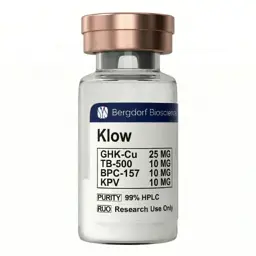
Tipične početne vrijednosti za orijentaciju. Svaki redak otvara kalkulator za odgovarajući peptid.
| Peptid | Kategorija | Uobičajena doza | Veličine bočica | BAC (početak) | Dostupno | Izračunaj |
|---|---|---|---|---|---|---|
| Retatrutide | GLP-1/GIP/GCG | 0,5-12 mg | 2 / 5 / 10 / 15 mg | 2 ml | Na zalihi | Izračunaj |
| Tirzepatide | GLP-1/GIP | 2,5-15 mg | 5 / 10 / 15 mg | 2 ml | Na zalihi | Izračunaj |
| GHK-Cu | Bakreni peptid | 1-4 mg | 10 / 20 / 50 mg | 5 ml | Na zalihi | Izračunaj |
| BPC-157 | Obnova tkiva | 200-500 mcg | 2 / 5 / 10 mg | 2 ml | Na zalihi | Izračunaj |
| TB-500 | Thymosin Beta-4 | 2-5 mg | 2 / 5 / 10 mg | 2 ml | Na zalihi | Izračunaj |
| CJC-1295 (bez DAC) | GHRH analog | 100-200 mcg | 2 / 5 / 10 mg | 2 ml | Na zalihi | Izračunaj |
| MOTS-c | Mitohondrijski | 5-10 mg | 5 / 10 mg | 2 ml | Na zalihi | Izračunaj |
| Glow Stack | Stack | 0,5-2 mg | 70 mg | 3 ml | Na zalihi | Izračunaj |
| Klow Stack | Stack | 0,5-2 mg | 55 mg | 3 ml | Na zalihi | Izračunaj |
| Melanotan II | Melanocortin | 100-1000 mcg | 5 / 10 mg | 2 ml | Na zalihi | Izračunaj |
| Tesamorelin | GHRH analog | 1-2 mg | 10 / 20 mg | 2 ml | Na zalihi | Izračunaj |
| Thymosin Alpha-1 | Timički peptid | 0,8-3,2 mg | 1.6 / 5 / 10 mg | 1 ml | Na zalihi | Izračunaj |
| KPV | Imuno / Barijera | 100-1000 mcg | 5 / 10 mg | 2 ml | Na zalihi | Izračunaj |
| Semax | Kognitivno | 100-1000 mcg | 10 / 30 mg | 2 ml | Na zalihi | Izračunaj |
| NAD+ | Dugovječnost / Kofaktor | 100-500 mg | 1000 mg | 10 ml | Na zalihi | Izračunaj |
| Semaglutide | GLP-1 | 0,25-2,4 mg | 2 / 5 / 10 mg | 2 ml | Samo kalkulator | Izračunaj |
| Ipamorelin | GHRP | 200-300 mcg | 2 / 5 mg | 2 ml | Samo kalkulator | Izračunaj |
| AOD-9604 | Gubitak masti | 250-500 mcg | 2 / 5 mg | 2 ml | Samo kalkulator | Izračunaj |
| PT-141 | Bremelanotide | 0,5-2 mg | 2 / 5 / 10 mg | 2 ml | Samo kalkulator | Izračunaj |
| Selank | Anksiolitik | 150-500 mcg | 2 / 5 mg | 2 ml | Samo kalkulator | Izračunaj |
| SS-31 | Elamipretide | 0,1-1 mg | 5 / 10 mg | 2 ml | Samo kalkulator | Izračunaj |
| Melanotan I | Melanocortin | 100-1000 mcg | 5 / 10 mg | 2 ml | Samo kalkulator | Izračunaj |
| Sermorelin | GHRH analog | 50-300 mcg | 2 / 5 mg | 2 ml | Samo kalkulator | Izračunaj |
| Epithalon | Dugovječnost | 2-10 mg | 10 / 20 / 50 mg | 2 ml | Samo kalkulator | Izračunaj |
| HGH Fragment 176-191 | Metabolički fragment | 100-500 mcg | 2 / 5 / 10 mg | 2 ml | Samo kalkulator | Izračunaj |
| N-Acetyl Semax | Kognitivno | 100-1000 mcg | 5 / 10 mg | 2 ml | Samo kalkulator | Izračunaj |
| Hexarelin | GHRP | 50-200 mcg | 2 / 5 mg | 2 ml | Samo kalkulator | Izračunaj |
| GHRP-6 | GHRP | 50-300 mcg | 2 / 5 mg | 2 ml | Samo kalkulator | Izračunaj |
| GHRP-2 | GHRP | 50-250 mcg | 2 / 5 mg | 2 ml | Samo kalkulator | Izračunaj |
| DSIP | San | 50-500 mcg | 2 / 5 mg | 2 ml | Samo kalkulator | Izračunaj |
| 5-Amino-1MQ | Metabolički | 2,5-10 mg | 5 / 10 mg | 2 ml | Samo kalkulator | Izračunaj |
| HGH 191AA | Hormon rasta | 1-5 mg | 10 mg | 1 ml | Samo kalkulator | Izračunaj |
Vrijednosti služe za orijentaciju u istraživačkom kontekstu i ne zamjenjuju stručni savjet.
Odaberite peptid da biste otvorili njegovu stranicu kalkulatora s unaprijed ispunjenim vrijednostima.