Reading HPLC Purity and a Peptide CoA Correctly
Dr. Sieglinde Klaus
Scientific Editorial Team · Bergdorf Bioscience

Dr. Sieglinde Klaus
Scientific Editorial Team · Bergdorf Bioscience
Dr. Sieglinde Klaus
Scientific Editorial Team · Bergdorf Bioscience
HPLC purity states the percentage of a chromatogram's peak area attributable to the target peptide, while the Certificate of Analysis (CoA) documents this value alongside the mass-spectrometry-confirmed identity, the batch, and the test methods used. A value of >=99% means only a very small fraction of the UV detector signal area belongs to side components. This guide explains how both figures are generated and how to verify them.
High-performance liquid chromatography (HPLC) separates a dissolved peptide mixture by physicochemical properties, revealing how many components a sample contains. In peptide analysis, reversed-phase HPLC (RP-HPLC) on C18, C8, or C4 columns dominates because it separates molecules by hydrophobicity with high resolving power. According to the methods review by Mant et al., 2007, HPLC has been the most versatile technique for isolating and determining the purity of synthetic peptides for over 25 years.
In practice, a mobile phase, usually a gradient of water and acetonitrile with 0.05 to 0.1% trifluoroacetic acid (TFA), flows through the column. Each component leaves the column at a characteristic time, the retention time, and generates a peak at the UV detector (typically 214 or 220 nm, where the peptide bond absorbs). HPLC therefore does not measure a substance's identity but its separation behaviour and relative quantity. Establishing identity requires a second method: mass spectrometry.
The HPLC purity percentage describes the main peak's share of the total area of all detected peaks. At 99%, 99% of the integrated UV signal area belongs to the target peptide and only 1% to all side components combined. Importantly, this is a relative area figure, not a weight figure: residual solvents, salts, or water that barely absorb at 214 nm do not factor into this value. That is why reputable manufacturers supplement HPLC purity with additional metrics such as net peptide content.
The side components mostly originate from solid-phase synthesis. According to Boysen & Hearn, 2006, stepwise synthesis chiefly produces deletion sequences (one missing amino acid), truncated sequences, and products of incomplete deprotection or racemization. These chemically very similar impurities are hard to separate and determine the achievable purity. A jump from 95% to 99% therefore means these close relatives have been largely removed. For background on the substance class itself, see the guide What are peptides?.
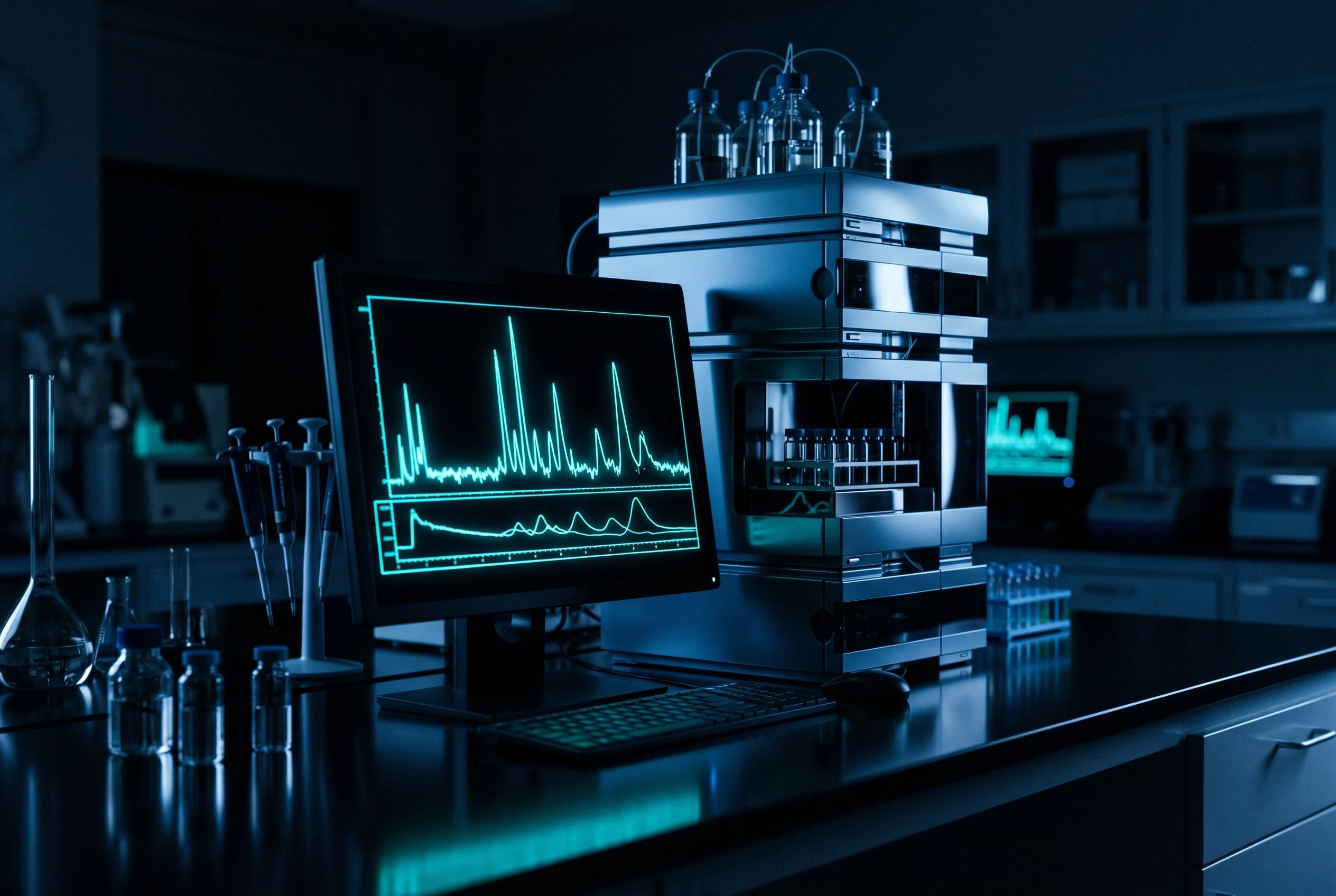
A CoA is the test record of a specific batch and bundles the results of all analyses performed onto one document. It typically names the product name, molecular formula and theoretical molecular weight, batch number, manufacturing or test date, and the methods applied. Two blocks form the core: identity confirmation by mass spectrometry and purity determination by HPLC. Often the appearance finding (white lyophilisate) and water content are also stated.
Crucially, a credible CoA shows the original data rather than merely asserting a number. This includes the displayed HPLC chromatogram with retention time and integration areas, plus the mass spectrum with the measured m/z value. A knowledgeable person can then follow the claims instead of taking them on faith. Method details should be precise, such as column type, gradient, detection wavelength, and the ionization technique used. At BergdorfBio, the batch-linked CoA serves as evidence for the >=99% HPLC and CoA assurance stated on the homepage. Products such as BPC-157 or Retatrutide ship with such a batch document.
While HPLC shows only separation behaviour, mass spectrometry answers whether the correct molecule is present. In peptide analysis, electrospray ionization (ESI) dominates, a soft ionization technique that transfers molecules into the gas phase without fragmentation. According to Banerjee & Mazumdar, 2012, ESI generates multiply charged ions, which substantially extends the measurable m/z range and allows even large peptides to be determined precisely.
On the CoA, the measured molecular weight is compared against the theoretical value calculated from the molecular formula. If both agree to within a few mass units, the peptide's identity is confirmed. A deviation of, say, 18 mass units could indicate a loss of water, a larger difference an incorrect or contaminated sequence. Coupling both methods, that is LC-MS, is especially powerful: Toll et al., 2005 showed that over 50 peptides of a tryptic digest could be separated in 15 to 20 minutes and simultaneously identified by ESI-MS. Identity and purity are thus captured in a single run.
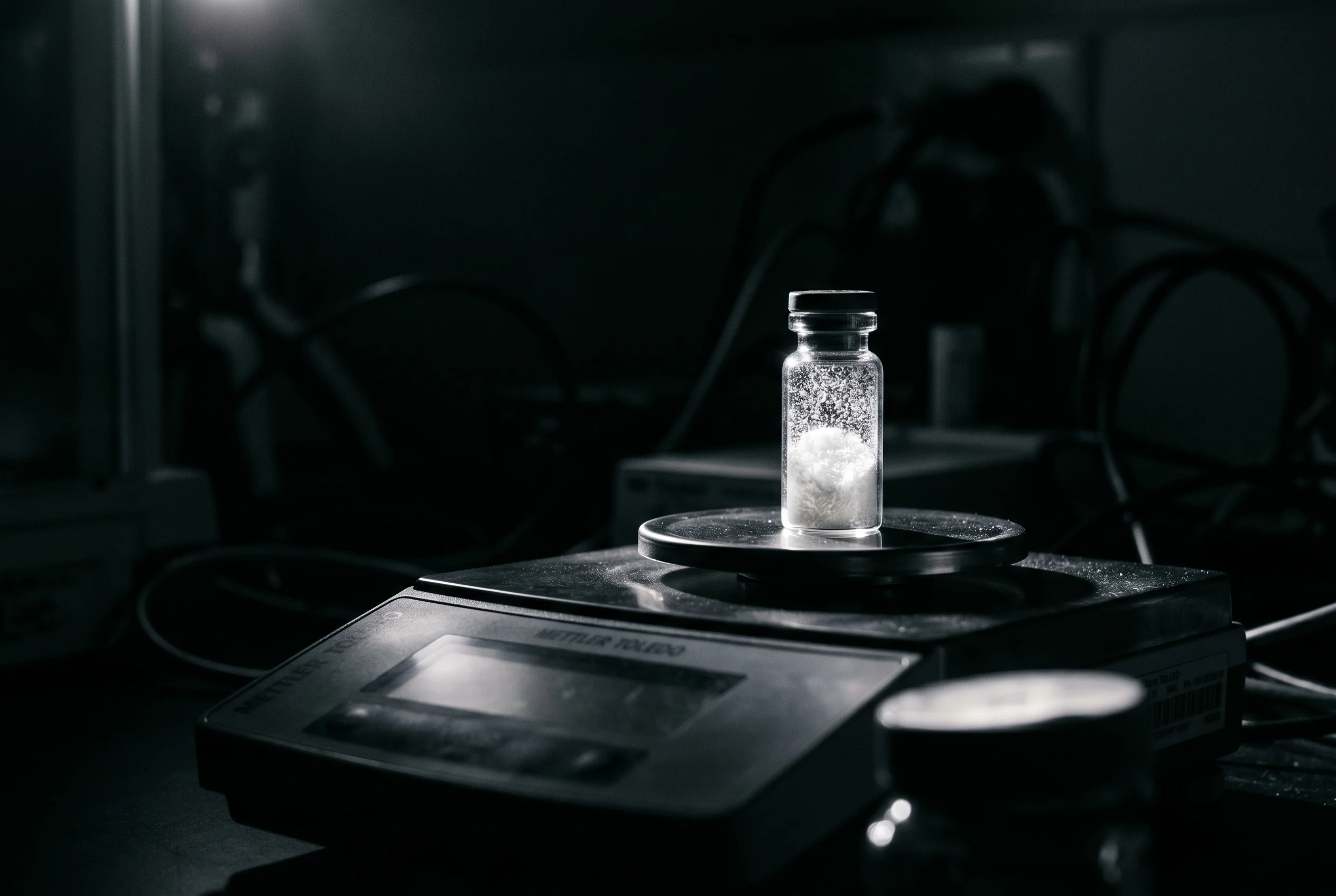
The chromatogram is the graphical heart of any CoA: the x-axis shows time in minutes, the y-axis the detector response, usually in milli-absorbance units (mAU). The target peptide appears as a tall, narrow main peak at its characteristic retention time, perhaps at 8 to 12 minutes depending on the method. A cleanly prepared sample shows a single, sharp, symmetrical peak with clear baseline separation from any side peaks.
When reading, watch three things. First, peak shape: a heavily skewed peak (tailing) or a broadened base can indicate co-eluting impurities or column problems. Second, small side peaks: these represent synthesis by-products; the sum of their areas accounts for the percentage missing from the 100% mark. Third, the baseline: it should run flat and quiet, without drift. Integration, the calculated area determination under each peak, finally yields the percentages. A TFA-containing mobile phase improves peak sharpness here, as TFA acts as an ion-pairing reagent that masks the peptide's basic side chains, producing more uniform elution behaviour (Mant et al., 2007).
A single percentage without context is of little value because it is method-dependent. The same sample can yield slightly different values on two different columns or at two detection wavelengths, since separation and the UV absorption of side components vary. A purity of 99% measured at only one wavelength becomes convincing only when the method is fully documented and the corresponding chromatogram is attached. A bare number without a spectrum cannot be verified.
Additionally, HPLC purity does not capture UV-inactive constituents. Salts from the synthesis and purification process, such as acetate or trifluoroacetate counter-ions, plus residual water contribute mass without appearing in the chromatogram. That is why net peptide content, often determined by amino acid analysis or nitrogen determination, is a sensible supplement: it states how much pure peptide is actually present per milligram of powder. Identity (MS), relative purity (HPLC), and absolute content are three distinct questions that a good CoA answers separately.
Every synthesis run is its own chemical process with its own variation, which is why a CoA must always be tied to a specific batch. A generic data sheet meant to apply to all units of a product ever made is not a test record but a marketing claim. Only the batch number on the document links the measured values to the physical material in the vial in front of you. The retention time, mass spectrum, and purity apply exactly to that production unit.
This matters because the impurity profile can differ between batches. One batch may reach 99.2%, another 98.6% with a slightly different side-peak pattern. Only a batch-bound CoA reflects this reality. In practice, you should match the batch number on the label with the one on the CoA, check the test date, and ensure the chromatogram is actually included. If the batch reference or the original data sheet is missing, the purity claim is not traceable, regardless of how high the number is.
The small peaks next to the main peak are not random but have defined chemical causes. From solid-phase synthesis come chiefly deletion peptides, where an amino acid was skipped during assembly, and truncated sequences from premature chain termination. Alongside these appear products of incomplete deprotection, where protecting groups remain on the molecule, and racemization products with altered stereochemistry. These relatives often differ only minimally from the target peptide and accordingly elute close to the main peak.
After storage, further degradation products can be added. According to the review by Lai & Topp, 1999, deamidation, peptide bond cleavage, oxidation, the Maillard reaction, beta-elimination, and aggregation are among the most important chemical reactions in the solid state. In the chromatogram, such processes show up as new or growing side peaks. A CoA created right after synthesis therefore documents the starting condition; the actual profile in the research lab additionally depends on handling and storage.
The purity documented on the CoA applies to the moment of measurement, usually right after synthesis and purification. Research peptides are therefore almost always supplied as a lyophilisate, that is a freeze-dried powder, because removing water greatly slows the hydrolytic and oxidative degradation pathways. According to Lai & Topp, 1999, chemical stability in the solid state is governed largely by temperature, residual moisture, and physical state; even low residual moisture can accelerate aggregation.
In practical terms: the finest 99% figure is of little use if the material is then stored improperly. Keeping the sealed lyophilisate cool, dry, and protected from light preserves the profile documented on the CoA the longest. Once a peptide is reconstituted, that is brought into solution, the water-dependent degradation reactions begin to proceed faster, and the original chromatogram loses its validity. Anyone wishing to interpret purity data correctly must therefore separate the time of measurement from the time of use: the CoA describes the condition at delivery, not a permanent state across the entire period of use.
A systematic check takes only a few minutes and makes the abstract values tangible. Work through the document in this order:
If any of these points is missing, the CoA is incomplete. The absence of the original graphics is especially critical: without a chromatogram and spectrum, the purity number remains a mere assertion. A complete, batch-bound document with all raw data, by contrast, is the strongest quality signal a research peptide can carry. It allows you to follow the claims yourself rather than rely on an isolated number.
HPLC purity is a relative area figure stating what fraction of the UV-active constituents belongs to the target peptide. Peptide content, by contrast, indicates how much pure peptide is present per milligram of total powder and also accounts for UV-inactive constituents such as salts and residual water. Both values complement each other and should be considered separately.
Not automatically, because the number is method-dependent. A documented chromatogram at 98% can be more meaningful than a bare 99% figure without original data. What matters is that the purity is backed by a traceable, batch-specific chromatogram and that the measurement method is clearly stated.
HPLC separates only by physicochemical properties and shows separation behaviour, not molecular composition. Two different molecules could in theory elute similarly. Only mass spectrometry measures the molecular weight and, by comparison with the theoretical value, confirms that the target peptide is actually present.
A CoA documents the condition at the time of testing, usually right after synthesis. It remains valid as a proof of origin but does not describe the condition after long or improper storage. Look for a stated test date and bear in mind that real purity depends on storage conditions.
For research purposes only. Not intended for human consumption. Scientific editor: Dr. Sieglinde Klaus
HPLC purity states the percentage of a chromatogram's peak area attributable to the target peptide, while the Certificate of Analysis (CoA) documents this value alongside the mass-spectrometry-confirmed identity, the batch, and the test methods used. A value of >=99% means only a very small fraction of the UV detector signal area belongs to side components. This guide explains how both figures are generated and how to verify them.
High-performance liquid chromatography (HPLC) separates a dissolved peptide mixture by physicochemical properties, revealing how many components a sample contains. In peptide analysis, reversed-phase HPLC (RP-HPLC) on C18, C8, or C4 columns dominates because it separates molecules by hydrophobicity with high resolving power. According to the methods review by Mant et al., 2007, HPLC has been the most versatile technique for isolating and determining the purity of synthetic peptides for over 25 years.
In practice, a mobile phase, usually a gradient of water and acetonitrile with 0.05 to 0.1% trifluoroacetic acid (TFA), flows through the column. Each component leaves the column at a characteristic time, the retention time, and generates a peak at the UV detector (typically 214 or 220 nm, where the peptide bond absorbs). HPLC therefore does not measure a substance's identity but its separation behaviour and relative quantity. Establishing identity requires a second method: mass spectrometry.
The HPLC purity percentage describes the main peak's share of the total area of all detected peaks. At 99%, 99% of the integrated UV signal area belongs to the target peptide and only 1% to all side components combined. Importantly, this is a relative area figure, not a weight figure: residual solvents, salts, or water that barely absorb at 214 nm do not factor into this value. That is why reputable manufacturers supplement HPLC purity with additional metrics such as net peptide content.
The side components mostly originate from solid-phase synthesis. According to Boysen & Hearn, 2006, stepwise synthesis chiefly produces deletion sequences (one missing amino acid), truncated sequences, and products of incomplete deprotection or racemization. These chemically very similar impurities are hard to separate and determine the achievable purity. A jump from 95% to 99% therefore means these close relatives have been largely removed. For background on the substance class itself, see the guide What are peptides?.
A CoA is the test record of a specific batch and bundles the results of all analyses performed onto one document. It typically names the product name, molecular formula and theoretical molecular weight, batch number, manufacturing or test date, and the methods applied. Two blocks form the core: identity confirmation by mass spectrometry and purity determination by HPLC. Often the appearance finding (white lyophilisate) and water content are also stated.
Crucially, a credible CoA shows the original data rather than merely asserting a number. This includes the displayed HPLC chromatogram with retention time and integration areas, plus the mass spectrum with the measured m/z value. A knowledgeable person can then follow the claims instead of taking them on faith. Method details should be precise, such as column type, gradient, detection wavelength, and the ionization technique used. At BergdorfBio, the batch-linked CoA serves as evidence for the >=99% HPLC and CoA assurance stated on the homepage. Products such as BPC-157 or Retatrutide ship with such a batch document.
While HPLC shows only separation behaviour, mass spectrometry answers whether the correct molecule is present. In peptide analysis, electrospray ionization (ESI) dominates, a soft ionization technique that transfers molecules into the gas phase without fragmentation. According to Banerjee & Mazumdar, 2012, ESI generates multiply charged ions, which substantially extends the measurable m/z range and allows even large peptides to be determined precisely.
On the CoA, the measured molecular weight is compared against the theoretical value calculated from the molecular formula. If both agree to within a few mass units, the peptide's identity is confirmed. A deviation of, say, 18 mass units could indicate a loss of water, a larger difference an incorrect or contaminated sequence. Coupling both methods, that is LC-MS, is especially powerful: Toll et al., 2005 showed that over 50 peptides of a tryptic digest could be separated in 15 to 20 minutes and simultaneously identified by ESI-MS. Identity and purity are thus captured in a single run.
The chromatogram is the graphical heart of any CoA: the x-axis shows time in minutes, the y-axis the detector response, usually in milli-absorbance units (mAU). The target peptide appears as a tall, narrow main peak at its characteristic retention time, perhaps at 8 to 12 minutes depending on the method. A cleanly prepared sample shows a single, sharp, symmetrical peak with clear baseline separation from any side peaks.
When reading, watch three things. First, peak shape: a heavily skewed peak (tailing) or a broadened base can indicate co-eluting impurities or column problems. Second, small side peaks: these represent synthesis by-products; the sum of their areas accounts for the percentage missing from the 100% mark. Third, the baseline: it should run flat and quiet, without drift. Integration, the calculated area determination under each peak, finally yields the percentages. A TFA-containing mobile phase improves peak sharpness here, as TFA acts as an ion-pairing reagent that masks the peptide's basic side chains, producing more uniform elution behaviour (Mant et al., 2007).
A single percentage without context is of little value because it is method-dependent. The same sample can yield slightly different values on two different columns or at two detection wavelengths, since separation and the UV absorption of side components vary. A purity of 99% measured at only one wavelength becomes convincing only when the method is fully documented and the corresponding chromatogram is attached. A bare number without a spectrum cannot be verified.
Additionally, HPLC purity does not capture UV-inactive constituents. Salts from the synthesis and purification process, such as acetate or trifluoroacetate counter-ions, plus residual water contribute mass without appearing in the chromatogram. That is why net peptide content, often determined by amino acid analysis or nitrogen determination, is a sensible supplement: it states how much pure peptide is actually present per milligram of powder. Identity (MS), relative purity (HPLC), and absolute content are three distinct questions that a good CoA answers separately.
Every synthesis run is its own chemical process with its own variation, which is why a CoA must always be tied to a specific batch. A generic data sheet meant to apply to all units of a product ever made is not a test record but a marketing claim. Only the batch number on the document links the measured values to the physical material in the vial in front of you. The retention time, mass spectrum, and purity apply exactly to that production unit.
This matters because the impurity profile can differ between batches. One batch may reach 99.2%, another 98.6% with a slightly different side-peak pattern. Only a batch-bound CoA reflects this reality. In practice, you should match the batch number on the label with the one on the CoA, check the test date, and ensure the chromatogram is actually included. If the batch reference or the original data sheet is missing, the purity claim is not traceable, regardless of how high the number is.
The small peaks next to the main peak are not random but have defined chemical causes. From solid-phase synthesis come chiefly deletion peptides, where an amino acid was skipped during assembly, and truncated sequences from premature chain termination. Alongside these appear products of incomplete deprotection, where protecting groups remain on the molecule, and racemization products with altered stereochemistry. These relatives often differ only minimally from the target peptide and accordingly elute close to the main peak.
After storage, further degradation products can be added. According to the review by Lai & Topp, 1999, deamidation, peptide bond cleavage, oxidation, the Maillard reaction, beta-elimination, and aggregation are among the most important chemical reactions in the solid state. In the chromatogram, such processes show up as new or growing side peaks. A CoA created right after synthesis therefore documents the starting condition; the actual profile in the research lab additionally depends on handling and storage.
The purity documented on the CoA applies to the moment of measurement, usually right after synthesis and purification. Research peptides are therefore almost always supplied as a lyophilisate, that is a freeze-dried powder, because removing water greatly slows the hydrolytic and oxidative degradation pathways. According to Lai & Topp, 1999, chemical stability in the solid state is governed largely by temperature, residual moisture, and physical state; even low residual moisture can accelerate aggregation.
In practical terms: the finest 99% figure is of little use if the material is then stored improperly. Keeping the sealed lyophilisate cool, dry, and protected from light preserves the profile documented on the CoA the longest. Once a peptide is reconstituted, that is brought into solution, the water-dependent degradation reactions begin to proceed faster, and the original chromatogram loses its validity. Anyone wishing to interpret purity data correctly must therefore separate the time of measurement from the time of use: the CoA describes the condition at delivery, not a permanent state across the entire period of use.
A systematic check takes only a few minutes and makes the abstract values tangible. Work through the document in this order:
If any of these points is missing, the CoA is incomplete. The absence of the original graphics is especially critical: without a chromatogram and spectrum, the purity number remains a mere assertion. A complete, batch-bound document with all raw data, by contrast, is the strongest quality signal a research peptide can carry. It allows you to follow the claims yourself rather than rely on an isolated number.
HPLC purity is a relative area figure stating what fraction of the UV-active constituents belongs to the target peptide. Peptide content, by contrast, indicates how much pure peptide is present per milligram of total powder and also accounts for UV-inactive constituents such as salts and residual water. Both values complement each other and should be considered separately.
Not automatically, because the number is method-dependent. A documented chromatogram at 98% can be more meaningful than a bare 99% figure without original data. What matters is that the purity is backed by a traceable, batch-specific chromatogram and that the measurement method is clearly stated.
HPLC separates only by physicochemical properties and shows separation behaviour, not molecular composition. Two different molecules could in theory elute similarly. Only mass spectrometry measures the molecular weight and, by comparison with the theoretical value, confirms that the target peptide is actually present.
A CoA documents the condition at the time of testing, usually right after synthesis. It remains valid as a proof of origin but does not describe the condition after long or improper storage. Look for a stated test date and bear in mind that real purity depends on storage conditions.
For research purposes only. Not intended for human consumption. Scientific editor: Dr. Sieglinde Klaus
