
NAD+: A Coenzyme in Cellular Metabolism - Research Guide
Dr. Sieglinde Klaus
Scientific Editorial Team · Bergdorf Bioscience
Table of Contents
- 01What is NAD+ and why is it a coenzyme, not a peptide?
- 02What role does NAD+ play in cellular metabolism and redox reactions?
- 03How do NAD+, NMN and NR differ from one another?
- 04What dosages are used in NAD+ research?
- 05How long is the half-life of NAD+ and how does its pharmacokinetics behave?
- 06How should NAD+ be stored as a research reagent?
- 07What is known from studies about the tolerability of NAD+ and its precursors?
- 08Is there confirmed longevity evidence for NAD+ in humans?
- 09What is the legal and research status of NAD+?
- 10How does NAD+ differ from related molecules and peptides?
- 11Frequently asked questions about NAD+ research
- Is NAD+ a peptide?
- What is the difference between NAD+, NMN and NR?
- How long is the half-life of NAD+?
- Does NAD+ demonstrably extend lifespan in humans?
NAD+ (nicotinamide adenine dinucleotide) is a coenzyme, not a peptide. In every cell it mediates electron transfer in redox reactions and serves as a co-substrate for sirtuins, PARPs and CD38. This guide places NAD+ in scientific context, clearly separates it from the precursors NMN and NR, and summarizes research data on dosing, pharmacokinetics and the evidence picture, strictly for research purposes.
What is NAD+ and why is it a coenzyme, not a peptide?
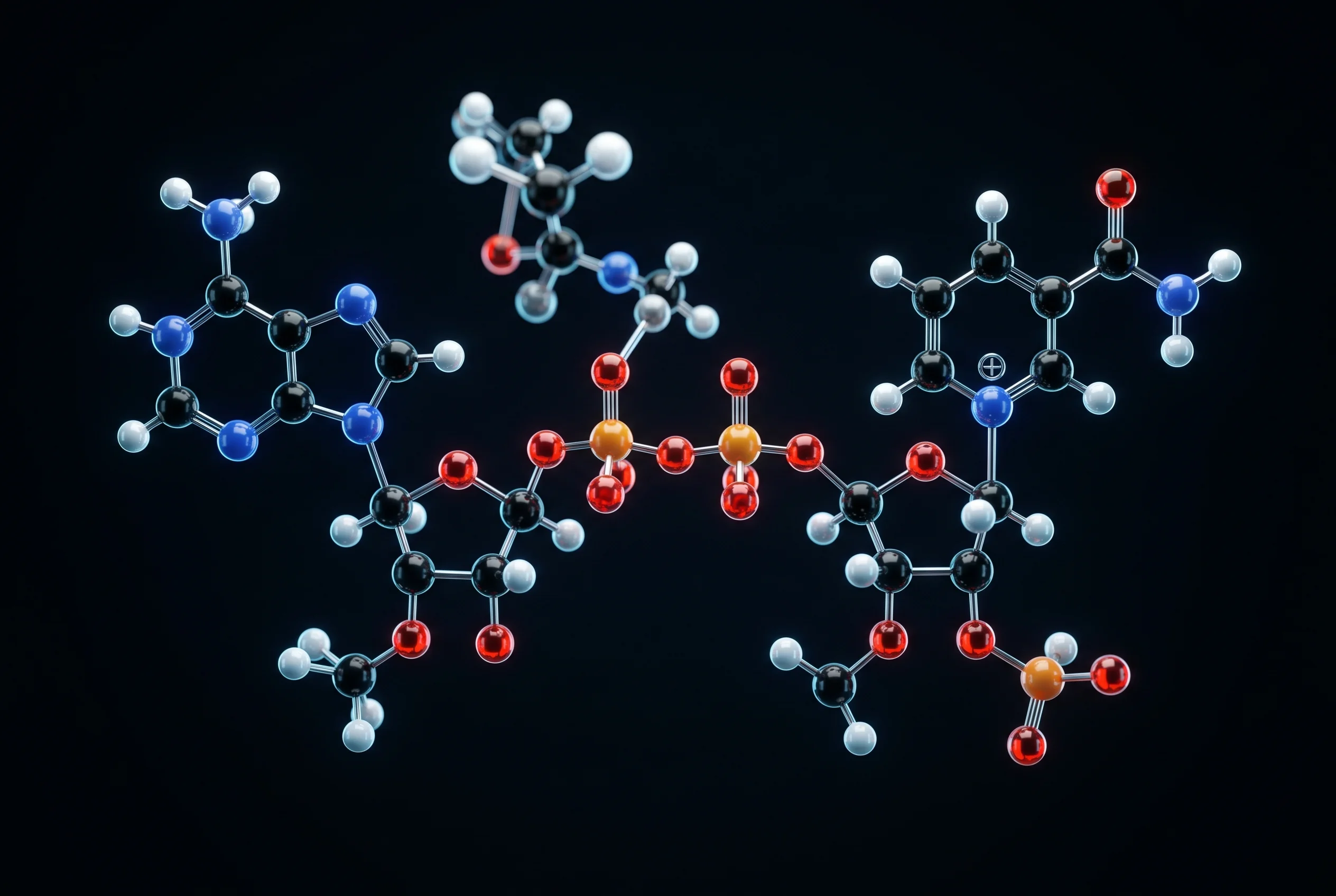
NAD+ is a dinucleotide: two nucleotides, one carrying adenine, one carrying nicotinamide, joined through their phosphate groups. It is a classic coenzyme from vitamin B3 metabolism, not an amino-acid chain. Peptides consist of amino acids linked by peptide bonds; NAD+ contains no peptide bond at all. This distinction is central in a research context because NAD+ is often listed alongside peptides even though it belongs to a completely different molecular class. For the underlying framework, the article What are peptides? provides the right context.
The molecule has a molar mass of roughly 663 Da in its free-acid form. It exists in two interconvertible states: the oxidized form NAD+ and the reduced form NADH. This pairing makes NAD+ the universal electron carrier of metabolism. According to the review by Xiao et al., 2018, the NAD+/NADH redox couple regulates both glycolysis and mitochondrial oxidative phosphorylation. NAD+ is therefore not a passive building block but a catalytically active mediator regenerated each reaction cycle. It is precisely this dual role (redox carrier and enzyme co-substrate) that makes the molecule so interesting for basic research.
What role does NAD+ play in cellular metabolism and redox reactions?
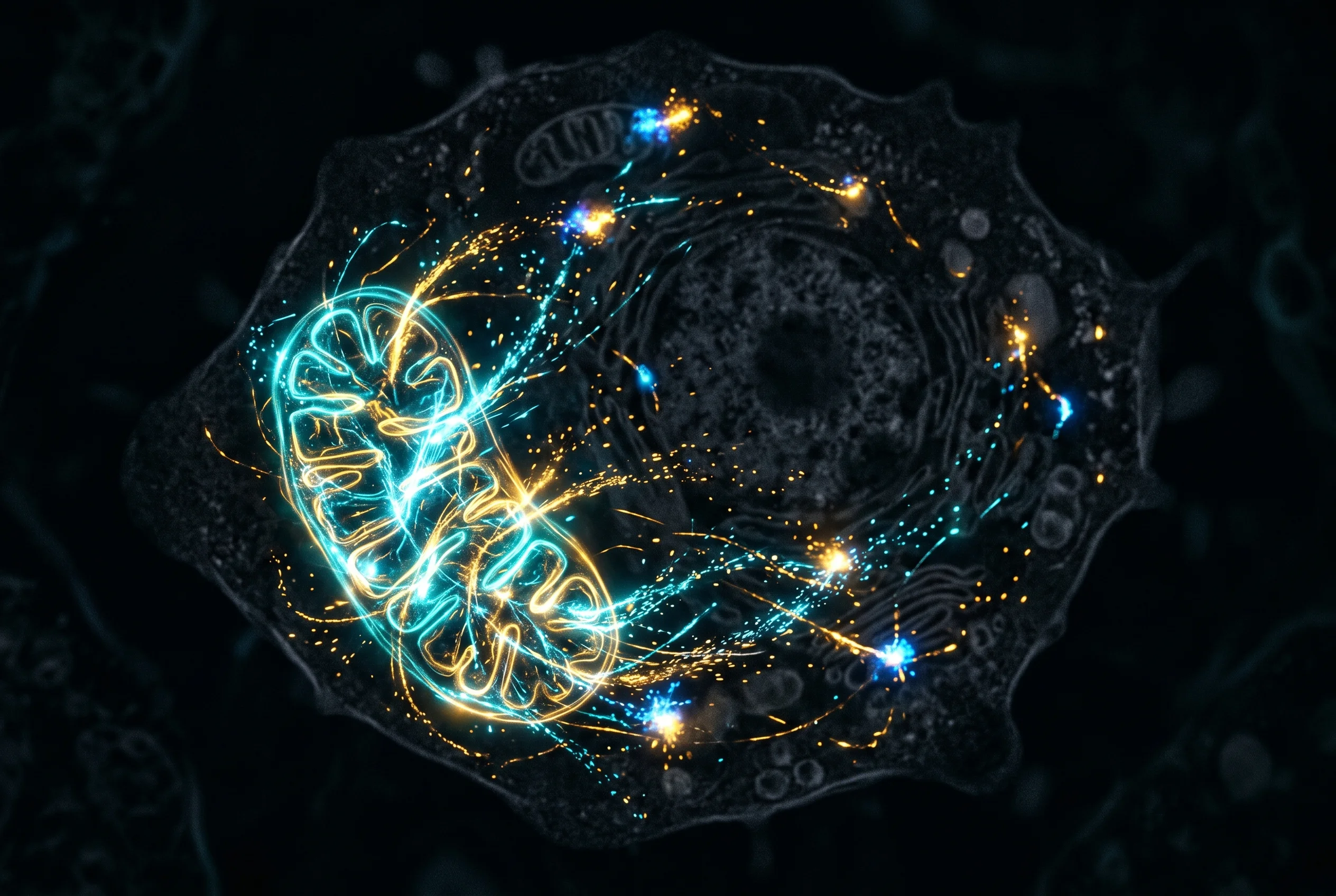
The core function of NAD+ is transferring electrons from one molecule to the next. In its oxidized form NAD+ accepts a hydride ion (two electrons plus a proton) and becomes NADH; in its reduced form NADH donates those electrons again. According to Xiao et al., 2018, under aerobic conditions eight molecules of NADH are produced per molecule of glucose, feeding electrons through complex I of the respiratory chain and driving ATP synthesis. The redox potential of the NADH/NAD+ couple in mitochondria is about minus 300 mV.
Beyond this energy function, NAD+ is a co-substrate for three enzyme classes. Verdin, 2015 describes in Science three NAD+-consuming enzyme groups: sirtuins, which deacetylate histones and other proteins while cleaving NAD+; poly(ADP-ribose) polymerases (PARPs), which transfer ADP-ribose during DNA repair; and cADP-ribose synthases such as CD38 and CD157. Unlike the redox function, here NAD+ is genuinely consumed and must be resynthesized. This continuous consumption explains why cells constantly regenerate NAD+ and why its level is regarded as a sensitive marker of cellular metabolism. Preclinical studies therefore usually focus on the intracellular NAD+ pool rather than plasma levels.
How do NAD+, NMN and NR differ from one another?
NAD+, NMN (nicotinamide mononucleotide) and NR (nicotinamide riboside) are often confused but are chemically distinct. NR is the smallest molecule: a nicotinamide with ribose, no phosphate. NMN is formed from it by adding a phosphate group, making it slightly larger. NAD+ finally is the complete dinucleotide, built from NMN by adding a second nucleotide (adenosine monophosphate). NMN and NR are therefore biosynthetic precursors of NAD+, not NAD+ itself.
The metabolic route is directional: inside the cell NR is converted in two steps via NMN to NAD+, bypassing a rate-limiting step of de novo synthesis. NMN can be taken up directly via its own transporter (Slc12a8) but in some tissues is first dephosphorylated to NR before crossing the cell membrane. In animal models both NMN and NR raise NAD+ levels; Yi et al., 2023 showed in a randomized trial that oral NMN raises blood NAD+ levels dose-dependently. For a direct comparison of the mechanisms of NAD+ and a mitochondrial peptide, the contrast MOTS-c vs NAD+ is useful. Those sourcing NAD+ as a research reagent can do so via order NAD+.
What dosages are used in NAD+ research?
In a research context two completely separate dosing worlds exist: direct NAD+ administration and administration of the precursors. In the pilot study by Grant et al., 2019, NAD+ was given as an intravenous infusion at 3 micromoles per minute over six hours. This parenteral route bypasses the first-pass effect but is slow: a measurable rise in plasma appeared only after two hours. Oral NAD+ is considered inefficient because the molecule is broken down in the digestive tract into nicotinamide and other building blocks before reaching cells.
The precursors are far better characterized. Yi et al., 2023 studied oral NMN in three arms: 300, 600 and 900 mg daily over 60 days. All doses significantly raised blood NAD+ levels versus placebo, with 600 and 900 mg reaching the highest values and barely differing from each other. For NR, Airhart et al., 2017 reported escalation up to 1000 mg twice daily, which roughly doubled blood NAD+ on average. These figures are explicitly research findings from controlled studies, not usage recommendations. Every dose stated in this guide serves solely to contextualize published protocols.
How long is the half-life of NAD+ and how does its pharmacokinetics behave?
The half-life of NAD+ is not a single value but depends heavily on the compartment and the measurement method. The classic work by Rechsteiner et al., 1976 determined the lifetime of an intact NAD+ molecule in cultured human cells (D98/AH2) as 60 plus minus 18 minutes, roughly 1.5 hours. This value reflects the rapid intracellular turnover: NAD+ is constantly consumed by sirtuins, PARPs and CD38 and resynthesized in parallel. Newer flux measurements with stable isotopes yield longer half-lives of several hours depending on cell type, which underscores the method dependence.
In plasma NAD+ behaves differently. In the infusion study by Grant et al., 2019, the plasma level remained unchanged for two hours and only rose afterward, peaking at plus 398 percent after six hours; in parallel nicotinamide, ADP-ribose and methyl-nicotinamide rose by about 390 to 410 percent. This points to extensive metabolism before NAD+ even becomes visible in plasma. The precursor NR has, according to Airhart et al., 2017, an elimination half-life of about 2.7 hours (elimination constant 0.26 per hour). These short half-lives explain why research protocols often dose several times daily.
How should NAD+ be stored as a research reagent?
NAD+ is hygroscopic and oxidation-sensitive, so storage decisively determines preservation of the compound. As a lyophilized powder the substance is typically kept cool, dry and protected from light; storage at minus 20 degrees Celsius in a tightly sealed container with desiccant is common in laboratory practice. At minus 20 degrees the powder remains stable for months to years, provided repeated thawing and moisture ingress are avoided. Room temperature and light exposure, by contrast, accelerate degradation.
In dissolved form NAD+ is considerably more labile. Aqueous solutions are particularly unstable at neutral to alkaline pH, because the molecule hydrolyzes and oxidizes. Aliquoting avoids repeated freeze-thaw cycles, each of which destroys part of the substance. Reconstituted solutions are usually held only briefly at 4 degrees Celsius in research practice and frozen for longer storage. Because NAD+ decomposes into nicotinamide and ADP-ribose under light and in the presence of oxygen, amber or darkened containers and displacing atmospheric oxygen are sensible precautions. The conditions mentioned are general laboratory practice and do not replace the respective manufacturer certificate (CoA), which documents purity and recommended storage.
What is known from studies about the tolerability of NAD+ and its precursors?
Tolerability data come mostly from studies on the precursors, not on NAD+ itself. Yi et al., 2023 reported for oral NMN up to 900 mg daily over 60 days no treatment-related adverse events and no dropouts; clinical laboratory parameters stayed within normal ranges across all groups. Airhart et al., 2017 likewise observed NR up to 2000 mg daily to be generally well tolerated in a small cohort of healthy subjects. These findings concern short periods and small samples.
For directly infused NAD+ the data are thin. The infusion study by Grant et al., 2019 was a pure pharmacokinetic pilot study with very few participants and was not designed for safety endpoints. From infusion-protocol practice, autonomic reactions are described with too-rapid administration, but robust controlled safety data on intravenous NAD+ are largely lacking. Overall: the available tolerability signals refer to preclinical and early clinical research, allow no statement on long-term use and constitute no safety assurance. In a research setting the usual protective measures for handling pure substances must be observed.
Is there confirmed longevity evidence for NAD+ in humans?
The honest answer is: confirmed longevity evidence in humans is lacking. The link between NAD+ and aging rests mostly on cell cultures and animal models. Verdin, 2015 summarizes that cellular NAD+ concentration declines with age and that NAD+ precursors could open a therapeutic perspective in preclinical models; this is explicitly a hypothesis, not a proven benefit in humans. In mice, an improvement in healthspan markers has been described for NMN, but translatability to humans is unclear.
The discrepancy is especially clear in the critical appraisal by Damgaard & Treebak, 2023 in Science Advances: oral NR supplementation has so far shown only few clinically relevant effects in humans, and the literature tends to exaggerate the importance and robustness of reported effects. Human studies reliably demonstrate that NMN and NR raise blood NAD+ levels; a rise in this biomarker, however, is not equivalent to an anti-aging benefit. Large long-term studies on functional endpoints have only recently begun. The SERP-typical portrayal as a finished longevity solution is not scientifically supported; the only serious framing is as an active, unresolved research field around cellular metabolism.
What is the legal and research status of NAD+?
NAD+ and its precursors sit in an inconsistent regulatory landscape. In the European Union NMN and NR are not automatically approved as foods or food supplements; their status depends on novel-food assessments and national interpretations and is the subject of ongoing review. NAD+ itself is traded mostly as a research chemical. No medicinal-product approval as a therapeutic exists in the relevant markets here.
For this reason NAD+ at BergdorfBio is offered exclusively as a pure substance for laboratory purposes, clearly labeled as for research purposes only and not intended for human consumption. In scientific work a safety data sheet and a certificate of analysis (CoA) with documented purity and identity are the basis of serious work; reproducible results require characterized batches. Those needing NAD+ as a reagent for in-vitro or preclinical investigations can obtain it via order NAD+. The legal framework may change; responsibility for compliance with the applicable local regulations lies with the using institution. This guide makes no statement on the permissibility of human use and is not legal advice.
How does NAD+ differ from related molecules and peptides?
NAD+ is often mentioned in the same breath as mitochondrial peptides but belongs to a different class of substances. While peptides such as MOTS-c consist of amino acids and act via receptor or signaling pathways, NAD+ is a coenzyme that participates directly in electron transfer and enzymatic ADP-ribosylations. Both are linked in a research context to mitochondrial function and cellular metabolism, yet the mechanism is fundamentally different: NAD+ is substrate and redox carrier, a peptide is a signaling molecule. The direct comparison MOTS-c vs NAD+ works out this dividing line.
Precision is also needed within the pyridine nucleotides. NADP+ is formed from NAD+ by an additional phosphate group and mainly serves anabolic and antioxidant pathways; according to Xiao et al., 2018 over 95 percent of the mitochondrial NADP pool exists in reduced form (NADPH), with a redox potential of about minus 400 mV. NAD+, by contrast, mainly drives catabolic, energy-yielding reactions. The precursors NMN and NR are, as shown above, not end products but intermediates on the path to NAD+. This clean delineation prevents the common conflation of coenzyme, precursor and peptide and is a prerequisite for correct interpretation of research data.
Frequently asked questions about NAD+ research
Is NAD+ a peptide?
No. NAD+ is a coenzyme from vitamin B3 metabolism, a dinucleotide with adenine and nicotinamide. It contains no peptide bond and does not belong to the peptide class. It is often listed next to peptides commercially but is chemically clearly distinct, as the article What are peptides? explains.
What is the difference between NAD+, NMN and NR?
NR is the smallest precursor (nicotinamide plus ribose), NMN additionally carries a phosphate, and NAD+ is the complete dinucleotide. NMN and NR are biosynthetic precursors converted to NAD+ inside the cell. Studies such as Yi et al., 2023 show that oral NMN raises blood NAD+ levels.
How long is the half-life of NAD+?
Intracellular turnover is rapid: Rechsteiner et al., 1976 determined a half-life of about 60 minutes in human cells, roughly 1.5 hours. Newer flux measurements yield longer values depending on cell type, so the exact value is method- and compartment-dependent.
Does NAD+ demonstrably extend lifespan in humans?
No. Confirmed longevity evidence in humans is lacking. The hypothesis comes from cell and animal models. Damgaard & Treebak, 2023 emphasize that oral NR supplementation has so far shown only few clinically relevant effects in humans.
For research purposes only. Not intended for human consumption. Scientific editor: Dr. Sieglinde Klaus
References
- Xiao W., et al. NAD(H) and NADP(H) Redox Couples and Cellular Energy Metabolism. Antioxidants & Redox Signaling. 2018.DOI
- Verdin E.. NAD <sup>+</sup> in aging, metabolism, and neurodegeneration. Science. 2015.DOI
- Rechsteiner M., Hillyard D., Olivera B.. Turnover of nicotinamide adenine dinucleotide in cultures of human cells. Journal of Cellular Physiology. 1976.DOI
- Grant R., et al. A Pilot Study Investigating Changes in the Human Plasma and Urine NAD+ Metabolome During a 6 Hour Intravenous Infusion of NAD+. Frontiers in Aging Neuroscience. 2019.DOI
- Airhart S., et al. An open-label, non-randomized study of the pharmacokinetics of the nutritional supplement nicotinamide riboside (NR) and its effects on blood NAD+ levels in healthy volunteers. PLOS ONE. 2017.