Longevity Peptide Stack: Peptides for Anti-Aging and Longevity in Research
Dr. Sieglinde Klaus
Scientific Editorial Team · Bergdorf Bioscience
Table of Contents
- 01What is a longevity peptide stack and what does it target in research?
- 02Why does NAD+ decline with age and what does that mean for the sirtuins?
- 03How is NAD+ investigated as an anti-aging approach?
- 04What do human studies say about the safety of NAD+ precursors?
- 05What role does GHK-Cu play in the aging process?
- 06What is Epithalon and how is the telomerase hypothesis investigated?
- 07How do NAD+, GHK-Cu, and Epithalon complement each other conceptually?
- 08What connection exists to mitochondrial peptides such as MOTS-c?
- 09How are these peptides handled and stored in the laboratory?
- 10What are the scientific limits of longevity research with peptides?
- 11Frequently Asked Questions
- Is a longevity peptide stack effective in humans?
- What makes NAD+ a central molecule of aging research?
- Why is Epithalon called a telomerase peptide?
- Are there safety data on NAD+ precursors?
- Are these peptides intended for human use?
A longevity peptide stack refers to the combined investigation of several signaling peptides and coenzymes that act in preclinical aging research on cellular repair, redox metabolism, and telomere biology. At its center sit NAD+ as a sirtuin substrate, the copper peptide GHK-Cu, and the tetrapeptide Epithalon. This guide summarizes the scientific evidence, strictly research-framed and without any therapeutic claims.
What is a longevity peptide stack and what does it target in research?
In the laboratory literature, the term longevity peptide stack describes no fixed formula but a research concept: the parallel study of several molecular signaling agents, each of which addresses one of the classic hallmarks of aging. Instead of a single compound, research groups investigate combinations because aging is a multifactorial process. A commonly discussed stack comprises NAD+ as the central redox coenzyme, GHK-Cu for tissue and matrix signaling, and Epithalon as a bioregulator of the telomerase axis.
The scientific rationale rests on the observation that many aging markers decline together: NAD+ levels, sirtuin activity, and circulating signaling peptides all fall with advancing age. A review of peptide gerontology frames bioregulator peptides and longevity stacks as mechanistically grounded research approaches for healthy aging Front Aging, 2026.
Important for context: to date there is no decisive human proof that such stacks extend the human lifespan. The robust data derive overwhelmingly from animal models and cell cultures. All substances discussed here are intended strictly for research purposes.
Why does NAD+ decline with age and what does that mean for the sirtuins?
NAD+ (nicotinamide adenine dinucleotide) is a central coenzyme of energy metabolism and simultaneously the obligate substrate of the sirtuins (SIRT1 through SIRT7), the PARP1 DNA-repair enzymes, and the ectoenzyme glycohydrolase CD38. Research well documents that NAD+ levels and sirtuin activity decline steadily with advancing age, a process further exacerbated by obesity and a sedentary lifestyle.
Sirtuins are NAD+-dependent deacylases. They mediate much of the cardiometabolic benefit observed in studies of caloric restriction and physical activity. The seven human sirtuins are functionally divided: SIRT1, SIRT6, and SIRT7 act predominantly in the nucleus and regulate chromatin and DNA repair, SIRT3, SIRT4, and SIRT5 are localized in the mitochondria and steer oxidative metabolism, while SIRT2 operates mainly in the cytoplasm. When NAD+ falls, the catalytic capacity of these sirtuins inevitably drops because they lack the shared cofactor. NAD+ research targets precisely this coupling.
The foundational work of Lin and Guarente established NAD+ as a metabolic regulator of transcription, longevity, and disease and demonstrated control of the Sir2p/sirtuin family Lin and Guarente, 2003. Imai and Guarente later described the interplay precisely: NAD+ and sirtuins jointly control aging and longevity, and the age-related NAD+ decline reduces sirtuin activity as a core mechanism Imai and Guarente, 2016. This axis is the most studied molecular basis in the longevity peptide stack.
How is NAD+ investigated as an anti-aging approach?
The rationale for NAD+ as an anti aging peptide-adjacent research approach is simple to state: if NAD+ falls with age and sirtuins lose activity without this cofactor, then research examines whether restoring the NAD+ pool measurably reactivates the dependent enzyme systems. Yoshino, Baur, and Imai summarized NAD+ biosynthesis, its age-related decline, and the scientific rationale for supplementation with NAD+ intermediates Yoshino et al., 2018.
In practice, laboratories work predominantly with the NAD+ precursors NMN (nicotinamide mononucleotide) and NR (nicotinamide riboside), as these are the established, best-characterized precursors. NAD+ itself is supplied in research as a high-purity lyophilized powder and serves as a direct reference point for redox and sirtuin assays.
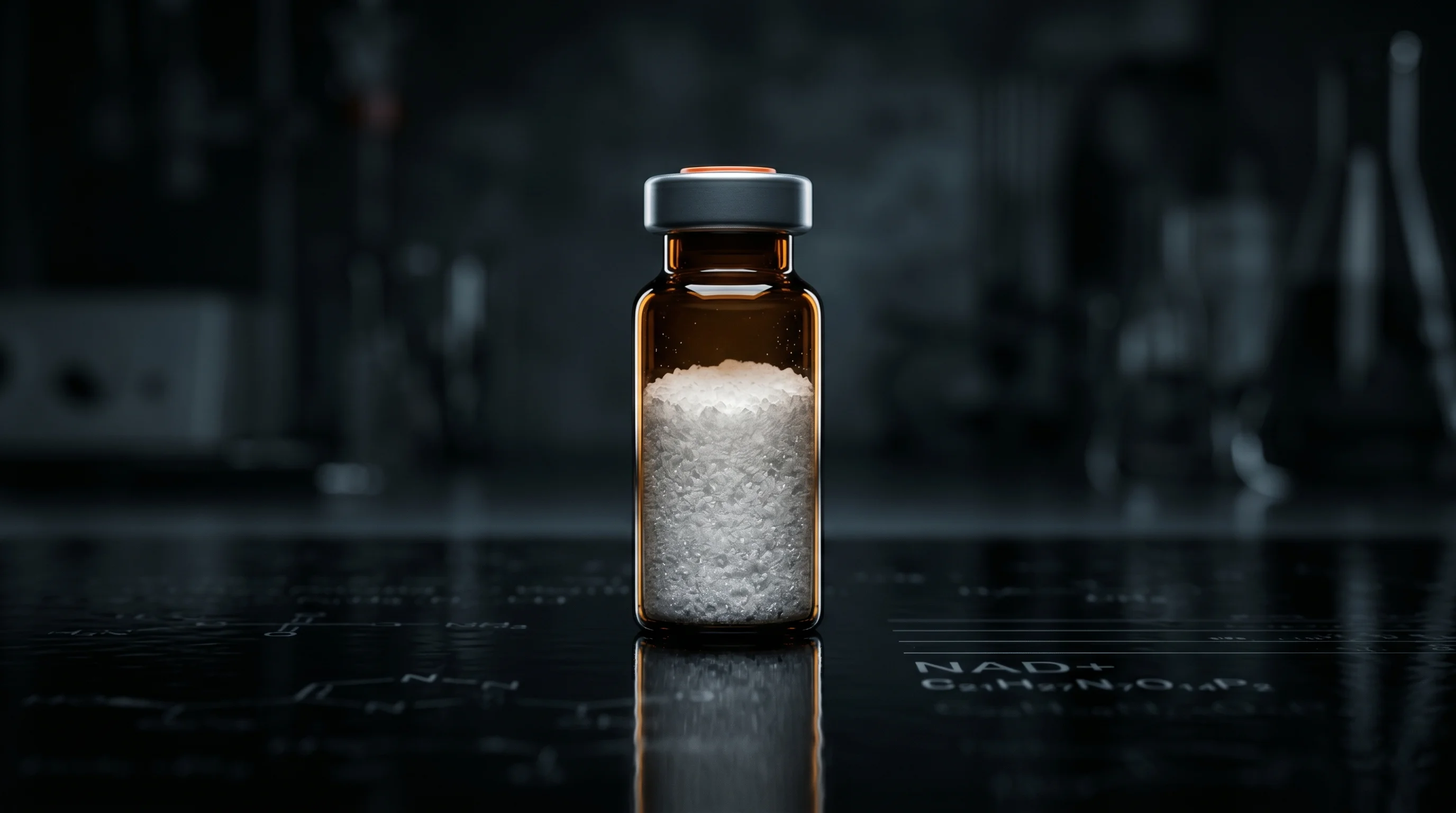
The product featured here, NAD+ 1000mg, is offered as a high-purity lyophilized powder (at least 99 percent HPLC) in 1000 mg vials and is assigned to the Anti-Aging category. It positions itself as a central redox coenzyme and primary substrate for sirtuins, PARP1, and CD38. For laboratory groups characterizing NAD+-dependent signaling pathways, it is available as a research compound: Order NAD+ 1000mg now. A deeper mechanistic account is offered by the NAD+ guide.
What do human studies say about the safety of NAD+ precursors?
For assessing safety, the NMN evidence is the most informative, as NMN is the NAD+ precursor most frequently tested in human studies. A recent review summarizes the clinical trials to date: they typically involved 8 to 108 participants, were predominantly phase I trials, and confirmed safety up to roughly 500 mg per day without serious adverse events Nadeeshani et al..
More precise is a randomized, multicenter, double-blind, placebo-controlled trial: Yi and colleagues tested beta-NMN in dose-dependent arms of 300, 600, and 900 mg per day over 60 days in healthy middle-aged adults and reported no serious adverse events Yi et al., 2023.
The scientific limits must be stated clearly: for repeated daily oral doses of 1000 mg or more, no robust data exist. Moreover, there is a theoretical concern that unnecessarily elevating NAD+ levels could have adverse physiological effects. A safe dose and frequency is not conclusively established scientifically. These studies concern NAD+ precursors, not the direct NAD+ molecule; transferability is an open research question. For these reasons this guide deliberately names no human application dose.
What role does GHK-Cu play in the aging process?
GHK (glycyl-L-histidyl-L-lysine) is an endogenous tripeptide that is particularly well characterized in research as an anti aging peptide. Its serum concentration falls markedly with age: from about 200 ng/ml at age 20 to around 80 ng/ml at age 60. This age-dependent decline of more than half is a central reason why GHK is studied in longevity stacks.
In its copper-complexed form GHK-Cu, the peptide modulates thousands of genes in large-scale gene-expression analyses that are involved in tissue repair, in the formation of collagen and elastin (particularly type I collagen), and in the control of inflammatory processes. Pickart and Margolina summarized the potential of GHK as an anti-aging peptide and documented the described serum decline as well as the stimulation of collagen and elastin Pickart and Margolina, 2022.
A further review contextualized the regenerative and protective actions of GHK-Cu in the light of new gene-expression data and described the modulation of thousands of genes involved in repair and inflammatory processes Pickart et al., 2018. All of these findings derive from cellular and gene-expression models; a deeper account is offered by the GHK-Cu guide.
What is Epithalon and how is the telomerase hypothesis investigated?
Epithalon (also Epitalon, sequence Ala-Glu-Asp-Gly) is a synthetic tetrapeptide developed at the St. Petersburg Institute of Bioregulation and Gerontology within the Khavinson program, which produced more than 100 publications. In longevity research it is the most prominent representative of the bioregulator peptides and the central candidate whenever a telomerase peptide is discussed.
The mechanistic core is telomere biology. In cell culture, Epitalon was reported to increase telomere length in human somatic cell lines via upregulation of telomerase or alternative ALT activity PMC12411320. Telomeres are the protective end caps of the chromosomes that shorten with each cell division; telomerase can extend them.
In rodent models, longevity studies suggest an extension of median and maximum lifespan by roughly 12 to 24 percent, and Epithalon has been associated with a restoration of the age-related declining melatonin rhythm. The essential framing: these telomere and lifespan data derive from animal models and in-vitro systems. Decisive human proof of an extension of the human lifespan is lacking. More on this in the Epithalon guide.
How do NAD+, GHK-Cu, and Epithalon complement each other conceptually?
The scientific appeal of a longevity peptide stack lies in the non-overlap of its targets. NAD+ addresses cellular redox and energy metabolism as well as sirtuin-mediated signaling. GHK-Cu acts at the level of the extracellular matrix and gene expression for repair and inflammation control. Epithalon targets the telomere axis and neuroendocrine rhythmicity. Three different hallmarks of aging, three different molecular classes.
This conceptual complementarity is why peptide gerontology discusses stacks at all: a single molecule can by definition influence only part of a multifactorial process. The review of therapeutic peptide gerontology frames precisely these bioregulator peptides and longevity stacks as mechanistically grounded research approaches Front Aging, 2026.
Methodological honesty remains essential: combined study is a research design, not a proven principle of action in humans. To date there are no controlled human studies demonstrating an additive or synergistic longevity effect of this combination. The individual findings derive from separate preclinical contexts. Those wishing to compare NAD+ and MOTS-c will find a structured juxtaposition in the MOTS-c vs. NAD+ comparison.
What connection exists to mitochondrial peptides such as MOTS-c?
Alongside the three core candidates, research increasingly brings mitochondrial peptides into the focus of the longevity peptide stack. MOTS-c is a mitochondrially encoded peptide that influences metabolic homeostasis pathways and is discussed in the preclinical literature as a link between mitochondrial function and systemic metabolism. It complements the NAD+ axis in that both act on cellular energy balance, yet via different molecular routes.
The conceptual proximity is evident: NAD+ is the cofactor of the mitochondrial and nuclear sirtuin system, while MOTS-c as a mitochondrial signaling agent modulates metabolic adaptation to stress. Research therefore often considers both in the same context of mitochondrial aging biology.
A further mitochondrially targeted molecule is SS-31 (elamipretide), a peptide that binds to cardiolipin of the inner mitochondrial membrane and is studied in research in connection with the stabilization of oxidative phosphorylation. It extends the mitochondrial segment of the stack with a membrane-stabilizing approach. Details are found in the MOTS-c guide and the SS-31 guide. Here too: the findings are preclinical, and statements about the human lifespan are not substantiated.
How are these peptides handled and stored in the laboratory?
Longevity peptides are supplied in research overwhelmingly as lyophilized (freeze-dried) powder, because this state offers the greatest chemical stability. The NAD+ 1000mg featured here reaches a purity of at least 99 percent by HPLC, a value relevant for reproducible assay results in redox and sirtuin research.
For handling, the general conventions of peptide chemistry apply. Unopened lyophilized powder is typically stored cool and protected from light, often at minus 20 degrees Celsius for long-term storage. After reconstitution with a suitable solvent, in research usually bacteriostatic water, stability decreases, which is why reconstituted solutions are stored refrigerated (2 to 8 degrees Celsius) and only for limited periods.
These parameters are purely technical statements on substance stability and not an application instruction. Copper peptides such as GHK-Cu require additional care regarding light exposure, as the copper complex can be photosensitive. Tetrapeptides such as Epithalon are, as small molecules, comparatively robust but follow the same principles of cool and dry storage. All substances remain intended strictly for research purposes and are not intended for human consumption.
What are the scientific limits of longevity research with peptides?
The honest summary of peptide longevity research reads: the mechanistic evidence is rich, the human evidence for lifespan extension is not. For NAD+ and its precursors, solid phase I safety data exist, but no long-term studies showing a longevity endpoint in humans. For Epithalon there are impressive rodent and cell-culture data, yet the leap to the human lifespan has not been made scientifically.
Several structural limits must be named. First: telomere extension in cell lines is not equivalent to organismal longevity, and uncontrolled telomerase activation is discussed critically in oncology. Second: the NMN safety data cover at most about 900 mg per day over 60 days, not the higher continuous doses frequently circulated. Third: the theoretical concern of an unnecessarily elevated NAD+ level is not resolved.
For research this means: these peptides are valuable tools for dissecting aging mechanisms, not validated interventions for lifespan extension. Responsible handling of the evidence requires not reinterpreting preclinical findings as human promises. All substances carried by BergdorfBio are intended strictly for research purposes, without any therapeutic claim.
Frequently Asked Questions
Is a longevity peptide stack effective in humans?
To date there is no decisive human proof that a longevity peptide stack extends the human lifespan. The robust data on telomeres, sirtuins, and lifespan derive overwhelmingly from animal models and cell cultures. All substances are intended strictly for research purposes.
What makes NAD+ a central molecule of aging research?
NAD+ is the obligate substrate of the sirtuins (SIRT1 through SIRT7), the PARP1 DNA-repair enzymes, and CD38. Because NAD+ levels and sirtuin activity fall in parallel with age, restoring the NAD+ pool is a central mechanistic research approach Imai and Guarente, 2016.
Why is Epithalon called a telomerase peptide?
Epithalon (Ala-Glu-Asp-Gly) was associated in cell culture with an increase in telomere length via telomerase upregulation or ALT activity PMC12411320. These findings derive from in-vitro systems and do not demonstrate any effect on the human lifespan.
Are there safety data on NAD+ precursors?
Yes, for NMN: clinical trials with 8 to 108 participants confirmed safety up to about 500 mg per day, and an RCT tested 300, 600, and 900 mg per day over 60 days without serious adverse events Yi et al., 2023. Data on continuous doses of 1000 mg or more are lacking.
Are these peptides intended for human use?
No. All substances discussed in this guide are intended strictly for research and laboratory purposes and are not intended for human consumption. This text deliberately names no human application dose.
For research purposes only. Not intended for human consumption. Scientific editing: Dr. Sieglinde Klaus
References
- https://pmc.ncbi.nlm.nih.gov/articles/PMC13095733/
- Lin SJ, Guarente L. Nicotinamide adenine dinucleotide, a metabolic regulator of transcription, longevity and disease. Current opinion in cell biology. 2003.PMID
- https://www.ncbi.nlm.nih.gov/pmc/articles/PMC5514996/
- https://www.ncbi.nlm.nih.gov/pmc/articles/PMC5795269/
- https://pmc.ncbi.nlm.nih.gov/articles/PMC10721522/
- https://www.ncbi.nlm.nih.gov/pmc/articles/PMC9735188/
- Dou Y, et al. The potential of GHK as an anti-aging peptide. Aging pathobiology and therapeutics. 2020.