Calculate exact reconstitution volumes, insulin units, and doses per vial for any peptide.
Melanotan I, known in the scientific literature as afamelanotide, is a synthetic linear tridecapeptide and a structural analog of alpha-melanocyte-stimulating hormone (alpha-MSH). Alpha-MSH is a naturally occurring messenger from the melanocortin family that, among other functions, regulates the production of skin pigment. The native hormone is broken down very rapidly by enzymes in the body, which makes it impractical for studying its effects in any sustained way. Melanotan I was developed in the 1980s at the University of Arizona as a stabilized variant: by selectively substituting individual amino acids, researchers produced a molecule that resists enzymatic degradation far better and remains in circulation longer than the native hormone.
The defining difference from its better-known relative, Melanotan II, is receptor selectivity. Melanotan I acts predominantly and comparatively selectively at the melanocortin-1 receptor (MC1R), the receptor subtype responsible for skin pigmentation. Melanotan II, by contrast, is a pan-agonist that additionally engages receptors in the central nervous system, producing effects such as appetite suppression and sexual arousal. This selectivity gives Melanotan I the profile that characterizes it in research: a melanocortin peptide focused on melanogenesis with markedly fewer central nervous system side effects.
Melanotan I is not an approved drug and is sold strictly as a substance for research purposes. The structurally related compound afamelanotide has received regulatory approval in some jurisdictions for a rare light-intolerance condition, but the freely reconstitutable research peptide described here should be considered separately from that. Robust long-term human data on Melanotan I as a research substance is largely lacking, so all consideration of it remains within the research domain.
Melanotan I exerts its effects exclusively through activation of melanocortin receptors, a family of G-protein-coupled receptors. Unlike the non-selective Melanotan II, the activity of Melanotan I is largely concentrated on a single subtype, which makes its effect profile more focused and predictable:
Compared to Melanotan II, Melanotan I acts more slowly and more mildly, which calls for a slightly more patient research plan. Because it stimulates the melanocytes directly, it is common to begin at the lower end of the dosing range, observe the response, and only then adjust the dose gradually.
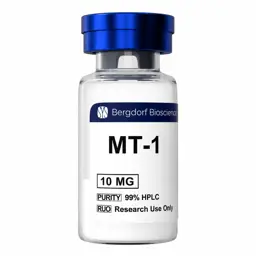
A common vial size is 10 mg. Adding 2 mL of bacteriostatic water gives a concentration of 5 mg/mL (5,000 mcg/mL).
At a standard dose of 0.25 mg, a 10 mg vial provides 40 administrations. The very small volumes at low doses are difficult to read precisely on an insulin syringe. It can therefore make sense to use more BAC water to lower the concentration and increase the readable volume. Use the Melanotan I calculator above to compute exact volumes and units for any vial size, reconstitution volume, and target dose.
Melanotan I is supplied as a lyophilized (freeze-dried) powder in sealed vials and must be reconstituted with bacteriostatic water (BAC water) before use. BAC water contains 0.9% benzyl alcohol, which inhibits microbial growth and extends the usable window of the dissolved solution. Sterile water for injection is less suitable for multi-dose vials because it contains no preservative.
If the solution appears cloudy, discolored, or contains visible particulate matter, discard the vial and do not use it.
Melanotan I is regarded in research as the more tolerable melanocortin peptide compared to Melanotan II because of its receptor selectivity. Since it engages central nervous system receptors only minimally, nausea, appetite suppression, and spontaneous erections occur less frequently and less intensely. Nevertheless, Melanotan I is not free of risk, and robust long-term human data is lacking.
Consultation with a qualified physician is strongly recommended, particularly because of the dermatological safety considerations associated with the entire Melanotan series.
In research, Melanotan I is most often compared directly with Melanotan II. Both peptides stimulate melanogenesis through MC1R, but their profiles differ markedly. Melanotan II is a pan-agonist that acts faster and more strongly but brings pronounced central nervous system side effects. Melanotan I acts more selectively, more slowly, and more mildly. A true simultaneous combination of the two substances is uncommon, since their pigmentation pathways overlap and effects become hard to attribute. The more relevant choice is a deliberate decision between potency (Melanotan II) and selectivity (Melanotan I).
PT-141 (bremelanotide) is also a melanocortin peptide, but it focuses on the central nervous system MC3R/MC4R effects around sexual arousal and produces little pigmentation. Where Melanotan I specifically targets MC1R-mediated melanogenesis, PT-141 addresses a different endpoint of the melanocortin family. A combination is unusual in research, since the two engage overlapping receptors and their circulatory effects could compound. The comparison mainly illustrates how very differently oriented analogs were developed from the same receptor family.
Because of its focused effect profile, Melanotan I is almost always considered a standalone substance in research practice. Since its mechanism is tightly limited to MC1R, combining it with other peptides mainly adds complexity without extending the pigmentation-related endpoint. For those who want to compare the peptide with its closely related but more potent counterpart, detailed information is available on the Melanotan II calculator page.
The central difference is receptor selectivity. Melanotan I acts comparatively selectively at the melanocortin-1 receptor and therefore produces mainly pigmentation, with only minor central nervous system effects. Melanotan II is a pan-agonist that additionally activates MC3R and MC4R, which makes it stronger, faster, and accompanied by more pronounced side effects such as nausea, appetite suppression, and sexual arousal. Melanotan I is regarded as more tolerable, Melanotan II as more potent.
Melanotan I stimulates melanocytes directly through MC1R and can in principle deepen pigmentation independently of UV. However, the research literature describes that moderate UV exposure can accelerate visible pigmentation because it triggers additional melanocyte activity. Excessive UV exposure is not advisable and conflicts with a careful research approach.
Melanotan I has a shorter estimated half-life of about one hour and engages essentially only MC1R. Melanotan II activates several receptors simultaneously and is regarded as a superpotent pan-agonist, which is why visible effects emerge faster. The slower kinetics of Melanotan I mean a research plan requires more patience, but it comes with less pronounced side effects.
The IU scale on an insulin syringe is a pure volume scale: 1 IU equals 0.01 mL. How much mass sits in that volume depends entirely on the concentration of the dissolved solution. At 5 mg/mL, 5 IU contain exactly 0.25 mg of peptide. The calculator translates your target dose in milligrams into the corresponding volume and the units to read off.
Nausea is markedly less frequent and weaker with Melanotan I than with Melanotan II because central nervous system melanocortin receptors are barely activated. It is most likely to appear at the start or after a dose increase and usually subsides as use continues. A low starting dose and a slow escalation are the most effective measures.
The research peptide described here is not approved as a drug and is sold strictly as a substance for research purposes. The structurally related compound afamelanotide has received regulatory approval in some countries for a narrowly defined medical indication, but that should be considered separately from a freely reconstitutable research peptide.
Because Melanotan I directly increases melanin production, existing moles, freckles, and pigment spots can appear darker, and new pigment spots may become visible. This is the most frequently cited safety-relevant observation. Regular dermatological monitoring is considered important in a research context.
In research practice, a loading phase with low, often daily doses is used first, until a target pigmentation level is reached. A maintenance phase with less frequent administration follows, typically every other day. Because of the slower kinetics, the loading phase can take several weeks. Exact volumes are most accurately determined with the calculator above.
Medical Disclaimer: The information on this page is provided for educational and research purposes only. Melanotan I is not an approved drug or medical treatment and is sold strictly for research use. Nothing on this page constitutes medical advice, diagnosis, or a recommendation to use any specific compound. Always consult a qualified healthcare professional before beginning any peptide protocol. BergdorfBio assumes no liability for the use or misuse of the information presented here.