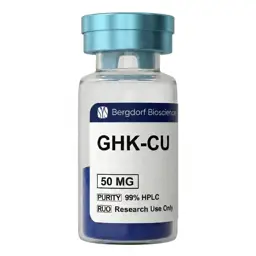
The single copper peptide GHK-Cu for collagen and ECM remodeling in a direct comparison with the GHK-Cu-led 3-in-1 blend Glow Stack (GHK-Cu 50 mg + TB-500 10 mg + BPC-157 10 mg). A research-oriented juxtaposition of mechanisms of action, the evidence base, and the safety profile.
 Medically reviewed by Dr. Sieglinde Klaus · Last reviewed June 2026
GHK-Cu is a single, best-characterized copper tripeptide backed by decades of research into collagen synthesis, dermal remodeling, and wound healing 13. Glow Stack combines GHK-Cu (50 mg) with the regenerative peptides TB-500 (10 mg) and BPC-157 (10 mg), thereby targeting a broader spectrum of tissue regeneration, angiogenesis, and healing modulation 57.
The single copper peptide GHK-Cu for collagen and ECM remodeling in a direct comparison with the GHK-Cu-led 3-in-1 blend Glow Stack (GHK-Cu 50 mg + TB-500 10 mg + BPC-157 10 mg). A research-oriented juxtaposition of mechanisms of action, the evidence base, and the safety profile.
Medically reviewed by Dr. Sieglinde Klaus · Last reviewed June 2026GHK-Cu is a single, best-characterized copper tripeptide backed by decades of research into collagen synthesis, dermal remodeling, and wound healing 13. Glow Stack combines GHK-Cu (50 mg) with the regenerative peptides TB-500 (10 mg) and BPC-157 (10 mg), thereby targeting a broader spectrum of tissue regeneration, angiogenesis, and healing modulation 57.
Single peptide: GHK-Cu (glycyl-L-histidyl-L-lysine copper)
3-in-1 blend: GHK-Cu 50 mg + TB-500 10 mg + BPC-157 10 mg
Collagen and ECM remodeling, dermal regeneration
Broad tissue regeneration, angiogenesis, healing modulation
1 (GHK-Cu)
3 (GHK-Cu, TB-500, BPC-157)
Intrinsic (copper tripeptide complex)
Present via the GHK-Cu fraction
Low: single variable, easy to isolate
Higher: three interacting variables
Single dose of GHK-Cu
Fixed combination of 50/10/10 mg
For research purposes only, not approved
For research purposes only, not approved
High (single variable)
Lower (multi-component interaction)
GHK-Cu is a naturally occurring copper tripeptide whose plasma levels decline with increasing age. In cell and animal models, GHK-Cu stimulates the synthesis of collagen, elastin, and glycosaminoglycans and supports the function of dermal fibroblasts 23. The copper fraction is functionally relevant: it modulates enzymes of matrix remodeling and shifts gene expression toward tissue regeneration and antioxidant protective mechanisms 3. In a collagen dressing model, GHK increased collagen production by up to ninefold 3.
Glow Stack combines three peptides with complementary mechanisms. GHK-Cu provides the ECM remodeling and collagen pathway as described above 3. TB-500 (synthetic thymosin beta-4) acts as a central G-actin-sequestering peptide, promoting cell migration, angiogenesis, and re-epithelialization 57. BPC-157, a stable gastric pentadecapeptide, is studied primarily for accelerated tendon, muscle, and connective tissue healing as well as cytoprotective effects 6. The goal of the blend is to address several regeneration pathways simultaneously.
The decisive difference is precision versus breadth: GHK-Cu isolates exactly one very well-characterized pathway and is therefore suited to clearly delineated questions about skin and collagen. Via TB-500 and BPC-157, Glow Stack additionally addresses angiogenesis and connective tissue healing, but in doing so introduces three interacting variables whose combined effect in humans has not been examined in controlled studies.
The evidence for GHK-Cu includes a genuine topical comparative study in humans with quantified collagen endpoints 1 as well as a broad mechanistic foundation 23. The evidence for Glow Stack is additively derived: it rests on separate preclinical studies of the three individual components 567; controlled studies of the fixed combination itself do not exist. GHK-Cu is therefore the better-substantiated single variable, while Glow Stack represents a broader but less directly validated approach.
GHK-Cu is among the longest-studied copper peptides and is generally described as well tolerated in topical and preclinical contexts. As a research substance, however, no comprehensive long-term safety data in humans are available.
The safety profile of the Glow Stack is derived from the three individual components; a combined safety profile of the fixed mixture is not established by controlled studies. TB-500 and BPC-157 are described as well tolerated in preclinical models.
The information summarized here serves scientific and educational purposes only. None of the peptides mentioned is approved as a medicinal product, and all efficacy and safety statements stem from preclinical models or limited investigations. No medical recommendations are made. For research purposes only. Not intended for human consumption.
GHK-Cu isolates exactly this pathway and has the most direct evidence, including a topical human study with collagen endpoints [1](#ref-1).
Via TB-500 and BPC-157, Glow Stack additionally addresses angiogenesis and connective tissue healing and thereby covers a broader regenerative spectrum [5](#ref-5)[6](#ref-6).
A single variable can be controlled more precisely than a three-component blend with possible interactions.
The Glow Stack is explicitly designed for the simultaneous modulation of several regeneration pathways and is suited to hypothesis-generating synergy questions.
GHK-Cu has the longest foundation of data; the Glow Stack builds on established components, but their combination has been studied less directly. The choice depends on the specific research question.
GHK-Cu is a single copper tripeptide focused on collagen and ECM remodeling 3. The Glow Stack is a blend that combines GHK-Cu (50 mg) with TB-500 (10 mg) and BPC-157 (10 mg) in order to address several regeneration pathways simultaneously.
For the isolated dermal area, GHK-Cu has the more direct evidence, including a topical comparative study in humans with quantified collagen endpoints 1. The evidence for the Glow Stack is additively derived from the individual components; controlled studies of the fixed combination itself do not exist 567.
The copper fraction is functionally central: it modulates enzymes of matrix remodeling and shifts gene expression toward tissue regeneration and antioxidant protective mechanisms 3. In the Glow Stack, this copper fraction is likewise present via the GHK-Cu component.
GHK-Cu has the longest and most consistent foundation of data and is considered well tolerated in topical contexts. For the Glow Stack, the safety profile is derived from the individual components; the interaction of three simultaneously administered peptides is not substantiated by controlled human studies. Both substances are intended for research purposes only.
For precise, well-controllable questions about collagen and skin, GHK-Cu is preferable. For exploratory, broadly designed investigations of several regeneration pathways, the Glow Stack may make more sense. The choice depends primarily on the study design and the hypothesis.
There is no blanket winner; the choice is context-dependent. GHK-Cu stands out through precision and the deepest, most direct evidence in the dermal area, including a topical human study with quantified collagen endpoints 13. The Glow Stack stands out through breadth: via TB-500 and BPC-157 it additionally addresses angiogenesis and connective tissue healing 56, but provides no controlled evidence for the fixed combination itself. Anyone seeking a clean single variable with the best foundation of data chooses GHK-Cu; anyone wanting to explore several regeneration pathways simultaneously chooses the Glow Stack.
GHK-Cu wins on depth of data and control of variables, the Glow Stack on the breadth of the regenerative approach. The optimal choice depends entirely on the specific research question.
Single peptide: GHK-Cu (glycyl-L-histidyl-L-lysine copper)
3-in-1 blend: GHK-Cu 50 mg + TB-500 10 mg + BPC-157 10 mg
Collagen and ECM remodeling, dermal regeneration
Broad tissue regeneration, angiogenesis, healing modulation
1 (GHK-Cu)
3 (GHK-Cu, TB-500, BPC-157)
Intrinsic (copper tripeptide complex)
Present via the GHK-Cu fraction
Low: single variable, easy to isolate
Higher: three interacting variables
Single dose of GHK-Cu
Fixed combination of 50/10/10 mg
For research purposes only, not approved
For research purposes only, not approved
High (single variable)
Lower (multi-component interaction)
GHK-Cu is a naturally occurring copper tripeptide whose plasma levels decline with increasing age. In cell and animal models, GHK-Cu stimulates the synthesis of collagen, elastin, and glycosaminoglycans and supports the function of dermal fibroblasts 23. The copper fraction is functionally relevant: it modulates enzymes of matrix remodeling and shifts gene expression toward tissue regeneration and antioxidant protective mechanisms 3. In a collagen dressing model, GHK increased collagen production by up to ninefold 3.
Glow Stack combines three peptides with complementary mechanisms. GHK-Cu provides the ECM remodeling and collagen pathway as described above 3. TB-500 (synthetic thymosin beta-4) acts as a central G-actin-sequestering peptide, promoting cell migration, angiogenesis, and re-epithelialization 57. BPC-157, a stable gastric pentadecapeptide, is studied primarily for accelerated tendon, muscle, and connective tissue healing as well as cytoprotective effects 6. The goal of the blend is to address several regeneration pathways simultaneously.
The decisive difference is precision versus breadth: GHK-Cu isolates exactly one very well-characterized pathway and is therefore suited to clearly delineated questions about skin and collagen. Via TB-500 and BPC-157, Glow Stack additionally addresses angiogenesis and connective tissue healing, but in doing so introduces three interacting variables whose combined effect in humans has not been examined in controlled studies.
The evidence for GHK-Cu includes a genuine topical comparative study in humans with quantified collagen endpoints 1 as well as a broad mechanistic foundation 23. The evidence for Glow Stack is additively derived: it rests on separate preclinical studies of the three individual components 567; controlled studies of the fixed combination itself do not exist. GHK-Cu is therefore the better-substantiated single variable, while Glow Stack represents a broader but less directly validated approach.
GHK-Cu is among the longest-studied copper peptides and is generally described as well tolerated in topical and preclinical contexts. As a research substance, however, no comprehensive long-term safety data in humans are available.
The safety profile of the Glow Stack is derived from the three individual components; a combined safety profile of the fixed mixture is not established by controlled studies. TB-500 and BPC-157 are described as well tolerated in preclinical models.
The information summarized here serves scientific and educational purposes only. None of the peptides mentioned is approved as a medicinal product, and all efficacy and safety statements stem from preclinical models or limited investigations. No medical recommendations are made. For research purposes only. Not intended for human consumption.
GHK-Cu isolates exactly this pathway and has the most direct evidence, including a topical human study with collagen endpoints [1](#ref-1).
Via TB-500 and BPC-157, Glow Stack additionally addresses angiogenesis and connective tissue healing and thereby covers a broader regenerative spectrum [5](#ref-5)[6](#ref-6).
A single variable can be controlled more precisely than a three-component blend with possible interactions.
The Glow Stack is explicitly designed for the simultaneous modulation of several regeneration pathways and is suited to hypothesis-generating synergy questions.
GHK-Cu has the longest foundation of data; the Glow Stack builds on established components, but their combination has been studied less directly. The choice depends on the specific research question.
GHK-Cu is a single copper tripeptide focused on collagen and ECM remodeling 3. The Glow Stack is a blend that combines GHK-Cu (50 mg) with TB-500 (10 mg) and BPC-157 (10 mg) in order to address several regeneration pathways simultaneously.
For the isolated dermal area, GHK-Cu has the more direct evidence, including a topical comparative study in humans with quantified collagen endpoints 1. The evidence for the Glow Stack is additively derived from the individual components; controlled studies of the fixed combination itself do not exist 567.
The copper fraction is functionally central: it modulates enzymes of matrix remodeling and shifts gene expression toward tissue regeneration and antioxidant protective mechanisms 3. In the Glow Stack, this copper fraction is likewise present via the GHK-Cu component.
GHK-Cu has the longest and most consistent foundation of data and is considered well tolerated in topical contexts. For the Glow Stack, the safety profile is derived from the individual components; the interaction of three simultaneously administered peptides is not substantiated by controlled human studies. Both substances are intended for research purposes only.
For precise, well-controllable questions about collagen and skin, GHK-Cu is preferable. For exploratory, broadly designed investigations of several regeneration pathways, the Glow Stack may make more sense. The choice depends primarily on the study design and the hypothesis.
There is no blanket winner; the choice is context-dependent. GHK-Cu stands out through precision and the deepest, most direct evidence in the dermal area, including a topical human study with quantified collagen endpoints 13. The Glow Stack stands out through breadth: via TB-500 and BPC-157 it additionally addresses angiogenesis and connective tissue healing 56, but provides no controlled evidence for the fixed combination itself. Anyone seeking a clean single variable with the best foundation of data chooses GHK-Cu; anyone wanting to explore several regeneration pathways simultaneously chooses the Glow Stack.
GHK-Cu wins on depth of data and control of variables, the Glow Stack on the breadth of the regenerative approach. The optimal choice depends entirely on the specific research question.