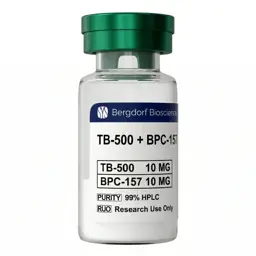
Both products share an identical TB-500 and BPC-157 repair core. The Glow Stack extends this core with GHK-Cu, a copper peptide for the skin, collagen and antioxidant axis. This comparison contrasts composition and research focus, not the superiority of individual peptides.
 Medically reviewed by Dr. Sieglinde Klaus · Last reviewed June 2026
The TB-500 + BPC-157 Blend and the Glow Stack are not alternatives for the same function; they share an identical repair core of TB-500 10mg and BPC-157 10mg. The decisive difference: the Glow Stack adds GHK-Cu 50mg, a copper tripeptide that opens up an orthogonal research axis around skin remodeling, collagen synthesis and antioxidant processes 1.
Choose the Blend if the focus is exclusively musculoskeletal, soft-tissue or gut-barrier repair, and if simple 1:1 reconstitution and a lower price are desired. Choose the Glow Stack if the dermal anti-aging axis via GHK-Cu should additionally be part of the model. Both products are intended ; all evidence is preclinical.
Both products share an identical TB-500 and BPC-157 repair core. The Glow Stack extends this core with GHK-Cu, a copper peptide for the skin, collagen and antioxidant axis. This comparison contrasts composition and research focus, not the superiority of individual peptides.
Medically reviewed by Dr. Sieglinde Klaus · Last reviewed June 2026The TB-500 + BPC-157 Blend and the Glow Stack are not alternatives for the same function; they share an identical repair core of TB-500 10mg and BPC-157 10mg. The decisive difference: the Glow Stack adds GHK-Cu 50mg, a copper tripeptide that opens up an orthogonal research axis around skin remodeling, collagen synthesis and antioxidant processes 1.
Choose the Blend if the focus is exclusively musculoskeletal, soft-tissue or gut-barrier repair, and if simple 1:1 reconstitution and a lower price are desired. Choose the Glow Stack if the dermal anti-aging axis via GHK-Cu should additionally be part of the model. Both products are intended ; all evidence is preclinical.
3 peptides: GHK-Cu 50mg + TB-500 10mg + BPC-157 10mg
2 peptides: TB-500 10mg + BPC-157 10mg (the repair core only)
3 components
2 components
Soft-tissue and gut repair PLUS skin remodeling, collagen synthesis and antioxidant anti-aging axis
Exclusively musculoskeletal, soft-tissue and gut-barrier repair
Actin-mediated cell migration/angiogenesis (TB-500) + NO-pathway tissue healing (BPC-157) + collagen/elastin synthesis and antioxidant gene modulation (GHK-Cu)
Actin-mediated cell migration/angiogenesis (TB-500) + NO-pathway tissue healing (BPC-157)
GHK-Cu approx. 2 h, TB-500 approx. 7 days, BPC-157 approx. 4 h (mixed)
TB-500 approx. 7 days, BPC-157 approx. 4 h
Three co-lyophilized peptides; the large 50mg GHK-Cu load dominates the vial and changes the volume/concentration math; the fixed 5:1:1 mass ratio limits independent titration
Two peptides, simple 1:1 mass ratio (10mg:10mg), simpler reconstitution
All three components preclinical/cosmetic-science; no human study of the combination
Both components preclinical; no human study of the combination
Inherits the repair-core considerations PLUS copper-related aspects: theoretical risk of copper accumulation with high or sustained exposure, possible local irritation
Repair-core considerations only; injection-site reactions; theoretical angiogenesis concern with occult neoplasia (shared by both)
Lyophilized powder stable refrigerated/frozen; reconstituted solution refrigerated, short usage window; identical to the Blend
Lyophilized powder stable refrigerated/frozen; reconstituted solution refrigerated, short usage window
From EUR 119.99 (1 pack); 2 pack 236.99; 3 pack 339.99 - higher price due to the additional 50mg GHK-Cu
From EUR 99.99 (1 pack); 2 pack 189.99; 3 pack 269.99 - lower price, lean repair core
When skin/collagen/anti-aging or antioxidant research is in scope alongside tissue repair
When exclusively soft-tissue/musculoskeletal/GI repair is studied and budget/simplicity matter
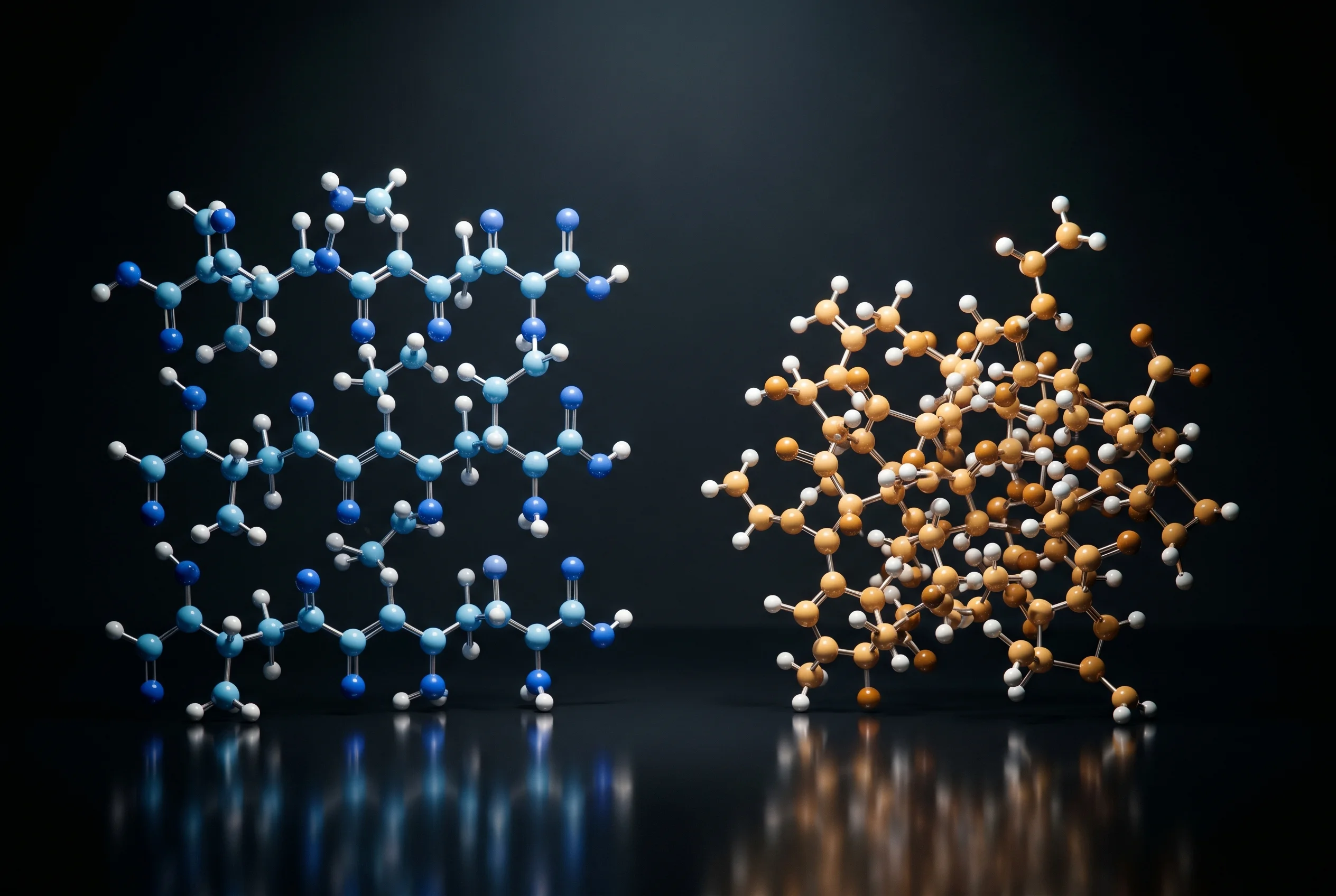
The Glow Stack combines three orthogonal regenerative mechanisms in one vial. The first two components are identical to the Blend: TB-500 (synthetic thymosin beta-4) sequesters G-actin and promotes cell migration as well as angiogenesis; BPC-157 modulates the nitric oxide signaling pathway (interacting with VEGFR2-Akt-eNOS) and stabilizes the gut-blood barrier 46. The third, added component is GHK-Cu (copper tripeptide-1), at 50mg five times the mass of each repair-core peptide. GHK-Cu is a copper-binding tripeptide that occurs naturally in human plasma and declines with age. In preclinical models it modulates gene expression around skin remodeling, stimulates collagen, elastin and glycosaminoglycan synthesis in fibroblasts, and shows antioxidant as well as anti-inflammatory activity 13. This is the orthogonal axis the Glow Stack layers on top of the repair core: skin, collagen and antioxidant research rather than purely musculoskeletal or gastrointestinal repair.
The TB-500 + BPC-157 Blend is the repair core in pure form. TB-500 acts via actin polymerization, upregulates the migration of endothelial cells and supports wound-healing and tissue-regeneration models 45. BPC-157, a pentadecapeptide derived from a gastric protein, modulates the NO system, upregulates angiogenic growth-factor signaling and, in animal models, accelerates the healing of tendons, ligaments, muscle and the gastrointestinal tract 678. The two mechanisms are complementary: TB-500 addresses cellular migration and neovascularization, BPC-157 the NO-mediated tissue regeneration and barrier stabilization. With a plain 1:1 mass ratio, the Blend stays focused on this musculoskeletal, soft-tissue and gut-barrier repair without introducing a third axis.
Because two of the three components are identical, this is not a mechanism duel but a question of scope: the Blend delivers the shared repair mechanisms, the Glow Stack adds the standalone copper-peptide mechanism of GHK-Cu (collagen, elastin, antioxidant). Anyone not studying the dermal/antioxidant axis gains nothing mechanistically from the Glow Stack.
All available evidence is preclinical: animal-experimental in vivo, in vitro on cultured cells, or ex vivo on human skin. No human study with an enrolled cohort exists, neither for BPC-157 or TB-500 nor for GHK-Cu, and certainly not for any of the combinations. The TB-500/BPC-157 studies apply equally to the shared repair core of both products; the GHK-Cu work concerns exclusively the additional axis of the Glow Stack.
The decisive point of this comparison is unusual: the two products do not compete for the same function. Their TB-500 10mg + BPC-157 10mg core is identical. Whoever buys either one receives the same repair core. The difference is confined entirely to the added GHK-Cu 50mg in the Glow Stack. The choice thus reduces to a single question: should the dermal, collagen and antioxidant research axis be part of the model? If yes, the Glow Stack is the right product. If no, the Blend delivers exactly the same repair core at a lower price, with simpler 1:1 reconstitution and without the additional copper-load risk axis.
Identical repair core; the Glow Stack differs solely through the added GHK-Cu axis.
The Glow Stack inherits all considerations of the repair core and adds a copper-related risk axis through GHK-Cu. All data are preclinical; no human safety database from controlled studies exists.
The Blend carries only the considerations of the TB-500 and BPC-157 repair core, without the additional copper-load axis. All data are preclinical; no human safety database from controlled studies exists.
All information presented here relates to preclinical research on animal models, cell cultures or ex-vivo tissues. It does not constitute therapeutic recommendations, dosing instructions or statements about use in humans. Neither the Glow Stack nor the TB-500 + BPC-157 Blend nor their constituents are approved medicinal products. For research purposes only. Not for human consumption.
The Blend delivers the full TB-500/BPC-157 repair core at a lower cost, without paying for the GHK-Cu axis, which is not studied in this model.
The additional 50mg GHK-Cu in the Glow Stack is the only distinguishing feature and directly supports the dermal and antioxidant research axis.
Both fix the peptides in a single vial. Anyone who needs independent titration may prefer single-peptide products (TB-500, BPC-157, GHK-Cu). When forced to choose between the combinations, the Blend's 1:1 ratio is simpler than the Glow Stack's 5:1:1.
The Blend avoids the copper-accumulation consideration that GHK-Cu introduces in the Glow Stack.
The Glow Stack bundles three orthogonal regenerative mechanisms in a single reconstitution and reduces the vial count for a broad screen.
Both contain the same repair core of TB-500 10mg and BPC-157 10mg. The only difference is that the Glow Stack additionally contains GHK-Cu 50mg, a copper tripeptide for the skin, collagen and antioxidant research axis 1. The Blend is the lean repair core without this third component.
Yes. TB-500 10mg and BPC-157 10mg are contained in both products in identical amounts. The two products are therefore not alternatives for the repair function; they share the same core, and the Glow Stack merely extends it with GHK-Cu.
For purely musculoskeletal, soft-tissue or gut-barrier research, the Blend delivers the full repair core at a lower price and with simpler 1:1 reconstitution. The additional GHK-Cu in the Glow Stack primarily addresses the dermal axis and contributes nothing mechanistically to pure tendon/muscle research 67.
The Glow Stack costs roughly EUR 20 more per pack than the Blend in the EU channel. This premium buys the GHK-Cu dimension: collagen synthesis, skin remodeling and antioxidant gene modulation in preclinical models 13. If this dermal anti-aging axis is part of your research model, the premium is justified; otherwise it is not.
No. There is no human study with an enrolled cohort for any of the combinations or for their individual constituents. All evidence is preclinical: animal-experimental in vivo, in vitro on cell cultures, or ex vivo on human skin. Both products are intended exclusively for research purposes.
Yes. GHK-Cu introduces an additional copper-load risk axis: a theoretical risk of copper accumulation with high or sustained exposure as well as possible local irritation from the copper chemistry. The Blend does not carry this axis. The angiogenic considerations around TB-500 and BPC-157 apply equally to both products.
There is no universal winner, because the two products share an identical repair core and differ only by a single component. The TB-500 + BPC-157 Blend is the right choice when studying exclusively musculoskeletal, soft-tissue or gut-barrier repair: full repair core, lower price, simple 1:1 reconstitution and no additional copper-load axis. The Glow Stack is the right choice when the dermal, collagen and antioxidant axis via GHK-Cu should additionally be part of the model: three orthogonal regenerative mechanisms in a single reconstitution, at the cost of a moderate premium and a more complex vial math dominated by the 50mg GHK-Cu load 1. Both remain strictly limited to research; the evidence is preclinical throughout.
Because the TB-500/BPC-157 repair core is identical in both products, the decision reduces to a single question: is the GHK-Cu axis (skin, collagen, antioxidant) within the research scope? If yes, the Glow Stack is superior, since only it contains this component. If no, the Blend is superior, because it delivers the same repair core more cheaply, more simply and without an additional copper-load risk axis. Neither is absolutely better; the context determines the choice.
3 peptides: GHK-Cu 50mg + TB-500 10mg + BPC-157 10mg
2 peptides: TB-500 10mg + BPC-157 10mg (the repair core only)
3 components
2 components
Soft-tissue and gut repair PLUS skin remodeling, collagen synthesis and antioxidant anti-aging axis
Exclusively musculoskeletal, soft-tissue and gut-barrier repair
Actin-mediated cell migration/angiogenesis (TB-500) + NO-pathway tissue healing (BPC-157) + collagen/elastin synthesis and antioxidant gene modulation (GHK-Cu)
Actin-mediated cell migration/angiogenesis (TB-500) + NO-pathway tissue healing (BPC-157)
GHK-Cu approx. 2 h, TB-500 approx. 7 days, BPC-157 approx. 4 h (mixed)
TB-500 approx. 7 days, BPC-157 approx. 4 h
Three co-lyophilized peptides; the large 50mg GHK-Cu load dominates the vial and changes the volume/concentration math; the fixed 5:1:1 mass ratio limits independent titration
Two peptides, simple 1:1 mass ratio (10mg:10mg), simpler reconstitution
All three components preclinical/cosmetic-science; no human study of the combination
Both components preclinical; no human study of the combination
Inherits the repair-core considerations PLUS copper-related aspects: theoretical risk of copper accumulation with high or sustained exposure, possible local irritation
Repair-core considerations only; injection-site reactions; theoretical angiogenesis concern with occult neoplasia (shared by both)
Lyophilized powder stable refrigerated/frozen; reconstituted solution refrigerated, short usage window; identical to the Blend
Lyophilized powder stable refrigerated/frozen; reconstituted solution refrigerated, short usage window
From EUR 119.99 (1 pack); 2 pack 236.99; 3 pack 339.99 - higher price due to the additional 50mg GHK-Cu
From EUR 99.99 (1 pack); 2 pack 189.99; 3 pack 269.99 - lower price, lean repair core
When skin/collagen/anti-aging or antioxidant research is in scope alongside tissue repair
When exclusively soft-tissue/musculoskeletal/GI repair is studied and budget/simplicity matter
The Glow Stack combines three orthogonal regenerative mechanisms in one vial. The first two components are identical to the Blend: TB-500 (synthetic thymosin beta-4) sequesters G-actin and promotes cell migration as well as angiogenesis; BPC-157 modulates the nitric oxide signaling pathway (interacting with VEGFR2-Akt-eNOS) and stabilizes the gut-blood barrier 46. The third, added component is GHK-Cu (copper tripeptide-1), at 50mg five times the mass of each repair-core peptide. GHK-Cu is a copper-binding tripeptide that occurs naturally in human plasma and declines with age. In preclinical models it modulates gene expression around skin remodeling, stimulates collagen, elastin and glycosaminoglycan synthesis in fibroblasts, and shows antioxidant as well as anti-inflammatory activity 13. This is the orthogonal axis the Glow Stack layers on top of the repair core: skin, collagen and antioxidant research rather than purely musculoskeletal or gastrointestinal repair.
The TB-500 + BPC-157 Blend is the repair core in pure form. TB-500 acts via actin polymerization, upregulates the migration of endothelial cells and supports wound-healing and tissue-regeneration models 45. BPC-157, a pentadecapeptide derived from a gastric protein, modulates the NO system, upregulates angiogenic growth-factor signaling and, in animal models, accelerates the healing of tendons, ligaments, muscle and the gastrointestinal tract 678. The two mechanisms are complementary: TB-500 addresses cellular migration and neovascularization, BPC-157 the NO-mediated tissue regeneration and barrier stabilization. With a plain 1:1 mass ratio, the Blend stays focused on this musculoskeletal, soft-tissue and gut-barrier repair without introducing a third axis.
Because two of the three components are identical, this is not a mechanism duel but a question of scope: the Blend delivers the shared repair mechanisms, the Glow Stack adds the standalone copper-peptide mechanism of GHK-Cu (collagen, elastin, antioxidant). Anyone not studying the dermal/antioxidant axis gains nothing mechanistically from the Glow Stack.
All available evidence is preclinical: animal-experimental in vivo, in vitro on cultured cells, or ex vivo on human skin. No human study with an enrolled cohort exists, neither for BPC-157 or TB-500 nor for GHK-Cu, and certainly not for any of the combinations. The TB-500/BPC-157 studies apply equally to the shared repair core of both products; the GHK-Cu work concerns exclusively the additional axis of the Glow Stack.
The decisive point of this comparison is unusual: the two products do not compete for the same function. Their TB-500 10mg + BPC-157 10mg core is identical. Whoever buys either one receives the same repair core. The difference is confined entirely to the added GHK-Cu 50mg in the Glow Stack. The choice thus reduces to a single question: should the dermal, collagen and antioxidant research axis be part of the model? If yes, the Glow Stack is the right product. If no, the Blend delivers exactly the same repair core at a lower price, with simpler 1:1 reconstitution and without the additional copper-load risk axis.
Identical repair core; the Glow Stack differs solely through the added GHK-Cu axis.
The Glow Stack inherits all considerations of the repair core and adds a copper-related risk axis through GHK-Cu. All data are preclinical; no human safety database from controlled studies exists.
The Blend carries only the considerations of the TB-500 and BPC-157 repair core, without the additional copper-load axis. All data are preclinical; no human safety database from controlled studies exists.
All information presented here relates to preclinical research on animal models, cell cultures or ex-vivo tissues. It does not constitute therapeutic recommendations, dosing instructions or statements about use in humans. Neither the Glow Stack nor the TB-500 + BPC-157 Blend nor their constituents are approved medicinal products. For research purposes only. Not for human consumption.
The Blend delivers the full TB-500/BPC-157 repair core at a lower cost, without paying for the GHK-Cu axis, which is not studied in this model.
The additional 50mg GHK-Cu in the Glow Stack is the only distinguishing feature and directly supports the dermal and antioxidant research axis.
Both fix the peptides in a single vial. Anyone who needs independent titration may prefer single-peptide products (TB-500, BPC-157, GHK-Cu). When forced to choose between the combinations, the Blend's 1:1 ratio is simpler than the Glow Stack's 5:1:1.
The Blend avoids the copper-accumulation consideration that GHK-Cu introduces in the Glow Stack.
The Glow Stack bundles three orthogonal regenerative mechanisms in a single reconstitution and reduces the vial count for a broad screen.
Both contain the same repair core of TB-500 10mg and BPC-157 10mg. The only difference is that the Glow Stack additionally contains GHK-Cu 50mg, a copper tripeptide for the skin, collagen and antioxidant research axis 1. The Blend is the lean repair core without this third component.
Yes. TB-500 10mg and BPC-157 10mg are contained in both products in identical amounts. The two products are therefore not alternatives for the repair function; they share the same core, and the Glow Stack merely extends it with GHK-Cu.
For purely musculoskeletal, soft-tissue or gut-barrier research, the Blend delivers the full repair core at a lower price and with simpler 1:1 reconstitution. The additional GHK-Cu in the Glow Stack primarily addresses the dermal axis and contributes nothing mechanistically to pure tendon/muscle research 67.
The Glow Stack costs roughly EUR 20 more per pack than the Blend in the EU channel. This premium buys the GHK-Cu dimension: collagen synthesis, skin remodeling and antioxidant gene modulation in preclinical models 13. If this dermal anti-aging axis is part of your research model, the premium is justified; otherwise it is not.
No. There is no human study with an enrolled cohort for any of the combinations or for their individual constituents. All evidence is preclinical: animal-experimental in vivo, in vitro on cell cultures, or ex vivo on human skin. Both products are intended exclusively for research purposes.
Yes. GHK-Cu introduces an additional copper-load risk axis: a theoretical risk of copper accumulation with high or sustained exposure as well as possible local irritation from the copper chemistry. The Blend does not carry this axis. The angiogenic considerations around TB-500 and BPC-157 apply equally to both products.
There is no universal winner, because the two products share an identical repair core and differ only by a single component. The TB-500 + BPC-157 Blend is the right choice when studying exclusively musculoskeletal, soft-tissue or gut-barrier repair: full repair core, lower price, simple 1:1 reconstitution and no additional copper-load axis. The Glow Stack is the right choice when the dermal, collagen and antioxidant axis via GHK-Cu should additionally be part of the model: three orthogonal regenerative mechanisms in a single reconstitution, at the cost of a moderate premium and a more complex vial math dominated by the 50mg GHK-Cu load 1. Both remain strictly limited to research; the evidence is preclinical throughout.
Because the TB-500/BPC-157 repair core is identical in both products, the decision reduces to a single question: is the GHK-Cu axis (skin, collagen, antioxidant) within the research scope? If yes, the Glow Stack is superior, since only it contains this component. If no, the Blend is superior, because it delivers the same repair core more cheaply, more simply and without an additional copper-load risk axis. Neither is absolutely better; the context determines the choice.