A structured comparison of linear Afamelanotide and cyclic MT-II within the same melanocortin receptor family, placing human findings and safety limits in context without equating the Scenesse implant or study preparations with current research vials.
 Medically reviewed by Dr. Sieglinde Klaus · Last reviewed August 2026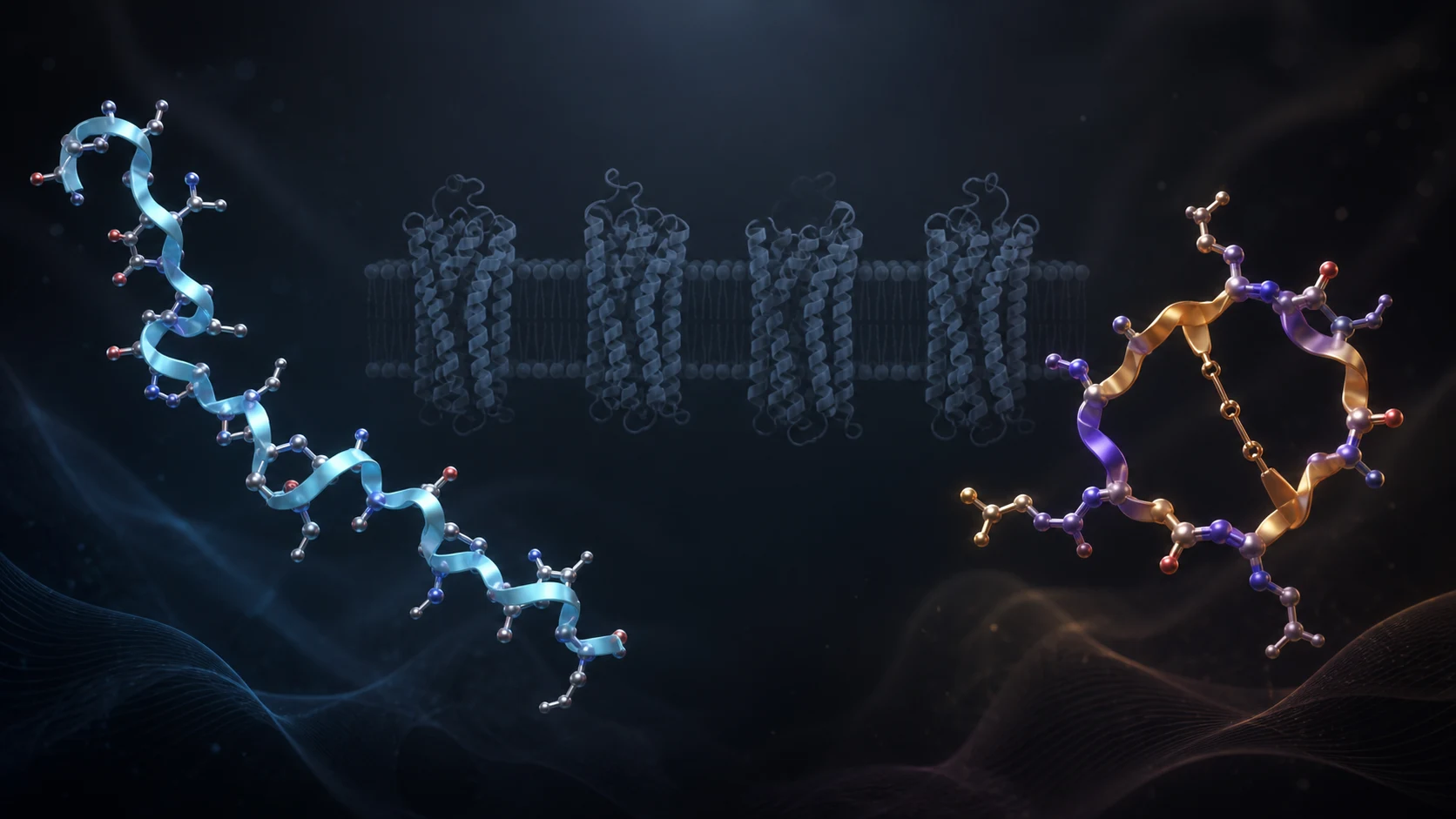
Melanotan I, also called Afamelanotide or NDP-MSH in the literature, is a linear 13-amino-acid analogue of alpha-MSH. Melanotan II is a shortened, lactam-bridged cyclic heptapeptide 14. A direct receptor paper reports that both scaffolds are recognised by the MC1R, MC3R, MC4R and MC5R family, while MC2R primarily recognises ACTH peptides 2. In a matched cAMP reporter bioassay using HEK-293 cells expressing murine mMC1R, mMC3R, mMC4R and mMC5R, MT-II was more potent at all four subtypes than NDP-MSH; the reported differences were approximately twofold at mMC1R and fourfold at mMC4R 19. This murine in-vitro finding establishes neither a ranking at human receptors nor claims about clinical effect, safety, dosing or Bergdorf Bio research vials. The Scenesse label's description of predominant MC1R binding belongs to the medicine context and is not a relative selectivity study against MT-II 7.
The human evidence is not product-equivalent. Early MT-I and MT-II studies used their own study preparations 491011. The larger Afamelanotide RCTs evaluated a controlled-release implant in EPP 6, not a lyophilised Bergdorf Bio research vial. Likewise, the small MT-II studies validate neither the composition nor the safety of today's lyophilised research product. There is no verified randomised direct human comparison trial of the two peptides.
Melanotan I is the historical research name for Afamelanotide, or [Nle4,D-Phe7]-alpha-MSH 4.
Melanotan II is a distinct cyclic alpha-MSH fragment analogue 1.
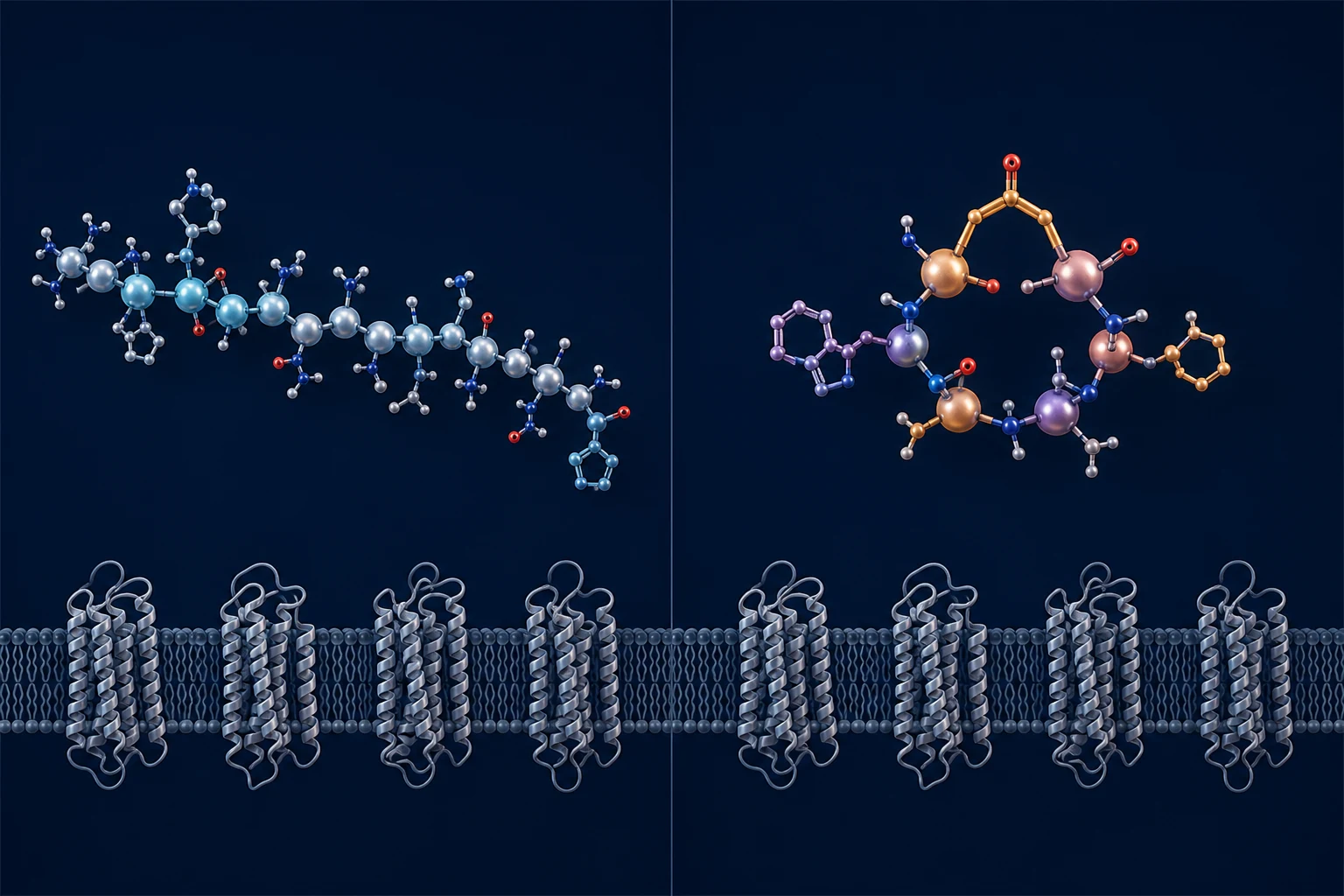
Melanotan I, or Afamelanotide, retains alpha-MSH's 13-amino-acid length and includes the characteristic Nle4 and D-Phe7 substitutions 4. A receptor paper lists NDP-MSH alongside MT-II as potent alpha-MSH agonists recognised by MC1R, MC3R, MC4R and MC5R 2. Human MC1R mutagenesis also identified receptor residues involved in binding and activation by NDP-MSH in that in-vitro model 3.
The current Scenesse label describes Afamelanotide as binding predominantly to MC1R in a medicine context 7. That wording is not a direct relative-selectivity study against MT-II. Equally, the controlled release, EPP indication and clinical monitoring of the Scenesse implant cannot be assigned to a lyophilised research vial 678.
Melanotan II shortens the alpha-MSH motif to a lactam-bridged cyclic heptapeptide 1. The same receptor paper also lists this scaffold as recognised by MC1R, MC3R, MC4R and MC5R; it does not show a difference from NDP-MSH in the number of recognised receptor types . A separate direct cAMP reporter bioassay in HEK-293 cells using murine mMC1R, mMC3R, mMC4R and mMC5R found MT-II more potent than NDP-MSH at all four subtypes; approximately twofold potency at mMC1R and fourfold potency at mMC4R were explicitly reported . This describes only that murine cell model, not human receptor pharmacology, clinical effect, safety or dosing.
The verified literature contains no randomised human study directly comparing Melanotan I and Melanotan II in the same protocol. The MT-I PK study enrolled three men 4; the Afamelanotide EPP trials used a controlled-release implant and different endpoints 6. The MT-II studies enrolled three or ten men and also captured centrally mediated effects 91011.
Differences in material, population, study duration, endpoints and monitoring prevent a robust statement about relative efficacy or safety. It would be especially inappropriate to present Scenesse authorisation and implant data as an advantage of a lyophilised Melanotan I vial, or to use early MT-II studies as evidence of the quality of a current research product.
A rigorous comparison remains mechanistic and context-specific. Direct clinical superiority is not established for either research vial.
The early MT-I study was too small, with three participants, to provide a robust safety profile and reported occasional gastrointestinal upset and facial flushing [4](#ref-4). Scenesse has RCT and postmarketing data, but these belong to a professionally administered controlled-release implant. The Scenesse label cannot be read as a safety label for a lyophilised Melanotan I research vial [6](#ref-6)[7](#ref-7).
MT-II has no approved safety label, and controlled human studies were small and brief [9](#ref-9)[10](#ref-10)[11](#ref-11)[16](#ref-16). Authorities warn about unapproved melanotan products whose quality and safety have not been assessed [15](#ref-15). One temporal single case described eruptive or darkened naevi; it proves neither causality nor frequency and is not transferred to the Bergdorf Bio research vial [14](#ref-14). A 2026 report describes another temporal single case of oral mucosal pigmentation after MT-II injections that partially regressed after discontinuation [18](#ref-18). This non-serious case likewise proves neither causality nor frequency; its injection route and material are not transferred to the Bergdorf Bio research vial or other routes.
Melanotan I fits experimental questions about the linear 13-amino-acid scaffold, the Nle4 and D-Phe7 substitutions, and defined ligand contacts in an MC1R model [3](#ref-3)[4](#ref-4). This does not establish relative selectivity versus MT-II or human use.
MT-II fits structural models of a shortened lactam-cyclic alpha-MSH core motif [1](#ref-1)[2](#ref-2). This is a topology assignment, not a claim of a different receptor count, a product recommendation or human use.
Both scaffolds are recognised by MC1R, MC3R, MC4R and MC5R [2](#ref-2). Testa et al. compared both ligands in the same cAMP reporter bioassay using HEK-293 cells and murine mMC1R, mMC3R, mMC4R and mMC5R: MT-II was more potent at all four subtypes, with approximately twofold potency at mMC1R and fourfold potency at mMC4R versus NDP-MSH [19](#ref-19). A dedicated harmonised design is needed for human receptors; the murine finding cannot be transferred to clinical effect, dosing, safety or research vials.
Afamelanotide has a larger but implant-bound EPP evidence base; MT-II has small early studies and temporal single cases involving different routes and unestablished causality [6](#ref-6)[12](#ref-12)[13](#ref-13)[17](#ref-17)[18](#ref-18). Each single case proves neither causality nor frequency and cannot transfer across route or material to Bergdorf Bio research vials. None of these evidence layers validates a current research vial.
In the cited literature, Melanotan I or MT-I refers to the peptide [Nle4,D-Phe7]-alpha-MSH, now called Afamelanotide 4. The same peptide identity does not make a lyophilised research vial equivalent to the finished Scenesse implant.
Not as "MC1R versus four receptors". A direct primary paper reports that both NDP-MSH/Afamelanotide and MT-II are recognised by MC1R, MC3R, MC4R and MC5R, while MC2R primarily recognises ACTH peptides 2. A matched murine HEK-293 cAMP comparison found MT-II more potent at all four studied subtypes, reporting approximately twofold potency at mMC1R and fourfold potency at mMC4R versus NDP-MSH 19. This is not a human receptor ranking or a claim about clinical effect, safety, dosing or Bergdorf Bio research vials. The Scenesse label's description of predominant MC1R binding is not a relative selectivity comparison 7.
Melanotan I and Melanotan II share an alpha-MSH origin and recognition by MC1R, MC3R, MC4R and MC5R 2. The defensible molecular difference is topology: linear 13-amino-acid NDP-MSH versus a shortened lactam-cyclic heptapeptide 14. A matched cAMP reporter bioassay using HEK-293 cells and murine mMC1R, mMC3R, mMC4R and mMC5R found MT-II more potent at all four subtypes; approximately twofold potency at mMC1R and fourfold potency at mMC4R versus NDP-MSH were reported 19. This model-bound in-vitro finding establishes neither a human receptor ranking nor claims about clinical effect, safety, dosing or Bergdorf Bio research vials.
The apparently greater clinical maturity on the Melanotan I side belongs chiefly to Scenesse, a controlled-release implant for EPP 68. It does not make a lyophilised Melanotan I research vial authorised or clinically validated. On the MT-II side, there are small early human studies and no authorised long-term safety base, alongside temporal single-case signals including a possible temporal association with oral mucosal melanoma 9121317. These cases prove neither causality nor frequency; their routes, materials and product identities cannot transfer to Bergdorf Bio research vials.
Melanotan I fits questions about the linear NDP-MSH scaffold, while Melanotan II suits research on a shortened lactam-cyclic scaffold. Both are assigned to the same family of four melanocortin receptors. The direct murine HEK-293 cAMP assay provides a model-bound potency direction [19](#ref-19), but no human receptor ranking or claim about clinical effect, safety, dosing or current research vials. Without a direct human comparison trial and without product equivalence, an overall winner is not scientifically justified.
A structured comparison of linear Afamelanotide and cyclic MT-II within the same melanocortin receptor family, placing human findings and safety limits in context without equating the Scenesse implant or study preparations with current research vials.
Medically reviewed by Dr. Sieglinde Klaus · Last reviewed August 2026Melanotan I, also called Afamelanotide or NDP-MSH in the literature, is a linear 13-amino-acid analogue of alpha-MSH. Melanotan II is a shortened, lactam-bridged cyclic heptapeptide 14. A direct receptor paper reports that both scaffolds are recognised by the MC1R, MC3R, MC4R and MC5R family, while MC2R primarily recognises ACTH peptides 2. In a matched cAMP reporter bioassay using HEK-293 cells expressing murine mMC1R, mMC3R, mMC4R and mMC5R, MT-II was more potent at all four subtypes than NDP-MSH; the reported differences were approximately twofold at mMC1R and fourfold at mMC4R 19. This murine in-vitro finding establishes neither a ranking at human receptors nor claims about clinical effect, safety, dosing or Bergdorf Bio research vials. The Scenesse label's description of predominant MC1R binding belongs to the medicine context and is not a relative selectivity study against MT-II 7.
The human evidence is not product-equivalent. Early MT-I and MT-II studies used their own study preparations 491011. The larger Afamelanotide RCTs evaluated a controlled-release implant in EPP 6, not a lyophilised Bergdorf Bio research vial. Likewise, the small MT-II studies validate neither the composition nor the safety of today's lyophilised research product. There is no verified randomised direct human comparison trial of the two peptides.
Melanotan I is the historical research name for Afamelanotide, or [Nle4,D-Phe7]-alpha-MSH 4.
Melanotan II is a distinct cyclic alpha-MSH fragment analogue 1.
Melanotan I, or Afamelanotide, retains alpha-MSH's 13-amino-acid length and includes the characteristic Nle4 and D-Phe7 substitutions 4. A receptor paper lists NDP-MSH alongside MT-II as potent alpha-MSH agonists recognised by MC1R, MC3R, MC4R and MC5R 2. Human MC1R mutagenesis also identified receptor residues involved in binding and activation by NDP-MSH in that in-vitro model 3.
The current Scenesse label describes Afamelanotide as binding predominantly to MC1R in a medicine context 7. That wording is not a direct relative-selectivity study against MT-II. Equally, the controlled release, EPP indication and clinical monitoring of the Scenesse implant cannot be assigned to a lyophilised research vial 678.
Melanotan II shortens the alpha-MSH motif to a lactam-bridged cyclic heptapeptide 1. The same receptor paper also lists this scaffold as recognised by MC1R, MC3R, MC4R and MC5R; it does not show a difference from NDP-MSH in the number of recognised receptor types . A separate direct cAMP reporter bioassay in HEK-293 cells using murine mMC1R, mMC3R, mMC4R and mMC5R found MT-II more potent than NDP-MSH at all four subtypes; approximately twofold potency at mMC1R and fourfold potency at mMC4R were explicitly reported . This describes only that murine cell model, not human receptor pharmacology, clinical effect, safety or dosing.
The verified literature contains no randomised human study directly comparing Melanotan I and Melanotan II in the same protocol. The MT-I PK study enrolled three men 4; the Afamelanotide EPP trials used a controlled-release implant and different endpoints 6. The MT-II studies enrolled three or ten men and also captured centrally mediated effects 91011.
Differences in material, population, study duration, endpoints and monitoring prevent a robust statement about relative efficacy or safety. It would be especially inappropriate to present Scenesse authorisation and implant data as an advantage of a lyophilised Melanotan I vial, or to use early MT-II studies as evidence of the quality of a current research product.
A rigorous comparison remains mechanistic and context-specific. Direct clinical superiority is not established for either research vial.
The early MT-I study was too small, with three participants, to provide a robust safety profile and reported occasional gastrointestinal upset and facial flushing [4](#ref-4). Scenesse has RCT and postmarketing data, but these belong to a professionally administered controlled-release implant. The Scenesse label cannot be read as a safety label for a lyophilised Melanotan I research vial [6](#ref-6)[7](#ref-7).
MT-II has no approved safety label, and controlled human studies were small and brief [9](#ref-9)[10](#ref-10)[11](#ref-11)[16](#ref-16). Authorities warn about unapproved melanotan products whose quality and safety have not been assessed [15](#ref-15). One temporal single case described eruptive or darkened naevi; it proves neither causality nor frequency and is not transferred to the Bergdorf Bio research vial [14](#ref-14). A 2026 report describes another temporal single case of oral mucosal pigmentation after MT-II injections that partially regressed after discontinuation [18](#ref-18). This non-serious case likewise proves neither causality nor frequency; its injection route and material are not transferred to the Bergdorf Bio research vial or other routes.
Melanotan I fits experimental questions about the linear 13-amino-acid scaffold, the Nle4 and D-Phe7 substitutions, and defined ligand contacts in an MC1R model [3](#ref-3)[4](#ref-4). This does not establish relative selectivity versus MT-II or human use.
MT-II fits structural models of a shortened lactam-cyclic alpha-MSH core motif [1](#ref-1)[2](#ref-2). This is a topology assignment, not a claim of a different receptor count, a product recommendation or human use.
Both scaffolds are recognised by MC1R, MC3R, MC4R and MC5R [2](#ref-2). Testa et al. compared both ligands in the same cAMP reporter bioassay using HEK-293 cells and murine mMC1R, mMC3R, mMC4R and mMC5R: MT-II was more potent at all four subtypes, with approximately twofold potency at mMC1R and fourfold potency at mMC4R versus NDP-MSH [19](#ref-19). A dedicated harmonised design is needed for human receptors; the murine finding cannot be transferred to clinical effect, dosing, safety or research vials.
Afamelanotide has a larger but implant-bound EPP evidence base; MT-II has small early studies and temporal single cases involving different routes and unestablished causality [6](#ref-6)[12](#ref-12)[13](#ref-13)[17](#ref-17)[18](#ref-18). Each single case proves neither causality nor frequency and cannot transfer across route or material to Bergdorf Bio research vials. None of these evidence layers validates a current research vial.
In the cited literature, Melanotan I or MT-I refers to the peptide [Nle4,D-Phe7]-alpha-MSH, now called Afamelanotide 4. The same peptide identity does not make a lyophilised research vial equivalent to the finished Scenesse implant.
Not as "MC1R versus four receptors". A direct primary paper reports that both NDP-MSH/Afamelanotide and MT-II are recognised by MC1R, MC3R, MC4R and MC5R, while MC2R primarily recognises ACTH peptides 2. A matched murine HEK-293 cAMP comparison found MT-II more potent at all four studied subtypes, reporting approximately twofold potency at mMC1R and fourfold potency at mMC4R versus NDP-MSH 19. This is not a human receptor ranking or a claim about clinical effect, safety, dosing or Bergdorf Bio research vials. The Scenesse label's description of predominant MC1R binding is not a relative selectivity comparison 7.
Melanotan I and Melanotan II share an alpha-MSH origin and recognition by MC1R, MC3R, MC4R and MC5R 2. The defensible molecular difference is topology: linear 13-amino-acid NDP-MSH versus a shortened lactam-cyclic heptapeptide 14. A matched cAMP reporter bioassay using HEK-293 cells and murine mMC1R, mMC3R, mMC4R and mMC5R found MT-II more potent at all four subtypes; approximately twofold potency at mMC1R and fourfold potency at mMC4R versus NDP-MSH were reported 19. This model-bound in-vitro finding establishes neither a human receptor ranking nor claims about clinical effect, safety, dosing or Bergdorf Bio research vials.
The apparently greater clinical maturity on the Melanotan I side belongs chiefly to Scenesse, a controlled-release implant for EPP 68. It does not make a lyophilised Melanotan I research vial authorised or clinically validated. On the MT-II side, there are small early human studies and no authorised long-term safety base, alongside temporal single-case signals including a possible temporal association with oral mucosal melanoma 9121317. These cases prove neither causality nor frequency; their routes, materials and product identities cannot transfer to Bergdorf Bio research vials.
Melanotan I fits questions about the linear NDP-MSH scaffold, while Melanotan II suits research on a shortened lactam-cyclic scaffold. Both are assigned to the same family of four melanocortin receptors. The direct murine HEK-293 cAMP assay provides a model-bound potency direction [19](#ref-19), but no human receptor ranking or claim about clinical effect, safety, dosing or current research vials. Without a direct human comparison trial and without product equivalence, an overall winner is not scientifically justified.
Melanotan II is a shortened scaffold conformationally constrained by its lactam ring; the original work reported residual activity in frog and lizard skin assays 1.
Melanotan II is likewise recognised by MC1R, MC3R, MC4R and MC5R; MC2R is not part of this alpha-MSH agonist profile 2.
Melanotan I: a study in three men reported a beta-phase plasma half-life of 0.8 to 1.7 hours for its subcutaneous MT-I protocol 4.
Melanotan I is considered here solely as a lyophilised Research-Use-Only vial, distinct from the Scenesse implant. Availability is not addressed in this static comparison.
Melanotan II: a lyophilised Research-Use-Only vial; the public MT-II research product is not a clinical study preparation.
Melanotan I: serious hypersensitivity reactions, including anaphylaxis, have been reported for Scenesse; this is an implant-specific regulatory context 7.
Melanotan I: no randomised direct human comparison trial with Melanotan II appears in the verified primary sources.
Melanotan II: no randomised direct human comparison trial with Melanotan I appears in the verified primary sources.
The human findings apply only to the historical study preparations and protocols. The Melanotan II guide provides scientific context; neither it nor the studies validates a current Research-Use-Only vial for human use.
The defensible difference is structural and contextual: a linear 13-amino-acid analogue versus a shortened lactam-cyclic heptapeptide, studied in a shared murine cAMP bioassay and across different preparations and evidence layers 12419. Human plasma PK for one scaffold and residual activity in animal-skin assays for the other are not directly comparable. Both scaffolds are recognised by MC1R, MC3R, MC4R and MC5R. The murine HEK-293 cAMP model directly measured the potency direction, but relative stability and human receptor-subtype potency and selectivity remain unresolved. Nor can the finding be transferred to clinical effect, safety, dosing or Bergdorf Bio research vials.
For Melanotan I, there are early human PK and pigmentation studies plus a substantially larger but implant-specific Scenesse evidence base 456. The MT-II human literature consists mainly of very small early studies with short observation windows 91011. Neither those studies nor the Scenesse data assess today's Bergdorf Bio research vials. A cross-trial ranking would therefore not be justified methodologically or at the product level.
This comparison contextualises published research and authority information. It is not medical advice, a treatment recommendation, a purchase recommendation or guidance on reconstitution, tanning or use. Bergdorf Bio lyophilised research vials are not Scenesse, the approved Afamelanotide finished medicine supplied as a controlled-release implant, and they are neither clinically nor pharmaceutically equivalent to it. Scenesse approval, efficacy, safety, dosing, quality and regulatory conclusions do not transfer to those research vials. Historical study preparations are also not interchangeable with current research vials. For research use only. Not intended for human consumption.
The FDA has identified MT-II as an unapproved new drug 16. The Bergdorf Bio product is classified as Research-Use-Only material. Such a designation is not medicine authorisation and not clearance for human use.
No. There is no randomised direct human comparison trial, and the available studies differ fundamentally in preparation, population, duration and endpoints 4691011. For further neutral context, see the comparison overview and the skin research category.
Melanotan II is a shortened scaffold conformationally constrained by its lactam ring; the original work reported residual activity in frog and lizard skin assays 1.
Melanotan II is likewise recognised by MC1R, MC3R, MC4R and MC5R; MC2R is not part of this alpha-MSH agonist profile 2.
Melanotan I: a study in three men reported a beta-phase plasma half-life of 0.8 to 1.7 hours for its subcutaneous MT-I protocol 4.
Melanotan I is considered here solely as a lyophilised Research-Use-Only vial, distinct from the Scenesse implant. Availability is not addressed in this static comparison.
Melanotan II: a lyophilised Research-Use-Only vial; the public MT-II research product is not a clinical study preparation.
Melanotan I: serious hypersensitivity reactions, including anaphylaxis, have been reported for Scenesse; this is an implant-specific regulatory context 7.
Melanotan I: no randomised direct human comparison trial with Melanotan II appears in the verified primary sources.
Melanotan II: no randomised direct human comparison trial with Melanotan I appears in the verified primary sources.
The human findings apply only to the historical study preparations and protocols. The Melanotan II guide provides scientific context; neither it nor the studies validates a current Research-Use-Only vial for human use.
The defensible difference is structural and contextual: a linear 13-amino-acid analogue versus a shortened lactam-cyclic heptapeptide, studied in a shared murine cAMP bioassay and across different preparations and evidence layers 12419. Human plasma PK for one scaffold and residual activity in animal-skin assays for the other are not directly comparable. Both scaffolds are recognised by MC1R, MC3R, MC4R and MC5R. The murine HEK-293 cAMP model directly measured the potency direction, but relative stability and human receptor-subtype potency and selectivity remain unresolved. Nor can the finding be transferred to clinical effect, safety, dosing or Bergdorf Bio research vials.
For Melanotan I, there are early human PK and pigmentation studies plus a substantially larger but implant-specific Scenesse evidence base 456. The MT-II human literature consists mainly of very small early studies with short observation windows 91011. Neither those studies nor the Scenesse data assess today's Bergdorf Bio research vials. A cross-trial ranking would therefore not be justified methodologically or at the product level.
This comparison contextualises published research and authority information. It is not medical advice, a treatment recommendation, a purchase recommendation or guidance on reconstitution, tanning or use. Bergdorf Bio lyophilised research vials are not Scenesse, the approved Afamelanotide finished medicine supplied as a controlled-release implant, and they are neither clinically nor pharmaceutically equivalent to it. Scenesse approval, efficacy, safety, dosing, quality and regulatory conclusions do not transfer to those research vials. Historical study preparations are also not interchangeable with current research vials. For research use only. Not intended for human consumption.
The FDA has identified MT-II as an unapproved new drug 16. The Bergdorf Bio product is classified as Research-Use-Only material. Such a designation is not medicine authorisation and not clearance for human use.
No. There is no randomised direct human comparison trial, and the available studies differ fundamentally in preparation, population, duration and endpoints 4691011. For further neutral context, see the comparison overview and the skin research category.