Research peptide · MT-I
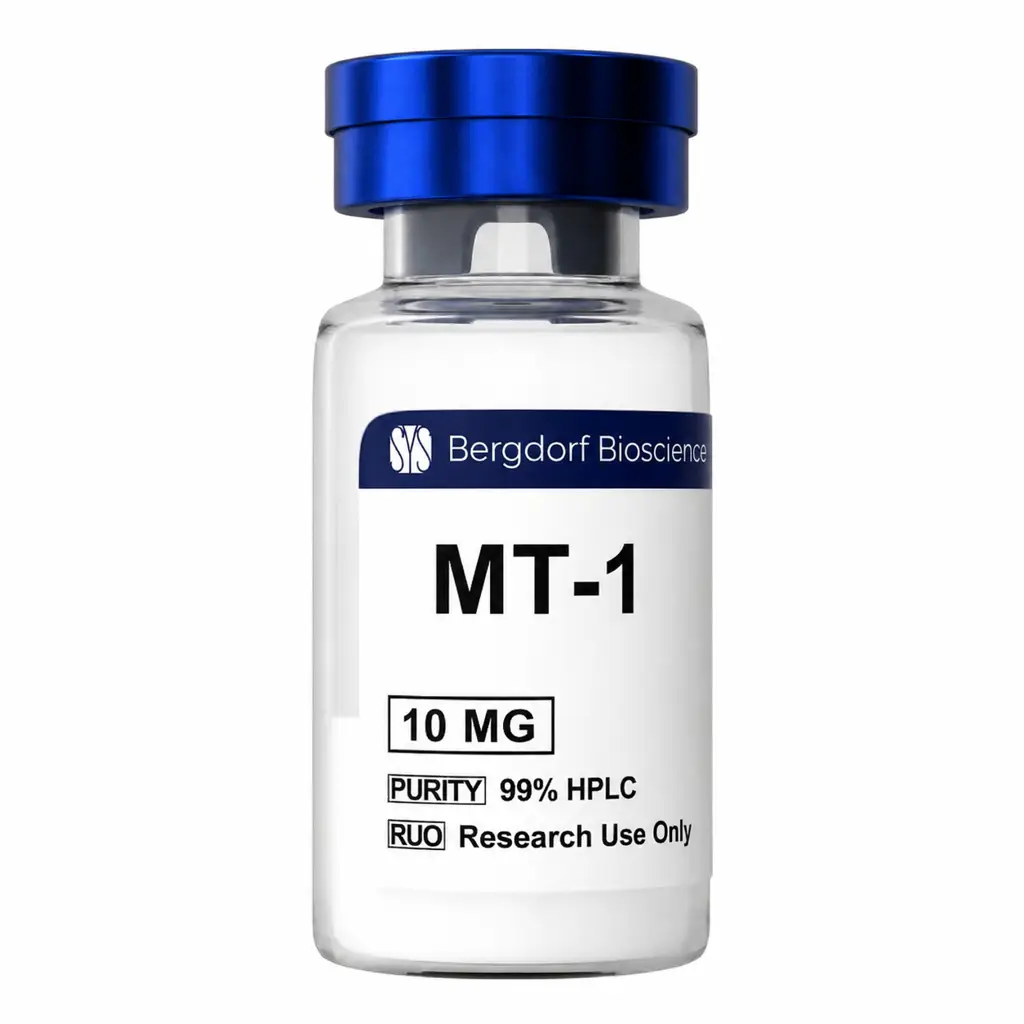
Melanotan I (MT-1) 10 mg
Melanotan I (afamelanotide) 10 mg lyophilized research vial with evidence-based MC1R context and clearly stated research-use-only positioning.

Research peptide · MT-I
Melanotan I (afamelanotide) 10 mg lyophilized research vial with evidence-based MC1R context and clearly stated research-use-only positioning.
Research peptide · MT-I
Melanotan I (afamelanotide) 10 mg lyophilized research vial with evidence-based MC1R context and clearly stated research-use-only positioning.
No reviews yet. Be the first to share your experience.
No reviews yet. Be the first to share your experience.
/ vial
Order today → Delivery Mon, Sep 28 – Tue, Oct 06 to United States
Payment Methods





/ vial
Order today → Delivery Mon, Sep 28 – Tue, Oct 06 to United States
Payment Methods
3,000+
satisfied researchers
99.43%
Avg. purity 2026
4.8 ★
ProvenExpert
99.43%
Avg. purity 2026
4.8 ★
ProvenExpert
3,000+ satisfied researchers
Steady-state plasma level after ~ 4 weeks with weekly administration.
Scientific references
Research details
Melanotan I, abbreviated MT-1 or MT-I, is the historical research name for afamelanotide. It is a synthetic tridecapeptide derived from alpha-melanocyte-stimulating hormone research, with amino-acid substitutions designed to alter melanocortin activity and peptide behavior. This product contains 10 mg of lyophilized Melanotan I in a sealed research vial for controlled laboratory work.
Afamelanotide and Melanotan I refer to the same peptide identity in the cited scientific and regulatory sources; they should not be presented as separate compounds. The vial remains a research material rather than a medicine, implant, cosmetic, tanning product, or preparation intended for administration. The 10 mg label identifies the nominal vial format and is not a recommended human dose.
The official Scenesse prescribing information describes afamelanotide as a melanocortin receptor agonist that binds predominantly to MC1R. It also reports that afamelanotide increases eumelanin production in skin independently of sunlight or artificial ultraviolet exposure in the context of that controlled-release medicine. These observations can inform receptor-level and pigmentation-pathway research questions.
They do not establish cosmetic suitability, tanning performance, clinical benefit, or a predictable result from this vial. Receptor expression, assay system, concentration, matrix, exposure duration, and analytical design can all affect experimental observations. Product content therefore states the documented mechanism without converting it into a consumer outcome or use instruction.
The FDA label identifies afamelanotide as a synthetic 13-amino-acid peptide and structural analog of alpha-MSH. It gives the sequence Ac-Ser-Tyr-Ser-Nle-Glu-His-(D)Phe-Arg-Trp-Gly-Lys-Pro-Val-NH2 and a free-base molecular weight of 1646.85 Da. The norleucine and D-phenylalanine substitutions are defining structural details for identity-focused comparison with native alpha-MSH and related melanocortin ligands.
Those published identifiers support literature matching and method planning, but they do not certify the analytical properties of an individual vial. Researchers should establish study-specific identity, suitability, controls, and acceptance criteria through methods appropriate to their work. No unverified purity percentage, analytical result, batch test, or manufacturing-grade status is asserted in this master copy.
A 1997 primary pharmacokinetic study evaluated Melanotan I by intravenous, oral, and subcutaneous routes in three male volunteers. Following subcutaneous exposure, the reported absorption-phase half-life ranged from 0.07 to 0.79 hours and the beta-phase plasma half-life ranged from 0.8 to 1.7 hours. For calculator and reference content, 1 hour is used as a representative systemic scalar while the full 0.8-to-1.7-hour beta-phase range remains visible in the evidence note.
The study was small and its findings are route-, protocol-, and formulation-specific. They are scientific context, not instructions for administration and not a basis for constructing a human schedule. The scalar also does not predict degradation or persistence in an in-vitro experiment; laboratory behavior must be measured under the conditions of the selected assay.
Scenesse is a regulated 16 mg controlled-release implant containing afamelanotide in a bioresorbable polymer matrix. The official label reports an apparent half-life of approximately 15 hours when afamelanotide is delivered through that implant. This longer value reflects controlled release from a specific finished formulation and must not be assigned to a standalone 10 mg lyophilized research vial.
The Bergdorf Bioscience vial is not Scenesse and is not presented as an alternative, generic, compounded version, or implant precursor. Scenesse has its own manufacturing controls, delivery system, professional-use labeling, indication, warnings, and safety framework. Its regulatory status does not establish approval, sterility, equivalence, interchangeability, or clinical suitability for this research product.
Use the material only in a qualified research environment with a documented protocol. Record product identity, vial label, receipt condition, storage history, and experiment-specific acceptance criteria before use. Choose controls and analytical procedures appropriate to the intended question. The cited human and implant literature supplies background on the peptide; it does not replace validation within the researcher's own system.
Keep the sealed vial under the storage conditions printed on its own label and documentation. Do not transfer preparation or storage instructions from a polymer implant to a lyophilized vial. The item is shipped with tracking in protective packaging. It is not for human or veterinary use, tanning, diagnosis, treatment, prevention, cosmetic application, or consumption.
Ugwu et al. (1997): Skin pigmentation and pharmacokinetics of Melanotan-I in humans
FDA: Scenesse (afamelanotide) implant prescribing information
For research use only. Not for human or veterinary use, tanning, diagnosis, treatment, prevention, cosmetic use, or consumption. The presence of afamelanotide in an approved implant does not make this research vial approved, interchangeable, or clinically validated.
Yes. Melanotan I, MT-1, and MT-I are historical research names for afamelanotide, the synthetic 13-amino-acid alpha-MSH analog described in the cited sources.
3,000+
satisfied researchers
99.43%
Avg. purity 2026
4.8 ★
ProvenExpert
99.43%
Avg. purity 2026
4.8 ★
ProvenExpert
3,000+ satisfied researchers
Steady-state plasma level after ~ 4 weeks with weekly administration.
Scientific references
Research details
Melanotan I, abbreviated MT-1 or MT-I, is the historical research name for afamelanotide. It is a synthetic tridecapeptide derived from alpha-melanocyte-stimulating hormone research, with amino-acid substitutions designed to alter melanocortin activity and peptide behavior. This product contains 10 mg of lyophilized Melanotan I in a sealed research vial for controlled laboratory work.
Afamelanotide and Melanotan I refer to the same peptide identity in the cited scientific and regulatory sources; they should not be presented as separate compounds. The vial remains a research material rather than a medicine, implant, cosmetic, tanning product, or preparation intended for administration. The 10 mg label identifies the nominal vial format and is not a recommended human dose.
The official Scenesse prescribing information describes afamelanotide as a melanocortin receptor agonist that binds predominantly to MC1R. It also reports that afamelanotide increases eumelanin production in skin independently of sunlight or artificial ultraviolet exposure in the context of that controlled-release medicine. These observations can inform receptor-level and pigmentation-pathway research questions.
They do not establish cosmetic suitability, tanning performance, clinical benefit, or a predictable result from this vial. Receptor expression, assay system, concentration, matrix, exposure duration, and analytical design can all affect experimental observations. Product content therefore states the documented mechanism without converting it into a consumer outcome or use instruction.
The FDA label identifies afamelanotide as a synthetic 13-amino-acid peptide and structural analog of alpha-MSH. It gives the sequence Ac-Ser-Tyr-Ser-Nle-Glu-His-(D)Phe-Arg-Trp-Gly-Lys-Pro-Val-NH2 and a free-base molecular weight of 1646.85 Da. The norleucine and D-phenylalanine substitutions are defining structural details for identity-focused comparison with native alpha-MSH and related melanocortin ligands.
Those published identifiers support literature matching and method planning, but they do not certify the analytical properties of an individual vial. Researchers should establish study-specific identity, suitability, controls, and acceptance criteria through methods appropriate to their work. No unverified purity percentage, analytical result, batch test, or manufacturing-grade status is asserted in this master copy.
A 1997 primary pharmacokinetic study evaluated Melanotan I by intravenous, oral, and subcutaneous routes in three male volunteers. Following subcutaneous exposure, the reported absorption-phase half-life ranged from 0.07 to 0.79 hours and the beta-phase plasma half-life ranged from 0.8 to 1.7 hours. For calculator and reference content, 1 hour is used as a representative systemic scalar while the full 0.8-to-1.7-hour beta-phase range remains visible in the evidence note.
The study was small and its findings are route-, protocol-, and formulation-specific. They are scientific context, not instructions for administration and not a basis for constructing a human schedule. The scalar also does not predict degradation or persistence in an in-vitro experiment; laboratory behavior must be measured under the conditions of the selected assay.
Scenesse is a regulated 16 mg controlled-release implant containing afamelanotide in a bioresorbable polymer matrix. The official label reports an apparent half-life of approximately 15 hours when afamelanotide is delivered through that implant. This longer value reflects controlled release from a specific finished formulation and must not be assigned to a standalone 10 mg lyophilized research vial.
The Bergdorf Bioscience vial is not Scenesse and is not presented as an alternative, generic, compounded version, or implant precursor. Scenesse has its own manufacturing controls, delivery system, professional-use labeling, indication, warnings, and safety framework. Its regulatory status does not establish approval, sterility, equivalence, interchangeability, or clinical suitability for this research product.
Use the material only in a qualified research environment with a documented protocol. Record product identity, vial label, receipt condition, storage history, and experiment-specific acceptance criteria before use. Choose controls and analytical procedures appropriate to the intended question. The cited human and implant literature supplies background on the peptide; it does not replace validation within the researcher's own system.
Keep the sealed vial under the storage conditions printed on its own label and documentation. Do not transfer preparation or storage instructions from a polymer implant to a lyophilized vial. The item is shipped with tracking in protective packaging. It is not for human or veterinary use, tanning, diagnosis, treatment, prevention, cosmetic application, or consumption.
Ugwu et al. (1997): Skin pigmentation and pharmacokinetics of Melanotan-I in humans
FDA: Scenesse (afamelanotide) implant prescribing information
For research use only. Not for human or veterinary use, tanning, diagnosis, treatment, prevention, cosmetic use, or consumption. The presence of afamelanotide in an approved implant does not make this research vial approved, interchangeable, or clinically validated.
Yes. Melanotan I, MT-1, and MT-I are historical research names for afamelanotide, the synthetic 13-amino-acid alpha-MSH analog described in the cited sources.