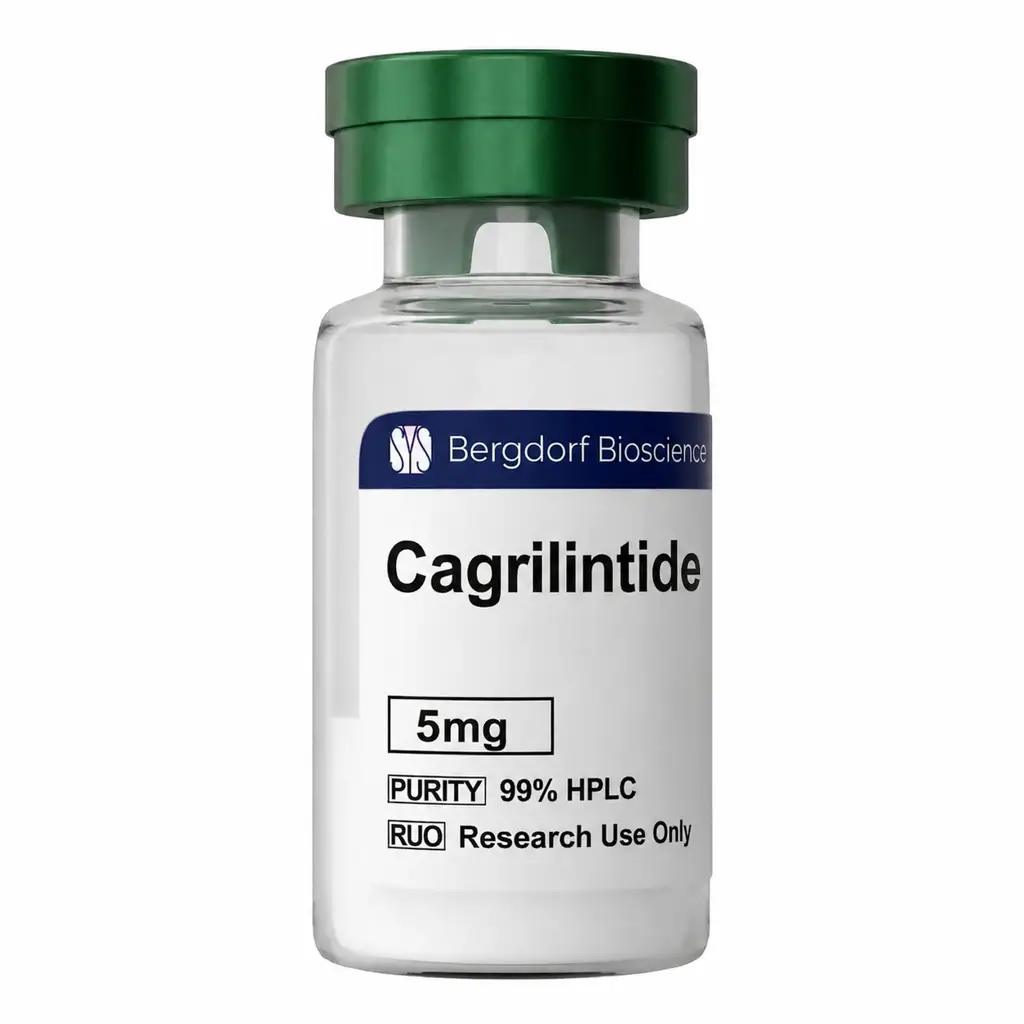
Cagrilintide addresses the amylin and calcitonin receptor system, whereas Retatrutide combines GIP, GLP-1 and glucagon receptor agonism. This comparison keeps monotherapy, combination evidence and indirect trial observations distinct.
 Medically reviewed by Dr. Sieglinde Klaus · Last reviewed August 2026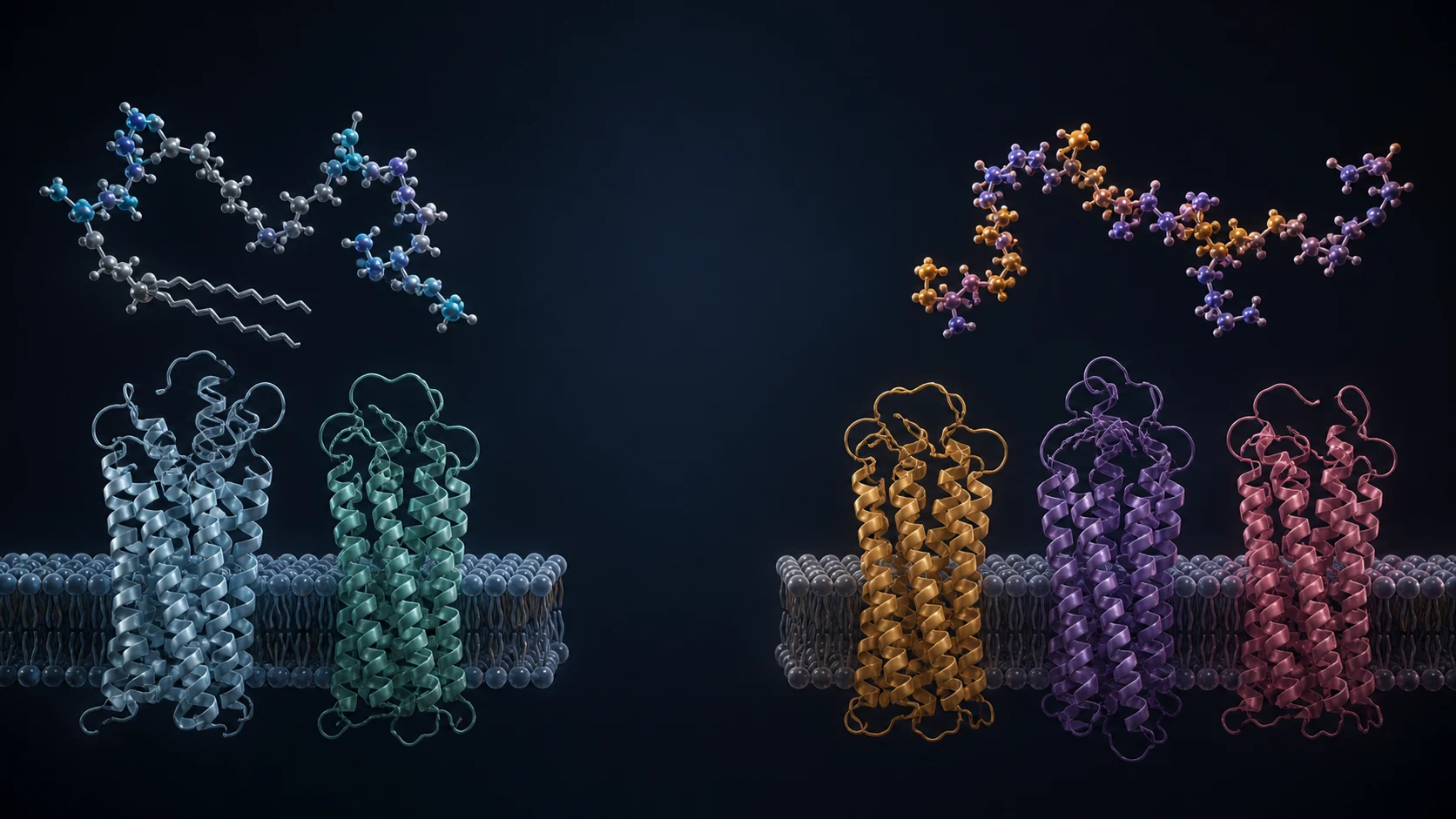
Cagrilintide is a stable, lipidated, long-acting amylin analogue. Preclinical work characterised AM833/Cagrilintide as a nonselective agonist at amylin receptors and the calcitonin receptor 12. Retatrutide, by contrast, is a single peptide active at GIP, GLP-1 and glucagon receptors 6.
Human studies exist for both compounds, but their populations, durations, comparators and estimands differ. Published percentages therefore cannot be read as a direct performance comparison 35810. Published on 6 June 2026, TRANSCEND-T2D-1 adds a peer-reviewed phase 3 trial in type 2 diabetes to the Retatrutide evidence base 10. CagriSema is the coadministration of Cagrilintide and semaglutide, and is not equivalent to Cagrilintide monotherapy 45. No randomised Cagrilintide-versus-Retatrutide head-to-head trial appears in the verified primary-source set.
Cagrilintide is a long-acting, lipidated amylin analogue 1
Retatrutide is a single-peptide triple agonist 6
At the receptor level, Cagrilintide acts as a nonselective agonist at amylin receptors and the calcitonin receptor 2
Retatrutide has agonist activity at GIPR, GLP-1R and GCGR 6
Cagrilintide has a distinct binding, activation and regulatory profile across calcitonin-family receptors 2
The mechanistic profile of Retatrutide encompasses GIPR and GLP-1R signalling plus a GCGR arm whose contribution to energy expenditure was studied preclinically
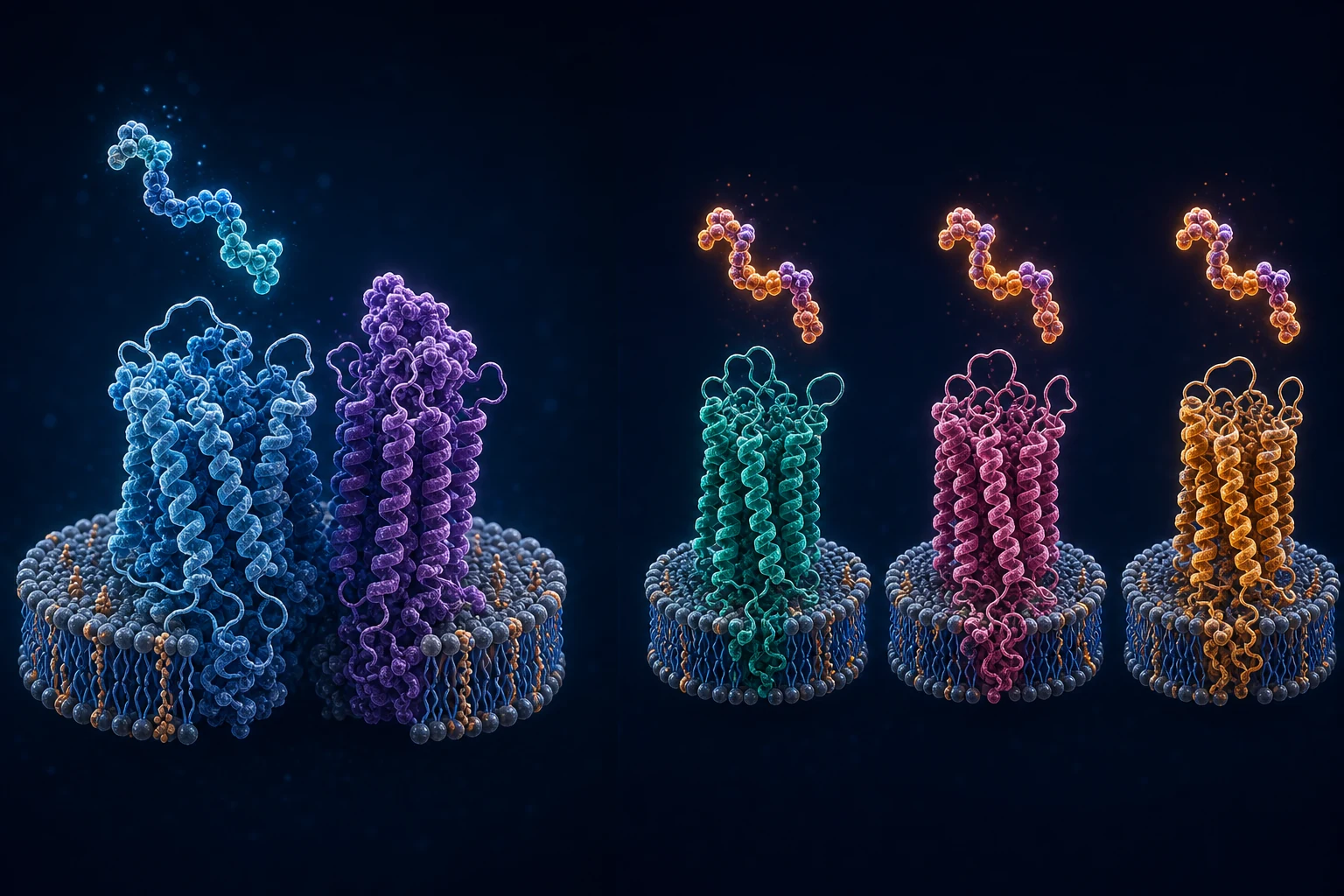
Cagrilintide emerged from a structure-activity programme designed to create a stable, lipidated, long-acting amylin analogue 1. Amylin receptors are complexes of the calcitonin receptor and receptor activity-modifying proteins. Preclinical pharmacology characterised AM833/Cagrilintide across 25 endpoints as a nonselective agonist at amylin receptors and the calcitonin receptor 2.
These receptor data define a mechanistic research framework, but do not demonstrate clinical benefit or equivalence to a particular research product. Findings from CagriSema studies also include semaglutide's contribution and must be read separately from Cagrilintide monotherapy 45. The Cagrilintide guide explores this distinction in more depth.
Retatrutide was developed as a single peptide with agonist activity at GIP, GLP-1 and glucagon receptors 6. Preclinically, the molecule showed greater GIPR activity alongside more balanced GLP-1R and GCGR activity. In mouse models, the additional GCGR arm was studied in relation to increased energy expenditure, while GIPR and GLP-1R signalling was associated with reduced energy intake .
Within their respective protocols, the verified Cagrilintide studies compared with placebo, liraglutide or semaglutide, or studied Cagrilintide together with semaglutide 345. Retatrutide studies used placebo and, in some cases, dulaglutide as comparators 78910. None of these trials randomised Cagrilintide against Retatrutide.
Differences in populations, treatment periods, endpoints, dose-finding logic and estimands shape the reported findings. The published TRANSCEND-T2D-1 results are therefore not a direct comparison with Cagrilintide either. Even similar-looking percentages remain indirect cross-trial observations.
A statement such as "Retatrutide is more effective" or "Cagrilintide is safer" would not be supported without direct randomised comparative data. A rigorous comparison remains mechanistic and context-specific.
Cagrilintide remains investigational. In the phase 2 monotherapy trial, gastrointestinal events and administration-site reactions were most common, and gastrointestinal events occurred more often in Cagrilintide groups than with placebo [3](#ref-3). CagriSema combination data cannot be transferred unchanged to Cagrilintide alone [4](#ref-4)[5](#ref-5).
Cagrilintide fits hypotheses about amylin and calcitonin-family receptors; Retatrutide fits hypotheses about the coupled GIPR, GLP-1R and GCGR signalling architecture [2](#ref-2)[6](#ref-6). The choice follows the target receptor system.
Human half-life data are available for both, but from different populations and protocols [4](#ref-4)[7](#ref-7). Use only the study context that fits the model and do not derive use instructions from it.
Cagrilintide was studied in phase 2 and as a distinct REDEFINE 1 arm; Retatrutide has a 48-week phase 2 trial [3](#ref-3)[5](#ref-5)[8](#ref-8). Endpoints should be considered separately rather than ranked.
Cagrilintide is useful for separating monotherapy from the CagriSema combination; Retatrutide for analysing one peptide with three receptor targets [4](#ref-4)[5](#ref-5)[6](#ref-6). They address different research questions.
Cagrilintide and Retatrutide are not interchangeable versions of the same mechanism. Cagrilintide focuses on the amylin and calcitonin receptor system; Retatrutide combines GIPR, GLP-1R and GCGR activity in one peptide 26.
Their clinical datasets are asymmetric as well. Cagrilintide has monotherapy evidence from phase 2 and one arm of the four-arm phase 3a REDEFINE 1 trial 35. Retatrutide has phase 1b and phase 2 data, plus phase 3 evidence published in June 2026 from TRANSCEND-T2D-1 in adults with type 2 diabetes inadequately controlled by diet and exercise alone 78910. CagriSema remains separate combination evidence 45.
Without a direct randomised comparison trial, neither clinical superiority nor a universal safety ranking can be inferred. For research, the suitable candidate is the one whose receptor architecture, population and evidence type match a pre-specified hypothesis. For further editorial context, see the Cagrilintide guide, the Retatrutide guide and Peptides for weight loss.
The mechanisms, study populations and development programmes answer different questions. Cagrilintide offers an amylin-centred perspective with distinguishable mono- and combination evidence; Retatrutide offers a single triple-agonist architecture. With no direct head-to-head trial, an overall winner would not be scientifically justified.
Cagrilintide addresses the amylin and calcitonin receptor system, whereas Retatrutide combines GIP, GLP-1 and glucagon receptor agonism. This comparison keeps monotherapy, combination evidence and indirect trial observations distinct.
Medically reviewed by Dr. Sieglinde Klaus · Last reviewed August 2026Cagrilintide is a stable, lipidated, long-acting amylin analogue. Preclinical work characterised AM833/Cagrilintide as a nonselective agonist at amylin receptors and the calcitonin receptor 12. Retatrutide, by contrast, is a single peptide active at GIP, GLP-1 and glucagon receptors 6.
Human studies exist for both compounds, but their populations, durations, comparators and estimands differ. Published percentages therefore cannot be read as a direct performance comparison 35810. Published on 6 June 2026, TRANSCEND-T2D-1 adds a peer-reviewed phase 3 trial in type 2 diabetes to the Retatrutide evidence base 10. CagriSema is the coadministration of Cagrilintide and semaglutide, and is not equivalent to Cagrilintide monotherapy 45. No randomised Cagrilintide-versus-Retatrutide head-to-head trial appears in the verified primary-source set.
Cagrilintide is a long-acting, lipidated amylin analogue 1
Retatrutide is a single-peptide triple agonist 6
At the receptor level, Cagrilintide acts as a nonselective agonist at amylin receptors and the calcitonin receptor 2
Retatrutide has agonist activity at GIPR, GLP-1R and GCGR 6
Cagrilintide has a distinct binding, activation and regulatory profile across calcitonin-family receptors 2
The mechanistic profile of Retatrutide encompasses GIPR and GLP-1R signalling plus a GCGR arm whose contribution to energy expenditure was studied preclinically
Cagrilintide emerged from a structure-activity programme designed to create a stable, lipidated, long-acting amylin analogue 1. Amylin receptors are complexes of the calcitonin receptor and receptor activity-modifying proteins. Preclinical pharmacology characterised AM833/Cagrilintide across 25 endpoints as a nonselective agonist at amylin receptors and the calcitonin receptor 2.
These receptor data define a mechanistic research framework, but do not demonstrate clinical benefit or equivalence to a particular research product. Findings from CagriSema studies also include semaglutide's contribution and must be read separately from Cagrilintide monotherapy 45. The Cagrilintide guide explores this distinction in more depth.
Retatrutide was developed as a single peptide with agonist activity at GIP, GLP-1 and glucagon receptors 6. Preclinically, the molecule showed greater GIPR activity alongside more balanced GLP-1R and GCGR activity. In mouse models, the additional GCGR arm was studied in relation to increased energy expenditure, while GIPR and GLP-1R signalling was associated with reduced energy intake .
Within their respective protocols, the verified Cagrilintide studies compared with placebo, liraglutide or semaglutide, or studied Cagrilintide together with semaglutide 345. Retatrutide studies used placebo and, in some cases, dulaglutide as comparators 78910. None of these trials randomised Cagrilintide against Retatrutide.
Differences in populations, treatment periods, endpoints, dose-finding logic and estimands shape the reported findings. The published TRANSCEND-T2D-1 results are therefore not a direct comparison with Cagrilintide either. Even similar-looking percentages remain indirect cross-trial observations.
A statement such as "Retatrutide is more effective" or "Cagrilintide is safer" would not be supported without direct randomised comparative data. A rigorous comparison remains mechanistic and context-specific.
Cagrilintide remains investigational. In the phase 2 monotherapy trial, gastrointestinal events and administration-site reactions were most common, and gastrointestinal events occurred more often in Cagrilintide groups than with placebo [3](#ref-3). CagriSema combination data cannot be transferred unchanged to Cagrilintide alone [4](#ref-4)[5](#ref-5).
Cagrilintide fits hypotheses about amylin and calcitonin-family receptors; Retatrutide fits hypotheses about the coupled GIPR, GLP-1R and GCGR signalling architecture [2](#ref-2)[6](#ref-6). The choice follows the target receptor system.
Human half-life data are available for both, but from different populations and protocols [4](#ref-4)[7](#ref-7). Use only the study context that fits the model and do not derive use instructions from it.
Cagrilintide was studied in phase 2 and as a distinct REDEFINE 1 arm; Retatrutide has a 48-week phase 2 trial [3](#ref-3)[5](#ref-5)[8](#ref-8). Endpoints should be considered separately rather than ranked.
Cagrilintide is useful for separating monotherapy from the CagriSema combination; Retatrutide for analysing one peptide with three receptor targets [4](#ref-4)[5](#ref-5)[6](#ref-6). They address different research questions.
Cagrilintide and Retatrutide are not interchangeable versions of the same mechanism. Cagrilintide focuses on the amylin and calcitonin receptor system; Retatrutide combines GIPR, GLP-1R and GCGR activity in one peptide 26.
Their clinical datasets are asymmetric as well. Cagrilintide has monotherapy evidence from phase 2 and one arm of the four-arm phase 3a REDEFINE 1 trial 35. Retatrutide has phase 1b and phase 2 data, plus phase 3 evidence published in June 2026 from TRANSCEND-T2D-1 in adults with type 2 diabetes inadequately controlled by diet and exercise alone 78910. CagriSema remains separate combination evidence 45.
Without a direct randomised comparison trial, neither clinical superiority nor a universal safety ranking can be inferred. For research, the suitable candidate is the one whose receptor architecture, population and evidence type match a pre-specified hypothesis. For further editorial context, see the Cagrilintide guide, the Retatrutide guide and Peptides for weight loss.
The mechanisms, study populations and development programmes answer different questions. Cagrilintide offers an amylin-centred perspective with distinguishable mono- and combination evidence; Retatrutide offers a single triple-agonist architecture. With no direct head-to-head trial, an overall winner would not be scientifically justified.
In a phase 1b coadministration study with semaglutide, Cagrilintide had a half-life of 159 to 195 hours 4
A phase 1b trial in type 2 diabetes reported a Retatrutide half-life of approximately 6 days 7
The randomised phase 2 Cagrilintide dose-finding trial enrolled 906 participants in total, with 26 weeks of treatment 3
A randomised phase 2 Retatrutide trial included 338 participants and 48 weeks of treatment 8
The Cagrilintide monotherapy arm in REDEFINE 1 studied adults without diabetes, so it does not provide standalone monotherapy evidence in type 2 diabetes 5
The events observed most often with Cagrilintide were gastrointestinal, including nausea, constipation and diarrhoea, together with administration-site reactions 3
For Retatrutide, nausea, diarrhoea, vomiting and constipation predominated; these events were mostly mild to moderate and dose-related 8
In the phase 2 Cagrilintide groups, serious adverse events occurred in 2 to 7% of participants, versus 3% with placebo; there were no fatal events and no consistent dose pattern 3
In TRANSCEND-T2D-1, serious adverse events occurred in 4%, 1% and 4% of participants in the Retatrutide groups, versus 1% with placebo; two deaths were assessed as unrelated to study intervention 10
No direct trial comparing Cagrilintide with Retatrutide appears in the verified primary sources
The verified primary sources likewise contain no direct trial comparing Retatrutide with Cagrilintide
Phase 1b pharmacokinetics in people with type 2 diabetes showed an approximately six-day half-life and dose-proportional exposure 7. Here too, mechanistic breadth is not a substitute for direct comparative evidence or long-term safety data. The Retatrutide guide provides further background.
The central difference is the receptor system, not an established ranking: Cagrilintide investigates sustained signalling across the amylin and calcitonin receptor family, while Retatrutide combines three metabolic receptor axes in one peptide 26. Which architecture better fits a research model depends on its hypothesis, endpoints and controls.
Cagrilintide has published monotherapy data from phase 2 and from one arm of the four-arm phase 3a REDEFINE 1 trial 35. Alongside phase 1b and phase 2 data, Retatrutide now has peer-reviewed phase 3 results from TRANSCEND-T2D-1 in 537 adults with type 2 diabetes 78910. The trials answer different questions and do not permit a numerical cross-trial ranking because their populations, protocols, durations and estimands differ. CagriSema data remain combination evidence and are not presented as Cagrilintide monotherapy 45.
Retatrutide also remains investigational. In the 48-week phase 2 trial, gastrointestinal events were most common, usually mild to moderate and dose-related [8](#ref-8). In TRANSCEND-T2D-1, the most common events were likewise gastrointestinal and mostly mild to moderate [10](#ref-10). A dose-dependent increase in heart rate was also observed in phase 2, peaking at week 24 before declining [8](#ref-8).
This comparison is solely a scientific appraisal of published research. It is not medical advice, a treatment recommendation or guidance for use. At Bergdorf Bio, a research vial is not an approved medicine, an investigational medicine or another clinical product, and the research material it contains is not clinically or pharmaceutically equivalent to the Cagrilintide or Retatrutide investigational drug products used in the cited trials. Findings on clinical efficacy, safety, dosing, quality and regulatory status therefore do not transfer to the research vial or its material. For research use only. Not intended for human consumption.
Neither overall. Cagrilintide offers an amylin and calcitonin receptor perspective as well as phase 2 monotherapy data and one phase 3a arm 235. Retatrutide offers a three-receptor profile and now peer-reviewed phase 3 data from TRANSCEND-T2D-1 in type 2 diabetes 610. Different populations and study designs do not support a ranking; without a direct comparison trial, the verdict remains contextual.
In a phase 1b coadministration study with semaglutide, Cagrilintide had a half-life of 159 to 195 hours 4
A phase 1b trial in type 2 diabetes reported a Retatrutide half-life of approximately 6 days 7
The randomised phase 2 Cagrilintide dose-finding trial enrolled 906 participants in total, with 26 weeks of treatment 3
A randomised phase 2 Retatrutide trial included 338 participants and 48 weeks of treatment 8
The Cagrilintide monotherapy arm in REDEFINE 1 studied adults without diabetes, so it does not provide standalone monotherapy evidence in type 2 diabetes 5
The events observed most often with Cagrilintide were gastrointestinal, including nausea, constipation and diarrhoea, together with administration-site reactions 3
For Retatrutide, nausea, diarrhoea, vomiting and constipation predominated; these events were mostly mild to moderate and dose-related 8
In the phase 2 Cagrilintide groups, serious adverse events occurred in 2 to 7% of participants, versus 3% with placebo; there were no fatal events and no consistent dose pattern 3
In TRANSCEND-T2D-1, serious adverse events occurred in 4%, 1% and 4% of participants in the Retatrutide groups, versus 1% with placebo; two deaths were assessed as unrelated to study intervention 10
No direct trial comparing Cagrilintide with Retatrutide appears in the verified primary sources
The verified primary sources likewise contain no direct trial comparing Retatrutide with Cagrilintide
Phase 1b pharmacokinetics in people with type 2 diabetes showed an approximately six-day half-life and dose-proportional exposure 7. Here too, mechanistic breadth is not a substitute for direct comparative evidence or long-term safety data. The Retatrutide guide provides further background.
The central difference is the receptor system, not an established ranking: Cagrilintide investigates sustained signalling across the amylin and calcitonin receptor family, while Retatrutide combines three metabolic receptor axes in one peptide 26. Which architecture better fits a research model depends on its hypothesis, endpoints and controls.
Cagrilintide has published monotherapy data from phase 2 and from one arm of the four-arm phase 3a REDEFINE 1 trial 35. Alongside phase 1b and phase 2 data, Retatrutide now has peer-reviewed phase 3 results from TRANSCEND-T2D-1 in 537 adults with type 2 diabetes 78910. The trials answer different questions and do not permit a numerical cross-trial ranking because their populations, protocols, durations and estimands differ. CagriSema data remain combination evidence and are not presented as Cagrilintide monotherapy 45.
Retatrutide also remains investigational. In the 48-week phase 2 trial, gastrointestinal events were most common, usually mild to moderate and dose-related [8](#ref-8). In TRANSCEND-T2D-1, the most common events were likewise gastrointestinal and mostly mild to moderate [10](#ref-10). A dose-dependent increase in heart rate was also observed in phase 2, peaking at week 24 before declining [8](#ref-8).
This comparison is solely a scientific appraisal of published research. It is not medical advice, a treatment recommendation or guidance for use. At Bergdorf Bio, a research vial is not an approved medicine, an investigational medicine or another clinical product, and the research material it contains is not clinically or pharmaceutically equivalent to the Cagrilintide or Retatrutide investigational drug products used in the cited trials. Findings on clinical efficacy, safety, dosing, quality and regulatory status therefore do not transfer to the research vial or its material. For research use only. Not intended for human consumption.
Neither overall. Cagrilintide offers an amylin and calcitonin receptor perspective as well as phase 2 monotherapy data and one phase 3a arm 235. Retatrutide offers a three-receptor profile and now peer-reviewed phase 3 data from TRANSCEND-T2D-1 in type 2 diabetes 610. Different populations and study designs do not support a ranking; without a direct comparison trial, the verdict remains contextual.