
Calculate exact reconstitution volumes, insulin units, and doses per vial for any peptide.
Vial, water and dose are known
Units measure volume, not active substance. 100 IU = 1.00 ml. How many mg are in there depends on the mix. The calculator has worked that out for you.
Almost all insulin syringes are U-100. Only choose U-40 if the syringe is marked U-40.
The linked sources lead to PubMed and open in a new tab.
Epithalon, also spelled Epitalon or Epithalone, is a synthetic tetrapeptide composed of four amino acids in the sequence alanine-glutamic acid-aspartic acid-glycine (Ala-Glu-Asp-Gly). It was developed as a synthetic analog of epithalamin, a polypeptide extract derived from the pineal gland. Research into this compound is largely associated with the Russian gerontologist Vladimir Khavinson and his team at the St. Petersburg Institute of Bioregulation and Gerontology, who from the 1980s and 1990s onward studied the role of pineal-derived peptides in the aging process.
The pineal gland is considered a central regulator of circadian rhythm and governs the sleep-wake cycle through the secretion of melatonin. With advancing age, pineal gland activity declines, which the research literature links to deterioration of circadian regulation, a reduction in nocturnal melatonin peaks, and a general decline in neuroendocrine function. Epithalon was conceived in this context as a short peptide intended to interact specifically with pineal-associated signaling pathways.
Epithalon is not a hormone and not a steroid. It does not bind to classical hormone receptors and does not suppress any endocrine axis. In preclinical models and a limited number of Russian studies, it has been investigated primarily in connection with telomerase activity, gene expression, and longevity. The available evidence comes predominantly from animal models and smaller investigations conducted by a single research group. Independent, large-scale human clinical trials are largely absent. For this reason, Epithalon is intended strictly for research purposes and is not offered as a medicine.
The mechanisms of action described for Epithalon in the research literature center on three closely interrelated areas: telomerase activation, pineal gland regulation, and effects on gene expression. These mechanisms are discussed in the context of aging research and should not be understood as established therapeutic effects.
Epithalon is typically administered in cycles in research rather than continuously. A typical protocol involves daily dosing over a limited period followed by an extended break. A slow titration is generally not required, since Epithalon does not exhibit a pronounced dose-dependent acute profile.
A common vial size is 10 mg. Adding 2 mL of bacteriostatic water gives a concentration of 5 mg/mL (5,000 mcg/mL).
At 5 mg once daily, a 10 mg vial provides two days of dosing. For longer cycles, a larger vial (20 mg or 50 mg) or a higher reconstitution volume is therefore advisable. Use the Epithalon calculator above to compute exact volumes for any vial size, reconstitution volume, and target dose.
Epithalon is generally administered subcutaneously into the abdominal fat tissue in research settings, since it aims for a systemic effect and does not require localized application. Subcutaneous administration is easy to perform and well tolerated. Some protocols use intramuscular injection as an alternative. Because of the short half-life, the daily dose is usually given as a single injection, occasionally split into two smaller doses.
Epithalon is supplied as a lyophilized (freeze-dried) powder in sealed vials. It must be reconstituted with bacteriostatic water (BAC water) before use. Do not use sterile water for injection for multi-dose vials. BAC water contains 0.9% benzyl alcohol, which inhibits microbial growth and extends the usable window of the reconstituted solution.
If the solution appears cloudy, discolored, or contains visible particulate matter, discard the vial and do not inject it.
Epithalon shows a favorable tolerability profile in the available research literature. The animal studies and smaller investigations conducted to date have not described serious toxic effects. However, the data is limited and originates predominantly from a single research group. Large-scale, independent human safety studies are absent, so all statements remain subject to the caveat of incomplete evidence.
No serious adverse events have been reported for Epithalon in the published literature at the doses commonly used in research. Given the absence of large-scale human clinical trials, caution is warranted, and consultation with a qualified healthcare professional is strongly recommended.
Epithalon is frequently studied as a standalone compound in research, because its central research focus, telomerase activation and pineal regulation, does not readily combine with other mechanisms. A typical research approach uses a time-limited Epithalon cycle without additional peptides, so that observed effects can be cleanly attributed.
Because Epithalon is discussed in the context of melatonin regulation and the sleep-wake cycle, it is occasionally grouped in research alongside DSIP (Delta Sleep-Inducing Peptide). Both compounds are associated with sleep architecture and circadian regulation, but they act through different mechanisms.
In the broader field of longevity research, Epithalon is often considered together with mitochondrial and cytoprotective peptides such as MOTS-c and SS-31. While Epithalon focuses on telomeres and the pineal gland, these peptides address mitochondrial function and protection against oxidative stress. For mood- and stress-related research, Selank is also discussed within the same peptide class. Each of these compounds should be reconstituted, dosed, and monitored separately.
Epithalon, Epitalon, and Epithalone all refer to the same compound. The differing spellings arose from transliteration of the originally Russian name. It is the same tetrapeptide with the sequence Ala-Glu-Asp-Gly. Differences in spelling do not indicate a different substance or a different quality.
In research protocols, Epithalon is usually used cyclically. A common approach involves daily dosing of approximately 5 mg over a period of 10 to 20 days, followed by a multi-month break. One to two cycles per year are frequently described. Continuous daily use is uncommon in the literature.
Epithalon is linked in research to the regulation of the pineal gland and melatonin secretion. In preclinical models, a restoration of nocturnal melatonin peaks has been described. Some users report more vivid dreams or changes in sleep patterns at the start of a cycle. However, robust clinical data on sleep quality in humans is limited.
Epithalon is a peptide and is largely broken down by digestive enzymes in the gastrointestinal tract. Oral bioavailability is therefore low. In research, Epithalon is administered almost exclusively subcutaneously or intramuscularly. Oral or intranasal formulations are not the standard route and are poorly characterized in terms of efficacy.
Epithalon is not used for immediately noticeable acute effects. The mechanisms discussed in research, such as telomerase activation and pineal-related effects, relate to slow cellular and neuroendocrine processes. Changes in sleep patterns may occur within the first days of a cycle, while other described effects appear only over longer time frames and in preclinical models.
No. Epithalon is a short peptide and not a hormone. It does not bind to classical hormone receptors and does not suppress any endocrine axis. No post-cycle therapy (PCT) is required. Through the pineal axis, it may indirectly influence neuroendocrine markers, but its mode of action differs fundamentally from that of hormones or steroids.
The cyclical approach is derived directly from the original research protocols, which combined short, intensive administration phases with long breaks. The rationale rests on the assumption that the described effects on telomeres and the pineal gland are triggered through a limited impulse and do not require continuous use. Cyclical administration also reduces cumulative exposure given the limited long-term evidence.
Epithalon is not currently available in the BergdorfBio product range. This page serves as a research and dosing reference. For available research peptides in related categories, it is worth looking at MOTS-c and Selank.
Medical Disclaimer: The information on this page is provided for educational and research purposes only. Epithalon is not an approved drug or medical treatment and is provided strictly for research use. Nothing on this page constitutes medical advice, diagnosis, or a recommendation to use any specific compound. Always consult a qualified healthcare professional before beginning any peptide protocol. BergdorfBio assumes no liability for the use or misuse of the information presented here.
From powder to a ready syringe in five steps. The calculator above gives you the amounts automatically.
Bring vial and water to room temperature. Wipe both rubber stoppers with an alcohol swab.
Draw up the amount of BAC water recommended by the calculator using a larger syringe.
Let the water run down the inside wall of the peptide vial, do not spray it directly onto the powder.
Roll the vial gently, do not shake. The powder dissolves clear within 1-2 minutes.
Draw up to exactly the calculated mark with the insulin syringe. Done.
Typical starting values for orientation. Each row opens the calculator for that peptide.
| Peptide | Category | Typical dose | Vial sizes | BAC (start) | Available | Calculate |
|---|---|---|---|---|---|---|
| VIP | Neuropeptide Research | - | 10 mg | 2 ml | Calculator only | Calculate |
| Retatrutide | GLP-1/GIP/GCG | 0,5-12 mg | 2 / 5 / 10 / 15 mg | 2 ml | Calculator only | Calculate |
| Cagrilintide | Amylin Analogue | - | 5 mg | 2 ml | Calculator only | Calculate |
| Semaglutide | GLP-1 | 0,25-2,4 mg | 2 / 5 / 10 mg | 2 ml | Calculator only | Calculate |
| Tirzepatide | GLP-1/GIP | 2,5-15 mg | 10 / 15 / 20 / 30 / 60 / 90 mg | 2 ml | Calculator only | Calculate |
| GHK-Cu | Copper Peptide | 1-4 mg | 10 / 20 / 50 mg | 5 ml | Calculator only | Calculate |
| AHK-Cu | Copper Peptide | - | 100 mg | 5 ml | Calculator only | Calculate |
| BPC-157 | Tissue Repair | 0,2-0,5 mg | 2 / 5 / 10 mg | 2 ml | Calculator only | Calculate |
| TB-500 | Thymosin Beta-4 | 2-5 mg | 2 / 5 / 10 mg | 2 ml | Calculator only | Calculate |
| CJC-1295 (no DAC) | GHRH Analog | 100-200 mcg | 2 / 5 / 10 mg | 2 ml | Calculator only | Calculate |
| Ipamorelin | GHRP | 200-300 mcg | 2 / 5 mg | 2 ml | Calculator only | Calculate |
| AOD-9604 | Fat Loss | 250-500 mcg | 2 / 5 mg | 2 ml | Calculator only | Calculate |
| PT-141 | Bremelanotide | - | 2 / 5 / 10 mg | 2 ml | Calculator only | Calculate |
| MOTS-c | Mitochondrial | 5-10 mg | 5 / 10 mg | 2 ml | Calculator only | Calculate |
| Selank | Anxiolytic | 150-500 mcg | 2 / 5 / 10 mg | 2 ml | Calculator only | Calculate |
| SS-31 | Elamipretide | 0,1-1 mg | 5 / 10 mg | 2 ml | Calculator only | Calculate |
| Glow Stack | Stack | 0,5-2 mg | 70 mg | 3 ml | Calculator only | Calculate |
| Klow Stack | Stack | 0,5-2 mg | 55 mg | 3 ml | Calculator only | Calculate |
| Melanotan II | Melanocortin | 100-1000 mcg | 5 / 10 mg | 2 ml | Calculator only | Calculate |
| Melanotan I | Melanocortin | - | 5 / 10 mg | 2 ml | Calculator only | Calculate |
| Sermorelin | GHRH Analog | 50-300 mcg | 5 mg | 2 ml | Calculator only | Calculate |
| Tesamorelin | GHRH Analog | 1-2 mg | 10 / 20 mg | 2 ml | Calculator only | Calculate |
| Thymosin Alpha-1 | Thymic Peptide | 0,8-3,2 mg | 1.6 / 5 / 10 mg | 1 ml | Calculator only | Calculate |
| Epithalon | Longevity | 2-10 mg | 10 / 20 / 50 mg | 2 ml | Calculator only | Calculate |
| KPV | Immune / Barrier | 100-1000 mcg | 5 / 10 mg | 2 ml | Calculator only | Calculate |
| HGH Fragment 176-191 | Metabolic Fragment | 100-500 mcg | 2 / 5 / 10 mg | 2 ml | Calculator only | Calculate |
| Semax | Cognitive | 100-1000 mcg | 10 / 30 mg | 2 ml | Calculator only | Calculate |
| N-Acetyl Semax | Cognitive | 100-1000 mcg | 5 / 10 mg | 2 ml | Calculator only | Calculate |
| Hexarelin | GHRP | 50-200 mcg | 2 / 5 mg | 2 ml | Calculator only | Calculate |
| GHRP-6 | GHRP | 50-300 mcg | 2 / 5 mg | 2 ml | Calculator only | Calculate |
| GHRP-2 | GHRP | 50-250 mcg | 2 / 5 mg | 2 ml | Calculator only | Calculate |
| DSIP | Sleep | 50-500 mcg | 10 mg | 2 ml | Calculator only | Calculate |
| 5-Amino-1MQ | Metabolic | 2,5-10 mg | 10 mg | 2 ml | Calculator only | Calculate |
| Pinealon | Research peptide | - | 10 mg | 2 ml | Calculator only | Calculate |
| Survodutide | GLP-1/Glucagon | - | 10 mg | 2 ml | Calculator only | Calculate |
| Kisspeptin-10 | KISS1R / GPR54 | - | 10 mg | 2 ml | Calculator only | Calculate |
| HGH 191AA | Growth Hormone | 1-5 mg | 10 mg | 1 ml | Calculator only | Calculate |
| NAD+ | Longevity / Cofactor | 100-500 mg | 1000 mg | 10 ml | Calculator only | Calculate |
Values are for orientation in a research context and do not replace professional advice.
Calculating concentration and injection volume correctly seems trivial, but it is the most common source of error. Even a 10 % miscalculation during reconstitution means you either get too little active substance or unintentionally overdose.
Lyophilized peptides are supplied in milligrams and dissolved in bacteriostatic water (BAC water). The ratio of peptide to water determines the concentration, and from that follows how many units you draw up on the insulin syringe. Insulin syringes are scaled in units, not milligrams. The calculator handles this conversion, including the plausibility check against the most dangerous error: confusing mg and mcg.
Milligrams (mg) is the unit lyophilized peptides are sold in, for example “5 mg BPC-157”. Micrograms (mcg) measure the single dose, for example “250 mcg per injection”. 1 mg = 1,000 mcg. The calculator converts automatically and warns when an entry looks like a mix-up.
U-100 means the syringe is calibrated for 100 units per milliliter. 100 IU = 1 ml, so 10 IU = 0.10 ml, regardless of what is in the syringe. The IU calculation is based on exactly this relationship.
With a lot of peptide and little water the solution becomes very concentrated, so the volume per dose is tiny and hard to read. Use the mixing helper: it finds the water volume that produces a clean, easily readable mark.
In the fridge at 2-8 °C usually 21-30 days. Label the vial with the reconstitution date. Cloudy solutions or particles are a no-go.
Blends contain several active substances in one vial. Just select the blend as your peptide: the calculator additionally shows how much of each component is in your injection. For combinations of several separate vials, use the Stack Builder.
No. Your last settings are stored locally in the browser and restored on your next visit. You can also recall calculations from the history, save them as a protocol or share them as a link.
Choose a peptide to open its dedicated calculator page with pre-filled values.
Calculate exact reconstitution volumes, insulin units, and doses per vial for any peptide.
Vial, water and dose are known
Units measure volume, not active substance. 100 IU = 1.00 ml. How many mg are in there depends on the mix. The calculator has worked that out for you.
Almost all insulin syringes are U-100. Only choose U-40 if the syringe is marked U-40.
The linked sources lead to PubMed and open in a new tab.
Epithalon, also spelled Epitalon or Epithalone, is a synthetic tetrapeptide composed of four amino acids in the sequence alanine-glutamic acid-aspartic acid-glycine (Ala-Glu-Asp-Gly). It was developed as a synthetic analog of epithalamin, a polypeptide extract derived from the pineal gland. Research into this compound is largely associated with the Russian gerontologist Vladimir Khavinson and his team at the St. Petersburg Institute of Bioregulation and Gerontology, who from the 1980s and 1990s onward studied the role of pineal-derived peptides in the aging process.
The pineal gland is considered a central regulator of circadian rhythm and governs the sleep-wake cycle through the secretion of melatonin. With advancing age, pineal gland activity declines, which the research literature links to deterioration of circadian regulation, a reduction in nocturnal melatonin peaks, and a general decline in neuroendocrine function. Epithalon was conceived in this context as a short peptide intended to interact specifically with pineal-associated signaling pathways.
Epithalon is not a hormone and not a steroid. It does not bind to classical hormone receptors and does not suppress any endocrine axis. In preclinical models and a limited number of Russian studies, it has been investigated primarily in connection with telomerase activity, gene expression, and longevity. The available evidence comes predominantly from animal models and smaller investigations conducted by a single research group. Independent, large-scale human clinical trials are largely absent. For this reason, Epithalon is intended strictly for research purposes and is not offered as a medicine.
The mechanisms of action described for Epithalon in the research literature center on three closely interrelated areas: telomerase activation, pineal gland regulation, and effects on gene expression. These mechanisms are discussed in the context of aging research and should not be understood as established therapeutic effects.
Epithalon is typically administered in cycles in research rather than continuously. A typical protocol involves daily dosing over a limited period followed by an extended break. A slow titration is generally not required, since Epithalon does not exhibit a pronounced dose-dependent acute profile.
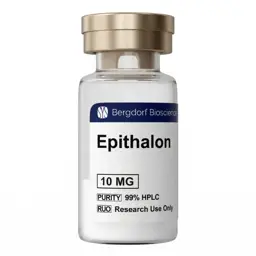
A common vial size is 10 mg. Adding 2 mL of bacteriostatic water gives a concentration of 5 mg/mL (5,000 mcg/mL).
At 5 mg once daily, a 10 mg vial provides two days of dosing. For longer cycles, a larger vial (20 mg or 50 mg) or a higher reconstitution volume is therefore advisable. Use the Epithalon calculator above to compute exact volumes for any vial size, reconstitution volume, and target dose.
Epithalon is generally administered subcutaneously into the abdominal fat tissue in research settings, since it aims for a systemic effect and does not require localized application. Subcutaneous administration is easy to perform and well tolerated. Some protocols use intramuscular injection as an alternative. Because of the short half-life, the daily dose is usually given as a single injection, occasionally split into two smaller doses.
Epithalon is supplied as a lyophilized (freeze-dried) powder in sealed vials. It must be reconstituted with bacteriostatic water (BAC water) before use. Do not use sterile water for injection for multi-dose vials. BAC water contains 0.9% benzyl alcohol, which inhibits microbial growth and extends the usable window of the reconstituted solution.
If the solution appears cloudy, discolored, or contains visible particulate matter, discard the vial and do not inject it.
Epithalon shows a favorable tolerability profile in the available research literature. The animal studies and smaller investigations conducted to date have not described serious toxic effects. However, the data is limited and originates predominantly from a single research group. Large-scale, independent human safety studies are absent, so all statements remain subject to the caveat of incomplete evidence.
No serious adverse events have been reported for Epithalon in the published literature at the doses commonly used in research. Given the absence of large-scale human clinical trials, caution is warranted, and consultation with a qualified healthcare professional is strongly recommended.
Epithalon is frequently studied as a standalone compound in research, because its central research focus, telomerase activation and pineal regulation, does not readily combine with other mechanisms. A typical research approach uses a time-limited Epithalon cycle without additional peptides, so that observed effects can be cleanly attributed.
Because Epithalon is discussed in the context of melatonin regulation and the sleep-wake cycle, it is occasionally grouped in research alongside DSIP (Delta Sleep-Inducing Peptide). Both compounds are associated with sleep architecture and circadian regulation, but they act through different mechanisms.
In the broader field of longevity research, Epithalon is often considered together with mitochondrial and cytoprotective peptides such as MOTS-c and SS-31. While Epithalon focuses on telomeres and the pineal gland, these peptides address mitochondrial function and protection against oxidative stress. For mood- and stress-related research, Selank is also discussed within the same peptide class. Each of these compounds should be reconstituted, dosed, and monitored separately.
Epithalon, Epitalon, and Epithalone all refer to the same compound. The differing spellings arose from transliteration of the originally Russian name. It is the same tetrapeptide with the sequence Ala-Glu-Asp-Gly. Differences in spelling do not indicate a different substance or a different quality.
In research protocols, Epithalon is usually used cyclically. A common approach involves daily dosing of approximately 5 mg over a period of 10 to 20 days, followed by a multi-month break. One to two cycles per year are frequently described. Continuous daily use is uncommon in the literature.
Epithalon is linked in research to the regulation of the pineal gland and melatonin secretion. In preclinical models, a restoration of nocturnal melatonin peaks has been described. Some users report more vivid dreams or changes in sleep patterns at the start of a cycle. However, robust clinical data on sleep quality in humans is limited.
Epithalon is a peptide and is largely broken down by digestive enzymes in the gastrointestinal tract. Oral bioavailability is therefore low. In research, Epithalon is administered almost exclusively subcutaneously or intramuscularly. Oral or intranasal formulations are not the standard route and are poorly characterized in terms of efficacy.
Epithalon is not used for immediately noticeable acute effects. The mechanisms discussed in research, such as telomerase activation and pineal-related effects, relate to slow cellular and neuroendocrine processes. Changes in sleep patterns may occur within the first days of a cycle, while other described effects appear only over longer time frames and in preclinical models.
No. Epithalon is a short peptide and not a hormone. It does not bind to classical hormone receptors and does not suppress any endocrine axis. No post-cycle therapy (PCT) is required. Through the pineal axis, it may indirectly influence neuroendocrine markers, but its mode of action differs fundamentally from that of hormones or steroids.
The cyclical approach is derived directly from the original research protocols, which combined short, intensive administration phases with long breaks. The rationale rests on the assumption that the described effects on telomeres and the pineal gland are triggered through a limited impulse and do not require continuous use. Cyclical administration also reduces cumulative exposure given the limited long-term evidence.
Epithalon is not currently available in the BergdorfBio product range. This page serves as a research and dosing reference. For available research peptides in related categories, it is worth looking at MOTS-c and Selank.
Medical Disclaimer: The information on this page is provided for educational and research purposes only. Epithalon is not an approved drug or medical treatment and is provided strictly for research use. Nothing on this page constitutes medical advice, diagnosis, or a recommendation to use any specific compound. Always consult a qualified healthcare professional before beginning any peptide protocol. BergdorfBio assumes no liability for the use or misuse of the information presented here.
From powder to a ready syringe in five steps. The calculator above gives you the amounts automatically.
Bring vial and water to room temperature. Wipe both rubber stoppers with an alcohol swab.
Draw up the amount of BAC water recommended by the calculator using a larger syringe.
Let the water run down the inside wall of the peptide vial, do not spray it directly onto the powder.
Roll the vial gently, do not shake. The powder dissolves clear within 1-2 minutes.
Draw up to exactly the calculated mark with the insulin syringe. Done.
Typical starting values for orientation. Each row opens the calculator for that peptide.
| Peptide | Category | Typical dose | Vial sizes | BAC (start) | Available | Calculate |
|---|---|---|---|---|---|---|
| VIP | Neuropeptide Research | - | 10 mg | 2 ml | Calculator only | Calculate |
| Retatrutide | GLP-1/GIP/GCG | 0,5-12 mg | 2 / 5 / 10 / 15 mg | 2 ml | Calculator only | Calculate |
| Cagrilintide | Amylin Analogue | - | 5 mg | 2 ml | Calculator only | Calculate |
| Semaglutide | GLP-1 | 0,25-2,4 mg | 2 / 5 / 10 mg | 2 ml | Calculator only | Calculate |
| Tirzepatide | GLP-1/GIP | 2,5-15 mg | 10 / 15 / 20 / 30 / 60 / 90 mg | 2 ml | Calculator only | Calculate |
| GHK-Cu | Copper Peptide | 1-4 mg | 10 / 20 / 50 mg | 5 ml | Calculator only | Calculate |
| AHK-Cu | Copper Peptide | - | 100 mg | 5 ml | Calculator only | Calculate |
| BPC-157 | Tissue Repair | 0,2-0,5 mg | 2 / 5 / 10 mg | 2 ml | Calculator only | Calculate |
| TB-500 | Thymosin Beta-4 | 2-5 mg | 2 / 5 / 10 mg | 2 ml | Calculator only | Calculate |
| CJC-1295 (no DAC) | GHRH Analog | 100-200 mcg | 2 / 5 / 10 mg | 2 ml | Calculator only | Calculate |
| Ipamorelin | GHRP | 200-300 mcg | 2 / 5 mg | 2 ml | Calculator only | Calculate |
| AOD-9604 | Fat Loss | 250-500 mcg | 2 / 5 mg | 2 ml | Calculator only | Calculate |
| PT-141 | Bremelanotide | - | 2 / 5 / 10 mg | 2 ml | Calculator only | Calculate |
| MOTS-c | Mitochondrial | 5-10 mg | 5 / 10 mg | 2 ml | Calculator only | Calculate |
| Selank | Anxiolytic | 150-500 mcg | 2 / 5 / 10 mg | 2 ml | Calculator only | Calculate |
| SS-31 | Elamipretide | 0,1-1 mg | 5 / 10 mg | 2 ml | Calculator only | Calculate |
| Glow Stack | Stack | 0,5-2 mg | 70 mg | 3 ml | Calculator only | Calculate |
| Klow Stack | Stack | 0,5-2 mg | 55 mg | 3 ml | Calculator only | Calculate |
| Melanotan II | Melanocortin | 100-1000 mcg | 5 / 10 mg | 2 ml | Calculator only | Calculate |
| Melanotan I | Melanocortin | - | 5 / 10 mg | 2 ml | Calculator only | Calculate |
| Sermorelin | GHRH Analog | 50-300 mcg | 5 mg | 2 ml | Calculator only | Calculate |
| Tesamorelin | GHRH Analog | 1-2 mg | 10 / 20 mg | 2 ml | Calculator only | Calculate |
| Thymosin Alpha-1 | Thymic Peptide | 0,8-3,2 mg | 1.6 / 5 / 10 mg | 1 ml | Calculator only | Calculate |
| Epithalon | Longevity | 2-10 mg | 10 / 20 / 50 mg | 2 ml | Calculator only | Calculate |
| KPV | Immune / Barrier | 100-1000 mcg | 5 / 10 mg | 2 ml | Calculator only | Calculate |
| HGH Fragment 176-191 | Metabolic Fragment | 100-500 mcg | 2 / 5 / 10 mg | 2 ml | Calculator only | Calculate |
| Semax | Cognitive | 100-1000 mcg | 10 / 30 mg | 2 ml | Calculator only | Calculate |
| N-Acetyl Semax | Cognitive | 100-1000 mcg | 5 / 10 mg | 2 ml | Calculator only | Calculate |
| Hexarelin | GHRP | 50-200 mcg | 2 / 5 mg | 2 ml | Calculator only | Calculate |
| GHRP-6 | GHRP | 50-300 mcg | 2 / 5 mg | 2 ml | Calculator only | Calculate |
| GHRP-2 | GHRP | 50-250 mcg | 2 / 5 mg | 2 ml | Calculator only | Calculate |
| DSIP | Sleep | 50-500 mcg | 10 mg | 2 ml | Calculator only | Calculate |
| 5-Amino-1MQ | Metabolic | 2,5-10 mg | 10 mg | 2 ml | Calculator only | Calculate |
| Pinealon | Research peptide | - | 10 mg | 2 ml | Calculator only | Calculate |
| Survodutide | GLP-1/Glucagon | - | 10 mg | 2 ml | Calculator only | Calculate |
| Kisspeptin-10 | KISS1R / GPR54 | - | 10 mg | 2 ml | Calculator only | Calculate |
| HGH 191AA | Growth Hormone | 1-5 mg | 10 mg | 1 ml | Calculator only | Calculate |
| NAD+ | Longevity / Cofactor | 100-500 mg | 1000 mg | 10 ml | Calculator only | Calculate |
Values are for orientation in a research context and do not replace professional advice.
Calculating concentration and injection volume correctly seems trivial, but it is the most common source of error. Even a 10 % miscalculation during reconstitution means you either get too little active substance or unintentionally overdose.
Lyophilized peptides are supplied in milligrams and dissolved in bacteriostatic water (BAC water). The ratio of peptide to water determines the concentration, and from that follows how many units you draw up on the insulin syringe. Insulin syringes are scaled in units, not milligrams. The calculator handles this conversion, including the plausibility check against the most dangerous error: confusing mg and mcg.
Milligrams (mg) is the unit lyophilized peptides are sold in, for example “5 mg BPC-157”. Micrograms (mcg) measure the single dose, for example “250 mcg per injection”. 1 mg = 1,000 mcg. The calculator converts automatically and warns when an entry looks like a mix-up.
U-100 means the syringe is calibrated for 100 units per milliliter. 100 IU = 1 ml, so 10 IU = 0.10 ml, regardless of what is in the syringe. The IU calculation is based on exactly this relationship.
With a lot of peptide and little water the solution becomes very concentrated, so the volume per dose is tiny and hard to read. Use the mixing helper: it finds the water volume that produces a clean, easily readable mark.
In the fridge at 2-8 °C usually 21-30 days. Label the vial with the reconstitution date. Cloudy solutions or particles are a no-go.
Blends contain several active substances in one vial. Just select the blend as your peptide: the calculator additionally shows how much of each component is in your injection. For combinations of several separate vials, use the Stack Builder.
No. Your last settings are stored locally in the browser and restored on your next visit. You can also recall calculations from the history, save them as a protocol or share them as a link.
Choose a peptide to open its dedicated calculator page with pre-filled values.
In stock
In stock
View Product
EpithalonView Product
EpithalonTypical starting values for orientation. Each row opens the calculator for that peptide.
| Peptide | Category | Typical dose | Vial sizes | BAC (start) | Available | Calculate |
|---|---|---|---|---|---|---|
| VIP | Neuropeptide Research | - | 10 mg | 2 ml | In stock | Calculate |
| Retatrutide | GLP-1/GIP/GCG | 0,5-12 mg | 2 / 5 / 10 / 15 mg | 2 ml | In stock | Calculate |
| Cagrilintide | Amylin Analogue | - | 5 mg | 2 ml | In stock | Calculate |
| Tirzepatide | GLP-1/GIP | 2,5-15 mg | 10 / 15 / 20 / 30 / 60 / 90 mg | 2 ml | In stock | Calculate |
| GHK-Cu | Copper Peptide | 1-4 mg | 10 / 20 / 50 mg | 5 ml | In stock | Calculate |
| AHK-Cu | Copper Peptide | - | 100 mg | 5 ml | In stock | Calculate |
| BPC-157 | Tissue Repair | 0,2-0,5 mg | 2 / 5 / 10 mg | 2 ml | In stock | Calculate |
| TB-500 | Thymosin Beta-4 | 2-5 mg | 2 / 5 / 10 mg | 2 ml | In stock | Calculate |
| CJC-1295 (no DAC) | GHRH Analog | 100-200 mcg | 2 / 5 / 10 mg | 2 ml | In stock | Calculate |
| Ipamorelin | GHRP | 200-300 mcg | 2 / 5 mg | 2 ml | In stock | Calculate |
| PT-141 | Bremelanotide | - | 2 / 5 / 10 mg | 2 ml | In stock | Calculate |
| MOTS-c | Mitochondrial | 5-10 mg | 5 / 10 mg | 2 ml | In stock | Calculate |
| Selank | Anxiolytic | 150-500 mcg | 2 / 5 / 10 mg | 2 ml | In stock | Calculate |
| SS-31 | Elamipretide | 0,1-1 mg | 5 / 10 mg | 2 ml | In stock | Calculate |
| Glow Stack | Stack | 0,5-2 mg | 70 mg | 3 ml | In stock | Calculate |
| Klow Stack | Stack | 0,5-2 mg | 55 mg | 3 ml | In stock | Calculate |
| Melanotan II | Melanocortin | 100-1000 mcg | 5 / 10 mg | 2 ml | In stock | Calculate |
| Melanotan I | Melanocortin | - | 5 / 10 mg | 2 ml | In stock | Calculate |
| Sermorelin | GHRH Analog | 50-300 mcg | 5 mg | 2 ml | In stock | Calculate |
| Tesamorelin | GHRH Analog | 1-2 mg | 10 / 20 mg | 2 ml | In stock | Calculate |
| Thymosin Alpha-1 | Thymic Peptide | 0,8-3,2 mg | 1.6 / 5 / 10 mg | 1 ml | In stock | Calculate |
| Epithalon | Longevity | 2-10 mg | 10 / 20 / 50 mg | 2 ml | In stock | Calculate |
| KPV | Immune / Barrier | 100-1000 mcg | 5 / 10 mg | 2 ml | In stock | Calculate |
| Semax | Cognitive | 100-1000 mcg | 10 / 30 mg | 2 ml | In stock | Calculate |
| DSIP | Sleep | 50-500 mcg | 10 mg | 2 ml | In stock | Calculate |
| 5-Amino-1MQ | Metabolic | 2,5-10 mg | 10 mg | 2 ml | In stock | Calculate |
| Pinealon | Research peptide | - | 10 mg | 2 ml | In stock | Calculate |
| Survodutide | GLP-1/Glucagon | - | 10 mg | 2 ml | In stock | Calculate |
| Kisspeptin-10 | KISS1R / GPR54 | - | 10 mg | 2 ml | In stock | Calculate |
| NAD+ | Longevity / Cofactor | 100-500 mg | 1000 mg | 10 ml | In stock | Calculate |
| Semaglutide | GLP-1 | 0,25-2,4 mg | 2 / 5 / 10 mg | 2 ml | Calculator only | Calculate |
| AOD-9604 | Fat Loss | 250-500 mcg | 2 / 5 mg | 2 ml | Calculator only | Calculate |
| HGH Fragment 176-191 | Metabolic Fragment | 100-500 mcg | 2 / 5 / 10 mg | 2 ml | Calculator only | Calculate |
| N-Acetyl Semax | Cognitive | 100-1000 mcg | 5 / 10 mg | 2 ml | Calculator only | Calculate |
| Hexarelin | GHRP | 50-200 mcg | 2 / 5 mg | 2 ml | Calculator only | Calculate |
| GHRP-6 | GHRP | 50-300 mcg | 2 / 5 mg | 2 ml | Calculator only | Calculate |
| GHRP-2 | GHRP | 50-250 mcg | 2 / 5 mg | 2 ml | Calculator only | Calculate |
| HGH 191AA | Growth Hormone | 1-5 mg | 10 mg | 1 ml | Calculator only | Calculate |
Values are for orientation in a research context and do not replace professional advice.
Typical starting values for orientation. Each row opens the calculator for that peptide.
| Peptide | Category | Typical dose | Vial sizes | BAC (start) | Available | Calculate |
|---|---|---|---|---|---|---|
| VIP | Neuropeptide Research | - | 10 mg | 2 ml | In stock | Calculate |
| Retatrutide | GLP-1/GIP/GCG | 0,5-12 mg | 2 / 5 / 10 / 15 mg | 2 ml | In stock | Calculate |
| Cagrilintide | Amylin Analogue | - | 5 mg | 2 ml | In stock | Calculate |
| Tirzepatide | GLP-1/GIP | 2,5-15 mg | 10 / 15 / 20 / 30 / 60 / 90 mg | 2 ml | In stock | Calculate |
| GHK-Cu | Copper Peptide | 1-4 mg | 10 / 20 / 50 mg | 5 ml | In stock | Calculate |
| AHK-Cu | Copper Peptide | - | 100 mg | 5 ml | In stock | Calculate |
| BPC-157 | Tissue Repair | 0,2-0,5 mg | 2 / 5 / 10 mg | 2 ml | In stock | Calculate |
| TB-500 | Thymosin Beta-4 | 2-5 mg | 2 / 5 / 10 mg | 2 ml | In stock | Calculate |
| CJC-1295 (no DAC) | GHRH Analog | 100-200 mcg | 2 / 5 / 10 mg | 2 ml | In stock | Calculate |
| Ipamorelin | GHRP | 200-300 mcg | 2 / 5 mg | 2 ml | In stock | Calculate |
| PT-141 | Bremelanotide | - | 2 / 5 / 10 mg | 2 ml | In stock | Calculate |
| MOTS-c | Mitochondrial | 5-10 mg | 5 / 10 mg | 2 ml | In stock | Calculate |
| Selank | Anxiolytic | 150-500 mcg | 2 / 5 / 10 mg | 2 ml | In stock | Calculate |
| SS-31 | Elamipretide | 0,1-1 mg | 5 / 10 mg | 2 ml | In stock | Calculate |
| Glow Stack | Stack | 0,5-2 mg | 70 mg | 3 ml | In stock | Calculate |
| Klow Stack | Stack | 0,5-2 mg | 55 mg | 3 ml | In stock | Calculate |
| Melanotan II | Melanocortin | 100-1000 mcg | 5 / 10 mg | 2 ml | In stock | Calculate |
| Melanotan I | Melanocortin | - | 5 / 10 mg | 2 ml | In stock | Calculate |
| Sermorelin | GHRH Analog | 50-300 mcg | 5 mg | 2 ml | In stock | Calculate |
| Tesamorelin | GHRH Analog | 1-2 mg | 10 / 20 mg | 2 ml | In stock | Calculate |
| Thymosin Alpha-1 | Thymic Peptide | 0,8-3,2 mg | 1.6 / 5 / 10 mg | 1 ml | In stock | Calculate |
| Epithalon | Longevity | 2-10 mg | 10 / 20 / 50 mg | 2 ml | In stock | Calculate |
| KPV | Immune / Barrier | 100-1000 mcg | 5 / 10 mg | 2 ml | In stock | Calculate |
| Semax | Cognitive | 100-1000 mcg | 10 / 30 mg | 2 ml | In stock | Calculate |
| DSIP | Sleep | 50-500 mcg | 10 mg | 2 ml | In stock | Calculate |
| 5-Amino-1MQ | Metabolic | 2,5-10 mg | 10 mg | 2 ml | In stock | Calculate |
| Pinealon | Research peptide | - | 10 mg | 2 ml | In stock | Calculate |
| Survodutide | GLP-1/Glucagon | - | 10 mg | 2 ml | In stock | Calculate |
| Kisspeptin-10 | KISS1R / GPR54 | - | 10 mg | 2 ml | In stock | Calculate |
| NAD+ | Longevity / Cofactor | 100-500 mg | 1000 mg | 10 ml | In stock | Calculate |
| Semaglutide | GLP-1 | 0,25-2,4 mg | 2 / 5 / 10 mg | 2 ml | Calculator only | Calculate |
| AOD-9604 | Fat Loss | 250-500 mcg | 2 / 5 mg | 2 ml | Calculator only | Calculate |
| HGH Fragment 176-191 | Metabolic Fragment | 100-500 mcg | 2 / 5 / 10 mg | 2 ml | Calculator only | Calculate |
| N-Acetyl Semax | Cognitive | 100-1000 mcg | 5 / 10 mg | 2 ml | Calculator only | Calculate |
| Hexarelin | GHRP | 50-200 mcg | 2 / 5 mg | 2 ml | Calculator only | Calculate |
| GHRP-6 | GHRP | 50-300 mcg | 2 / 5 mg | 2 ml | Calculator only | Calculate |
| GHRP-2 | GHRP | 50-250 mcg | 2 / 5 mg | 2 ml | Calculator only | Calculate |
| HGH 191AA | Growth Hormone | 1-5 mg | 10 mg | 1 ml | Calculator only | Calculate |
Values are for orientation in a research context and do not replace professional advice.
Choose a peptide to open its dedicated calculator page with pre-filled values.
Choose a peptide to open its dedicated calculator page with pre-filled values.