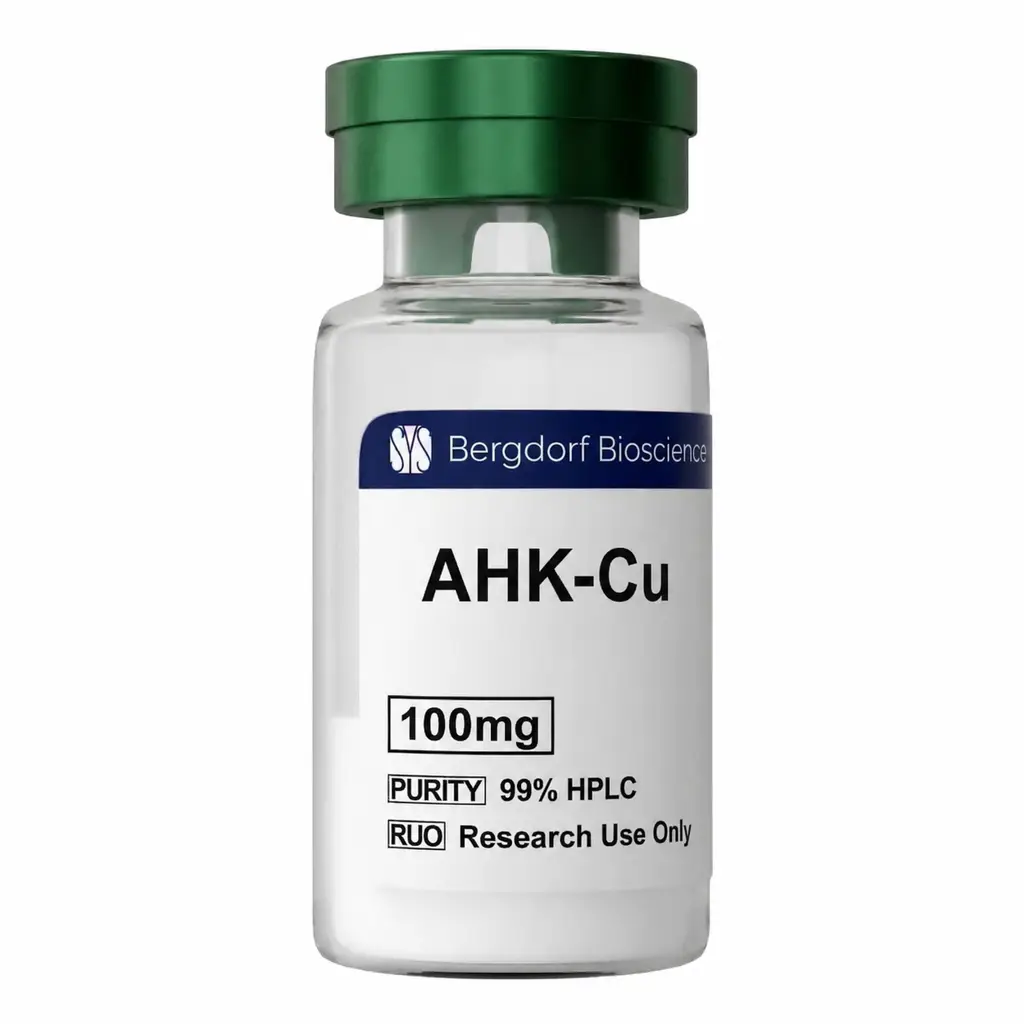
Research peptide · Alanine-histidine-lysine copper complex
AHK-Cu 100 mg
AHK-Cu 100 mg is a lyophilized copper tripeptide for controlled ex vivo hair-follicle and in vitro dermal papilla cell research models.

Research peptide · Alanine-histidine-lysine copper complex
AHK-Cu 100 mg is a lyophilized copper tripeptide for controlled ex vivo hair-follicle and in vitro dermal papilla cell research models.
Research peptide · Alanine-histidine-lysine copper complex
AHK-Cu 100 mg is a lyophilized copper tripeptide for controlled ex vivo hair-follicle and in vitro dermal papilla cell research models.
No reviews yet. Be the first to share your experience.
No reviews yet. Be the first to share your experience.
/ vial
Order today → Delivery Mon, Sep 28 – Tue, Oct 06 to United States
Payment Methods





/ vial
Order today → Delivery Mon, Sep 28 – Tue, Oct 06 to United States
Payment Methods
3,000+
satisfied researchers
99.43%
Avg. purity 2026
4.8 ★
ProvenExpert
99.43%
Avg. purity 2026
4.8 ★
ProvenExpert
3,000+ satisfied researchers
Research details
AHK-Cu is the copper(II) complex of the tripeptide L-alanyl-L-histidyl-L-lysine (Ala-His-Lys). It is a copper peptide, but not interchangeable with GHK-Cu: AHK begins with alanine, while GHK begins with glycine. This sequence difference must be preserved when literature, materials, and assay results are compared.
This 100 mg product is supplied as lyophilized material in a sealed research vial. It is an experimental input for controlled laboratory work, not a medicine, cosmetic, food, or consumer preparation. This page limits its evidence summary to AHK-Cu itself and does not transfer findings from GHK-Cu.
The central primary publication is the 2007 study by Pyo and colleagues in Archives of Pharmacal Research (PMID 17703734). The investigators evaluated AHK-Cu in two complementary experimental systems: isolated human hair follicles maintained ex vivo and cultured human dermal papilla cells studied in vitro. These are human-derived laboratory models, but they are not clinical trials and do not measure outcomes in treated people.
Dermal papilla cells are specialized fibroblast-like cells within the follicle and are relevant to morphogenesis and growth. The paired models allowed the authors to assess tissue elongation, cell proliferation, and apoptosis-related markers. The evidence remains specific to those systems.
In the reported experiments, AHK-Cu at concentrations from 10⁻¹² to 10⁻⁹ M stimulated elongation of isolated human hair follicles ex vivo and proliferation of cultured dermal papilla cells in vitro. These concentrations describe the experimental systems in the paper. They are not human doses, administration instructions, or a basis for converting the study into personal use.
The observations support using AHK-Cu as a laboratory reference for follicle tissue and dermal papilla cell behavior. They do not show that a finished product causes hair growth in people. Model design, exposure, vehicle, tissue condition, timing, and analytical method can affect reproducibility.
The authors also examined markers connected with programmed cell death in dermal papilla cells. At 10⁻⁹ M, AHK-Cu was associated with a higher Bcl-2/Bax ratio and lower levels of the cleaved forms of caspase-3 and PARP. These molecular observations were interpreted within the study as consistent with an anti-apoptotic signaling pattern in the cultured cells.
An important qualifier is part of the same primary report: although flow-cytometry analysis showed fewer apoptotic dermal papilla cells after exposure at 10⁻⁹ M, that reduction was not statistically significant. Preserving this distinction prevents a directional laboratory observation from being presented as a confirmed effect. The biomarker findings remain mechanistic evidence from cultured cells, not proof of clinical benefit.
The cited evidence is preclinical. Ex vivo follicles retain tissue architecture, while in vitro cultures isolate dermal papilla cells; neither model reproduces human pharmacokinetics or safety. The study cannot establish treatment efficacy, cosmetic performance, tolerability, dose, or an administration route.
The publication also does not provide a validated human systemic half-life for AHK-Cu. No half-life value is assigned in this master because substituting pharmacokinetic figures from GHK-Cu or another copper peptide would conflate distinct compounds. Any future half-life statement would require direct, molecule-specific systemic pharmacokinetic evidence and an explicit source.
AHK-Cu should be identified consistently by its full sequence and copper(II)-complex designation when experiments are documented. Laboratories should record the material identifier, weighed mass, preparation conditions, solvent or buffer, final molar concentration, controls, exposure period, and assay endpoint. These details are essential when nanomolar or picomolar experimental conditions are compared across runs.
Copper-peptide studies may require controls for the peptide, complex, and vehicle where relevant. AHK-Cu results must not be labeled as GHK-Cu results, and observations from other copper peptides cannot be imported as though measured for AHK-Cu. Qualified laboratory personnel remain responsible for protocol design and interpretation.
The vial contains 100 mg of lyophilized AHK-Cu research material. Lyophilization defines the physical format; it does not establish purity, sterility, shelf life, or assay performance. This master makes no unverified claim about GMP manufacture, certificates, chromatography, mass spectrometry, percentage purity, endotoxin status, or batch testing.
Keep the unopened vial sealed, dry, protected from light, and under the conditions printed on its label. Preparation and post-preparation stability depend on the laboratory protocol and must be established for the intended analytical system. This description intentionally provides no reconstitution recipe, injection guidance, human-use instruction, or clinical handling recommendation.
AHK-Cu is for laboratory research use only, not human consumption, cosmetic self-application, diagnosis, treatment, clinical use, or veterinary use. Researchers must follow institutional risk assessment, documentation, protective equipment, waste handling, and regulatory procedures.
The sealed lyophilized vial is dispatched with tracking in protective packaging. On receipt, the laboratory should inspect the container and label, document its condition, and transfer it to the labeled storage environment. Current availability and logistics belong in operational storefront data rather than scientific claims in the product description.
For laboratory research use only. Not for human consumption, cosmetic self-application, diagnosis, treatment, clinical use, or veterinary use.
In the cited preclinical models, AHK-Cu was associated with elongation of isolated human hair follicles ex vivo and proliferation of cultured human dermal papilla cells in vitro. At 10⁻⁹ M, the study also reported a higher Bcl-2/Bax ratio and lower levels of cleaved caspase-3 and PARP; a reduction in apoptotic cell count was not statistically significant.
AHK-Cu is L-alanyl-L-histidyl-L-lysine complexed with copper(II), a three-residue copper peptide studied in laboratory models involving human hair follicles and dermal papilla cells.
3,000+
satisfied researchers
99.43%
Avg. purity 2026
4.8 ★
ProvenExpert
99.43%
Avg. purity 2026
4.8 ★
ProvenExpert
3,000+ satisfied researchers
Research details
AHK-Cu is the copper(II) complex of the tripeptide L-alanyl-L-histidyl-L-lysine (Ala-His-Lys). It is a copper peptide, but not interchangeable with GHK-Cu: AHK begins with alanine, while GHK begins with glycine. This sequence difference must be preserved when literature, materials, and assay results are compared.
This 100 mg product is supplied as lyophilized material in a sealed research vial. It is an experimental input for controlled laboratory work, not a medicine, cosmetic, food, or consumer preparation. This page limits its evidence summary to AHK-Cu itself and does not transfer findings from GHK-Cu.
The central primary publication is the 2007 study by Pyo and colleagues in Archives of Pharmacal Research (PMID 17703734). The investigators evaluated AHK-Cu in two complementary experimental systems: isolated human hair follicles maintained ex vivo and cultured human dermal papilla cells studied in vitro. These are human-derived laboratory models, but they are not clinical trials and do not measure outcomes in treated people.
Dermal papilla cells are specialized fibroblast-like cells within the follicle and are relevant to morphogenesis and growth. The paired models allowed the authors to assess tissue elongation, cell proliferation, and apoptosis-related markers. The evidence remains specific to those systems.
In the reported experiments, AHK-Cu at concentrations from 10⁻¹² to 10⁻⁹ M stimulated elongation of isolated human hair follicles ex vivo and proliferation of cultured dermal papilla cells in vitro. These concentrations describe the experimental systems in the paper. They are not human doses, administration instructions, or a basis for converting the study into personal use.
The observations support using AHK-Cu as a laboratory reference for follicle tissue and dermal papilla cell behavior. They do not show that a finished product causes hair growth in people. Model design, exposure, vehicle, tissue condition, timing, and analytical method can affect reproducibility.
The authors also examined markers connected with programmed cell death in dermal papilla cells. At 10⁻⁹ M, AHK-Cu was associated with a higher Bcl-2/Bax ratio and lower levels of the cleaved forms of caspase-3 and PARP. These molecular observations were interpreted within the study as consistent with an anti-apoptotic signaling pattern in the cultured cells.
An important qualifier is part of the same primary report: although flow-cytometry analysis showed fewer apoptotic dermal papilla cells after exposure at 10⁻⁹ M, that reduction was not statistically significant. Preserving this distinction prevents a directional laboratory observation from being presented as a confirmed effect. The biomarker findings remain mechanistic evidence from cultured cells, not proof of clinical benefit.
The cited evidence is preclinical. Ex vivo follicles retain tissue architecture, while in vitro cultures isolate dermal papilla cells; neither model reproduces human pharmacokinetics or safety. The study cannot establish treatment efficacy, cosmetic performance, tolerability, dose, or an administration route.
The publication also does not provide a validated human systemic half-life for AHK-Cu. No half-life value is assigned in this master because substituting pharmacokinetic figures from GHK-Cu or another copper peptide would conflate distinct compounds. Any future half-life statement would require direct, molecule-specific systemic pharmacokinetic evidence and an explicit source.
AHK-Cu should be identified consistently by its full sequence and copper(II)-complex designation when experiments are documented. Laboratories should record the material identifier, weighed mass, preparation conditions, solvent or buffer, final molar concentration, controls, exposure period, and assay endpoint. These details are essential when nanomolar or picomolar experimental conditions are compared across runs.
Copper-peptide studies may require controls for the peptide, complex, and vehicle where relevant. AHK-Cu results must not be labeled as GHK-Cu results, and observations from other copper peptides cannot be imported as though measured for AHK-Cu. Qualified laboratory personnel remain responsible for protocol design and interpretation.
The vial contains 100 mg of lyophilized AHK-Cu research material. Lyophilization defines the physical format; it does not establish purity, sterility, shelf life, or assay performance. This master makes no unverified claim about GMP manufacture, certificates, chromatography, mass spectrometry, percentage purity, endotoxin status, or batch testing.
Keep the unopened vial sealed, dry, protected from light, and under the conditions printed on its label. Preparation and post-preparation stability depend on the laboratory protocol and must be established for the intended analytical system. This description intentionally provides no reconstitution recipe, injection guidance, human-use instruction, or clinical handling recommendation.
AHK-Cu is for laboratory research use only, not human consumption, cosmetic self-application, diagnosis, treatment, clinical use, or veterinary use. Researchers must follow institutional risk assessment, documentation, protective equipment, waste handling, and regulatory procedures.
The sealed lyophilized vial is dispatched with tracking in protective packaging. On receipt, the laboratory should inspect the container and label, document its condition, and transfer it to the labeled storage environment. Current availability and logistics belong in operational storefront data rather than scientific claims in the product description.
For laboratory research use only. Not for human consumption, cosmetic self-application, diagnosis, treatment, clinical use, or veterinary use.
In the cited preclinical models, AHK-Cu was associated with elongation of isolated human hair follicles ex vivo and proliferation of cultured human dermal papilla cells in vitro. At 10⁻⁹ M, the study also reported a higher Bcl-2/Bax ratio and lower levels of cleaved caspase-3 and PARP; a reduction in apoptotic cell count was not statistically significant.
AHK-Cu is L-alanyl-L-histidyl-L-lysine complexed with copper(II), a three-residue copper peptide studied in laboratory models involving human hair follicles and dermal papilla cells.