
Calculate exact reconstitution volumes, insulin units, and doses per vial for any peptide.
Vial, water and dose are known
Units measure volume, not active substance. 6 IU = 0.06 ml. How many mg are in there depends on the mix. The calculator has worked that out for you.
Almost all insulin syringes are U-100. Only choose U-40 if the syringe is marked U-40.
The linked sources lead to PubMed and open in a new tab.
Semax is a synthetic heptapeptide composed of seven amino acids with the sequence Met-Glu-His-Phe-Pro-Gly-Pro (MEHFPGP). It is derived from a fragment of adrenocorticotropic hormone (ACTH 4-10), to which the stabilizing tripeptide ending Pro-Gly-Pro has been attached at the C-terminus. This modification fully removes the hormonal — that is, corticotropic — activity of the original ACTH fragment while substantially extending the duration of biological action. What remains are the neurotropic and neuroprotective properties, without any stimulation of the adrenal axis. Semax is therefore classified as a pure neuropeptide rather than a hormone.
Semax was developed in the 1980s at the Institute of Molecular Genetics of the Russian Academy of Sciences in collaboration with Lomonosov Moscow State University. In Russia, the compound has since been studied intensively in neurological research, including in models of ischemic stroke, cognitive load, attention disorders, and optic neuropathy. A defining feature is its intranasal route: Semax is typically administered as an aqueous solution in the form of nasal drops or nasal spray, not by injection. Through the well-vascularized nasal mucosa, and in part via the olfactory nerve, the peptide reaches central nervous system compartments quickly.
In plasma, Semax has an exceptionally short half-life on the order of a few minutes, as it is rapidly degraded by peptidases. The biological effect, however, lasts considerably longer than the measurable plasma concentration would suggest. This is attributed to downstream signaling cascades — in particular the upregulation of neurotrophic factors, which remain detectable hours after administration. This decoupling of plasma half-life from duration of action is a hallmark of regulatory neuropeptides and shapes the dosing logic for Semax.
Semax does not act through a single receptor; instead, it modulates several neurochemical systems simultaneously. The mechanisms best documented in preclinical research are:
An important distinction from classic stimulants: Semax does not acutely increase catecholamine release the way an amphetamine does — it modulates signal processing. The reported effects are therefore better described as regulating and stabilizing rather than acutely activating.
Because Semax is administered intranasally, dosing does not refer to an injection volume but to the amount of peptide delivered into the nose per application. The lyophilized powder is typically dissolved in water so that a defined concentration per drop is obtained. Dosing is individual and should begin at the lower end of the range.
A common vial size is 5 mg. Dissolving it in 2 mL of a suitable solvent (sterile or bacteriostatic water) gives a concentration of 2.5 mg/mL (2,500 mcg/mL). A typical drop from a standard dropper bottle is roughly 0.05 mL.
The exact drop size varies with the pipette or spray head, so it is only a guideline. At a daily dose of 300 mcg, a 5 mg vial provides roughly 16 days of dosing on paper. Use the Semax calculator above to determine the concentration, volume per dose, and vial duration precisely for any vial size and solvent volume.
Semax is supplied as a lyophilized (freeze-dried) powder in sealed vials and must be brought into solution before use. For an intranasal solution used over several days, bacteriostatic water is sensible, as the benzyl alcohol it contains inhibits microbial growth. Cleanliness is especially important when handling anything applied to the nasal mucosa.
Before use, gently blow the nose if needed. Tilt the head slightly back or to the side and deliver the calculated number of drops into each nostril without letting the pipette or spray head touch the nasal mucosa. After instilling the drops, remain in the tilted position for a few seconds so the solution can be absorbed by the mucosa, and do not blow the nose immediately afterward. If the daily dose is split, the applications should be spread across the day. If the solution becomes cloudy, discolored, or contains visible particles, discard the vial and do not continue using it.
Semax is regarded as well tolerated in preclinical research and in the limited clinical research conducted in Russia. Because the Pro-Gly-Pro modification removes the corticotropic activity of the original ACTH fragment, Semax does not stimulate the adrenal axis and causes no hormonal shifts. Robust long-term human data outside Russia is lacking, however, which is why use remains in the research domain.
No serious adverse events have been described in the published research at standard doses. Given the absence of large-scale international trials, caution is warranted, and consultation with a qualified healthcare professional is strongly recommended.
The combination of Semax and Selank is one of the best-known neuropeptide stacks. Both peptides come from the same Russian research tradition and are administered intranasally, but they complement each other in profile: Semax leans toward drive and focus, while Selank, as an anxiolytic peptide, contributes a calming, anxiety-dampening component. Combined, the stack aims to support cognitive performance without the jitteriness often associated with stimulants. The two solutions are typically prepared separately and used one after the other, not mixed in a single vial.
N-Acetyl Semax is an acetylated variant of the Semax molecule. The acetyl group at the N-terminus increases stability against peptidases and extends the duration of action, which is why N-Acetyl Semax is often described as a more potent and longer-acting version. In practice, the two compounds are usually viewed not as a stack but as alternatives to each other. Anyone switching from Semax to N-Acetyl Semax should recalibrate the dose, as effective potency differs.
Some research protocols combine daytime Semax with DSIP (Delta Sleep-Inducing Peptide) in the evening. The rationale is to confine the drive-oriented effect of Semax to the active part of the day and flank it with a sleep-supporting component in the evening. Because Semax can disrupt sleep when used late, this separation addresses the timing issue directly.
Research-grade Semax is available directly from BergdorfBio: Semax at BergdorfBio.
Semax is used almost exclusively as nasal drops or nasal spray. The nasal mucosa is richly vascularized, and a portion of the peptide can reach central nervous system structures relatively directly via the olfactory nerve. The intranasal route also bypasses first-pass metabolism in the liver. Because Semax is degraded very quickly in plasma, mucosal absorption offers a practical, non-invasive route of administration.
Users often report a relatively rapid effect on alertness and concentration within the first one to two hours after application. The neurotrophic effects — the upregulation of BDNF and NGF — develop more slowly and are associated more with repeated use over days and weeks.
No. Although Semax is derived from an ACTH fragment, the added Pro-Gly-Pro sequence removes the corticotropic, hormone-stimulating activity. Semax does not stimulate the adrenal glands and does not raise cortisol levels. It is therefore classified as a pure neuropeptide rather than a hormone, and no post-cycle therapy is required.
N-Acetyl Semax carries an acetyl group at the N-terminus, which makes the molecule more stable against enzymatic breakdown. As a result, N-Acetyl Semax tends to act more strongly and for longer than unmodified Semax. Both share the same mechanism of action through the upregulation of neurotrophic factors. Anyone switching between the two should adjust the dose.
Research protocols often run for two to four weeks, followed by a break. Longer continuous use has been described, but cyclical use is preferred as a precaution, since robust long-term human data outside Russia is lacking. Breaks also provide an opportunity to assess one's actual baseline state without the peptide.
It can. Because of its drive- and alertness-oriented effect, Semax may make it harder to fall asleep when used in the late afternoon or evening. In practice, use is therefore usually scheduled in the first half of the day.
No. Semax does not acutely increase catecholamine release the way a classic stimulant does; instead, it modulates signal processing within monoaminergic and neurotrophic systems. The reported effects are better described as regulating and stabilizing. A pronounced crash, as seen with stimulants, is typically not reported.
BergdorfBio offers research-grade Semax with verified purity and concentration. View the product page: Buy Semax at BergdorfBio. All products are sold strictly for research purposes.
Medical Disclaimer: The information on this page is provided for educational and research purposes only. Outside its country of origin, Semax is not an approved drug or medical treatment and is sold strictly for research use. Nothing on this page constitutes medical advice, diagnosis, or a recommendation to use any specific compound. Always consult a qualified healthcare professional before beginning any peptide protocol. BergdorfBio assumes no liability for the use or misuse of the information presented here.
From powder to a ready syringe in five steps. The calculator above gives you the amounts automatically.
Bring vial and water to room temperature. Wipe both rubber stoppers with an alcohol swab.
Draw up the amount of BAC water recommended by the calculator using a larger syringe.
Let the water run down the inside wall of the peptide vial, do not spray it directly onto the powder.
Roll the vial gently, do not shake. The powder dissolves clear within 1-2 minutes.
Draw up to exactly the calculated mark with the insulin syringe. Done.
Typical starting values for orientation. Each row opens the calculator for that peptide.
| Peptide | Category | Typical dose | Vial sizes | BAC (start) | Available | Calculate |
|---|---|---|---|---|---|---|
| VIP | Neuropeptide Research | - | 10 mg | 2 ml | Calculator only | Calculate |
| Retatrutide | GLP-1/GIP/GCG | 0,5-12 mg | 2 / 5 / 10 / 15 mg | 2 ml | Calculator only | Calculate |
| Cagrilintide | Amylin Analogue | - | 5 mg | 2 ml | Calculator only | Calculate |
| Semaglutide | GLP-1 | 0,25-2,4 mg | 2 / 5 / 10 mg | 2 ml | Calculator only | Calculate |
| Tirzepatide | GLP-1/GIP | 2,5-15 mg | 10 / 15 / 20 / 30 / 60 / 90 mg | 2 ml | Calculator only | Calculate |
| GHK-Cu | Copper Peptide | 1-4 mg | 10 / 20 / 50 mg | 5 ml | Calculator only | Calculate |
| AHK-Cu | Copper Peptide | - | 100 mg | 5 ml | Calculator only | Calculate |
| BPC-157 | Tissue Repair | 0,2-0,5 mg | 2 / 5 / 10 mg | 2 ml | Calculator only | Calculate |
| TB-500 | Thymosin Beta-4 | 2-5 mg | 2 / 5 / 10 mg | 2 ml | Calculator only | Calculate |
| CJC-1295 (no DAC) | GHRH Analog | 100-200 mcg | 2 / 5 / 10 mg | 2 ml | Calculator only | Calculate |
| Ipamorelin | GHRP | 200-300 mcg | 2 / 5 mg | 2 ml | Calculator only | Calculate |
| AOD-9604 | Fat Loss | 250-500 mcg | 2 / 5 mg | 2 ml | Calculator only | Calculate |
| PT-141 | Bremelanotide | - | 2 / 5 / 10 mg | 2 ml | Calculator only | Calculate |
| MOTS-c | Mitochondrial | 5-10 mg | 5 / 10 mg | 2 ml | Calculator only | Calculate |
| Selank | Anxiolytic | 150-500 mcg | 2 / 5 / 10 mg | 2 ml | Calculator only | Calculate |
| SS-31 | Elamipretide | 0,1-1 mg | 5 / 10 mg | 2 ml | Calculator only | Calculate |
| Glow Stack | Stack | 0,5-2 mg | 70 mg | 3 ml | Calculator only | Calculate |
| Klow Stack | Stack | 0,5-2 mg | 55 mg | 3 ml | Calculator only | Calculate |
| Melanotan II | Melanocortin | 100-1000 mcg | 5 / 10 mg | 2 ml | Calculator only | Calculate |
| Melanotan I | Melanocortin | - | 5 / 10 mg | 2 ml | Calculator only | Calculate |
| Sermorelin | GHRH Analog | 50-300 mcg | 5 mg | 2 ml | Calculator only | Calculate |
| Tesamorelin | GHRH Analog | 1-2 mg | 10 / 20 mg | 2 ml | Calculator only | Calculate |
| Thymosin Alpha-1 | Thymic Peptide | 0,8-3,2 mg | 1.6 / 5 / 10 mg | 1 ml | Calculator only | Calculate |
| Epithalon | Longevity | 2-10 mg | 10 / 20 / 50 mg | 2 ml | Calculator only | Calculate |
| KPV | Immune / Barrier | 100-1000 mcg | 5 / 10 mg | 2 ml | Calculator only | Calculate |
| HGH Fragment 176-191 | Metabolic Fragment | 100-500 mcg | 2 / 5 / 10 mg | 2 ml | Calculator only | Calculate |
| Semax | Cognitive | 100-1000 mcg | 10 / 30 mg | 2 ml | Calculator only | Calculate |
| N-Acetyl Semax | Cognitive | 100-1000 mcg | 5 / 10 mg | 2 ml | Calculator only | Calculate |
| Hexarelin | GHRP | 50-200 mcg | 2 / 5 mg | 2 ml | Calculator only | Calculate |
| GHRP-6 | GHRP | 50-300 mcg | 2 / 5 mg | 2 ml | Calculator only | Calculate |
| GHRP-2 | GHRP | 50-250 mcg | 2 / 5 mg | 2 ml | Calculator only | Calculate |
| DSIP | Sleep | 50-500 mcg | 10 mg | 2 ml | Calculator only | Calculate |
| 5-Amino-1MQ | Metabolic | 2,5-10 mg | 10 mg | 2 ml | Calculator only | Calculate |
| Pinealon | Research peptide | - | 10 mg | 2 ml | Calculator only | Calculate |
| Survodutide | GLP-1/Glucagon | - | 10 mg | 2 ml | Calculator only | Calculate |
| Kisspeptin-10 | KISS1R / GPR54 | - | 10 mg | 2 ml | Calculator only | Calculate |
| HGH 191AA | Growth Hormone | 1-5 mg | 10 mg | 1 ml | Calculator only | Calculate |
| NAD+ | Longevity / Cofactor | 100-500 mg | 1000 mg | 10 ml | Calculator only | Calculate |
Values are for orientation in a research context and do not replace professional advice.
Calculating concentration and injection volume correctly seems trivial, but it is the most common source of error. Even a 10 % miscalculation during reconstitution means you either get too little active substance or unintentionally overdose.
Lyophilized peptides are supplied in milligrams and dissolved in bacteriostatic water (BAC water). The ratio of peptide to water determines the concentration, and from that follows how many units you draw up on the insulin syringe. Insulin syringes are scaled in units, not milligrams. The calculator handles this conversion, including the plausibility check against the most dangerous error: confusing mg and mcg.
Milligrams (mg) is the unit lyophilized peptides are sold in, for example “5 mg BPC-157”. Micrograms (mcg) measure the single dose, for example “250 mcg per injection”. 1 mg = 1,000 mcg. The calculator converts automatically and warns when an entry looks like a mix-up.
U-100 means the syringe is calibrated for 100 units per milliliter. 100 IU = 1 ml, so 10 IU = 0.10 ml, regardless of what is in the syringe. The IU calculation is based on exactly this relationship.
With a lot of peptide and little water the solution becomes very concentrated, so the volume per dose is tiny and hard to read. Use the mixing helper: it finds the water volume that produces a clean, easily readable mark.
In the fridge at 2-8 °C usually 21-30 days. Label the vial with the reconstitution date. Cloudy solutions or particles are a no-go.
Blends contain several active substances in one vial. Just select the blend as your peptide: the calculator additionally shows how much of each component is in your injection. For combinations of several separate vials, use the Stack Builder.
No. Your last settings are stored locally in the browser and restored on your next visit. You can also recall calculations from the history, save them as a protocol or share them as a link.
Choose a peptide to open its dedicated calculator page with pre-filled values.
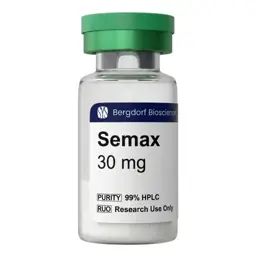
In stock
View Product
SemaxTypical starting values for orientation. Each row opens the calculator for that peptide.
| Peptide | Category | Typical dose | Vial sizes | BAC (start) | Available | Calculate |
|---|---|---|---|---|---|---|
| VIP | Neuropeptide Research | - | 10 mg | 2 ml | In stock | Calculate |
| Retatrutide | GLP-1/GIP/GCG | 0,5-12 mg | 2 / 5 / 10 / 15 mg | 2 ml | In stock | Calculate |
| Cagrilintide | Amylin Analogue | - | 5 mg | 2 ml | In stock | Calculate |
| Tirzepatide | GLP-1/GIP | 2,5-15 mg | 10 / 15 / 20 / 30 / 60 / 90 mg | 2 ml | In stock | Calculate |
| GHK-Cu | Copper Peptide | 1-4 mg | 10 / 20 / 50 mg | 5 ml | In stock | Calculate |
| AHK-Cu | Copper Peptide | - | 100 mg | 5 ml | In stock | Calculate |
| BPC-157 | Tissue Repair | 0,2-0,5 mg | 2 / 5 / 10 mg | 2 ml | In stock | Calculate |
| TB-500 | Thymosin Beta-4 | 2-5 mg | 2 / 5 / 10 mg | 2 ml | In stock | Calculate |
| CJC-1295 (no DAC) | GHRH Analog | 100-200 mcg | 2 / 5 / 10 mg | 2 ml | In stock | Calculate |
| Ipamorelin | GHRP | 200-300 mcg | 2 / 5 mg | 2 ml | In stock | Calculate |
| PT-141 | Bremelanotide | - | 2 / 5 / 10 mg | 2 ml | In stock | Calculate |
| MOTS-c | Mitochondrial | 5-10 mg | 5 / 10 mg | 2 ml | In stock | Calculate |
| Selank | Anxiolytic | 150-500 mcg | 2 / 5 / 10 mg | 2 ml | In stock | Calculate |
| SS-31 | Elamipretide | 0,1-1 mg | 5 / 10 mg | 2 ml | In stock | Calculate |
| Glow Stack | Stack | 0,5-2 mg | 70 mg | 3 ml | In stock | Calculate |
| Klow Stack | Stack | 0,5-2 mg | 55 mg | 3 ml | In stock | Calculate |
| Melanotan II | Melanocortin | 100-1000 mcg | 5 / 10 mg | 2 ml | In stock | Calculate |
| Melanotan I | Melanocortin | - | 5 / 10 mg | 2 ml | In stock | Calculate |
| Sermorelin | GHRH Analog | 50-300 mcg | 5 mg | 2 ml | In stock | Calculate |
| Tesamorelin | GHRH Analog | 1-2 mg | 10 / 20 mg | 2 ml | In stock | Calculate |
| Thymosin Alpha-1 | Thymic Peptide | 0,8-3,2 mg | 1.6 / 5 / 10 mg | 1 ml | In stock | Calculate |
| Epithalon | Longevity | 2-10 mg | 10 / 20 / 50 mg | 2 ml | In stock | Calculate |
| KPV | Immune / Barrier | 100-1000 mcg | 5 / 10 mg | 2 ml | In stock | Calculate |
| Semax | Cognitive | 100-1000 mcg | 10 / 30 mg | 2 ml | In stock | Calculate |
| DSIP | Sleep | 50-500 mcg | 10 mg | 2 ml | In stock | Calculate |
| 5-Amino-1MQ | Metabolic | 2,5-10 mg | 10 mg | 2 ml | In stock | Calculate |
| Pinealon | Research peptide | - | 10 mg | 2 ml | In stock | Calculate |
| Survodutide | GLP-1/Glucagon | - | 10 mg | 2 ml | In stock | Calculate |
| Kisspeptin-10 | KISS1R / GPR54 | - | 10 mg | 2 ml | In stock | Calculate |
| NAD+ | Longevity / Cofactor | 100-500 mg | 1000 mg | 10 ml | In stock | Calculate |
| Semaglutide | GLP-1 | 0,25-2,4 mg | 2 / 5 / 10 mg | 2 ml | Calculator only | Calculate |
| AOD-9604 | Fat Loss | 250-500 mcg | 2 / 5 mg | 2 ml | Calculator only | Calculate |
| HGH Fragment 176-191 | Metabolic Fragment | 100-500 mcg | 2 / 5 / 10 mg | 2 ml | Calculator only | Calculate |
| N-Acetyl Semax | Cognitive | 100-1000 mcg | 5 / 10 mg | 2 ml | Calculator only | Calculate |
| Hexarelin | GHRP | 50-200 mcg | 2 / 5 mg | 2 ml | Calculator only | Calculate |
| GHRP-6 | GHRP | 50-300 mcg | 2 / 5 mg | 2 ml | Calculator only | Calculate |
| GHRP-2 | GHRP | 50-250 mcg | 2 / 5 mg | 2 ml | Calculator only | Calculate |
| HGH 191AA | Growth Hormone | 1-5 mg | 10 mg | 1 ml | Calculator only | Calculate |
Values are for orientation in a research context and do not replace professional advice.
Choose a peptide to open its dedicated calculator page with pre-filled values.