
Calcule volumes de reconstituição exatos, unidades de insulina e doses por frasco para qualquer peptídeo.
Frasco, água e dose são conhecidos
Os traços medem o volume, não a substância ativa. 10 IU = 0,10 ml. Quantos mg estão contidos depende da mistura. A calculadora já fez essa conta por si.
Quase todas as seringas de insulina são U-100. Escolha U-40 apenas se a seringa indicar U-40.
As fontes vinculadas levam ao PubMed e abrem em uma nova aba.
Perfil científico
SS-31 no Léxico de Peptídeos: mecanismo de ação, nível de evidência e fontes
Ferramenta complementar
Veja quanto tempo SS-31 permanece no seu sistema
SS-31, also known by its clinical development name elamipretide and the research designation MTP-131, is a synthetic tetrapeptide developed by Hazel Szeto and Peter Schiller at Weill Cornell Medical College in the early 2000s. The sequence is D-Arg-dimethylTyr-Lys-Phe-NH2 — a cell-permeable, mitochondria-targeted peptide belonging to the Szeto-Schiller (SS) family of compounds.
SS-31 is unique among research peptides in its ability to selectively concentrate in the inner mitochondrial membrane (IMM), where it binds with high affinity to cardiolipin — a phospholipid found almost exclusively in the IMM and essential for the structural integrity of the electron transport chain (ETC). This specific mechanism of action places SS-31 in a class of its own: it is not a signaling peptide acting through cell-surface receptors, but a membrane-targeted therapeutic that physically restores mitochondrial architecture.
Clinically, SS-31 (as elamipretide) has been the subject of Phase II and Phase III trials for Barth syndrome — a rare genetic disorder caused by mutations in the tafazzin gene that result in abnormal cardiolipin remodeling and consequent mitochondrial dysfunction. The drug received Orphan Drug and Breakthrough Therapy designation from the FDA. Beyond Barth syndrome, SS-31 has been studied in models of heart failure, renal ischemia-reperfusion injury, neurodegenerative disease, and aging.
SS-31's mechanism is centered on cardiolipin, a structurally critical phospholipid of the inner mitochondrial membrane:
SS-31 research dosing in humans is extrapolated primarily from animal studies and from the clinical trial dosing used in Barth syndrome research. Use the SS-31 Calculator to determine exact volumes for your reconstituted vial.
SS-31 is typically dosed once daily:
A standard 5 mg vial reconstituted with 2 mL BAC water yields 2.5 mg/mL. At this concentration, a 0.5 mg dose = 0.20 mL (200 µL) drawn into a 0.3 mL insulin syringe. View SS-31 at BergdorfBio for purchasing options.
SS-31 is supplied as lyophilized powder, typically in 5 mg or 10 mg vials. Reconstitute with bacteriostatic water (BAC water) as follows:
SS-31 reconstitutes readily and does not require extended mixing. Use the SS-31 Peptide Calculator to compute exact draw volumes for any dose and vial concentration combination.
SS-31 has a well-characterized preclinical safety profile and has been evaluated in multiple human clinical trials as elamipretide. The overall safety record is favorable.
In Phase I pharmacokinetic studies, SS-31 was well tolerated at single doses up to 0.25 mg/kg in healthy volunteers. No dose-limiting toxicities, organ toxicity, or serious adverse events were reported at research-relevant doses.
The most mechanistically coherent SS-31 stack pairs it with MOTS-c. SS-31 addresses structural damage in the inner mitochondrial membrane — restoring cardiolipin integrity, ETC supercomplex function, and reducing ROS. MOTS-c addresses mitochondrial signaling deficits — activating AMPK, upregulating PGC-1α-driven biogenesis, and improving systemic metabolic efficiency. Together they form a complete mitochondrial rehabilitation protocol: structural repair (SS-31) plus functional reprogramming (MOTS-c).
For researchers focused on brain health, the combination of SS-31 and Selank addresses mitochondrial neuronal aging alongside anxiolytic and neuroplasticity support. Neuronal mitochondria are among the most metabolically demanding in the body and among the most affected by age-related cardiolipin peroxidation. SS-31 addresses this at the structural level while Selank enhances BDNF, reduces cortisol stress burden, and supports GABAergic tone. For cognitive longevity or stress-related cognitive decline, this is a well-reasoned combination.
For individuals with a clear mitochondrial dysfunction focus — post-ischemic recovery, Barth syndrome research, heart failure models, or general mitochondrial aging — SS-31 as a standalone protocol is well supported by existing data. Its highly specific mechanism means it does not require supporting peptides to achieve its primary target, though the combinations above broaden its scope.
Coenzyme Q10 and MitoQ are lipophilic antioxidants that reduce mitochondrial ROS by accepting electrons. SS-31 works differently — it does not function primarily as an antioxidant but as a structural stabilizer of cardiolipin. By preventing cardiolipin peroxidation, SS-31 addresses the upstream cause of ETC dysfunction and ROS generation rather than downstream consequences. Studies directly comparing SS-31 with mitochondrial antioxidants in aged tissue consistently show superior outcomes for SS-31 in restoring ETC function and mitochondrial membrane potential.
Barth syndrome is a rare X-linked genetic disorder caused by mutations in the tafazzin (TAZ) gene, which encodes an enzyme essential for cardiolipin remodeling. The result is structurally abnormal cardiolipin that cannot support ETC supercomplex integrity, causing severe mitochondrial cardiomyopathy, skeletal muscle weakness, and immunodeficiency. Because SS-31 targets cardiolipin directly, Barth syndrome is the most mechanistically precise clinical indication for elamipretide, and the clinical trial data from Barth syndrome informs dosing and safety assumptions for broader research use.
In animal studies, significant improvements in mitochondrial respiration and ROS reduction are measurable within 1–2 hours of acute administration. With chronic dosing, structural improvements in cristae morphology and ETC organization are observed within 2–4 weeks. Human researchers in non-clinical settings typically report subjective improvements in energy levels and exercise recovery within 3–6 weeks.
Yes. The cardiac application of SS-31 is one of its best-studied areas. In heart failure models, SS-31 restores mitochondrial bioenergetics in cardiomyocytes, reduces oxidative stress, improves systolic function, and reduces pathological cardiac remodeling. In clinical trials for Barth syndrome cardiomyopathy, improvements in exercise capacity, cardiac function, and quality of life have been documented. The peptide is sometimes used by researchers focusing specifically on cardiovascular longevity.
SS-31 does not permanently accumulate in mitochondria — it distributes rapidly to the inner mitochondrial membrane following subcutaneous injection and is cleared with a half-life of approximately 4 hours. Its benefits are therefore sustained through regular dosing rather than through accumulation. This is consistent with its status as a membrane-stabilizing agent rather than a gene expression modifier.
Renal tubular cells are among the most mitochondria-dense cells in the body and are highly susceptible to ischemia-reperfusion injury. Multiple preclinical studies have demonstrated SS-31's ability to protect renal tissue from ischemic damage, reduce acute kidney injury severity, and preserve renal function. Some researchers investigating nephroprotective protocols include SS-31 based on this body of evidence.
Yes. Neuronal mitochondrial dysfunction is implicated in Alzheimer's disease, Parkinson's disease, ALS, and general cognitive aging. SS-31 has shown neuroprotective effects in multiple preclinical models of these conditions, reducing mitochondrial ROS, preserving synaptic function, and improving neuronal survival. It has been studied specifically in the context of Alzheimer's-related mitochondrial dysfunction, where amyloid-beta-induced cardiolipin peroxidation is a key mechanism.
Given the typical dose of 0.5 mg and a concentration of 2.5 mg/mL (volume = 0.20 mL), a 0.3 mL or 0.5 mL insulin syringe with a 29–31 gauge, 0.5-inch needle is ideal. The small volume allows precise measurement and comfortable subcutaneous delivery.
Medical Disclaimer: The information on this page is provided for educational and research purposes only. SS-31 (elamipretide) is not an approved drug for general use. It is sold strictly for research purposes. Nothing on this page constitutes medical advice, diagnosis, or a recommendation to use any specific compound. Always consult a qualified healthcare professional before beginning any peptide protocol. BergdorfBio assumes no liability for the use or misuse of the information presented here.
Do pó à seringa pronta em cinco passos. As quantidades são fornecidas automaticamente pela calculadora acima.
Deixe o frasco e a água atingirem a temperatura ambiente. Limpe ambas as tampas de borracha com uma compressa de álcool.
Aspire a quantidade de água BAC recomendada pela calculadora com uma seringa maior.
Deixe a água escorrer pela parede de vidro até ao frasco do peptídeo, não a injete diretamente sobre o pó.
Rode o frasco suavemente, não o agite. O pó dissolve-se de forma límpida em 1-2 minutos.
Aspire exatamente até ao traço calculado com a seringa de insulina. Pronto.
Valores iniciais típicos para orientação. Cada linha abre a calculadora para o respectivo peptídeo.
| Peptídeo | Categoria | Dose habitual | Tamanhos de frasco | BAC (início) | Disponível | Calcular |
|---|---|---|---|---|---|---|
| VIP | Pesquisa de neuropeptídeos | - | 10 mg | 2 ml | Só calculadora | Calcular |
| Retatrutide | GLP-1/GIP/GCG | 0,5-12 mg | 2 / 5 / 10 / 15 mg | 2 ml | Só calculadora | Calcular |
| Cagrilintide | Análogo da amilina | - | 5 mg | 2 ml | Só calculadora | Calcular |
| Semaglutid | GLP-1 | 0,25-2,4 mg | 2 / 5 / 10 mg | 2 ml | Só calculadora | Calcular |
| Tirzepatid | GLP-1/GIP | 2,5-15 mg | 5 / 10 / 15 / 20 / 30 / 60 mg | 2 ml | Só calculadora | Calcular |
| GHK-Cu | Kupferpeptid | 1-4 mg | 10 / 20 / 50 mg | 5 ml | Só calculadora | Calcular |
| AHK-Cu | Peptídeo de cobre | - | 100 mg | 5 ml | Só calculadora | Calcular |
| BPC-157 | Gewebereparatur | 0,2-0,5 mg | 2 / 5 / 10 mg | 2 ml | Só calculadora | Calcular |
| TB-500 | Thymosin Beta-4 | 2-5 mg | 2 / 5 / 10 mg | 2 ml | Só calculadora | Calcular |
| CJC-1295 (kein DAC) | GHRH-Analog | 100-200 mcg | 2 / 5 / 10 mg | 2 ml | Só calculadora | Calcular |
| Ipamorelin | GHRP | 200-300 mcg | 2 / 5 mg | 2 ml | Só calculadora | Calcular |
| AOD-9604 | Fettverbrennung | 250-500 mcg | 2 / 5 mg | 2 ml | Só calculadora | Calcular |
| PT-141 | Bremelanotide | - | 2 / 5 / 10 mg | 2 ml | Só calculadora | Calcular |
| MOTS-c | Mitochondrial | 5-10 mg | 5 / 10 mg | 2 ml | Só calculadora | Calcular |
| Selank | Anxiolytisch | 150-500 mcg | 2 / 5 / 10 mg | 2 ml | Só calculadora | Calcular |
| SS-31 | Elamipretide | 0,1-1 mg | 5 / 10 mg | 2 ml | Só calculadora | Calcular |
| Glow Stack | Stack | 0,5-2 mg | 70 mg | 3 ml | Só calculadora | Calcular |
| Klow Stack | Stack | 0,5-2 mg | 55 mg | 3 ml | Só calculadora | Calcular |
| Melanotan II | Melanocortin | 100-1000 mcg | 5 / 10 mg | 2 ml | Só calculadora | Calcular |
| Melanotan I | Melanocortina | - | 5 / 10 mg | 2 ml | Só calculadora | Calcular |
| Sermorelin | GHRH-Analog | 50-300 mcg | 2 / 5 mg | 2 ml | Só calculadora | Calcular |
| Tesamorelin | GHRH-Analog | 1-2 mg | 10 / 20 mg | 2 ml | Só calculadora | Calcular |
| Thymosin Alpha-1 | Thymisches Peptid | 0,8-3,2 mg | 1.6 / 5 / 10 mg | 1 ml | Só calculadora | Calcular |
| Epithalon | Langlebigkeit | 2-10 mg | 10 / 20 / 50 mg | 2 ml | Só calculadora | Calcular |
| KPV | Immun / Barriere | 100-1000 mcg | 5 / 10 mg | 2 ml | Só calculadora | Calcular |
| HGH-Fragment 176-191 | Metabolisches Fragment | 100-500 mcg | 2 / 5 / 10 mg | 2 ml | Só calculadora | Calcular |
| Semax | Kognitiv | 100-1000 mcg | 10 / 30 mg | 2 ml | Só calculadora | Calcular |
| N-Acetyl-Semax | Kognitiv | 100-1000 mcg | 5 / 10 mg | 2 ml | Só calculadora | Calcular |
| Hexarelin | GHRP | 50-200 mcg | 2 / 5 mg | 2 ml | Só calculadora | Calcular |
| GHRP-6 | GHRP | 50-300 mcg | 2 / 5 mg | 2 ml | Só calculadora | Calcular |
| GHRP-2 | GHRP | 50-250 mcg | 2 / 5 mg | 2 ml | Só calculadora | Calcular |
| DSIP | Schlaf | 50-500 mcg | 2 / 5 mg | 2 ml | Só calculadora | Calcular |
| 5-Amino-1MQ | Metabolisch | 2,5-10 mg | 5 / 10 mg | 2 ml | Só calculadora | Calcular |
| HGH 191AA | Wachstumshormon | 1-5 mg | 10 mg | 1 ml | Só calculadora | Calcular |
| NAD+ | Longevity / Cofaktor | 100-500 mg | 1000 mg | 10 ml | Só calculadora | Calcular |
Os valores servem de orientação no contexto de pesquisa e não substituem aconselhamento especializado.
Calcular corretamente a concentração e o volume de injeção parece trivial, mas é a fonte de erro mais comum. Mesmo um erro de cálculo de 10 % durante a reconstituição significa que recebe substância ativa a menos ou que faz uma sobredosagem involuntária.
Os peptídeos liofilizados são fornecidos em miligramas e dissolvidos em água bacteriostática (água BAC). A proporção entre peptídeo e água determina a concentração e, a partir daí, define-se quantos traços aspira na seringa de insulina. As seringas de insulina são graduadas em unidades, não em miligramas. A calculadora trata desta conversão, incluindo a verificação de plausibilidade contra o erro mais perigoso: confundir mg e mcg.
Miligrama (mg) é a unidade em que os peptídeos liofilizados são vendidos, por exemplo «5 mg BPC-157». Micrograma (mcg) mede a dose individual, por exemplo «250 mcg por injeção». 1 mg = 1000 mcg. A calculadora converte automaticamente e avisa quando uma entrada parece ser uma confusão.
U-100 significa que a seringa está calibrada para 100 unidades por mililitro. 100 IU = 1 ml, ou seja, 10 IU = 0,10 ml, independentemente do que está na seringa. O cálculo das IU baseia-se exatamente nesta relação.
Com muito peptídeo e pouca água, a solução fica muito concentrada, pelo que o volume por dose é minúsculo e difícil de ler. Use a ajuda à mistura: ela encontra o volume de água que produz um traço limpo e fácil de ler.
No frigorífico, a 2-8 °C, normalmente 21-30 dias. Identifique o frasco com a data da reconstituição. Soluções turvas ou com partículas são motivo de exclusão.
Os blends contêm várias substâncias ativas num só frasco. Basta selecionar o blend como peptídeo: a calculadora mostra adicionalmente quanto de cada componente está contido na sua injeção. Para combinações de vários frascos separados, use o Stack Builder.
Não. As suas últimas configurações são salvas localmente no navegador e restauradas na próxima visita. Além disso, você pode recuperar cálculos do histórico, salvá-los como protocolo ou compartilhá-los por link.
Escolha um peptídeo para abrir sua página de calculadora dedicada com valores pré-preenchidos.
Calcule volumes de reconstituição exatos, unidades de insulina e doses por frasco para qualquer peptídeo.
Frasco, água e dose são conhecidos
Os traços medem o volume, não a substância ativa. 10 IU = 0,10 ml. Quantos mg estão contidos depende da mistura. A calculadora já fez essa conta por si.
Quase todas as seringas de insulina são U-100. Escolha U-40 apenas se a seringa indicar U-40.
As fontes vinculadas levam ao PubMed e abrem em uma nova aba.
Perfil científico
SS-31 no Léxico de Peptídeos: mecanismo de ação, nível de evidência e fontes
Ferramenta complementar
Veja quanto tempo SS-31 permanece no seu sistema
SS-31, also known by its clinical development name elamipretide and the research designation MTP-131, is a synthetic tetrapeptide developed by Hazel Szeto and Peter Schiller at Weill Cornell Medical College in the early 2000s. The sequence is D-Arg-dimethylTyr-Lys-Phe-NH2 — a cell-permeable, mitochondria-targeted peptide belonging to the Szeto-Schiller (SS) family of compounds.
SS-31 is unique among research peptides in its ability to selectively concentrate in the inner mitochondrial membrane (IMM), where it binds with high affinity to cardiolipin — a phospholipid found almost exclusively in the IMM and essential for the structural integrity of the electron transport chain (ETC). This specific mechanism of action places SS-31 in a class of its own: it is not a signaling peptide acting through cell-surface receptors, but a membrane-targeted therapeutic that physically restores mitochondrial architecture.
Clinically, SS-31 (as elamipretide) has been the subject of Phase II and Phase III trials for Barth syndrome — a rare genetic disorder caused by mutations in the tafazzin gene that result in abnormal cardiolipin remodeling and consequent mitochondrial dysfunction. The drug received Orphan Drug and Breakthrough Therapy designation from the FDA. Beyond Barth syndrome, SS-31 has been studied in models of heart failure, renal ischemia-reperfusion injury, neurodegenerative disease, and aging.
SS-31's mechanism is centered on cardiolipin, a structurally critical phospholipid of the inner mitochondrial membrane:
SS-31 research dosing in humans is extrapolated primarily from animal studies and from the clinical trial dosing used in Barth syndrome research. Use the SS-31 Calculator to determine exact volumes for your reconstituted vial.
SS-31 is typically dosed once daily:
A standard 5 mg vial reconstituted with 2 mL BAC water yields 2.5 mg/mL. At this concentration, a 0.5 mg dose = 0.20 mL (200 µL) drawn into a 0.3 mL insulin syringe. View SS-31 at BergdorfBio for purchasing options.
SS-31 is supplied as lyophilized powder, typically in 5 mg or 10 mg vials. Reconstitute with bacteriostatic water (BAC water) as follows:
SS-31 reconstitutes readily and does not require extended mixing. Use the SS-31 Peptide Calculator to compute exact draw volumes for any dose and vial concentration combination.
SS-31 has a well-characterized preclinical safety profile and has been evaluated in multiple human clinical trials as elamipretide. The overall safety record is favorable.
In Phase I pharmacokinetic studies, SS-31 was well tolerated at single doses up to 0.25 mg/kg in healthy volunteers. No dose-limiting toxicities, organ toxicity, or serious adverse events were reported at research-relevant doses.
The most mechanistically coherent SS-31 stack pairs it with MOTS-c. SS-31 addresses structural damage in the inner mitochondrial membrane — restoring cardiolipin integrity, ETC supercomplex function, and reducing ROS. MOTS-c addresses mitochondrial signaling deficits — activating AMPK, upregulating PGC-1α-driven biogenesis, and improving systemic metabolic efficiency. Together they form a complete mitochondrial rehabilitation protocol: structural repair (SS-31) plus functional reprogramming (MOTS-c).
For researchers focused on brain health, the combination of SS-31 and Selank addresses mitochondrial neuronal aging alongside anxiolytic and neuroplasticity support. Neuronal mitochondria are among the most metabolically demanding in the body and among the most affected by age-related cardiolipin peroxidation. SS-31 addresses this at the structural level while Selank enhances BDNF, reduces cortisol stress burden, and supports GABAergic tone. For cognitive longevity or stress-related cognitive decline, this is a well-reasoned combination.
For individuals with a clear mitochondrial dysfunction focus — post-ischemic recovery, Barth syndrome research, heart failure models, or general mitochondrial aging — SS-31 as a standalone protocol is well supported by existing data. Its highly specific mechanism means it does not require supporting peptides to achieve its primary target, though the combinations above broaden its scope.
Coenzyme Q10 and MitoQ are lipophilic antioxidants that reduce mitochondrial ROS by accepting electrons. SS-31 works differently — it does not function primarily as an antioxidant but as a structural stabilizer of cardiolipin. By preventing cardiolipin peroxidation, SS-31 addresses the upstream cause of ETC dysfunction and ROS generation rather than downstream consequences. Studies directly comparing SS-31 with mitochondrial antioxidants in aged tissue consistently show superior outcomes for SS-31 in restoring ETC function and mitochondrial membrane potential.
Barth syndrome is a rare X-linked genetic disorder caused by mutations in the tafazzin (TAZ) gene, which encodes an enzyme essential for cardiolipin remodeling. The result is structurally abnormal cardiolipin that cannot support ETC supercomplex integrity, causing severe mitochondrial cardiomyopathy, skeletal muscle weakness, and immunodeficiency. Because SS-31 targets cardiolipin directly, Barth syndrome is the most mechanistically precise clinical indication for elamipretide, and the clinical trial data from Barth syndrome informs dosing and safety assumptions for broader research use.
In animal studies, significant improvements in mitochondrial respiration and ROS reduction are measurable within 1–2 hours of acute administration. With chronic dosing, structural improvements in cristae morphology and ETC organization are observed within 2–4 weeks. Human researchers in non-clinical settings typically report subjective improvements in energy levels and exercise recovery within 3–6 weeks.
Yes. The cardiac application of SS-31 is one of its best-studied areas. In heart failure models, SS-31 restores mitochondrial bioenergetics in cardiomyocytes, reduces oxidative stress, improves systolic function, and reduces pathological cardiac remodeling. In clinical trials for Barth syndrome cardiomyopathy, improvements in exercise capacity, cardiac function, and quality of life have been documented. The peptide is sometimes used by researchers focusing specifically on cardiovascular longevity.
SS-31 does not permanently accumulate in mitochondria — it distributes rapidly to the inner mitochondrial membrane following subcutaneous injection and is cleared with a half-life of approximately 4 hours. Its benefits are therefore sustained through regular dosing rather than through accumulation. This is consistent with its status as a membrane-stabilizing agent rather than a gene expression modifier.
Renal tubular cells are among the most mitochondria-dense cells in the body and are highly susceptible to ischemia-reperfusion injury. Multiple preclinical studies have demonstrated SS-31's ability to protect renal tissue from ischemic damage, reduce acute kidney injury severity, and preserve renal function. Some researchers investigating nephroprotective protocols include SS-31 based on this body of evidence.
Yes. Neuronal mitochondrial dysfunction is implicated in Alzheimer's disease, Parkinson's disease, ALS, and general cognitive aging. SS-31 has shown neuroprotective effects in multiple preclinical models of these conditions, reducing mitochondrial ROS, preserving synaptic function, and improving neuronal survival. It has been studied specifically in the context of Alzheimer's-related mitochondrial dysfunction, where amyloid-beta-induced cardiolipin peroxidation is a key mechanism.
Given the typical dose of 0.5 mg and a concentration of 2.5 mg/mL (volume = 0.20 mL), a 0.3 mL or 0.5 mL insulin syringe with a 29–31 gauge, 0.5-inch needle is ideal. The small volume allows precise measurement and comfortable subcutaneous delivery.
Medical Disclaimer: The information on this page is provided for educational and research purposes only. SS-31 (elamipretide) is not an approved drug for general use. It is sold strictly for research purposes. Nothing on this page constitutes medical advice, diagnosis, or a recommendation to use any specific compound. Always consult a qualified healthcare professional before beginning any peptide protocol. BergdorfBio assumes no liability for the use or misuse of the information presented here.
Do pó à seringa pronta em cinco passos. As quantidades são fornecidas automaticamente pela calculadora acima.
Deixe o frasco e a água atingirem a temperatura ambiente. Limpe ambas as tampas de borracha com uma compressa de álcool.
Aspire a quantidade de água BAC recomendada pela calculadora com uma seringa maior.
Deixe a água escorrer pela parede de vidro até ao frasco do peptídeo, não a injete diretamente sobre o pó.
Rode o frasco suavemente, não o agite. O pó dissolve-se de forma límpida em 1-2 minutos.
Aspire exatamente até ao traço calculado com a seringa de insulina. Pronto.
Valores iniciais típicos para orientação. Cada linha abre a calculadora para o respectivo peptídeo.
| Peptídeo | Categoria | Dose habitual | Tamanhos de frasco | BAC (início) | Disponível | Calcular |
|---|---|---|---|---|---|---|
| VIP | Pesquisa de neuropeptídeos | - | 10 mg | 2 ml | Só calculadora | Calcular |
| Retatrutide | GLP-1/GIP/GCG | 0,5-12 mg | 2 / 5 / 10 / 15 mg | 2 ml | Só calculadora | Calcular |
| Cagrilintide | Análogo da amilina | - | 5 mg | 2 ml | Só calculadora | Calcular |
| Semaglutid | GLP-1 | 0,25-2,4 mg | 2 / 5 / 10 mg | 2 ml | Só calculadora | Calcular |
| Tirzepatid | GLP-1/GIP | 2,5-15 mg | 5 / 10 / 15 / 20 / 30 / 60 mg | 2 ml | Só calculadora | Calcular |
| GHK-Cu | Kupferpeptid | 1-4 mg | 10 / 20 / 50 mg | 5 ml | Só calculadora | Calcular |
| AHK-Cu | Peptídeo de cobre | - | 100 mg | 5 ml | Só calculadora | Calcular |
| BPC-157 | Gewebereparatur | 0,2-0,5 mg | 2 / 5 / 10 mg | 2 ml | Só calculadora | Calcular |
| TB-500 | Thymosin Beta-4 | 2-5 mg | 2 / 5 / 10 mg | 2 ml | Só calculadora | Calcular |
| CJC-1295 (kein DAC) | GHRH-Analog | 100-200 mcg | 2 / 5 / 10 mg | 2 ml | Só calculadora | Calcular |
| Ipamorelin | GHRP | 200-300 mcg | 2 / 5 mg | 2 ml | Só calculadora | Calcular |
| AOD-9604 | Fettverbrennung | 250-500 mcg | 2 / 5 mg | 2 ml | Só calculadora | Calcular |
| PT-141 | Bremelanotide | - | 2 / 5 / 10 mg | 2 ml | Só calculadora | Calcular |
| MOTS-c | Mitochondrial | 5-10 mg | 5 / 10 mg | 2 ml | Só calculadora | Calcular |
| Selank | Anxiolytisch | 150-500 mcg | 2 / 5 / 10 mg | 2 ml | Só calculadora | Calcular |
| SS-31 | Elamipretide | 0,1-1 mg | 5 / 10 mg | 2 ml | Só calculadora | Calcular |
| Glow Stack | Stack | 0,5-2 mg | 70 mg | 3 ml | Só calculadora | Calcular |
| Klow Stack | Stack | 0,5-2 mg | 55 mg | 3 ml | Só calculadora | Calcular |
| Melanotan II | Melanocortin | 100-1000 mcg | 5 / 10 mg | 2 ml | Só calculadora | Calcular |
| Melanotan I | Melanocortina | - | 5 / 10 mg | 2 ml | Só calculadora | Calcular |
| Sermorelin | GHRH-Analog | 50-300 mcg | 2 / 5 mg | 2 ml | Só calculadora | Calcular |
| Tesamorelin | GHRH-Analog | 1-2 mg | 10 / 20 mg | 2 ml | Só calculadora | Calcular |
| Thymosin Alpha-1 | Thymisches Peptid | 0,8-3,2 mg | 1.6 / 5 / 10 mg | 1 ml | Só calculadora | Calcular |
| Epithalon | Langlebigkeit | 2-10 mg | 10 / 20 / 50 mg | 2 ml | Só calculadora | Calcular |
| KPV | Immun / Barriere | 100-1000 mcg | 5 / 10 mg | 2 ml | Só calculadora | Calcular |
| HGH-Fragment 176-191 | Metabolisches Fragment | 100-500 mcg | 2 / 5 / 10 mg | 2 ml | Só calculadora | Calcular |
| Semax | Kognitiv | 100-1000 mcg | 10 / 30 mg | 2 ml | Só calculadora | Calcular |
| N-Acetyl-Semax | Kognitiv | 100-1000 mcg | 5 / 10 mg | 2 ml | Só calculadora | Calcular |
| Hexarelin | GHRP | 50-200 mcg | 2 / 5 mg | 2 ml | Só calculadora | Calcular |
| GHRP-6 | GHRP | 50-300 mcg | 2 / 5 mg | 2 ml | Só calculadora | Calcular |
| GHRP-2 | GHRP | 50-250 mcg | 2 / 5 mg | 2 ml | Só calculadora | Calcular |
| DSIP | Schlaf | 50-500 mcg | 2 / 5 mg | 2 ml | Só calculadora | Calcular |
| 5-Amino-1MQ | Metabolisch | 2,5-10 mg | 5 / 10 mg | 2 ml | Só calculadora | Calcular |
| HGH 191AA | Wachstumshormon | 1-5 mg | 10 mg | 1 ml | Só calculadora | Calcular |
| NAD+ | Longevity / Cofaktor | 100-500 mg | 1000 mg | 10 ml | Só calculadora | Calcular |
Os valores servem de orientação no contexto de pesquisa e não substituem aconselhamento especializado.
Calcular corretamente a concentração e o volume de injeção parece trivial, mas é a fonte de erro mais comum. Mesmo um erro de cálculo de 10 % durante a reconstituição significa que recebe substância ativa a menos ou que faz uma sobredosagem involuntária.
Os peptídeos liofilizados são fornecidos em miligramas e dissolvidos em água bacteriostática (água BAC). A proporção entre peptídeo e água determina a concentração e, a partir daí, define-se quantos traços aspira na seringa de insulina. As seringas de insulina são graduadas em unidades, não em miligramas. A calculadora trata desta conversão, incluindo a verificação de plausibilidade contra o erro mais perigoso: confundir mg e mcg.
Miligrama (mg) é a unidade em que os peptídeos liofilizados são vendidos, por exemplo «5 mg BPC-157». Micrograma (mcg) mede a dose individual, por exemplo «250 mcg por injeção». 1 mg = 1000 mcg. A calculadora converte automaticamente e avisa quando uma entrada parece ser uma confusão.
U-100 significa que a seringa está calibrada para 100 unidades por mililitro. 100 IU = 1 ml, ou seja, 10 IU = 0,10 ml, independentemente do que está na seringa. O cálculo das IU baseia-se exatamente nesta relação.
Com muito peptídeo e pouca água, a solução fica muito concentrada, pelo que o volume por dose é minúsculo e difícil de ler. Use a ajuda à mistura: ela encontra o volume de água que produz um traço limpo e fácil de ler.
No frigorífico, a 2-8 °C, normalmente 21-30 dias. Identifique o frasco com a data da reconstituição. Soluções turvas ou com partículas são motivo de exclusão.
Os blends contêm várias substâncias ativas num só frasco. Basta selecionar o blend como peptídeo: a calculadora mostra adicionalmente quanto de cada componente está contido na sua injeção. Para combinações de vários frascos separados, use o Stack Builder.
Não. As suas últimas configurações são salvas localmente no navegador e restauradas na próxima visita. Além disso, você pode recuperar cálculos do histórico, salvá-los como protocolo ou compartilhá-los por link.
Escolha um peptídeo para abrir sua página de calculadora dedicada com valores pré-preenchidos.
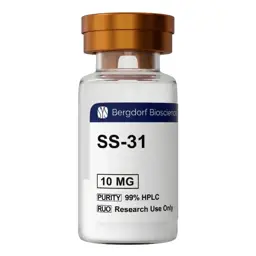
Em estoque
Em estoque
Ver Produto
SS-31Ver Produto
SS-31Valores iniciais típicos para orientação. Cada linha abre a calculadora para o respectivo peptídeo.
| Peptídeo | Categoria | Dose habitual | Tamanhos de frasco | BAC (início) | Disponível | Calcular |
|---|---|---|---|---|---|---|
| VIP | Pesquisa de neuropeptídeos | - | 10 mg | 2 ml | Em estoque | Calcular |
| Retatrutide | GLP-1/GIP/GCG | 0,5-12 mg | 2 / 5 / 10 / 15 mg | 2 ml | Em estoque | Calcular |
| Cagrilintide | Análogo da amilina | - | 5 mg | 2 ml | Em estoque | Calcular |
| Tirzepatid | GLP-1/GIP | 2,5-15 mg | 5 / 10 / 15 / 20 / 30 / 60 mg | 2 ml | Em estoque | Calcular |
| GHK-Cu | Kupferpeptid | 1-4 mg | 10 / 20 / 50 mg | 5 ml | Em estoque | Calcular |
| AHK-Cu | Peptídeo de cobre | - | 100 mg | 5 ml | Em estoque | Calcular |
| BPC-157 | Gewebereparatur | 0,2-0,5 mg | 2 / 5 / 10 mg | 2 ml | Em estoque | Calcular |
| TB-500 | Thymosin Beta-4 | 2-5 mg | 2 / 5 / 10 mg | 2 ml | Em estoque | Calcular |
| CJC-1295 (kein DAC) | GHRH-Analog | 100-200 mcg | 2 / 5 / 10 mg | 2 ml | Em estoque | Calcular |
| Ipamorelin | GHRP | 200-300 mcg | 2 / 5 mg | 2 ml | Em estoque | Calcular |
| PT-141 | Bremelanotide | - | 2 / 5 / 10 mg | 2 ml | Em estoque | Calcular |
| MOTS-c | Mitochondrial | 5-10 mg | 5 / 10 mg | 2 ml | Em estoque | Calcular |
| Selank | Anxiolytisch | 150-500 mcg | 2 / 5 / 10 mg | 2 ml | Em estoque | Calcular |
| SS-31 | Elamipretide | 0,1-1 mg | 5 / 10 mg | 2 ml | Em estoque | Calcular |
| Glow Stack | Stack | 0,5-2 mg | 70 mg | 3 ml | Em estoque | Calcular |
| Klow Stack | Stack | 0,5-2 mg | 55 mg | 3 ml | Em estoque | Calcular |
| Melanotan II | Melanocortin | 100-1000 mcg | 5 / 10 mg | 2 ml | Em estoque | Calcular |
| Melanotan I | Melanocortina | - | 5 / 10 mg | 2 ml | Em estoque | Calcular |
| Tesamorelin | GHRH-Analog | 1-2 mg | 10 / 20 mg | 2 ml | Em estoque | Calcular |
| Thymosin Alpha-1 | Thymisches Peptid | 0,8-3,2 mg | 1.6 / 5 / 10 mg | 1 ml | Em estoque | Calcular |
| Epithalon | Langlebigkeit | 2-10 mg | 10 / 20 / 50 mg | 2 ml | Em estoque | Calcular |
| KPV | Immun / Barriere | 100-1000 mcg | 5 / 10 mg | 2 ml | Em estoque | Calcular |
| Semax | Kognitiv | 100-1000 mcg | 10 / 30 mg | 2 ml | Em estoque | Calcular |
| NAD+ | Longevity / Cofaktor | 100-500 mg | 1000 mg | 10 ml | Em estoque | Calcular |
| Semaglutid | GLP-1 | 0,25-2,4 mg | 2 / 5 / 10 mg | 2 ml | Só calculadora | Calcular |
| AOD-9604 | Fettverbrennung | 250-500 mcg | 2 / 5 mg | 2 ml | Só calculadora | Calcular |
| Sermorelin | GHRH-Analog | 50-300 mcg | 2 / 5 mg | 2 ml | Só calculadora | Calcular |
| HGH-Fragment 176-191 | Metabolisches Fragment | 100-500 mcg | 2 / 5 / 10 mg | 2 ml | Só calculadora | Calcular |
| N-Acetyl-Semax | Kognitiv | 100-1000 mcg | 5 / 10 mg | 2 ml | Só calculadora | Calcular |
| Hexarelin | GHRP | 50-200 mcg | 2 / 5 mg | 2 ml | Só calculadora | Calcular |
| GHRP-6 | GHRP | 50-300 mcg | 2 / 5 mg | 2 ml | Só calculadora | Calcular |
| GHRP-2 | GHRP | 50-250 mcg | 2 / 5 mg | 2 ml | Só calculadora | Calcular |
| DSIP | Schlaf | 50-500 mcg | 2 / 5 mg | 2 ml | Só calculadora | Calcular |
| 5-Amino-1MQ | Metabolisch | 2,5-10 mg | 5 / 10 mg | 2 ml | Só calculadora | Calcular |
| HGH 191AA | Wachstumshormon | 1-5 mg | 10 mg | 1 ml | Só calculadora | Calcular |
Os valores servem de orientação no contexto de pesquisa e não substituem aconselhamento especializado.
Valores iniciais típicos para orientação. Cada linha abre a calculadora para o respectivo peptídeo.
| Peptídeo | Categoria | Dose habitual | Tamanhos de frasco | BAC (início) | Disponível | Calcular |
|---|---|---|---|---|---|---|
| VIP | Pesquisa de neuropeptídeos | - | 10 mg | 2 ml | Em estoque | Calcular |
| Retatrutide | GLP-1/GIP/GCG | 0,5-12 mg | 2 / 5 / 10 / 15 mg | 2 ml | Em estoque | Calcular |
| Cagrilintide | Análogo da amilina | - | 5 mg | 2 ml | Em estoque | Calcular |
| Tirzepatid | GLP-1/GIP | 2,5-15 mg | 5 / 10 / 15 / 20 / 30 / 60 mg | 2 ml | Em estoque | Calcular |
| GHK-Cu | Kupferpeptid | 1-4 mg | 10 / 20 / 50 mg | 5 ml | Em estoque | Calcular |
| AHK-Cu | Peptídeo de cobre | - | 100 mg | 5 ml | Em estoque | Calcular |
| BPC-157 | Gewebereparatur | 0,2-0,5 mg | 2 / 5 / 10 mg | 2 ml | Em estoque | Calcular |
| TB-500 | Thymosin Beta-4 | 2-5 mg | 2 / 5 / 10 mg | 2 ml | Em estoque | Calcular |
| CJC-1295 (kein DAC) | GHRH-Analog | 100-200 mcg | 2 / 5 / 10 mg | 2 ml | Em estoque | Calcular |
| Ipamorelin | GHRP | 200-300 mcg | 2 / 5 mg | 2 ml | Em estoque | Calcular |
| PT-141 | Bremelanotide | - | 2 / 5 / 10 mg | 2 ml | Em estoque | Calcular |
| MOTS-c | Mitochondrial | 5-10 mg | 5 / 10 mg | 2 ml | Em estoque | Calcular |
| Selank | Anxiolytisch | 150-500 mcg | 2 / 5 / 10 mg | 2 ml | Em estoque | Calcular |
| SS-31 | Elamipretide | 0,1-1 mg | 5 / 10 mg | 2 ml | Em estoque | Calcular |
| Glow Stack | Stack | 0,5-2 mg | 70 mg | 3 ml | Em estoque | Calcular |
| Klow Stack | Stack | 0,5-2 mg | 55 mg | 3 ml | Em estoque | Calcular |
| Melanotan II | Melanocortin | 100-1000 mcg | 5 / 10 mg | 2 ml | Em estoque | Calcular |
| Melanotan I | Melanocortina | - | 5 / 10 mg | 2 ml | Em estoque | Calcular |
| Tesamorelin | GHRH-Analog | 1-2 mg | 10 / 20 mg | 2 ml | Em estoque | Calcular |
| Thymosin Alpha-1 | Thymisches Peptid | 0,8-3,2 mg | 1.6 / 5 / 10 mg | 1 ml | Em estoque | Calcular |
| Epithalon | Langlebigkeit | 2-10 mg | 10 / 20 / 50 mg | 2 ml | Em estoque | Calcular |
| KPV | Immun / Barriere | 100-1000 mcg | 5 / 10 mg | 2 ml | Em estoque | Calcular |
| Semax | Kognitiv | 100-1000 mcg | 10 / 30 mg | 2 ml | Em estoque | Calcular |
| NAD+ | Longevity / Cofaktor | 100-500 mg | 1000 mg | 10 ml | Em estoque | Calcular |
| Semaglutid | GLP-1 | 0,25-2,4 mg | 2 / 5 / 10 mg | 2 ml | Só calculadora | Calcular |
| AOD-9604 | Fettverbrennung | 250-500 mcg | 2 / 5 mg | 2 ml | Só calculadora | Calcular |
| Sermorelin | GHRH-Analog | 50-300 mcg | 2 / 5 mg | 2 ml | Só calculadora | Calcular |
| HGH-Fragment 176-191 | Metabolisches Fragment | 100-500 mcg | 2 / 5 / 10 mg | 2 ml | Só calculadora | Calcular |
| N-Acetyl-Semax | Kognitiv | 100-1000 mcg | 5 / 10 mg | 2 ml | Só calculadora | Calcular |
| Hexarelin | GHRP | 50-200 mcg | 2 / 5 mg | 2 ml | Só calculadora | Calcular |
| GHRP-6 | GHRP | 50-300 mcg | 2 / 5 mg | 2 ml | Só calculadora | Calcular |
| GHRP-2 | GHRP | 50-250 mcg | 2 / 5 mg | 2 ml | Só calculadora | Calcular |
| DSIP | Schlaf | 50-500 mcg | 2 / 5 mg | 2 ml | Só calculadora | Calcular |
| 5-Amino-1MQ | Metabolisch | 2,5-10 mg | 5 / 10 mg | 2 ml | Só calculadora | Calcular |
| HGH 191AA | Wachstumshormon | 1-5 mg | 10 mg | 1 ml | Só calculadora | Calcular |
Os valores servem de orientação no contexto de pesquisa e não substituem aconselhamento especializado.
Escolha um peptídeo para abrir sua página de calculadora dedicada com valores pré-preenchidos.
Escolha um peptídeo para abrir sua página de calculadora dedicada com valores pré-preenchidos.