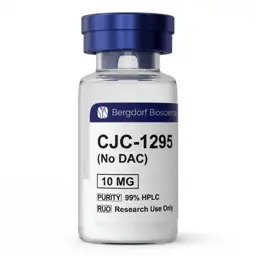
Both stimulate the body's own growth hormone axis through the GHRH receptor. But they are worlds apart in half-life, clinical maturity, and approval status. This comparison puts the data into context for research purposes only.
 Medically reviewed by Dr. Sieglinde Klaus · Last reviewed June 2026

CJC-1295 (No DAC), identical to Modified GRF (1-29), is a short-acting GHRH analog (half-life about 30 minutes) without albumin binding. It produces a pulsatile GH/IGF-1 profile that resembles physiological secretion, but has no approved human indication of its own and only sparse specific human data 1. Tesamorelin (Egrifta) is a 44-amino-acid GHRH analog with a likewise very short half-life (about 11 minutes in healthy subjects, about 26-38 minutes in patients with HIV), but, in contrast, is FDA-approved for reducing visceral abdominal fat in HIV-associated lipodystrophy and is supported by extensive Phase III data 4, 5. The main difference is not in the duration of action (both short) but in the .
Both stimulate the body's own growth hormone axis through the GHRH receptor. But they are worlds apart in half-life, clinical maturity, and approval status. This comparison puts the data into context for research purposes only.
Medically reviewed by Dr. Sieglinde Klaus · Last reviewed June 2026CJC-1295 (No DAC), identical to Modified GRF (1-29), is a short-acting GHRH analog (half-life about 30 minutes) without albumin binding. It produces a pulsatile GH/IGF-1 profile that resembles physiological secretion, but has no approved human indication of its own and only sparse specific human data 1. Tesamorelin (Egrifta) is a 44-amino-acid GHRH analog with a likewise very short half-life (about 11 minutes in healthy subjects, about 26-38 minutes in patients with HIV), but, in contrast, is FDA-approved for reducing visceral abdominal fat in HIV-associated lipodystrophy and is supported by extensive Phase III data 4, 5. The main difference is not in the duration of action (both short) but in the .
GHRH analog, tetrasubstituted GRF(1-29) fragment (Modified GRF 1-29)
GHRH analog, 44-amino-acid analog of GRF(1-44) with N-terminal trans-3-hexenoic acid
29 (N-terminal core fragment)
44 (complete GRF-1-44 backbone)
about 30 minutes (reported range about 30 min to 2 h), short-acting
about 11 minutes in healthy subjects; about 26-38 minutes in HIV patients
Pulsatile, no albumin tethering, GH returns to baseline within about 2-3 h
Brief GHRH pulse once daily; clinical effect accumulates over weeks to months
No approved human indication; purely a research substance
FDA-approved (Egrifta, first approval 2010; Egrifta SV 2019; Egrifta WR more recent)
Sparse; the No-DAC form largely lacks its own human data, and controlled data come from the DAC variant
High / mature: two large Phase III RCTs (about 800 patients pooled) plus follow-up analyses
Pulsatile GH release, often combined with a GHRP/ghrelin receptor agonist (preclinical/secondary protocols)
Reduction of visceral abdominal fat in HIV lipodystrophy; investigational for NAFLD in HIV
No approved regimen; reported: about 100 mcg subcutaneously, often 1-3x daily (not from controlled studies)
Subcutaneously once daily into the abdomen; Phase III: 10 mg/day, Egrifta WR 1.28 mg, Egrifta SV 1.4 mg
Frozen, typically -20 °C (or colder for long-term storage)
Egrifta WR at 20-25 °C protected from light; older Egrifta/SV at 2-8 °C; product-specific
Refrigerated 2-8 °C, use within about 28 days (benzyl alcohol window); avoid freeze-thaw cycles
Egrifta WR at room temperature, discard the remainder after 7 days; use older Egrifta immediately after mixing
No serious reactions reported in CJC/DAC studies; long-term safety of the No-DAC form is not established
Glucose intolerance/new diabetes (risk increased about 3.3-fold), IGF-1 increase, neoplasia concerns in the setting of HIV
The effect fades quickly given the short half-life; pulsatile pattern between doses
Effect reversible: visceral fat accumulates again after discontinuation (effectively maintenance therapy)

CJC-1295 (No DAC) is identical to Modified GRF (1-29), the N-terminal 1-29 fragment of human GHRH, the same active core as in sermorelin. It carries four stabilizing amino acid substitutions (position 2 D-Ala, 8 Gln, 15 Ala, 27 Leu) that confer resistance to degradation by dipeptidyl peptidase IV (DPP-IV) and lower metabolic clearance relative to native GRF(1-29) 7. As an agonist at the GHRH receptor (a class B GPCR on somatotrophs), it couples via Gs to adenylyl cyclase, raises cAMP and PKA activity, and thereby drives exocytosis of stored GH as well as, chronically, GH gene transcription 8. Crucially, the No-DAC form lacks the maleimide linker that covalently binds the DAC variant to serum albumin. As a result, it remains short-acting and pulsatile 3.
Tesamorelin is a synthetic 44-amino-acid analog of human GHRH (GRF 1-44) with a trans-3-hexenoic acid group at the N-terminus, which likewise confers resistance to DPP-IV and prolongs activity relative to native GHRH. It binds and stimulates the same GHRH receptors on pituitary somatotrophs, increasing the endogenous synthesis and pulsatile release of GH and thus IGF-1. The restored, more physiological GH/IGF-1 axis drives lipolysis preferentially in visceral (intra-abdominal) adipose tissue. Unlike recombinant GH, tesamorelin acts through the body's own regulated feedback loop instead of supplying exogenous GH.
Both substances are DPP-IV-stabilized GHRH agonists and preserve the pulsatile GH secretion pattern. They differ in backbone (29- vs 44-amino-acid base) and in the type of stabilization (four substitutions vs an N-terminal hexenoic acid residue). Functionally, tesamorelin serves a clearly defined, approved purpose (visceral fat reduction in HIV lipodystrophy), whereas CJC-1295 (No DAC) is classified as a general-purpose research tool for generating GH pulses.
The evidence base is asymmetric: tesamorelin is supported by two large, randomized, double-blind Phase III trials (pooled around 800 patients) plus follow-up analyses in a clearly defined population (HIV lipodystrophy) 4, 5. For CJC-1295 (No DAC), by contrast, there are hardly any controlled human data of its own; the robust human studies were conducted with the albumin-binding DAC variant 1, 2, not with the short-acting form considered here.
In the controlled CJC-1295 human studies (with the DAC variant), no serious adverse effects were reported and tolerability was good, particularly at 30-60 mcg/kg [1]. Class-typical effects of GHRH analogs and GH axis stimulation are documented; however, the long-term safety of the short-acting No-DAC form is not established in controlled human studies.
Tesamorelin has a well-documented safety profile from the Phase III trials. Injection site reactions are common (about 17-25% vs about 6-14% with placebo), as are symptoms related to fluid retention. The warnings include glucose intolerance, IGF-1 increase, and neoplasia concerns; the effect is reversible after discontinuation (visceral fat returns).
This comparison is provided for scientific information only and does not constitute medical advice, diagnosis, or a treatment recommendation. Nothing described here should be construed as a recommendation for human use. For research use only. Not for human consumption.
With its short half-life of about 30 minutes and the absence of albumin binding, CJC-1295 (No DAC) is well suited to model episodic GH pulses between doses rather than produce a sustained tonic elevation. Precisely this pulsatile profile distinguishes it from the DAC variant.
Tesamorelin is the only substance approved specifically for this indication, with reproducible Phase III evidence for a 10-15% reduction in visceral adipose tissue. For this defined question there is no comparably validated alternative peptide.
Tesamorelin has FDA approval, a complete product label, and an established monitoring scheme (glucose, IGF-1). CJC-1295 (No DAC) has no approved human indication and no established long-term safety, which limits the regulatory usability of the data.
In the research literature, CJC-1295 (No DAC) is frequently paired with GHRP/ghrelin receptor agonists such as ipamorelin, since GHRH analogs and ghrelin agonists act through complementary signaling pathways. Its short half-life allows temporally precise co-stimulation; tesamorelin is not established for this.
For tesamorelin, a randomized controlled trial result on reducing the hepatic fat fraction is available (investigational, in HIV). Comparable controlled data do not exist for CJC-1295 (No DAC), which is why tesamorelin provides the more robust starting point.
Both are GHRH analogs and both are short-acting. The decisive difference lies in clinical maturity: tesamorelin is FDA-approved and supported by two large Phase III trials, whereas CJC-1295 (No DAC) is a research-only substance with no approved human indication and only sparse specific human data 1, 4.
No, both are short-acting. CJC-1295 (No DAC) has a reported plasma half-life of about 30 minutes, tesamorelin about 11 minutes in healthy subjects and about 26-38 minutes in patients with HIV. The long half-life of several days applies only to the DAC variant of CJC-1295, which binds covalently to albumin, not to the No-DAC form compared here 2.
The robust controlled human studies (Teichman 2006, Ionescu 2006) were conducted with the albumin-binding DAC construct 1, 2. A dedicated, peer-reviewed human pharmacokinetic study specifically on the No-DAC form is lacking; the value of about 30 minutes rests largely on the design rationale of the DPP-IV-resistant peptide and secondary sources.
Tesamorelin (Egrifta) is approved by the FDA to reduce excess abdominal (visceral) fat in HIV-infected adults with lipodystrophy. It is not approved for general weight loss, body recomposition, or anti-aging. NAFLD/liver fat accumulation in HIV is an investigational, non-approved application 6.
Both share the same active 29-amino-acid core. CJC-1295 (No DAC), i.e., Modified GRF (1-29), carries four stabilizing substitutions, however, that make it more resistant to DPP-IV degradation. As a result, it has a longer half-life (about 30 min) than native sermorelin (about 6-20 min). Functionally, it is a DPP-IV-stabilized, longer-lived sermorelin variant 7.
A direct safety comparison is possible only to a limited extent, since tesamorelin has a documented Phase III safety profile (with clear warnings about glucose intolerance, IGF-1 increase, and neoplasia), whereas no controlled long-term human data are available for CJC-1295 (No DAC). The absence of documented risks does not mean that no risks exist; it means that data are lacking 1.
In the research literature, CJC-1295 (No DAC) is frequently combined with ghrelin receptor agonists such as ipamorelin, since these act through complementary signaling pathways and may show additive GH release. Tesamorelin is not established for such combinations and is used as monotherapy in its approved indication.
This comparison has no blanket winner, because the two peptides play very different roles despite their shared GHRH receptor action. Tesamorelin clearly dominates in clinical maturity, regulatory status, and depth of evidence: it is FDA-approved and supported by two large Phase III trials for a defined indication 4, 5. CJC-1295 (No DAC) stands out as a flexible research tool for pulsatile GHRH questions and combination approaches, but suffers from a very thin body of its own human data 1. Researchers who need maximum evidence and approval will favor tesamorelin; those modeling pulsatile GH mechanisms will favor CJC-1295 (No DAC). The decision is therefore context-dependent.
Tesamorelin clearly wins on approval and evidence, but is tailored to a specific indication (HIV lipodystrophy). CJC-1295 (No DAC) remains relevant for pulsatile GHRH research and combination models, despite sparse human data. Since neither peptide dominates the other across all research questions, the result is context-dependent and cannot be reduced to a single overall winner.
GHRH analog, tetrasubstituted GRF(1-29) fragment (Modified GRF 1-29)
GHRH analog, 44-amino-acid analog of GRF(1-44) with N-terminal trans-3-hexenoic acid
29 (N-terminal core fragment)
44 (complete GRF-1-44 backbone)
about 30 minutes (reported range about 30 min to 2 h), short-acting
about 11 minutes in healthy subjects; about 26-38 minutes in HIV patients
Pulsatile, no albumin tethering, GH returns to baseline within about 2-3 h
Brief GHRH pulse once daily; clinical effect accumulates over weeks to months
No approved human indication; purely a research substance
FDA-approved (Egrifta, first approval 2010; Egrifta SV 2019; Egrifta WR more recent)
Sparse; the No-DAC form largely lacks its own human data, and controlled data come from the DAC variant
High / mature: two large Phase III RCTs (about 800 patients pooled) plus follow-up analyses
Pulsatile GH release, often combined with a GHRP/ghrelin receptor agonist (preclinical/secondary protocols)
Reduction of visceral abdominal fat in HIV lipodystrophy; investigational for NAFLD in HIV
No approved regimen; reported: about 100 mcg subcutaneously, often 1-3x daily (not from controlled studies)
Subcutaneously once daily into the abdomen; Phase III: 10 mg/day, Egrifta WR 1.28 mg, Egrifta SV 1.4 mg
Frozen, typically -20 °C (or colder for long-term storage)
Egrifta WR at 20-25 °C protected from light; older Egrifta/SV at 2-8 °C; product-specific
Refrigerated 2-8 °C, use within about 28 days (benzyl alcohol window); avoid freeze-thaw cycles
Egrifta WR at room temperature, discard the remainder after 7 days; use older Egrifta immediately after mixing
No serious reactions reported in CJC/DAC studies; long-term safety of the No-DAC form is not established
Glucose intolerance/new diabetes (risk increased about 3.3-fold), IGF-1 increase, neoplasia concerns in the setting of HIV
The effect fades quickly given the short half-life; pulsatile pattern between doses
Effect reversible: visceral fat accumulates again after discontinuation (effectively maintenance therapy)
CJC-1295 (No DAC) is identical to Modified GRF (1-29), the N-terminal 1-29 fragment of human GHRH, the same active core as in sermorelin. It carries four stabilizing amino acid substitutions (position 2 D-Ala, 8 Gln, 15 Ala, 27 Leu) that confer resistance to degradation by dipeptidyl peptidase IV (DPP-IV) and lower metabolic clearance relative to native GRF(1-29) 7. As an agonist at the GHRH receptor (a class B GPCR on somatotrophs), it couples via Gs to adenylyl cyclase, raises cAMP and PKA activity, and thereby drives exocytosis of stored GH as well as, chronically, GH gene transcription 8. Crucially, the No-DAC form lacks the maleimide linker that covalently binds the DAC variant to serum albumin. As a result, it remains short-acting and pulsatile 3.
Tesamorelin is a synthetic 44-amino-acid analog of human GHRH (GRF 1-44) with a trans-3-hexenoic acid group at the N-terminus, which likewise confers resistance to DPP-IV and prolongs activity relative to native GHRH. It binds and stimulates the same GHRH receptors on pituitary somatotrophs, increasing the endogenous synthesis and pulsatile release of GH and thus IGF-1. The restored, more physiological GH/IGF-1 axis drives lipolysis preferentially in visceral (intra-abdominal) adipose tissue. Unlike recombinant GH, tesamorelin acts through the body's own regulated feedback loop instead of supplying exogenous GH.
Both substances are DPP-IV-stabilized GHRH agonists and preserve the pulsatile GH secretion pattern. They differ in backbone (29- vs 44-amino-acid base) and in the type of stabilization (four substitutions vs an N-terminal hexenoic acid residue). Functionally, tesamorelin serves a clearly defined, approved purpose (visceral fat reduction in HIV lipodystrophy), whereas CJC-1295 (No DAC) is classified as a general-purpose research tool for generating GH pulses.
The evidence base is asymmetric: tesamorelin is supported by two large, randomized, double-blind Phase III trials (pooled around 800 patients) plus follow-up analyses in a clearly defined population (HIV lipodystrophy) 4, 5. For CJC-1295 (No DAC), by contrast, there are hardly any controlled human data of its own; the robust human studies were conducted with the albumin-binding DAC variant 1, 2, not with the short-acting form considered here.
In the controlled CJC-1295 human studies (with the DAC variant), no serious adverse effects were reported and tolerability was good, particularly at 30-60 mcg/kg [1]. Class-typical effects of GHRH analogs and GH axis stimulation are documented; however, the long-term safety of the short-acting No-DAC form is not established in controlled human studies.
Tesamorelin has a well-documented safety profile from the Phase III trials. Injection site reactions are common (about 17-25% vs about 6-14% with placebo), as are symptoms related to fluid retention. The warnings include glucose intolerance, IGF-1 increase, and neoplasia concerns; the effect is reversible after discontinuation (visceral fat returns).
This comparison is provided for scientific information only and does not constitute medical advice, diagnosis, or a treatment recommendation. Nothing described here should be construed as a recommendation for human use. For research use only. Not for human consumption.
With its short half-life of about 30 minutes and the absence of albumin binding, CJC-1295 (No DAC) is well suited to model episodic GH pulses between doses rather than produce a sustained tonic elevation. Precisely this pulsatile profile distinguishes it from the DAC variant.
Tesamorelin is the only substance approved specifically for this indication, with reproducible Phase III evidence for a 10-15% reduction in visceral adipose tissue. For this defined question there is no comparably validated alternative peptide.
Tesamorelin has FDA approval, a complete product label, and an established monitoring scheme (glucose, IGF-1). CJC-1295 (No DAC) has no approved human indication and no established long-term safety, which limits the regulatory usability of the data.
In the research literature, CJC-1295 (No DAC) is frequently paired with GHRP/ghrelin receptor agonists such as ipamorelin, since GHRH analogs and ghrelin agonists act through complementary signaling pathways. Its short half-life allows temporally precise co-stimulation; tesamorelin is not established for this.
For tesamorelin, a randomized controlled trial result on reducing the hepatic fat fraction is available (investigational, in HIV). Comparable controlled data do not exist for CJC-1295 (No DAC), which is why tesamorelin provides the more robust starting point.
Both are GHRH analogs and both are short-acting. The decisive difference lies in clinical maturity: tesamorelin is FDA-approved and supported by two large Phase III trials, whereas CJC-1295 (No DAC) is a research-only substance with no approved human indication and only sparse specific human data 1, 4.
No, both are short-acting. CJC-1295 (No DAC) has a reported plasma half-life of about 30 minutes, tesamorelin about 11 minutes in healthy subjects and about 26-38 minutes in patients with HIV. The long half-life of several days applies only to the DAC variant of CJC-1295, which binds covalently to albumin, not to the No-DAC form compared here 2.
The robust controlled human studies (Teichman 2006, Ionescu 2006) were conducted with the albumin-binding DAC construct 1, 2. A dedicated, peer-reviewed human pharmacokinetic study specifically on the No-DAC form is lacking; the value of about 30 minutes rests largely on the design rationale of the DPP-IV-resistant peptide and secondary sources.
Tesamorelin (Egrifta) is approved by the FDA to reduce excess abdominal (visceral) fat in HIV-infected adults with lipodystrophy. It is not approved for general weight loss, body recomposition, or anti-aging. NAFLD/liver fat accumulation in HIV is an investigational, non-approved application 6.
Both share the same active 29-amino-acid core. CJC-1295 (No DAC), i.e., Modified GRF (1-29), carries four stabilizing substitutions, however, that make it more resistant to DPP-IV degradation. As a result, it has a longer half-life (about 30 min) than native sermorelin (about 6-20 min). Functionally, it is a DPP-IV-stabilized, longer-lived sermorelin variant 7.
A direct safety comparison is possible only to a limited extent, since tesamorelin has a documented Phase III safety profile (with clear warnings about glucose intolerance, IGF-1 increase, and neoplasia), whereas no controlled long-term human data are available for CJC-1295 (No DAC). The absence of documented risks does not mean that no risks exist; it means that data are lacking 1.
In the research literature, CJC-1295 (No DAC) is frequently combined with ghrelin receptor agonists such as ipamorelin, since these act through complementary signaling pathways and may show additive GH release. Tesamorelin is not established for such combinations and is used as monotherapy in its approved indication.
This comparison has no blanket winner, because the two peptides play very different roles despite their shared GHRH receptor action. Tesamorelin clearly dominates in clinical maturity, regulatory status, and depth of evidence: it is FDA-approved and supported by two large Phase III trials for a defined indication 4, 5. CJC-1295 (No DAC) stands out as a flexible research tool for pulsatile GHRH questions and combination approaches, but suffers from a very thin body of its own human data 1. Researchers who need maximum evidence and approval will favor tesamorelin; those modeling pulsatile GH mechanisms will favor CJC-1295 (No DAC). The decision is therefore context-dependent.
Tesamorelin clearly wins on approval and evidence, but is tailored to a specific indication (HIV lipodystrophy). CJC-1295 (No DAC) remains relevant for pulsatile GHRH research and combination models, despite sparse human data. Since neither peptide dominates the other across all research questions, the result is context-dependent and cannot be reduced to a single overall winner.