
Both blends share a core of GHK-Cu, TB-500, and BPC-157. The difference: KLOW adds the anti-inflammatory KPV, while GLOW relies instead on a higher GHK-Cu load. This comparison assesses the composition, the evidence, and the open questions in a sober, evidence-based way.
 Medically reviewed by Dr. Sieglinde Klaus · Last reviewed June 2026
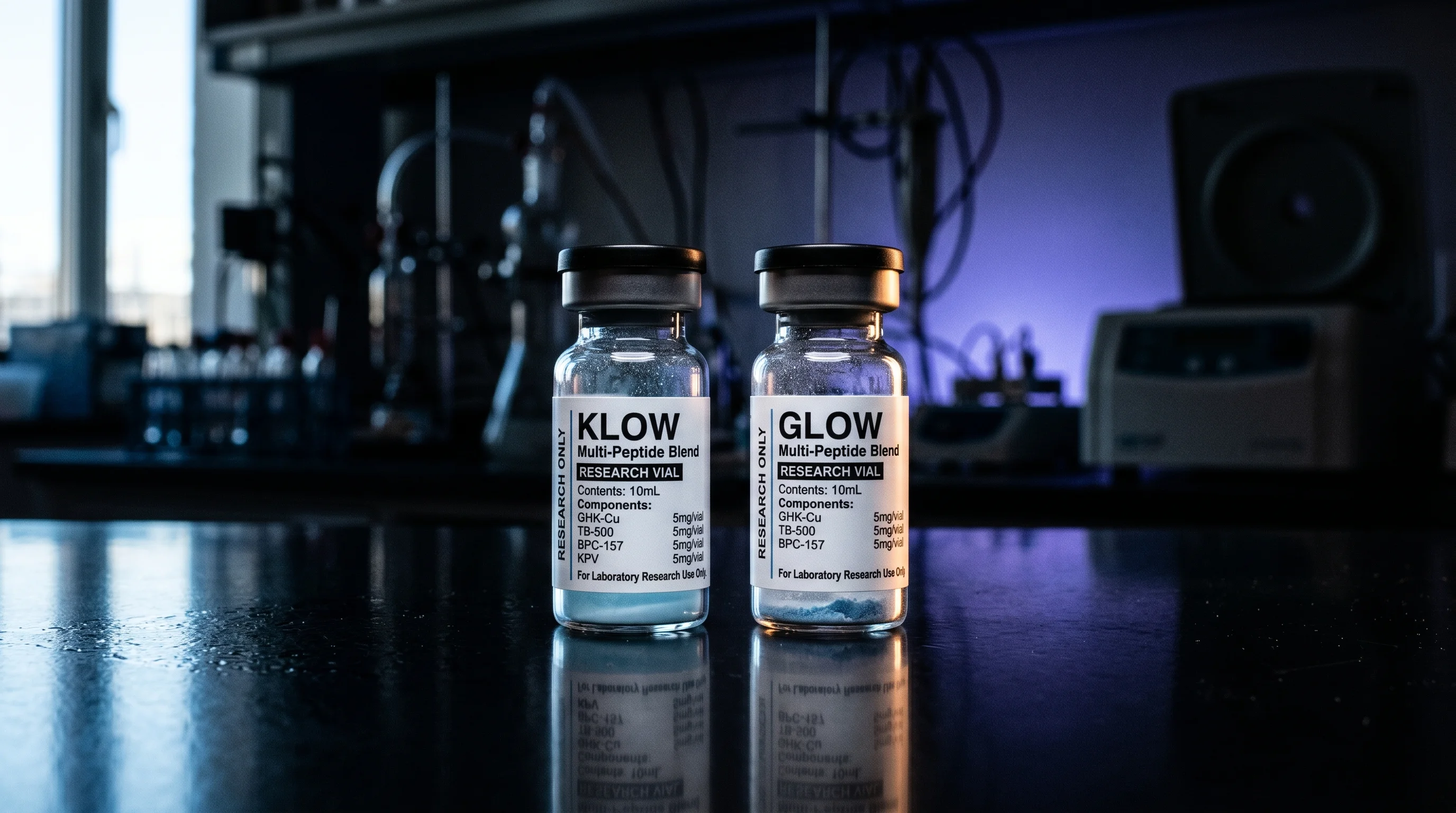
KLOW and GLOW are two closely related fixed-combination research blends. Both combine three peptides that have been studied in tissue-regeneration models: GHK-Cu (a copper-binding tripeptide studied for effects on collagen and matrix), TB-500 (an actin-sequestering fragment of thymosin beta-4), and BPC-157 (a gastric pentadecapeptide with a pro-angiogenic profile). The decisive difference: KLOW additionally contains KPV, an anti-inflammatory tripeptide derived from alpha-MSH that acts through NF-kB and MAPK inhibition. GLOW omits KPV and instead carries twice the GHK-Cu amount in the formulation compared here (50 mg instead of 25 mg). Neither blend has been studied clinically as a combination; all available evidence comes from single-component investigations, predominantly preclinical. The choice is therefore purely a matter of profile, not a ranking of efficacy.
Both blends share a core of GHK-Cu, TB-500, and BPC-157. The difference: KLOW adds the anti-inflammatory KPV, while GLOW relies instead on a higher GHK-Cu load. This comparison assesses the composition, the evidence, and the open questions in a sober, evidence-based way.
Medically reviewed by Dr. Sieglinde Klaus · Last reviewed June 2026KLOW and GLOW are two closely related fixed-combination research blends. Both combine three peptides that have been studied in tissue-regeneration models: GHK-Cu (a copper-binding tripeptide studied for effects on collagen and matrix), TB-500 (an actin-sequestering fragment of thymosin beta-4), and BPC-157 (a gastric pentadecapeptide with a pro-angiogenic profile). The decisive difference: KLOW additionally contains KPV, an anti-inflammatory tripeptide derived from alpha-MSH that acts through NF-kB and MAPK inhibition. GLOW omits KPV and instead carries twice the GHK-Cu amount in the formulation compared here (50 mg instead of 25 mg). Neither blend has been studied clinically as a combination; all available evidence comes from single-component investigations, predominantly preclinical. The choice is therefore purely a matter of profile, not a ranking of efficacy.
Four peptides: GHK-Cu + TB-500 + BPC-157 + KPV (in the formulation compared here: 25 / 10 / 10 / 10 mg, 55 mg total)
Three peptides: GHK-Cu + TB-500 + BPC-157 (GHK-Cu 50 mg in the formulation compared here, no KPV)
Included - a dedicated NF-kB/MAPK-attenuating axis (Lys-Pro-Val)
Not included - no dedicated anti-inflammatory component
Lower (25 mg in the formulation compared here)
Higher (50 mg in the formulation compared here)
Angiogenesis + cell migration + ECM remodeling + inflammation suppression (four nodes)
Angiogenesis + cell migration + ECM remodeling (three nodes)
Composite injury with an inflammation/mucosal component (e.g., models with chronic inflammation)
Tissue/skin regeneration with a focus on matrix and collagen
None - zero studies on the four-way combination
None - zero studies on the three-way combination
GHK-Cu (human RCTs, predominantly topical/cosmetic) + data on the parent molecule thymosin beta-4
GHK-Cu (human RCTs, higher dose) + data on the parent molecule thymosin beta-4
Blend PK unknown; components short-lived (Tbeta4 parent ~0.5-2 h, BPC-157 IV <30 min in animals)
Blend PK unknown; the same short-lived components, without any KPV contribution
Refrigerated at 2-8 °C, ~28-30 days; limited by GHK-Cu (light-sensitive); KPV stable
Refrigerated at 2-8 °C, ~4 weeks; also limited by GHK-Cu
For research use only; not approved; explicitly not for human consumption
For research use only; not approved; explicitly not for human consumption
Stacked pro-angiogenic activity (TB-500 + BPC-157 + GHK-Cu); KPV mitigates inflammation, not the angiogenesis risk
Stacked pro-angiogenic activity, potentially amplified by a higher GHK-Cu load

KLOW combines four peptides that address largely non-overlapping nodes of tissue regeneration in the preclinical literature:
The rationale behind the blend: angiogenesis, matrix, cell migration, and anti-inflammatory activity in one vial. This synergy has not been tested in any co-administration study.
GLOW is mechanistically the KLOW core without the KPV inflammation axis, but with twice the GHK-Cu load in the formulation compared here:
GLOW thus covers three of the four KLOW axes. GLOW has no anti-inflammatory axis; the theory is that a higher GHK-Cu dose partly compensates for this function by suppressing IL-6 and NF-kB-driven signaling. That too is not proven.
The mechanistic core of both blends is identical (GHK-Cu, TB-500, BPC-157). KLOW adds a targeted, receptor-independent inflammation axis with KPV; GLOW trades this for a higher GHK-Cu load. Which trade-off is superior in a preclinical model cannot be decided from the published literature, because neither of the two combinations has ever been compared.
The decisive point is the gap, not the volume of data: neither KLOW nor GLOW has ever been studied as a combination in a trial. Every study cited here tests a single component in isolation, and the most robust human data (thymosin beta-4 IV, GHK-Cu topical) concern other molecular forms or other routes of administration than the advertised subcutaneous blend administration. With KPV, KLOW has an additional anti-inflammatory component that is well described preclinically; with the higher GHK-Cu dose, GLOW has more of the best-characterized component. Both remain theoretical advantages, without evidence for the combination.
For the KLOW blend there are no controlled human safety data; it is sold exclusively for research use only. Component by component: thymosin beta-4 (TB-500 parent) was well tolerated IV up to 1260 mg [8]; GHK-Cu has a benign topical profile; KPV shows a benign profile in rodent models, but there are no human pharmacovigilance data [4]; BPC-157 is considered well tolerated in animals, but the human dossier is unpublished. The central theoretical risk is the stacked pro-angiogenic activity; KPV dampens inflammation, not this risk.
There are also no controlled human safety data for the GLOW blend; it too is for research use only. The profile corresponds to KLOW minus KPV: GHK-Cu (at twice the dose in this formulation), TB-500, and BPC-157. Without KPV one component and thus one variable is dropped, but the higher GHK-Cu load adds to the theoretical concern about copper exposure. The pro-angiogenic stacking risk remains and is not offset here by any anti-inflammatory axis.
This comparison is provided exclusively for scientific information and does not constitute medical advice, diagnosis, treatment recommendation, or dosing instruction. None of the substances named is approved by a drug regulatory agency for the systemic use described; all statements are preclinical or early-clinical and must not be read as clinical guidance. Use should be avoided during pregnancy, during breastfeeding, and in individuals with active cancer or a history of cancer. For research use only. Not for human consumption.
Anyone investigating a model with a pronounced inflammatory or mucosal component gets the additional KPV axis with KLOW (NF-kB/MAPK inhibition), which GLOW completely lacks. The KPV evidence is preclinical but mechanistically well described [4].
In this formulation GLOW carries twice the GHK-Cu amount (50 mg), the best-characterized component with a genuine human RCT history (though predominantly topical) [1][2]. For a purely matrix/ECM question, that is the stronger axis, without the extra cost of an unused KPV component.
GLOW has three active agents instead of four. Anyone who wants to reduce confounding and interaction variables in an already unvalidated blend is methodologically better off with the leaner three-way mixture. Each additional component makes it harder to attribute effects.
From a safety standpoint both are equally problematic: no human blend data, stacked pro-angiogenic activity as an unquantified theoretical risk, and unregulated research-chemical quality. GLOW's higher GHK-Cu load adds to the theoretical concern about copper exposure; KLOW's KPV mitigates inflammation, not the angiogenesis risk. No blend is clearly safer here.
For this case the honest answer is: neither. Neither KLOW nor GLOW has clinical efficacy, safety, or PK data as a combination, and no component is approved for the advertised systemic use. Anyone who needs validation should turn to approved, individually tested active agents, not a blend.
KLOW contains four peptides, GLOW three. Concretely, KLOW = GLOW + KPV: both share GHK-Cu, TB-500, and BPC-157, but only KLOW adds the anti-inflammatory tripeptide KPV (Lys-Pro-Val). In the formulation compared here, GLOW instead carries twice the GHK-Cu amount (50 mg instead of 25 mg). So KLOW emphasizes an additional inflammation axis, GLOW a stronger matrix/collagen axis.
No. No clinical studies exist for either blend as a fixed combination, and no pharmacokinetic, safety, or efficacy data for the mixture have been published. Every available study tests a single component in isolation, and the most robust human data concern the thymosin beta-4 parent molecule [7][8] or topical GHK-Cu [1][2], not the blend.
No. More components mean only more theoretical axes of action, not a greater demonstrated effect. Since the combination effect has not been tested in any study, it cannot be said whether the additional KPV axis brings a practical advantage. More active agents also mean more unknown interactions and make it harder to attribute effects.
GHK-Cu, which is present in both blends, has the strongest evidence. It is the only component with human randomized trials, although these are predominantly topical/cosmetic. For full transparency: one well-controlled split-face study on CO2-laser-treated skin showed no statistically significant advantage on objective endpoints. TB-500 relies on data for the thymosin beta-4 parent molecule [7][8], BPC-157 is purely preclinical [5][6], and KPV likewise [4].
Neither blend has a human safety dossier. The central theoretical risk, stacked pro-angiogenic activity with an unquantified oncological relevance, applies to both. GLOW's higher GHK-Cu load adds to the theoretical concern about copper exposure; KLOW's KPV dampens inflammation, not the angiogenesis risk. Both are unregulated research chemicals with no guaranteed purity or sterility.
Both are limited by the least stable component, GHK-Cu. After reconstitution with bacteriostatic water, store refrigerated at 2-8 °C and protected from light, do not freeze, and use within about 28-30 days. The lyophilized powder keeps considerably longer frozen at -20 °C. These figures are manufacturer convention and not validated stability data.
No. No validated human dose exists for KLOW or GLOW; circulating protocols are manufacturer or community figures, not clinically established. The clinical trial dosing of the parent molecules is entirely different (e.g., thymosin beta-4 intravenously under medical supervision). No human dose may be derived from animal mg/kg values. This content is intended exclusively for research purposes.
KLOW and GLOW are not competing products with a clear winner, but two configurations of the same core. KLOW adds a targeted, receptor-independent inflammation axis with KPV and is theoretically suited to research questions in which an inflammatory or mucosal component is the focus. GLOW omits KPV, carries twice the GHK-Cu load instead, and thereby theoretically sharpens the matrix and collagen axis, the best-characterized component of both blends. The decisive point remains: none of these properties is proven as a combination. Both blends are for research use only, without clinical efficacy, safety, or PK data for the mixture, and the stacked pro-angiogenic profile is an unquantified theoretical risk in both. The choice depends solely on the research question, not on a proven advantage.
A clear winner cannot be named, because neither of the two combinations has ever been tested in a study or compared against the other. KLOW wins theoretically where an additional inflammation axis (KPV) is called for; GLOW where the focus is on matrix/collagen remodeling with a higher GHK-Cu dose. Since both share identical evidence gaps, identical regulatory status (for research use only), and the same theoretical core risk, the decision is purely context-dependent.
Four peptides: GHK-Cu + TB-500 + BPC-157 + KPV (in the formulation compared here: 25 / 10 / 10 / 10 mg, 55 mg total)
Three peptides: GHK-Cu + TB-500 + BPC-157 (GHK-Cu 50 mg in the formulation compared here, no KPV)
Included - a dedicated NF-kB/MAPK-attenuating axis (Lys-Pro-Val)
Not included - no dedicated anti-inflammatory component
Lower (25 mg in the formulation compared here)
Higher (50 mg in the formulation compared here)
Angiogenesis + cell migration + ECM remodeling + inflammation suppression (four nodes)
Angiogenesis + cell migration + ECM remodeling (three nodes)
Composite injury with an inflammation/mucosal component (e.g., models with chronic inflammation)
Tissue/skin regeneration with a focus on matrix and collagen
None - zero studies on the four-way combination
None - zero studies on the three-way combination
GHK-Cu (human RCTs, predominantly topical/cosmetic) + data on the parent molecule thymosin beta-4
GHK-Cu (human RCTs, higher dose) + data on the parent molecule thymosin beta-4
Blend PK unknown; components short-lived (Tbeta4 parent ~0.5-2 h, BPC-157 IV <30 min in animals)
Blend PK unknown; the same short-lived components, without any KPV contribution
Refrigerated at 2-8 °C, ~28-30 days; limited by GHK-Cu (light-sensitive); KPV stable
Refrigerated at 2-8 °C, ~4 weeks; also limited by GHK-Cu
For research use only; not approved; explicitly not for human consumption
For research use only; not approved; explicitly not for human consumption
Stacked pro-angiogenic activity (TB-500 + BPC-157 + GHK-Cu); KPV mitigates inflammation, not the angiogenesis risk
Stacked pro-angiogenic activity, potentially amplified by a higher GHK-Cu load
KLOW combines four peptides that address largely non-overlapping nodes of tissue regeneration in the preclinical literature:
The rationale behind the blend: angiogenesis, matrix, cell migration, and anti-inflammatory activity in one vial. This synergy has not been tested in any co-administration study.
GLOW is mechanistically the KLOW core without the KPV inflammation axis, but with twice the GHK-Cu load in the formulation compared here:
GLOW thus covers three of the four KLOW axes. GLOW has no anti-inflammatory axis; the theory is that a higher GHK-Cu dose partly compensates for this function by suppressing IL-6 and NF-kB-driven signaling. That too is not proven.
The mechanistic core of both blends is identical (GHK-Cu, TB-500, BPC-157). KLOW adds a targeted, receptor-independent inflammation axis with KPV; GLOW trades this for a higher GHK-Cu load. Which trade-off is superior in a preclinical model cannot be decided from the published literature, because neither of the two combinations has ever been compared.
The decisive point is the gap, not the volume of data: neither KLOW nor GLOW has ever been studied as a combination in a trial. Every study cited here tests a single component in isolation, and the most robust human data (thymosin beta-4 IV, GHK-Cu topical) concern other molecular forms or other routes of administration than the advertised subcutaneous blend administration. With KPV, KLOW has an additional anti-inflammatory component that is well described preclinically; with the higher GHK-Cu dose, GLOW has more of the best-characterized component. Both remain theoretical advantages, without evidence for the combination.
For the KLOW blend there are no controlled human safety data; it is sold exclusively for research use only. Component by component: thymosin beta-4 (TB-500 parent) was well tolerated IV up to 1260 mg [8]; GHK-Cu has a benign topical profile; KPV shows a benign profile in rodent models, but there are no human pharmacovigilance data [4]; BPC-157 is considered well tolerated in animals, but the human dossier is unpublished. The central theoretical risk is the stacked pro-angiogenic activity; KPV dampens inflammation, not this risk.
There are also no controlled human safety data for the GLOW blend; it too is for research use only. The profile corresponds to KLOW minus KPV: GHK-Cu (at twice the dose in this formulation), TB-500, and BPC-157. Without KPV one component and thus one variable is dropped, but the higher GHK-Cu load adds to the theoretical concern about copper exposure. The pro-angiogenic stacking risk remains and is not offset here by any anti-inflammatory axis.
This comparison is provided exclusively for scientific information and does not constitute medical advice, diagnosis, treatment recommendation, or dosing instruction. None of the substances named is approved by a drug regulatory agency for the systemic use described; all statements are preclinical or early-clinical and must not be read as clinical guidance. Use should be avoided during pregnancy, during breastfeeding, and in individuals with active cancer or a history of cancer. For research use only. Not for human consumption.
Anyone investigating a model with a pronounced inflammatory or mucosal component gets the additional KPV axis with KLOW (NF-kB/MAPK inhibition), which GLOW completely lacks. The KPV evidence is preclinical but mechanistically well described [4].
In this formulation GLOW carries twice the GHK-Cu amount (50 mg), the best-characterized component with a genuine human RCT history (though predominantly topical) [1][2]. For a purely matrix/ECM question, that is the stronger axis, without the extra cost of an unused KPV component.
GLOW has three active agents instead of four. Anyone who wants to reduce confounding and interaction variables in an already unvalidated blend is methodologically better off with the leaner three-way mixture. Each additional component makes it harder to attribute effects.
From a safety standpoint both are equally problematic: no human blend data, stacked pro-angiogenic activity as an unquantified theoretical risk, and unregulated research-chemical quality. GLOW's higher GHK-Cu load adds to the theoretical concern about copper exposure; KLOW's KPV mitigates inflammation, not the angiogenesis risk. No blend is clearly safer here.
For this case the honest answer is: neither. Neither KLOW nor GLOW has clinical efficacy, safety, or PK data as a combination, and no component is approved for the advertised systemic use. Anyone who needs validation should turn to approved, individually tested active agents, not a blend.
KLOW contains four peptides, GLOW three. Concretely, KLOW = GLOW + KPV: both share GHK-Cu, TB-500, and BPC-157, but only KLOW adds the anti-inflammatory tripeptide KPV (Lys-Pro-Val). In the formulation compared here, GLOW instead carries twice the GHK-Cu amount (50 mg instead of 25 mg). So KLOW emphasizes an additional inflammation axis, GLOW a stronger matrix/collagen axis.
No. No clinical studies exist for either blend as a fixed combination, and no pharmacokinetic, safety, or efficacy data for the mixture have been published. Every available study tests a single component in isolation, and the most robust human data concern the thymosin beta-4 parent molecule [7][8] or topical GHK-Cu [1][2], not the blend.
No. More components mean only more theoretical axes of action, not a greater demonstrated effect. Since the combination effect has not been tested in any study, it cannot be said whether the additional KPV axis brings a practical advantage. More active agents also mean more unknown interactions and make it harder to attribute effects.
GHK-Cu, which is present in both blends, has the strongest evidence. It is the only component with human randomized trials, although these are predominantly topical/cosmetic. For full transparency: one well-controlled split-face study on CO2-laser-treated skin showed no statistically significant advantage on objective endpoints. TB-500 relies on data for the thymosin beta-4 parent molecule [7][8], BPC-157 is purely preclinical [5][6], and KPV likewise [4].
Neither blend has a human safety dossier. The central theoretical risk, stacked pro-angiogenic activity with an unquantified oncological relevance, applies to both. GLOW's higher GHK-Cu load adds to the theoretical concern about copper exposure; KLOW's KPV dampens inflammation, not the angiogenesis risk. Both are unregulated research chemicals with no guaranteed purity or sterility.
Both are limited by the least stable component, GHK-Cu. After reconstitution with bacteriostatic water, store refrigerated at 2-8 °C and protected from light, do not freeze, and use within about 28-30 days. The lyophilized powder keeps considerably longer frozen at -20 °C. These figures are manufacturer convention and not validated stability data.
No. No validated human dose exists for KLOW or GLOW; circulating protocols are manufacturer or community figures, not clinically established. The clinical trial dosing of the parent molecules is entirely different (e.g., thymosin beta-4 intravenously under medical supervision). No human dose may be derived from animal mg/kg values. This content is intended exclusively for research purposes.
KLOW and GLOW are not competing products with a clear winner, but two configurations of the same core. KLOW adds a targeted, receptor-independent inflammation axis with KPV and is theoretically suited to research questions in which an inflammatory or mucosal component is the focus. GLOW omits KPV, carries twice the GHK-Cu load instead, and thereby theoretically sharpens the matrix and collagen axis, the best-characterized component of both blends. The decisive point remains: none of these properties is proven as a combination. Both blends are for research use only, without clinical efficacy, safety, or PK data for the mixture, and the stacked pro-angiogenic profile is an unquantified theoretical risk in both. The choice depends solely on the research question, not on a proven advantage.
A clear winner cannot be named, because neither of the two combinations has ever been tested in a study or compared against the other. KLOW wins theoretically where an additional inflammation axis (KPV) is called for; GLOW where the focus is on matrix/collagen remodeling with a higher GHK-Cu dose. Since both share identical evidence gaps, identical regulatory status (for research use only), and the same theoretical core risk, the decision is purely context-dependent.

